

Annual Compliance for a Private Limited Company: The Ultimate 2026 Guide
Mastering your company’s legal duties doesn’t have to be a source of stress. With our simple checklist for the financial year 2025-26, you can confidently avoid penalties and stay focused on what truly matters: growing your business. For any entrepreneur in India, navigating the world of corporate law can feel overwhelming. This guide is designed to bring you Krystal-clear clarity on every requirement.
What is Annual Compliance and Why Does It Matter?
Simply put, annual compliance for private limited company refers to the mandatory set of legal and financial tasks your private limited company must complete every year under the Companies Act, 2013, and other relevant laws. Fulfilling these obligations is non-negotiable.
-
Maintains Active Status: It keeps your company in good standing with the Registrar of Companies (ROC).
-
Builds Trust & Credibility: A compliant company is seen as reliable by investors, banks, customers, and government bodies.
-
Avoids Legal Trouble: Think of it as a crucial health check-up for your business’s legal standing, preventing serious complications down the line.
The High Cost of Non-Compliance: Penalties to Avoid
Ignoring or delaying your annual compliance can have severe consequences that go far beyond a simple fine. The costs of non-compliance are designed to be a strong deterrent.
-
Heavy Daily Penalties: Late filings attract significant daily penalties that can accumulate into a substantial financial burden.
-
Director Disqualification: The Ministry of Corporate Affairs (MCA) can disqualify directors of non-compliant companies, barring them from holding directorships in any other company.
-
Company Strike-Off: In severe cases, the ROC can strike the company’s name from the official register, effectively shutting it down.
Key Authorities: Understanding MCA, ROC, and the IT Department
To understand compliance, you need to know the key players. Here’s a simple breakdown of the authorities you’ll interact with:
-
MCA (Ministry of Corporate Affairs): This is the central government body that regulates corporate affairs in India and administers the Companies Act.
-
ROC (Registrar of Companies): The ROC is the specific office under the MCA located in each state. This is where you submit your company’s annual forms and documents.
-
Income Tax Department: This department is responsible for governing and collecting all direct taxes, including your company’s annual income tax.
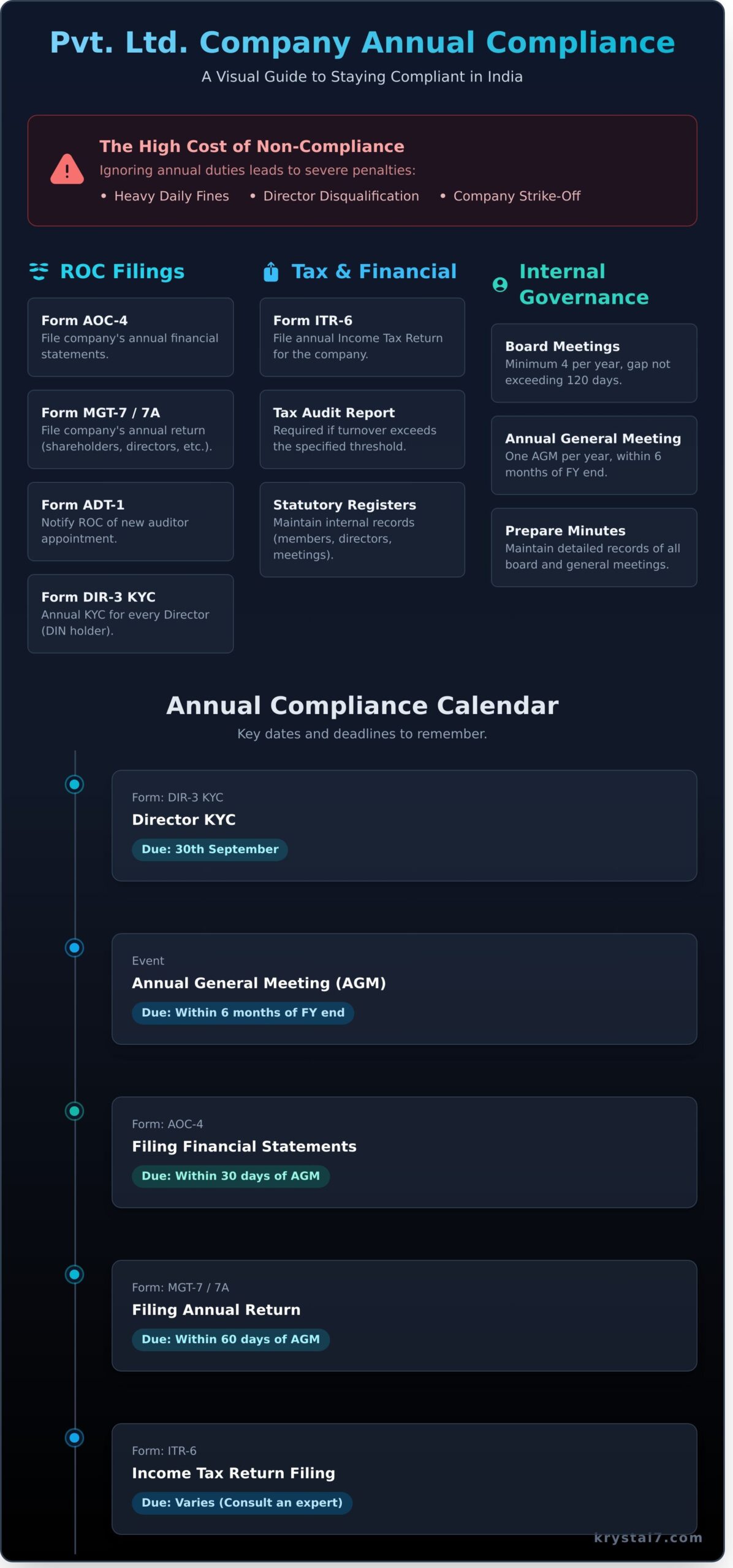
The Ultimate Annual Compliance Checklist for Pvt Ltd Companies
We’ve broken down your essential duties into simple, manageable categories. Follow this checklist to ensure nothing gets missed and your business remains secure and compliant throughout the year.
Mandatory ROC Filings (MCA Compliance)
These are the core filings required by the Ministry of Corporate Affairs to report your company’s financial health and operational status.
-
Form AOC-4 (Financial Statements): This form is used to file your company’s audited financial statements, including the Balance Sheet and Profit & Loss Account, with the ROC.
-
Form MGT-7/MGT-7A (Annual Return): This is a comprehensive summary of your company’s key details as of the end of the financial year, including information about shareholders, directors, and share capital. MGT-7A is a shorter version for Small Companies and One Person Companies.
-
Form ADT-1 (Auditor Appointment): When you appoint a statutory auditor, this form must be filed to formally notify the ROC.
-
Form DIR-3 KYC (Director’s KYC): Every individual holding a Director Identification Number (DIN) must complete an annual KYC verification to ensure their details are up-to-date.
Income Tax & Financial Compliance
Beyond the ROC, your company has crucial obligations to the Income Tax Department.
-
Filing Form ITR-6: This is the specific Income Tax Return form that all private limited companies must use to declare their annual income and pay taxes.
-
Tax Audit Report: If your company’s turnover or gross receipts exceed a specified threshold during the financial year, a mandatory tax audit must be conducted by a Chartered Accountant.
-
Maintaining Statutory Registers: Throughout the year, you must maintain internal records like the register of members, register of directors, register of charges, and minutes of meetings.
Essential Meetings & Internal Governance
Proper corporate governance is a cornerstone of compliance and involves conducting regular meetings.
-
Board Meetings: A private limited company must conduct a minimum of four Board Meetings each year, with a gap of no more than 120 days between two consecutive meetings.
-
Annual General Meeting (AGM): One AGM must be held within six months from the end of each financial year to approve financial statements, appoint auditors, and declare dividends.
-
Meeting Minutes: Detailed minutes for every Board Meeting and General Meeting must be prepared and maintained at the company’s registered office.
Feeling overwhelmed by the forms and deadlines? Let our experts create your custom compliance plan.
Simplify Your Compliance: The Krystal7 Advantage
Staying compliant doesn’t have to be a source of stress or a drain on your valuable time. At Krystal7, we provide the clarity and expert support you need to get it done right, so you can gain the freedom to focus on your business vision.
Your Annual Compliance Calendar at a Glance (FY 2025-26)
This simple table provides a clear, scannable overview of your key deadlines for the Financial Year ending March 31, 2026.
| Compliance Task | Relevant Form(s) | General Due Date |
|---|---|---|
| Director’s KYC | Form DIR-3 KYC | On or before 30th September 2026 |
| Annual General Meeting | N/A | On or before 30th September 2026 |
| Income Tax Return Filing | Form ITR-6 | On or before 31st October 2026 |
| Filing Financial Statements | Form AOC-4 | Within 30 days of the AGM |
| Filing Annual Return | Form MGT-7 / MGT-7A | Within 60 days of the AGM |
Note: Due dates can be subject to government extensions. Always verify the latest dates with a professional.
Beyond the Annual: What are Event-Based Compliances?
Compliance isn’t just a once-a-year task. Certain events trigger immediate filing requirements. These "event-based" compliances include actions like:
-
Changing your company’s registered office address
-
Appointing or removing a director
-
Increasing the company’s authorized share capital
-
Altering the company’s Memorandum or Articles of Association
This highlights the need for ongoing expert guidance to ensure you remain compliant every step of the way.
Get Your Freedom to Focus: How Our Package Works
We’ve streamlined the entire compliance process to make it completely hassle-free for you.
-
Dedicated Advisor: We assign a dedicated compliance expert who understands your business and acts as your single point of contact.
-
All-in-One Package: Our comprehensive package covers every filing and meeting requirement on this checklist, leaving no room for error.
-
Krystal-Clear Pricing: Enjoy complete transparency with our upfront pricing. There are no hidden fees or surprise charges.
Secure Your All-in-One Annual Compliance Package Today!
Frequently Asked Questions (FAQs)
1. What happens if a private limited company does not file an annual return?
If a company fails to file its annual return (Form MGT-7), it will incur a daily penalty of ₹100 per day of default, with no upper limit. Additionally, the company and its directors may face prosecution, and directors could be disqualified.
2. Is an audit compulsory for every private limited company in India?
Yes, every private limited company, regardless of its turnover or profit, is required to have its financial accounts audited by a qualified Chartered Accountant at the end of every financial year.
3. What is the difference between Form AOC-4 and MGT-7?
Form AOC-4 is used to file the company’s financial statements (Balance Sheet, P&L Account, Auditor’s Report). Form MGT-7 is the company’s Annual Return, which contains a broader set of information about its structure, including details of directors, shareholders, and shareholding patterns. Both are mandatory annual filings.
4. How many board meetings are mandatory for a private limited company in a year?
A private limited company must hold a minimum of four board meetings in a calendar year. The gap between two consecutive board meetings should not exceed 120 days.
5. Can I file my company’s annual compliance myself without a professional?
While technically possible, it is highly discouraged. The forms are complex and require certification from a practicing professional like a Company Secretary (CS) or Chartered Accountant (CA). Errors or delays can lead to significant penalties. Using a professional ensures accuracy, timeliness, and peace of mind.
6. What are the due dates for annual filing for the financial year 2025-26?
For the financial year ending on March 31, 2026, the key due dates are:
-
ITR-6 (Income Tax Return): October 31, 2026.
-
AOC-4 (Financials): Within 30 days of your AGM (e.g., by October 30, 2026, if AGM is held on Sep 30).
-
MGT-7 (Annual Return): Within 60 days of your AGM (e.g., by November 29, 2026, if AGM is held on Sep 30).

Article by
Nihal Srivastava
Nihal Srivastava is the Co-Founder of Krystal7 Consultants, helping Indian entrepreneurs and startups navigate company registration, compliance, trademark protection, and regulatory requirements with clarity and confidence. With 6+ years of hands-on expertise in MCA filings, GST compliance, and corporate structuring, Nihal has guided 1000+ businesses across India through their legal and compliance journeys. He believes every business dream deserves crystal clear foundations, and that no founder should be held back by paperwork or red tape.