
Annual Compliance for Private Limited Company: Your 2026 Checklist
For any entrepreneur in India, successfully registering a Private Limited Company is a major milestone. But the journey doesn’t end there. To maintain your company’s legal standing and avoid severe penalties, you must navigate the world of annual compliance. This can seem daunting, filled with complex forms and deadlines. This guide will give you crystal clear on all mandatory filings for your Private Limited Company in India and show you how to avoid costly penalties with a simple, step-by-step checklist.
What is Annual Compliance? (And Why You Can’t Ignore It)
In simple terms, annual compliance for private limited company refers to the set of mandatory tasks that every Private Limited Company must complete each year as required by the Companies Act, 2013, and the Income Tax Act. It’s not just about submitting paperwork; it’s a fundamental process for maintaining your company’s active legal status with the Registrar of Companies (ROC) and tax authorities. Staying compliant builds trust with investors, banks, and customers, enhances your company’s credibility, and most importantly, keeps you safe from serious legal trouble.
The Real Cost of Non-Compliance: More Than Just Fines
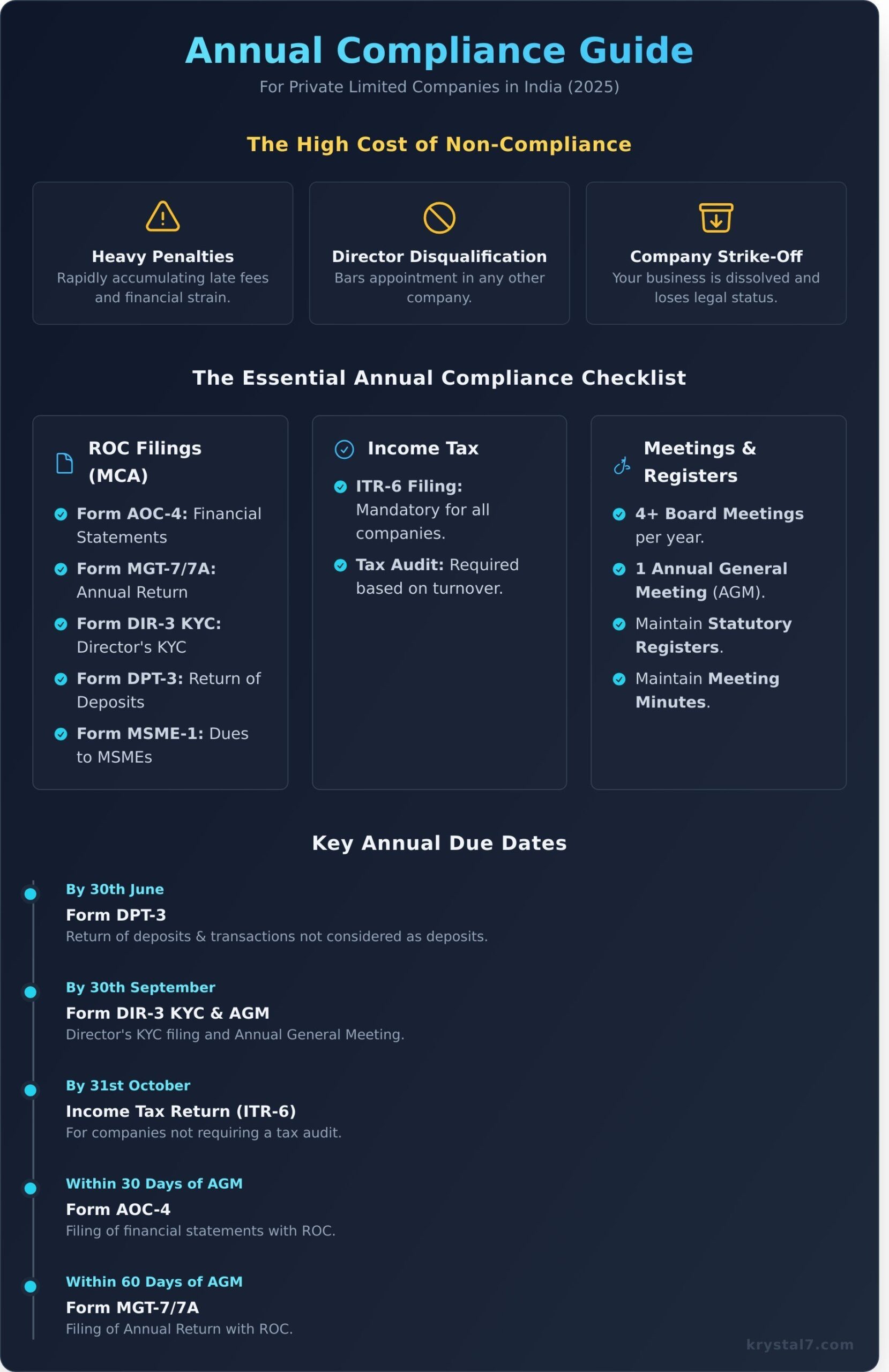
Ignoring your annual compliance obligations can have severe consequences that go far beyond simple fines. The Ministry of Corporate Affairs (MCA) compliance requirements impose heavy penalties and late fees that can accumulate rapidly, putting a significant financial strain on your business. Furthermore, directors risk disqualification, which prevents them from being appointed to any other company. In severe cases, the ROC can mark the company as "dormant" or even "struck off" its register, effectively dissolving your business. A poor compliance record also makes it incredibly difficult to secure business loans or attract potential investors.
The Essential Annual Compliance Checklist for 2026
To help you stay on track, we’ve broken down every mandatory task into clear, manageable categories. Use this comprehensive checklist to ensure nothing gets missed throughout the financial year.
Mandatory ROC Filings (with the MCA)
-
Form AOC-4: This is the financial statement of your company. It includes the Balance Sheet, Profit and Loss Account, and the Director’s Report, which must be filed with the ROC annually.
-
Form MGT-7/7A: This is the Annual Return. It contains up-to-date information about the company’s directors, shareholders, and shareholding structure. MGT-7A is a shorter version applicable to Small Companies and One Person Companies.
-
Form DIR-3 KYC: Every individual who holds a Director Identification Number (DIN) must submit their KYC details to the MCA every year to keep their DIN active.
-
Form DPT-3: This form is required for filing a return of deposits or particulars of transactions not considered as deposits. Essentially, it declares any money received by the company from any source.
-
Form MSME-1: If your company has outstanding payments due to Micro, Small, and Medium Enterprise (MSME) vendors for more than 45 days, you must file this half-yearly return.
Income Tax Filings
-
Filing Income Tax Return (ITR-6): Every Private Limited Company is required to file its income tax return using Form ITR-6. This is mandatory, even if the company had zero business activity or incurred a loss during the financial year.
-
Tax Audit: Depending on the company’s annual turnover and other criteria, a tax audit conducted by a practicing Chartered Accountant may be required. You must verify the latest turnover threshold to confirm if this applies to your business.
Statutory Meetings & Registers
-
Board Meetings: A Private Limited Company must conduct a minimum of four Board Meetings in a calendar year, with a gap of not more than 120 days between two consecutive meetings.
-
Annual General Meeting (AGM): One AGM must be held within six months from the end of each financial year to discuss agenda items like the approval of financial statements and the appointment of auditors.
-
Statutory Registers: It is mandatory to maintain various statutory registers, such as the Register of Members, Register of Directors and Key Managerial Personnel, and Register of Charges.
-
Meeting Minutes: Preparing and maintaining the minutes for all Board Meetings and the Annual General Meeting is a crucial compliance requirement.
Your Annual Compliance Calendar: Key Due Dates to Remember
A simplified timeline can help you plan your year and ensure you never miss a critical filing deadline. Mark these dates in your calendar to stay ahead of your compliance obligations.
By 30th June: DPT-3 Filing
File your company’s return for any outstanding loans, deposits, or other specified transactions from the previous financial year.
By 30th September: Director KYC
Ensure every director completes their annual DIR-3 KYC with the MCA to keep their Director Identification Number (DIN) active.
By 30th September: Annual General Meeting (AGM)
You must hold your company’s AGM within 6 months from the end of the financial year (which concludes on March 31st).
By 31st October: Income Tax Return
File your company’s income tax return (Form ITR-6) for the previous financial year. This is the deadline for companies that do not require a tax audit.
Within 30 Days of AGM: Form AOC-4
After your AGM, you have 30 days to file your audited financial statements and Director’s Report with the Registrar of Companies.
Within 60 Days of AGM: Form MGT-7/7A
Following the AGM, you have 60 days to file your company’s Annual Return, containing details of shareholders and directors, with the ROC.
Gain Clarity and Freedom with Krystal7’s Compliance Services
Trying to manage annual compliance on your own can be a stressful and risky endeavor. The rules are complex, the deadlines are strict, and a single missed filing can cost you significantly more than a full year of expert assistance. Our all-in-one annual compliance package is designed to handle everything for you, giving you the peace of mind and freedom to focus on what you do best: growing your business.
How Our Process Works
-
We start by assigning a dedicated relationship manager who understands the specifics of your business.
-
Our system sends proactive reminders well in advance, so you never have to worry about missing a deadline.
-
Our team of expert Chartered Accountants and Company Secretaries prepares and files all necessary documents with precision and accuracy.
-
You receive Krystal-Clear reports on your compliance status, so you are always informed and in control. Why not let our experts bring you clarity and peace of mind? Explore Our Annual Compliance Package Today.
FAQs on Annual Compliance
Is annual compliance mandatory for a company with no business activity?
Yes, absolutely. Every registered Private Limited Company must fulfill its annual compliance obligations, including filing ROC forms and income tax returns, regardless of whether it conducted any business or generated revenue.
What happens if I miss an annual filing deadline?
Missing a deadline results in an additional government fee for each day of delay. The longer the delay, the higher the penalty. Continuous non-compliance can lead to director disqualification and the company being struck off by the ROC.
What is the difference between ROC compliance and income tax compliance?
ROC compliance relates to the Companies Act, 2013, and is managed by the Ministry of Corporate Affairs (MCA). It focuses on corporate governance and reporting. Income tax compliance relates to the Income Tax Act and involves filing tax returns and paying taxes to the Income Tax Department. For a deeper understanding of MCA compliance requirements and key filings, it’s essential to understand the specific forms and deadlines that apply to your business.
Can I file my company’s annual compliance myself?
While technically possible, it is highly discouraged unless you have expert knowledge of corporate law and accounting. The forms are complex, and errors can lead to rejection and penalties. Professional services are required for tasks like auditing financial statements.
How much does it cost to manage annual compliance for a private limited company?
The cost varies based on the scope of services. However, professional packages are often more cost-effective than paying accumulating penalties for late or incorrect filings. It’s an investment in your company’s legal health and longevity. For comprehensive guidance on managing these requirements effectively, our detailed annual compliance for private limited company checklist provides step-by-step instructions to ensure nothing is missed.
What is a Director Identification Number (DIN) and why is KYC needed?
A DIN is a unique identification number assigned to an individual who is a director of a company. The annual KYC (Know Your Customer) process is a mandatory verification to ensure the director’s details on the MCA portal are correct and up-to-date.
Staying on top of your annual compliance is non-negotiable for the health and growth of your business. By understanding the requirements and partnering with a trusted expert, you can transform a complex obligation into a seamless process. This ensures your company remains in good legal standing and gives you the ultimate advantage: the freedom to focus on your vision. Let us handle the paperwork. Get your All-in-One Annual Compliance Package. With Krystal-Clear Transparency, a dedicated team of experts, and a commitment to your success, we are here to support your entrepreneurial journey.

Article by
Nihal Srivastava
Nihal Srivastava is the Co-Founder of Krystal7 Consultants, helping Indian entrepreneurs and startups navigate company registration, compliance, trademark protection, and regulatory requirements with clarity and confidence. With 6+ years of hands-on expertise in MCA filings, GST compliance, and corporate structuring, Nihal has guided 1000+ businesses across India through their legal and compliance journeys. He believes every business dream deserves crystal clear foundations, and that no founder should be held back by paperwork or red tape.