

How to Register: A Founder’s Guide to Business Registration in India
Starting a new business is an exciting journey, but the first steps can often feel confusing. You know you need to “register,” but what does that actually mean? The term can refer to many different legal formalities, leaving many entrepreneurs feeling overwhelmed before they even begin. This guide is designed to provide crystal clarity, breaking down the different types of business registrations in India so you can start your venture with confidence and a clear path forward.
First, What Are You Trying to Register? Understanding the Types
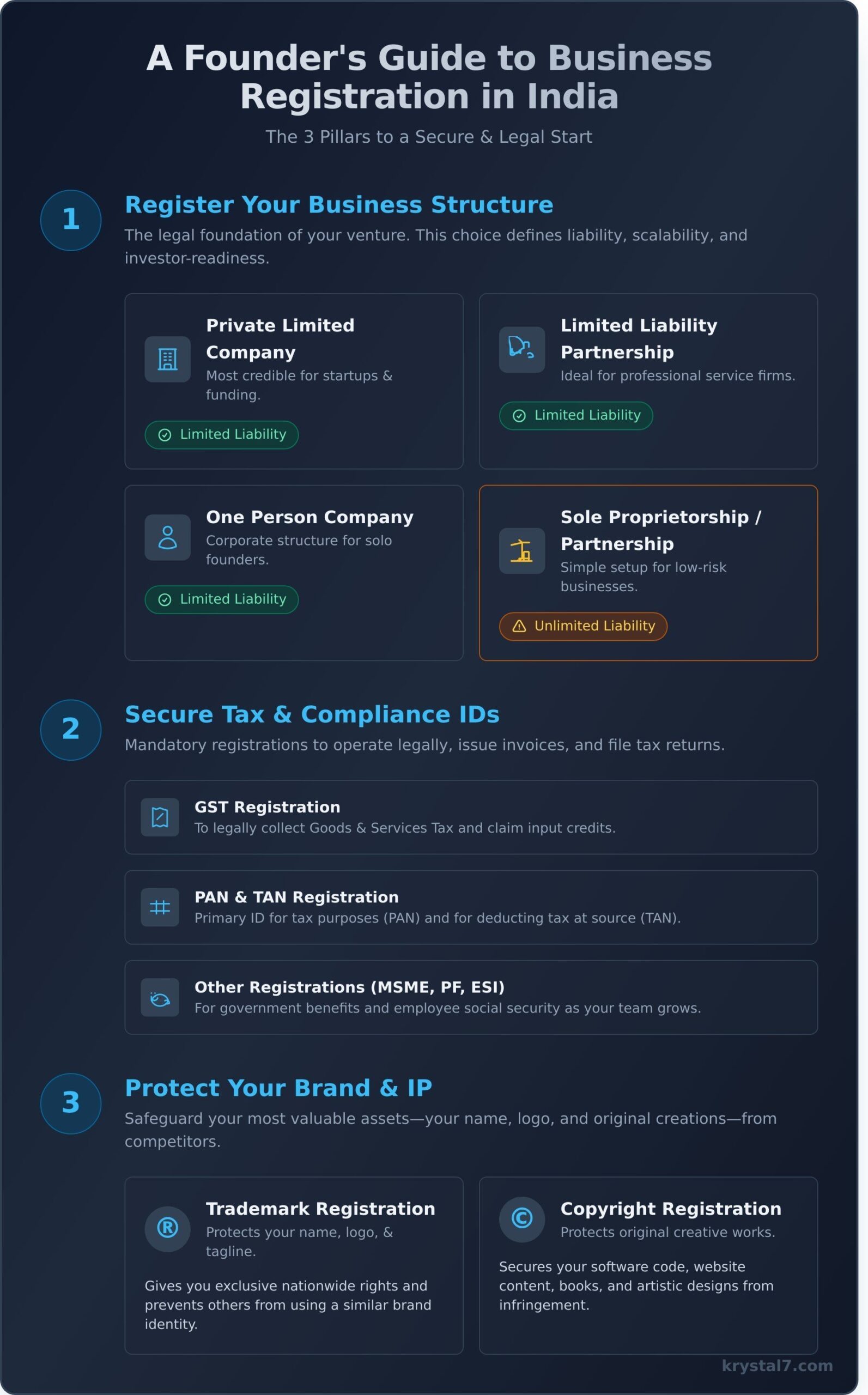
For a new business owner, the word “registration” can be a source of major confusion because it isn’t a single action. It’s a series of steps that give your business its legal structure, tax identity, and brand protection. To simplify this, we’ll break down the process into the three main categories you need to understand. This framework will provide the clarity you need to take your first steps correctly.
1. Registering Your Business Structure (Company Registration)
This is the foundational step that gives your business a formal legal identity, separate from yourself. Think of it as your business’s official birth certificate. This registration determines crucial factors like your personal liability for business debts, how you are taxed, and your ability to raise funds from investors in the future. It’s the most important first step for most serious entrepreneurs.
2. Registering for Taxes (Tax Registration)
Once your business has a legal structure, it needs to be registered with the tax authorities to operate legally. This is a mandatory requirement for conducting transactions in India. This category includes essential registrations like the Goods and Services Tax (GST), Permanent Account Number (PAN), and Tax Deduction and Collection Account Number (TAN). These registrations allow you to legally collect taxes from customers and file your company’s tax returns.
3. Registering Your Brand (IP Registration)
Your business name, logo, and unique ideas are valuable assets. Intellectual Property (IP) registration is the process of legally protecting them. This includes services like trademark registration for your brand name, copyright for original content or software, and patents for inventions. Proper IP registration prevents competitors from using your brand assets and secures your unique position in the market.
How to Register Your Business Structure: The Core Options
Choosing the right legal structure for your new venture is one of the most critical decisions you’ll make as a founder. This choice will impact everything from your personal financial liability to your annual compliance requirements and future growth potential. Let’s explore the most common and effective options for businesses in India.
Private Limited Company (Pvt Ltd) Registration
The Private Limited Company is the most popular and credible business structure for startups in India, especially those planning to raise funding. It establishes the business as a separate legal entity, which means it offers limited liability protection to its owners (shareholders). This structure is seen by investors, banks, and clients as a professional and scalable business format. However, it’s important to understand that choosing this structure means you’ll need to stay on top of annual compliance for private limited company requirements to maintain your legal standing.
Limited Liability Partnership (LLP) Registration
An LLP combines the benefits of a traditional partnership with the limited liability of a company. It is a separate legal entity, protecting partners’ personal assets from business debts. With simpler compliance requirements and greater operational flexibility than a Pvt Ltd company, it is an ideal structure for professional services firms, such as teams of consultants, architects, or accountants.
One Person Company (OPC) Registration
The One Person Company is a revolutionary concept that allows a single entrepreneur to operate a corporate entity with limited liability protection. Previously, a solo founder had to choose between being a sole proprietor (with unlimited liability) or finding a partner to form a Pvt Ltd company. An OPC provides the perfect starting point for a single founder to build their business with a corporate structure before scaling up.
Sole Proprietorship / Partnership Firm
These are the simplest business structures to start, with minimal registration formalities and compliance burdens. However, they come with a significant drawback: they do not offer limited liability. This means the owner’s or partners’ personal assets are at risk to cover business debts. These structures are often registered at a local level through licenses like the Shop and Establishment Act and are suitable for small, local businesses with low risk.
Navigating Essential Tax & Compliance Registrations
Once your company is officially formed, you must obtain key tax identification numbers to begin legal operations. These registrations are non-negotiable for conducting business transactions, issuing invoices, and maintaining compliance with Indian law.
GST Registration (Goods and Services Tax)
GST registration is mandatory for any business whose annual turnover exceeds the government-prescribed threshold. It is also required for certain types of businesses regardless of turnover, such as e-commerce sellers. This registration allows you to legally collect GST from your customers on goods or services sold and is essential for claiming input tax credits on your business purchases, which reduces your tax liability.
PAN and TAN Registration
A Permanent Account Number (PAN) is the primary identification number for any entity for all tax-related purposes in India; it’s like a social security number for your company. A Tax Deduction and Collection Account Number (TAN) is required for businesses that are responsible for deducting tax at source (TDS) when making payments like salaries or payments to contractors. Both are essential for filing corporate income tax returns.
Other Key Registrations (MSME, PF, ESI)
Depending on your business type and size, you may need other registrations. An MSME/Udyam registration can make your business eligible for various government schemes and benefits. As your team grows, registrations for Provident Fund (PF) and Employees’ State Insurance (ESI) become mandatory after you hire a certain number of employees, ensuring social security benefits for your staff.
Don’t Just Register Your Company, Register Your Brand
In today’s competitive market, your brand is your most valuable asset. It’s what differentiates you from everyone else. Protecting it legally from day one is a crucial step that many founders overlook. Intellectual Property (IP) registration secures your unique identity and provides a powerful legal shield.
Trademark Registration
A trademark protects your unique brand identity, which includes your business name, logo, and tagline. Securing a trademark gives you the exclusive legal right to use these brand elements nationwide in connection with your goods or services. Most importantly, it prevents competitors from using a confusingly similar name or logo, which could dilute your brand and mislead your customers.
Copyright Registration
If your business creates original works, copyright registration is essential. This protects creative assets such as software code, website content, books, marketing materials, and artistic designs. While copyright exists automatically upon creation, registering it provides a public record of your ownership and serves as strong legal evidence in court if you ever need to defend your work against infringement.
The Krystal7 Method: A Streamlined Path to Registration
Feeling overwhelmed by the different layers of registration? You don’t have to navigate this complex landscape alone. Our all-in-one packages are designed to handle every legal formality, giving you the freedom to focus on what you do best: building your business. We provide Krystal-Clear guidance at every stage of the process.
Step 1: Free Consultation & Strategy
Your journey with us begins with a free consultation where our experts help you choose the right business structure based on your vision and goals. We take the time to understand your needs and answer all your initial questions, ensuring you start on a solid legal foundation.
Step 2: Document Collection & Filing
Once you’re ready, a dedicated relationship advisor will guide you through the document collection process. We make it simple and hassle-free. Our team then handles the entire filing process with the Ministry of Corporate Affairs (MCA) and other relevant authorities, ensuring every detail is accurate.
Step 3: Receive Your Registration & Get Started
We manage the process until completion, delivering your Certificate of Incorporation and other essential registration documents directly to you. With all the legal formalities handled, your business is officially registered and ready to operate. Once your Private Limited Company is incorporated, it’s crucial to understand your ongoing legal obligations through our comprehensive annual compliance for private limited company checklist to ensure you stay compliant year after year. Start your business journey with clarity today.
Frequently Asked Questions
What is the very first thing I need to register for my new business?
The very first step is to register your business structure by incorporating a legal entity, such as a Private Limited Company or an LLP. This creates the legal foundation upon which all other registrations (like GST or trademark) are built. For a comprehensive understanding of this process, explore our detailed guide on company registration for founders starting a business in India.
Can I register a company by myself without a consultant?
While it is technically possible, the process involves complex legal forms, documentation, and specific procedures on government portals like the MCA. Mistakes can lead to delays or rejections. Using a professional consultant like Krystal7 streamlines the process and ensures it’s done correctly and efficiently.
How long does the company registration process take in India?
The timeline can vary, but with all documents in order, a Private Limited Company can typically be registered within 7-10 working days. Our team at Krystal7 works to make this process as fast and smooth as possible.
What is the difference between a business name and a trademark?
Registering a business name with the MCA (e.g., “ABC Ventures Pvt Ltd”) gives you the right to use that name as a legal entity. A trademark, however, protects your brand name or logo as an intellectual property asset, preventing others nationwide from using a similar name in your industry.
Do I need GST registration when I first start my company?
You are only required to register for GST once your annual turnover is projected to cross the government-set threshold (e.g., ₹40 lakhs for goods). However, you can also register voluntarily to claim input tax credits, or if you are in a business where it is mandatory from day one (like e-commerce).
What is a Company Registration Number (CIN)?
The Corporate Identity Number (CIN) is a unique 21-digit alphanumeric code assigned by the Registrar of Companies (ROC) to every company registered in India. It is used to track all aspects of the company’s compliance and is quoted on all official documents.
Navigating the world of business registration can seem daunting, but it doesn’t have to be a barrier to your entrepreneurial dreams. By understanding the key types of registration and partnering with an expert, you can ensure your business starts on a firm, compliant, and protected foundation. Let us handle the complexities so you can focus on growth. Get your All-in-One Company Incorporation Package today!

Article by
Nihal Srivastava
Nihal Srivastava is the Co-Founder of Krystal7 Consultants, helping Indian entrepreneurs and startups navigate company registration, compliance, trademark protection, and regulatory requirements with clarity and confidence. With 6+ years of hands-on expertise in MCA filings, GST compliance, and corporate structuring, Nihal has guided 1000+ businesses across India through their legal and compliance journeys. He believes every business dream deserves crystal clear foundations, and that no founder should be held back by paperwork or red tape.