
Business Registration Certificate in India: The Complete 2026 Guide
Business Registration Certificate in India: The Complete 2025 Guide
Your business vision is clear, but the path to making it official feels anything but. Navigating the maze of paperwork to get a business registration certificate in India-from Company Incorporation to GST and MSME-can leave even the most passionate entrepreneur feeling overwhelmed. The fear of a misstep causing delays or rejection is a real concern, stopping great ideas before they can even start.
This is where the guesswork ends. Consider this your complete 2025 guide, designed to bring crystal clarity to the entire process. We will demystify which registration your business legally requires, provide a practical checklist of all necessary documents, and walk you through the essential post-registration steps, ensuring you get it right the first time.
Our goal is to replace uncertainty with confidence, empowering you to establish a legal entity that can open bank accounts, secure funding, and build lasting trust. It’s time to move past the red tape and gain the freedom to focus on what truly matters: building your business legacy.
What is a Business Registration Certificate in India? (And Why You Need One)
When you start a business, understanding what a business registration certificate india entails can seem confusing. That’s because it isn’t a single, universal document. Instead, it’s an umbrella term for the official proof issued by a government authority that legally validates your business’s existence. Think of it as your venture’s official birth certificate-the foundational document that transforms your idea into a recognized legal entity.
Operating without this formal recognition is not just risky; it’s a barrier to growth. An unregistered business cannot open a current bank account, secure loans, or even onboard most payment gateways. It operates in a grey area, facing potential legal penalties and severely limiting its credibility with customers and partners. Securing the right business registration certificate in India is the first, non-negotiable step toward building a legitimate and scalable enterprise.
The Core Benefits of Formal Business Registration
Beyond basic compliance, formal registration unlocks critical advantages that give your business the freedom to thrive. It moves you from a freelance operation to a professional entity, providing the clarity and structure needed for long-term success.
- Legal Protection: For structures like a Private Limited Company or LLP, registration creates a separate legal entity. This shields your personal assets from business debts and liabilities, a crucial safeguard for any entrepreneur.
- Building Trust: A registered business is seen as more credible and trustworthy. It reassures customers, suppliers, and potential partners that you are a legitimate operation, making it easier to build lasting relationships.
- Financial Access: This is a prerequisite for financial growth. Banks require a valid business registration certificate india to open current accounts, approve business loans, and issue credit. Investors and venture capitalists will only fund a formally registered entity.
- Perpetual Succession: A registered company has a life of its own, independent of its owners. It can continue to operate even if the founders leave or pass away, ensuring the legacy of your vision endures.
Understanding the Issuing Authorities
The specific type of business registration certificate india you receive depends entirely on your business structure. Each structure is governed by a different authority, and understanding this distinction brings clarity to the process. While you can explore a comprehensive list of Types of Business Entities in India to understand all available options, the primary registration certificates are issued by these key bodies:
- Ministry of Corporate Affairs (MCA): Issues the Certificate of Incorporation for Private Limited Companies (Pvt. Ltd.) and Limited Liability Partnerships (LLPs).
- Registrar of Firms: Manages the registration of Partnership Firms at the state level.
- Udyam Portal (MSME): Provides Udyam Registration for micro, small, and medium enterprises, often used by sole proprietors to access government schemes.
- GST Department: Issues the GST Registration Certificate (GSTIN), which is mandatory for businesses exceeding specified turnover thresholds.
Types of Business Registrations: Which Certificate is Right for You?
Choosing the right business structure is the foundational step in your entrepreneurial journey. It’s a strategic decision that directly impacts your personal liability, fundraising capabilities, and ongoing compliance. Navigating the maze of which business registration certificate India requires can feel complex, but understanding these core structures is the first step towards clarity. The right choice depends entirely on your vision, scale, and long-term goals.
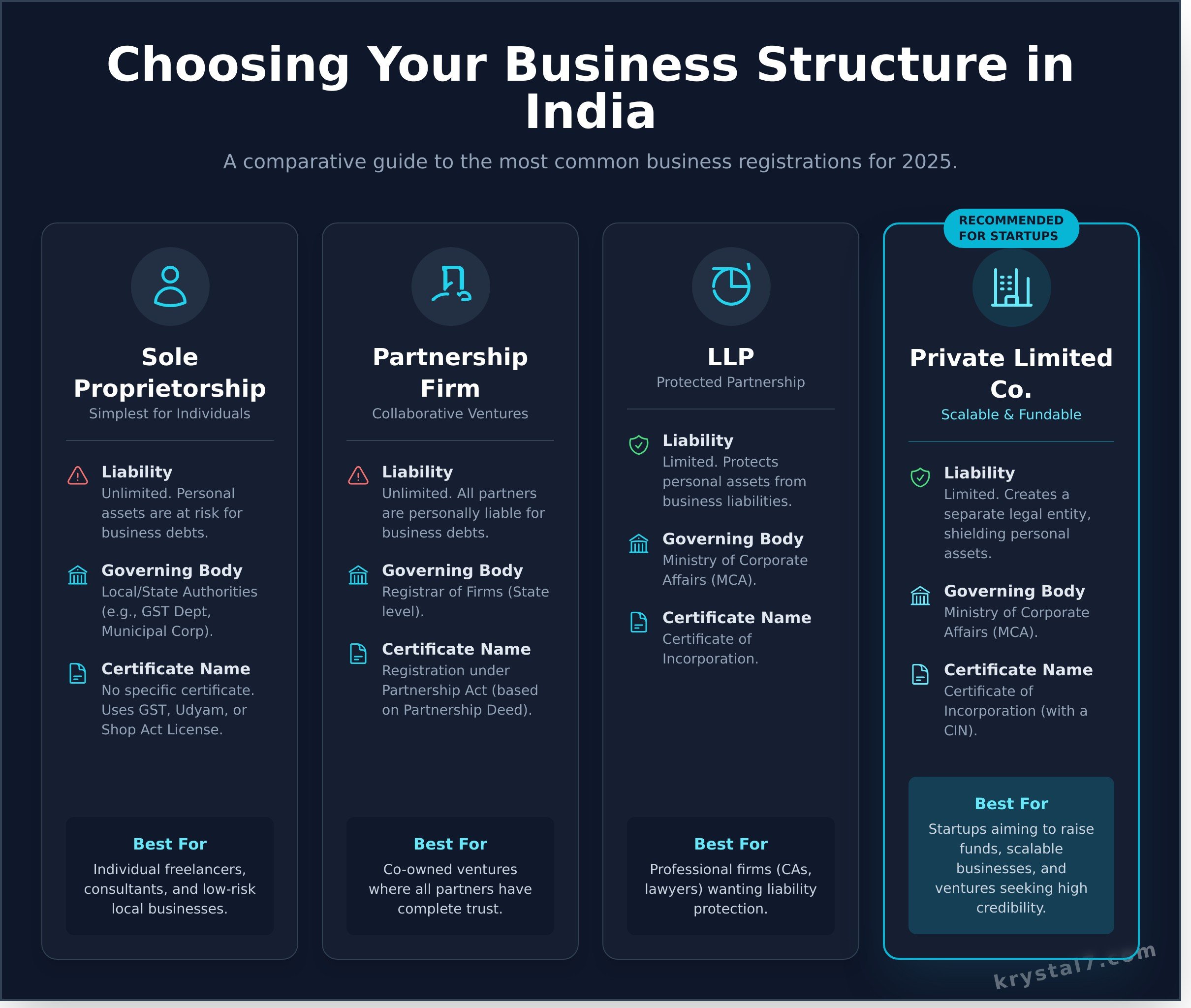
To simplify your decision, here’s a clear comparison of the most common business structures:
- Sole Proprietorship
- Governing Body: Local/State Authorities (e.g., GST Dept, Municipal Corp)
- Certificate Name: No incorporation certificate; uses GST Certificate, Udyam Registration, or Shop Act License as proof.
- Best For: Individual freelancers, consultants, and small local businesses with low risk.
- Partnership Firm
- Governing Body: Registrar of Firms
- Certificate Name: Registration under Partnership Act (based on Partnership Deed).
- Best For: Businesses co-owned by two or more people with complete trust, where formal structure is not a priority.
- Limited Liability Partnership (LLP)
- Governing Body: Ministry of Corporate Affairs (MCA)
- Certificate Name: Certificate of Incorporation.
- Best For: Professional firms (CAs, lawyers) and ventures wanting liability protection without complex company compliance.
- Private Limited Company
- Governing Body: Ministry of Corporate Affairs (MCA)
- Certificate Name: Certificate of Incorporation (with a CIN).
- Best For: Startups aiming to raise funds, scalable businesses, and any venture seeking high credibility.
For Solo Entrepreneurs: Sole Proprietorship
This is the simplest path to starting up. There is no formal incorporation because you and your business are legally the same entity. This means you have unlimited liability-your personal assets can be used to clear business debts. Your business’s existence is proven through other essential licenses like an Udyam Registration, a GST Certificate, or a Shop & Establishment Act License.
For Partnerships: Partnership Firm & LLP
When co-founding a business, a traditional Partnership Firm is governed by a Partnership Deed but comes with unlimited liability for all partners. For a more secure and modern structure, the Limited Liability Partnership (LLP) is the superior choice. It provides the crucial benefit of limited liability, protecting your personal assets from business losses. An LLP is formally registered and receives a Certificate of Incorporation from the Ministry of Corporate Affairs (MCA), blending flexibility with security.
For Scalable Ventures: Private Limited Company
The Private Limited Company is the most robust and preferred structure for startups aiming for high growth and external funding. As a separate legal entity, it shields its owners with limited liability. Upon registration, it receives a formal Certificate of Incorporation (COI) which includes its unique Corporate Identity Number (CIN). This structure offers unmatched credibility with clients and investors, making it the ideal foundation for building a lasting legacy.
How to Get Your Business Registration Certificate: A Step-by-Step Process
Securing your business registration certificate is the foundational step that transforms your vision into a legally recognized entity. While the Indian government has streamlined this process significantly through the Ministry of Corporate Affairs (MCA) portal, it demands meticulous attention to detail. Navigating the legal landscape is a critical part of any comprehensive guide on how to start a business, and getting your registration right is the first major milestone. We’ll use the Private Limited Company registration as our primary example, as it covers the most comprehensive set of requirements.
Phase 1: Preparation and Documentation
The groundwork you lay here is crucial for a smooth application. Accuracy is non-negotiable, as even minor errors can lead to significant delays. This phase is all about gathering the essential components for your application.
- Step 1: Obtain DSC and DIN. Before any forms are filed, all proposed directors must acquire a Digital Signature Certificate (DSC) for secure online submissions and a Director Identification Number (DIN) from the MCA.
- Step 2: Reserve a Unique Company Name. Using the MCA’s RUN (Reserve Unique Name) service, you must propose a name for your company. It must be unique and not infringe on existing trademarks to ensure approval.
- Step 3: Draft MOA and AOA. The Memorandum of Association (MOA) defines your company’s objectives, while the Articles of Association (AOA) outline its internal governance rules. These are the constitutional documents of your venture.
- Step 4: Gather Required Documents. Collate all necessary paperwork, including PAN cards, identity proofs (Aadhaar/Voter ID), and address proofs for all directors, along with proof of the registered office address (e.g., rental agreement and a utility bill).
Phase 2: Filing the Application
With all your documentation prepared, you can proceed to the central filing stage. This is handled through a single, integrated electronic form designed to simplify the process.
- Step 5: Complete the SPICe+ Form. The SPICe+ (Simplified Proforma for Incorporating Company Electronically Plus) is the all-in-one web form for incorporation. It cleverly integrates applications for your company’s PAN, TAN, and even GSTIN, saving you time and effort. Attach all scanned documents and ensure the form is digitally signed by a professional (like a Chartered Accountant or Company Secretary) before submission.
Phase 3: Scrutiny and Issuance
Once submitted, your application enters the final review stage with the regulatory authorities.
- Step 6: ROC Scrutiny and Approval. The Registrar of Companies (ROC) for your state will scrutinize your application. If all documents and details are in order, the ROC approves the application and issues the Certificate of Incorporation (Form INC-11). This certificate is the official business registration certificate in India, confirming your company’s legal existence. Should the ROC find discrepancies, they will mark the application for resubmission with comments, which must be addressed promptly.
Feeling overwhelmed? The path to a valid business registration certificate in India can be complex, but it doesn’t have to be a roadblock for your vision. Let Krystal7’s experts handle the entire registration process for you. We bring clarity to compliance, giving you the freedom to focus on building your business.
Checklist: Documents Required for Business Registration in India
Navigating the paperwork for your business registration doesn’t have to be overwhelming. To bring crystal clarity to the process, we’ve created a comprehensive checklist of the documents you’ll need. Preparing these items in advance will streamline your journey towards obtaining your business registration certificate in India. Remember, all submitted documents must be clear, valid, and self-attested where required to avoid unnecessary delays.
Identity and Address Proof for Directors/Partners
Every individual involved in the business as a director, partner, or proprietor must provide valid proof of their identity and current address. This establishes the legal identity of the key personnel behind the venture.
- PAN Card: This is mandatory for all Indian nationals and is a primary identifier for all financial and business transactions.
- Identity Proof: A self-attested copy of an Aadhaar Card, Voter’s ID, Passport, or Driver’s License.
- Address Proof: The latest bank statement, electricity bill, or telephone bill in the individual’s name. (Note: This document should not be older than two months).
- Photographs: Recent passport-sized photographs of all directors or partners.
Proof for the Registered Business Address
You must provide valid documentation for the official address of your business. This address will be listed on your business registration certificate and used for all official correspondence.
- If you own the property: A recent utility bill (like an electricity or gas bill) or a property tax receipt in the owner’s name.
- If the property is rented: You will need a notarized rental agreement along with a No Objection Certificate (NOC) from the property owner, granting permission to use the premises as a registered office. A copy of the owner’s utility bill is also required.
Essential Incorporation Documents
The core legal documents defining your business structure are fundamental to the registration process. The specific documents depend on the type of business entity you are forming.
- For a Private Limited or Public Limited Company: The Memorandum of Association (MOA) and Articles of Association (AOA) are required.
- For a Limited Liability Partnership (LLP): The LLP Agreement, which outlines the rights and duties of the partners.
- For a Partnership Firm: The Partnership Deed, detailing the terms and conditions agreed upon by the partners.
Having these documents in order is the most critical step in ensuring a smooth and efficient registration. If you need assistance compiling or drafting these legal documents, the expert team at Krystal7 is here to provide the clarity you can build on.
You’ve Got Your Certificate! What Are the Crucial Next Steps?
Congratulations! Holding your business registration certificate is a monumental achievement. It’s the official validation of your vision and hard work. But as the initial excitement settles, the big question emerges: “I’m registered, now what?” This document isn’t the finish line; it’s the starting pistol for your operational journey. Think of it as the master key that unlocks everything else your business needs to thrive legally and financially.
At Krystal7, we believe our partnership extends far beyond the initial registration. We provide the clarity you need to navigate the critical post-incorporation landscape. Securing your business registration certificate in India is the first step; building a compliant, resilient enterprise is the long-term mission.
Step 1: Open a Corporate Current Account
Your immediate priority is to establish a separate financial identity for your business. A corporate current account is non-negotiable for maintaining clean books, ensuring legal liability protection, and projecting a professional image. Your Certificate of Incorporation is the primary document banks will ask for. You will typically also need:
- Company PAN Card
- Memorandum of Association (MOA) and Articles of Association (AOA)
- A Board Resolution authorising the opening of the bank account
Step 2: Obtain Secondary Licenses and Registrations
Your primary registration is the foundation, but most businesses require additional licenses to operate legally. The specific permits depend on your industry, location, and scale. Key secondary registrations include:
- GST Registration: Mandatory if your annual turnover exceeds the prescribed threshold.
- Shop and Establishment Act License: A state-specific license required for all commercial premises.
- Professional Tax Registration: Necessary in most states if you are hiring employees.
- Industry-Specific Licenses: Examples include an FSSAI license for food businesses or an Import Export Code (IEC) for international trade.
Step 3: Understand Your Annual Compliance Obligations
Compliance is not a one-time task; it’s an ongoing commitment that protects your business from penalties and ensures its good standing. This involves regular filings with both the Registrar of Companies (ROC) and the Income Tax Department. Key activities include conducting board meetings, preparing financial statements, undergoing statutory audits, and maintaining statutory records. This continuous process ensures your journey after getting the business registration certificate in India is smooth and legally sound.
Navigating this complex calendar can be overwhelming. Let our experts provide the clarity and support you need to stay compliant, year after year. Secure your business’s future with our all-in-one Annual Compliance Packages.
From Vision to Venture: Securing Your Business’s Future
Navigating the path to official recognition in India begins with a single, crucial document. As we’ve explored, understanding the different types of registrations and meticulously preparing your documents are foundational steps. Securing the right business registration certificate india is not just about compliance; it’s about building a credible, scalable foundation for your venture and unlocking its full potential.
While the path is clear, the process can be complex, involving red tape that diverts your focus from what truly matters-growing your business. This is where professional guidance transforms a daunting task into a streamlined success, giving you the freedom to focus on your vision.
Give your dream the professional start it deserves. Our team of top-tier Chartered Accountants and Company Secretaries is here to manage the entire process with Krystal-Clear transparency. With a dedicated relationship manager for every client and our promise of no hidden costs, you gain more than just a certificate-you gain a genuine partner. Ready to start your business with crystal clarity? Let our experts manage your company registration from start to finish.
Your entrepreneurial journey awaits. Take the first step with confidence.
Frequently Asked Questions
How long does it take to get a business registration certificate in India?
The timeline to secure your business registration certificate in India is typically a streamlined 10 to 15 working days. This period covers crucial steps from name approval to the final issuance of the Certificate of Incorporation by the Ministry of Corporate Affairs (MCA). A swift, hassle-free process hinges on the complete and accurate submission of all required documents. Our role is to ensure every detail is perfect, minimizing potential delays from government processing.
What is the total cost of registering a private limited company in India?
The total cost to register a Private Limited Company in India generally ranges from ₹6,000 to ₹15,000, depending on the authorised capital and the state of registration. This all-inclusive cost typically covers government fees (like stamp duty), Digital Signature Certificates (DSC) for directors, and professional fees for advisory and filing. We provide Krystal-Clear pricing upfront, ensuring there are no hidden charges and giving you complete financial clarity from the start.
How can I check or verify if a company is genuinely registered?
You can easily verify a company’s legal standing by using the public portal of the Ministry of Corporate Affairs (MCA). Simply visit the official MCA website and navigate to the ‘View Company/LLP Master Data’ service. By entering the company’s Corporate Identity Number (CIN) or its full name, you can access key details like its registration date, address, and compliance status. This provides a transparent and reliable confirmation of a company’s legitimacy.
Can I change my company’s name or address after receiving the registration certificate?
Yes, you can absolutely change your company’s name or registered address after incorporation. The process involves passing a board resolution, obtaining shareholder approval (for a name change), and filing the requisite forms with the Registrar of Companies (RoC). This is a formal statutory procedure that requires careful documentation to ensure full compliance. Partnering with a professional ensures the transition is smooth, efficient, and correctly recorded in all official registers.
What is the difference between a Company Registration Number (CIN) and a GST Identification Number (GSTIN)?
The key difference lies in their purpose and issuing authority. A Company Registration Number (CIN) is a unique 21-digit alphanumeric code issued by the Registrar of Companies (RoC) upon incorporation; it serves as your company’s legal identity. In contrast, a GST Identification Number (GSTIN) is a 15-digit number issued by tax authorities for tracking all Goods and Services Tax (GST) compliance. Essentially, CIN is for corporate identity, while GSTIN is for tax identity.
Do I need a physical office address to register my business?
A registered office address is mandatory, but it does not need to be a commercial space. You can use a residential address as your company’s registered office, provided you have a No Objection Certificate (NOC) from the property owner. This flexibility is ideal for startups and home-based entrepreneurs, allowing you to establish your legal entity without the immediate overhead of leasing a commercial property and still get your business registration certificate in India.
Is it possible to register a business in India as a foreign national?
Yes, it is entirely possible for a foreign national to register a business in India. The most common structures, like a Private Limited Company, require at least two directors, one of whom must be a resident of India (staying in India for at least 182 days in the previous year). This structure allows foreign promoters to hold 100% of the company’s shares in most sectors. The process is straightforward and well-defined with the right expert guidance.