

Foreign Subsidiary Registration in India: The Complete Guide (2026)
India’s dynamic market represents a monumental growth opportunity, but the path to entry can seem tangled in a web of complex bureaucracy and confusing regulations. If the thought of navigating the Companies Act and FEMA compliance feels overwhelming, you are not alone. This uncertainty is precisely why we created this guide-to demystify the process of Foreign Subsidiary Registration in India and replace anxiety with absolute clarity.
This comprehensive 2025 guide is your definitive roadmap. We will walk you through every critical stage, from choosing the right legal structure to preparing the exact documentation required from your parent company. You will gain a clear understanding of your legal obligations before, during, and after incorporation. Our mission is to transform a seemingly daunting task into a streamlined, manageable process, giving you the confidence and freedom to focus on launching your Indian venture successfully. Let’s build your legacy in one of the world’s fastest-growing economies.
Key Takeaways
- Determine the ideal legal structure for your Indian entry-Wholly-Owned Subsidiary or Joint Venture-to align with your goals for control and growth.
- Prepare a complete, correctly apostilled document checklist to ensure a smooth and streamlined Foreign Subsidiary Registration in India.
- Navigate the 7-step digital incorporation process on the MCA portal, which begins with securing Digital Signature Certificates (DSCs) for directors.
- Understand that incorporation is just the first step; mastering post-registration compliance is essential to avoid penalties and operate successfully.
Why Register a Foreign Subsidiary in India? Key Advantages
Venturing into the Indian market is a strategic move for any global business aiming for significant growth. As one of the world’s fastest-growing major economies, India presents a landscape ripe with opportunity. The process of Foreign Subsidiary Registration in India is more than a legal formality; it’s the foundation for building a lasting and thriving presence in this dynamic environment.
Opting for a subsidiary structure offers several clear advantages over other entry methods. Most importantly, a subsidiary is a distinct legal entity, meaning the parent company’s liability is limited to its investment in the subsidiary. This creates a crucial financial firewall. Furthermore, supportive government policies like ‘Make in India’ have streamlined the environment for Foreign Direct Investment in India, making it more welcoming than ever for international ventures to establish a strong foothold.
Understanding the Legal Framework: Companies Act & FEMA
Navigating the legal landscape is the first step toward clarity. Corporate governance in India is primarily regulated by the Companies Act, 2013, which outlines the rules for incorporation, compliance, and management. Simultaneously, all foreign investment transactions fall under the purview of the Foreign Exchange Management Act (FEMA), which governs the inflow and outflow of foreign currency. The Ministry of Corporate Affairs (MCA) is the central regulatory body overseeing this entire framework, ensuring transparent and structured operations.
Subsidiary vs. Branch Office vs. Liaison Office
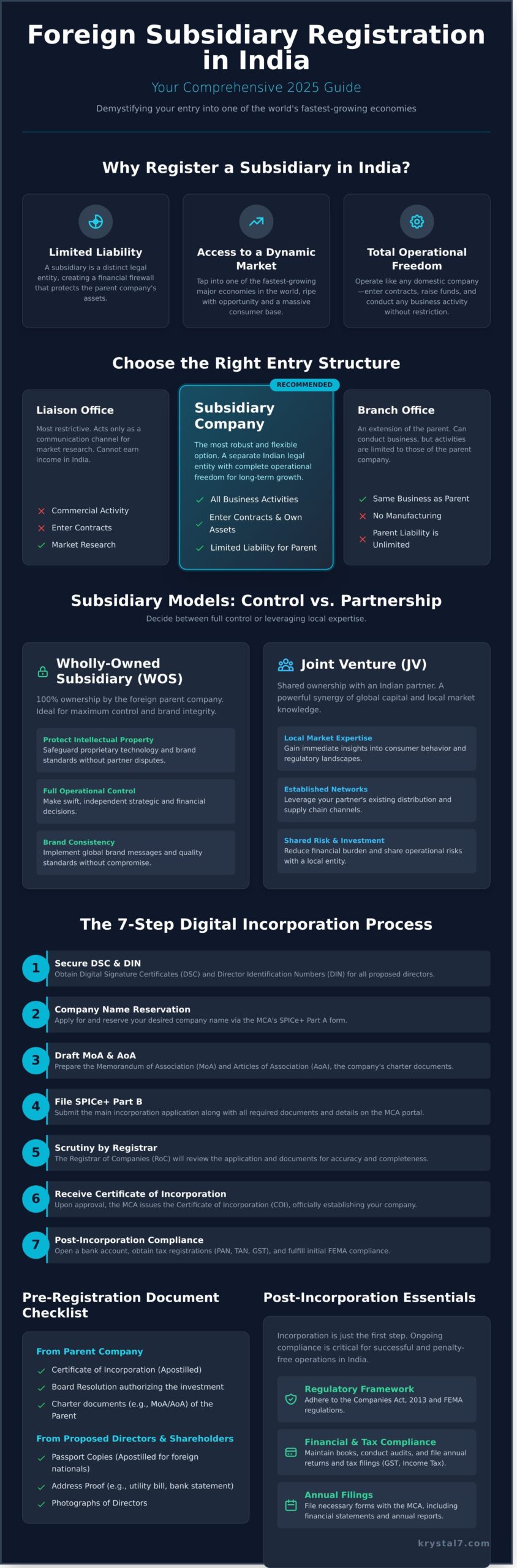
Choosing the right entity type is critical for your operational freedom. A subsidiary offers the most flexibility and is the preferred choice for companies with long-term strategic plans. Here’s a clear comparison:
- Subsidiary Company: A distinct Indian legal entity, owned by the foreign parent. It can conduct any and all business activities, enter into contracts, raise funds, and operate just like a domestic company, offering complete operational freedom.
- Branch Office: An extension of the parent company, not a separate entity. Its activities are restricted to the same business operations as the parent company and it cannot engage in manufacturing activities on its own.
- Liaison Office: The most restrictive option. It cannot undertake any commercial, trading, or industrial activities. Its role is limited to acting as a communication channel and facilitating market research for the parent company.
Ultimately, the successful Foreign Subsidiary Registration in India provides the most robust and scalable platform for your business to grow, innovate, and thrive within the Indian market.
Choosing Your Structure: Wholly-Owned Subsidiary vs. Joint Venture
One of the most critical decisions in the process of Foreign Subsidiary Registration in India is choosing the right corporate structure. This foundational choice dictates your level of control, operational freedom, and strategic partnerships. It’s a balance between leveraging local expertise and maintaining complete command of your venture. Understanding the nuances of India’s dynamic economy, as highlighted by World Bank data on India, is key to making an informed decision that aligns with your global vision.
While most foreign companies opt for a Wholly-Owned Subsidiary for maximum control and IP protection, understanding both models provides the clarity needed to build a thriving enterprise.
The Wholly-Owned Subsidiary (WOS) Model
For international companies seeking maximum control and brand integrity, the Wholly-Owned Subsidiary is the definitive choice. As the name implies, the foreign parent company holds 100% of the shares, giving it absolute authority. This structure is ideal for:
- Protecting Intellectual Property: Safeguard your proprietary technology, patents, and brand standards without risk of partner disputes.
- Full Operational Control: Make strategic, financial, and management decisions swiftly and independently.
- Brand Consistency: Ensure your global brand message and quality standards are implemented without compromise.
The Joint Venture (JV) Model with an Indian Partner
A Joint Venture offers a powerful synergy, combining your international capital and technology with a local partner’s invaluable market knowledge. In this model, shareholding is divided between the foreign and Indian entities. It is an excellent way to gain immediate access to established distribution networks, navigate regulatory landscapes, and understand local consumer behavior. However, success hinges on a robust, meticulously drafted JV agreement that clearly defines roles, responsibilities, and exit strategies to prevent future friction.
Key Factors to Consider in Your Decision
Your final choice should be a strategic one, not just a default. There is no one-size-fits-all answer in the Foreign Subsidiary Registration in India journey. Weigh these critical factors to find the clarity you need:
- Level of Investment: A JV can mitigate financial risk by sharing the initial capital outlay and operational costs.
- Need for Local Expertise: Is a local partner’s distribution network or market insight essential for your success?
- IP Sensitivity: If your core value lies in proprietary technology, a WOS provides the most secure environment.
This decision sets the stage for your entire Indian operation. It’s a choice that requires foresight and expert legal and business advisory. Making the right move now eliminates future complexities and empowers you to focus on growth. Need help deciding? Get expert advice from our strategists.
Pre-Registration Checklist: Documents & Key Requirements
Navigating the paperwork for your Foreign Subsidiary Registration in India can feel complex, but meticulous preparation is the key to a smooth and streamlined process. Getting your documentation right from the start eliminates potential delays and provides the clarity needed for a successful launch. Think of this checklist as your roadmap to avoiding common hurdles and ensuring your venture is built on a solid foundation of compliance.
Documents Required from the Foreign Parent Company
To establish the legal identity and intent of the parent corporation, the Ministry of Corporate Affairs (MCA) requires a specific set of authenticated documents. Ensuring these are prepared correctly is a critical first step.
- Board Resolution: An official resolution passed by the parent company’s Board of Directors authorizing the incorporation of the Indian subsidiary and naming the authorized signatories.
- Certificate of Incorporation: A certified copy of the parent company’s registration or incorporation certificate.
- Memorandum & Articles of Association (MOA & AOA): A copy of the parent company’s charter documents that outline its business purpose and governance rules.
Crucial Note: All documents originating from the parent company must be notarized in their country of origin and then apostilled as per the Hague Convention. This international certification is non-negotiable for the documents to be legally valid in India.
Documents Required for Proposed Directors
Every proposed director, whether a foreign national or an Indian resident, must provide clear identity and address verification to obtain a Director Identification Number (DIN).
- For Foreign Nationals: A notarized and apostilled copy of their passport is mandatory. They must also provide a valid address proof (such as a recent bank statement or utility bill), which also needs to be notarized and apostilled.
- For Indian Nationals: A self-attested copy of their PAN Card and Aadhaar Card is required, along with a recent address proof (like a bank statement, electricity bill, or telephone bill).
- For All Directors: Recent passport-sized photographs are required.
The Resident Director Requirement Explained
This is one of the most vital compliance points often overlooked by international companies. Under Indian law, every company must have at least one director who qualifies as a ‘resident of India’. A resident is defined as a person who has stayed in India for a total period of not less than 182 days during the previous calendar year. This is a non-negotiable statutory requirement under the Companies Act, 2013, a framework well-documented by official bodies like Invest India to ensure a local point of accountability. This director can be an Indian national or a foreign national who meets the residency criteria, providing flexibility for your management structure.
The 7-Step Registration Process for a Foreign Subsidiary
India’s Ministry of Corporate Affairs (MCA) has streamlined the entire incorporation process through its V3 portal, making it more efficient and transparent. The cornerstone of this digital-first approach is the integrated web form, SPICe+ (Simplified Proforma for Incorporating Company Electronically Plus). While this simplifies procedures, it demands absolute accuracy. A single error can lead to rejection, causing delays and frustration. Partnering with a professional firm ensures every form is filed with meticulous care, transforming a complex task into a clear, manageable process.
Step 1 & 2: Obtain DSC and Director Identification Number (DIN)
Before any forms can be submitted, all proposed directors of the Indian subsidiary must have a Digital Signature Certificate (DSC) for secure electronic signing. Additionally, each director needs a Director Identification Number (DIN). The SPICe+ form conveniently integrates the application for both, making the initial steps seamless and efficient for up to three directors.
Step 3: Company Name Approval via ‘RUN’ Service
The first active step is reserving your company’s name through the MCA’s RUN (Reserve Unique Name) web service, which is part of SPICe+. You can propose up to two names in order of preference. The name must be unique, not resemble any existing company or trademark, and align with the principal business activities outlined in your objectives.
Step 4 & 5: Draft MoA/AoA and File SPICe+ Forms
This is the core of the Foreign Subsidiary Registration in India. You must draft the company’s constitutional documents: the Memorandum of Association (MoA), which defines its objectives, and the Articles of Association (AoA), which outlines its internal governance. These documents, along with all director and company details, are submitted in the SPICe+ Part B form. Crucially, all documents from the foreign parent company-such as board resolutions-must be properly apostilled or notarized.
Step 6 & 7: Receive Certificate of Incorporation & Obtain PAN/TAN
Once the Registrar of Companies (RoC) verifies all documents and forms, they will issue the Certificate of Incorporation (COI). This official document includes your unique Company Identification Number (CIN) and signifies your company’s legal existence. The integrated process also ensures that your company’s key business identities are automatically allotted, including:
- PAN (Permanent Account Number)
- TAN (Tax Deduction and Collection Account Number)
- EPFO & ESIC registration
Navigating this meticulous process requires clarity and expertise. The team at Krystal7 Consultants ensures a smooth, hassle-free incorporation, giving you the freedom to focus on your business vision.
Post-Incorporation Compliance: Your Legal Obligations in India
Successfully completing your Foreign Subsidiary Registration in India is a significant milestone, but it’s the first step in a longer journey. Incorporation marks the beginning of your company’s legal life, which comes with a series of mandatory ongoing compliance obligations. Navigating this regulatory landscape is critical, as failure to comply can lead to heavy penalties, legal complications, and potential disqualification for the directors. Staying current with these requirements ensures your venture remains in good standing and can thrive in the Indian market.
Initial RBI & FEMA Reporting (Form FC-GPR)
Once your foreign parent company transfers the initial share capital, the clock starts ticking. Within 30 days of receiving these funds, you must file Form FC-GPR with the Reserve Bank of India (RBI). This form officially reports the Foreign Direct Investment (FDI) and is a non-negotiable step under the Foreign Exchange Management Act (FEMA). Proper filing ensures your investment is legally recognized, providing a solid foundation for future operations and transactions.
First Board Meeting and Auditor Appointment
Your new company must hold its first meeting of the Board of Directors within 30 days of its incorporation date. This foundational meeting is where key initial decisions are made. The most crucial agenda items include appointing the company’s first statutory auditor, who will oversee your financial reporting, and passing a resolution to open a corporate bank account. These actions formally establish your company’s governance and financial infrastructure in India.
Mandatory Annual Filings and ROC Compliance
Maintaining transparency and good standing requires consistent annual reporting to various government bodies. These filings provide a clear picture of your company’s financial health and operational structure. Key annual obligations include:
- Annual Financial Statements (Form AOC-4): Filing your audited balance sheet and profit and loss statement with the Registrar of Companies (ROC).
- Annual Return (Form MGT-7): Submitting a comprehensive summary of the company’s shareholding structure, directors, and other key details to the ROC.
- Income Tax Return: Filing the annual corporate tax return with the Indian Income Tax Department.
Managing these deadlines without expert help can be overwhelming. Let Krystal7 manage your annual compliance for complete peace of mind. Our streamlined process ensures every deadline is met, giving you the freedom to focus on growing your business.
Your Gateway to India: A Clear Path Forward
Embarking on your expansion into India is a monumental step toward global growth. As this guide has shown, success hinges on a clear strategy, meticulous preparation, and a firm grasp of ongoing compliance. A successful Foreign Subsidiary Registration in India is more than a legal formality-it’s the foundation for your long-term growth in one of the world’s most dynamic economies.
Why navigate the complexities of FEMA and the Companies Act alone? At Krystal7, we bring clarity to the entire process. Our expert team offers transparent, all-inclusive packages and assigns a dedicated advisor to your business, ensuring a streamlined and hassle-free journey. We manage the compliance, giving you the freedom to focus on your vision.
Ready to launch your business in India? Get Krystal-Clear guidance today.
Your Indian venture awaits. Let’s build your legacy together.
Frequently Asked Questions
What is the minimum capital requirement to start a subsidiary in India?
While the Companies Act, 2013, does not mandate a specific minimum capital, it is standard practice to start with a nominal authorized capital, such as INR 1,00,000 (approx. USD 1,200). This establishes credibility without requiring a large initial investment. The actual funds can be remitted into India post-incorporation. This flexible approach provides operational clarity and allows you to capitalize your venture according to its immediate business needs, ensuring a smooth financial start.
How long does the entire foreign subsidiary registration process take?
The complete foreign subsidiary registration in India typically takes between 20 to 30 working days. This timeline is contingent upon the prompt submission of correctly apostilled documents from the parent company and the processing speed at the Ministry of Corporate Affairs (MCA). Our streamlined process is designed to manage each stage-from director identification to final incorporation-efficiently, helping you avoid bureaucratic delays and launch your Indian operations faster.
Can all the shareholders of the Indian subsidiary be foreign entities or nationals?
Yes, 100% of the shareholders in an Indian subsidiary can be foreign nationals or corporate bodies, creating what is known as a wholly-owned subsidiary. This is permitted in most sectors under India’s Foreign Direct Investment (FDI) policy. However, the company must appoint at least one director who is a resident of India (having stayed in India for a minimum of 182 days in the previous calendar year) to ensure local accountability.
Do I need a physical office address in India to register a company?
A registered office address in India is mandatory for incorporation, as it is used for all official correspondence from statutory authorities. However, you do not need a conventional physical office space from day one. A virtual office address is a legally compliant and cost-effective alternative. It fulfills the statutory requirement by providing a professional address for mail and communication, giving you the freedom to establish a physical presence when your business is ready.
What are the approximate annual compliance costs for a private limited subsidiary in India?
The approximate annual compliance costs for a subsidiary typically range from INR 60,000 to over INR 1,50,000. This figure varies based on factors like transaction volume, revenue, and the complexity of operations. These costs cover mandatory activities such as statutory audits, annual filings with the Registrar of Companies (ROC), income tax filings, and FEMA reporting. We provide Krystal-Clear pricing to ensure you have a transparent view of all recurring compliance obligations.
Can a foreign subsidiary own property in India?
Absolutely. A subsidiary company incorporated in India is treated as an Indian entity under the law. Therefore, it is legally permitted to acquire and own immovable property in its own name to carry out its business operations, subject to regulations under the Foreign Exchange Management Act (FEMA). This provides a significant advantage for long-term strategic planning and asset building, offering your venture a solid foundation for growth and stability in the Indian market.
What is the difference between an apostilled document and a notarized one?
A notarized document is one that has been certified by a local Notary Public to verify its authenticity. An apostilled document, however, is certified under the terms of the 1961 Hague Convention, which makes it legally recognized in all member countries, including India, without needing further verification. For foreign documents required for your company registration in India, an apostille is mandatory to ensure they are accepted by Indian authorities, preventing critical delays in the process.