

Convincing Your Co-Founder on Company Structure: A Guide to Alignment
You and your co-founder share a vision, a passion, and countless late nights building your dream. Yet, one critical conversation keeps hitting a wall: the company structure. The circular debates about LLP vs. Private Limited can feel less like strategic planning and more like a source of friction. You know that the challenge of convincing my co-founder on company structure is about more than just legal paperwork; it’s about aligning on the very foundation of your venture’s future.
This guide is designed to move you beyond the stalemate. We provide a clear, data-driven framework to transform this difficult discussion into a productive collaboration. You will learn how to logically present the long-term implications of each option-from funding and liability to taxation and scalability in India. Our goal is to empower you and your co-founder to make a confident, unified decision that protects your business, strengthens your partnership, and gives you the freedom to focus on building your legacy.
Key Takeaways
- Start by aligning on your business’s long-term vision and fundraising goals before debating specific legal entities like a Private Limited Company or LLP.
- Move beyond opinions by using a clear framework to objectively compare structures based on liability, taxation, and compliance requirements in India.
- The key to convincing my co-founder on company structure is to present a logical, data-backed case that connects directly to your shared ambitions.
- Discover communication strategies that foster consensus, turning this critical decision into a moment of co-founder alignment rather than a point of conflict.
Why Choosing a Company Structure is Your First Big Test as Co-Founders
Before the first product is shipped or the first client is billed, you and your co-founder face a foundational decision that many new entrepreneurs dismiss as mere paperwork. But choosing your company structure is far more than a legal formality-it is the architectural blueprint for your entire venture. This decision dictates how you operate, how you grow, and how you protect the vision you both share.
This isn’t just about picking between a Private Limited Company or a Limited Liability Partnership. This choice has direct, long-term consequences for personal liability, taxation, your ability to raise capital, and your ultimate exit strategy. The process of convincing my co-founder on company structure is, therefore, not a debate to be won, but a strategic alignment to be achieved. Getting it right establishes a powerful precedent for how you will navigate critical decisions together. It’s your first opportunity to prove to each other-and to future investors-that you are a cohesive, forward-thinking team.
The Long-Term Costs of Misalignment
Failing to align on a structure can introduce risk and friction into your business from day one. The consequences of a rushed or contentious decision often surface when the stakes are highest, creating significant roadblocks to your growth. Common pitfalls include:
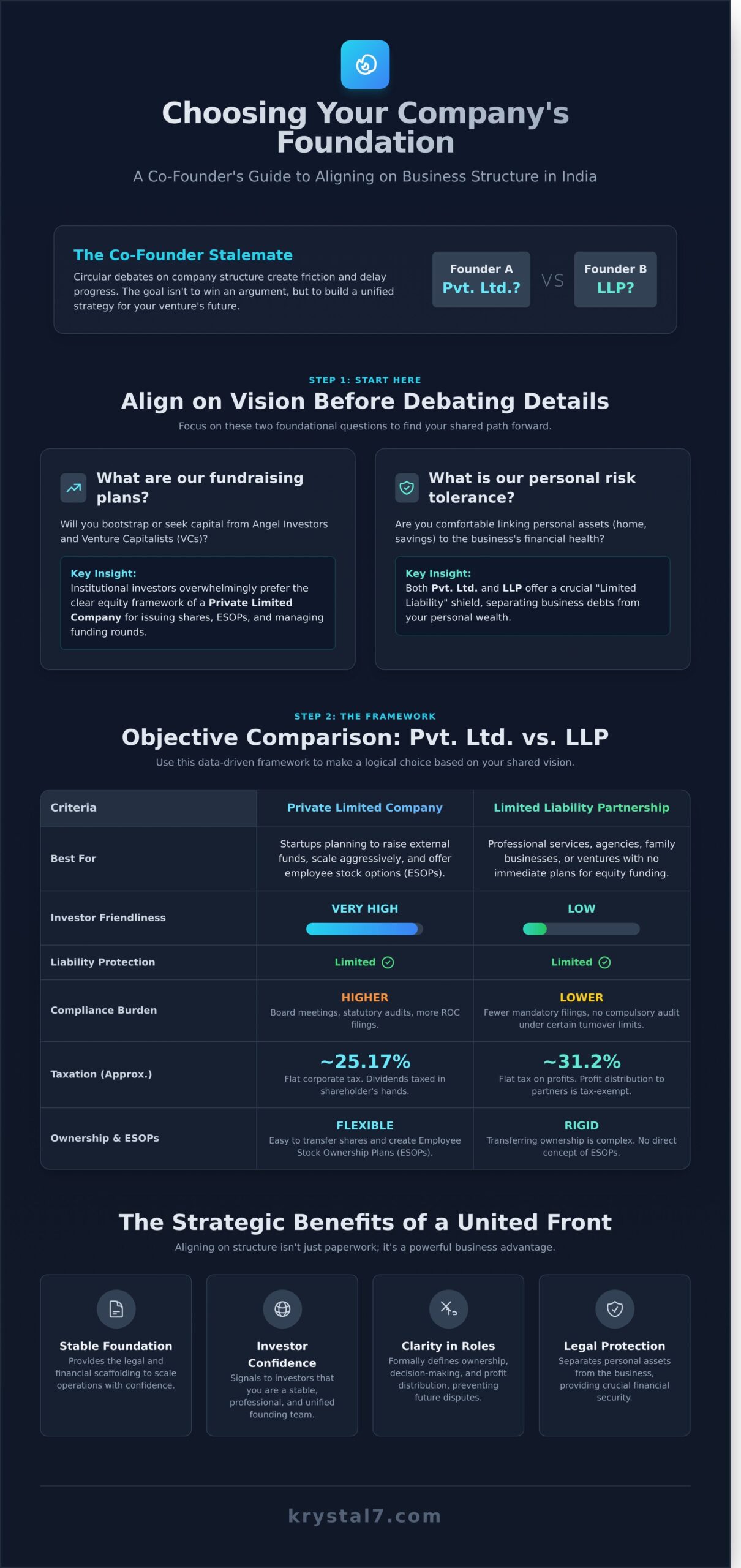
- Fundraising Hurdles: Venture capitalists and angel investors often have strict preferences for certain legal structures (like a Private Limited Company) and may pass on ventures that require complex restructuring.
- Operational Friction: An ill-fitting structure can leave roles, responsibilities, and equity ownership ambiguous, leading to internal disputes that drain energy and focus.
- Personal Asset Risk: Choosing a structure without limited liability, such as a traditional partnership, can put your personal assets on the line if the business incurs debt or faces legal action.
- Expensive Restructuring: Changing your legal entity later is a complex and costly process, involving significant legal fees, paperwork, and potential tax implications.
The Strategic Benefits of a United Front
Conversely, achieving Krystal-Clear alignment on your company structure builds a resilient foundation for everything that follows. A united front on this decision provides immediate and lasting advantages that empower your business to thrive.
- A Stable Foundation for Growth: A well-chosen structure provides the legal and financial scaffolding necessary to scale your operations, hire employees, and enter new markets with confidence.
- Clarity in Roles and Ownership: It formally defines ownership percentages, decision-making authority, and profit distribution, preventing future misunderstandings.
- Boosted Investor Confidence: Demonstrating that you have thoughtfully aligned on your structure signals to investors that you are a stable, professional, and unified founding team.
- Essential Legal Protection: The right entity separates your personal assets from the business, providing a crucial layer of financial security and giving you the freedom to focus on your vision.
Step 1: Align on the Vision Before Debating the Details
The temptation is to jump straight into a debate: “Should we be a Private Limited Company or an LLP?” This is the fastest way to create friction. A more strategic approach turns this potential conflict into a collaborative planning session. Before you get lost in legal jargon, it’s crucial to align on the vision before debating the tactical details. By focusing on shared goals, the process of convincing my co-founder on company structure becomes a shared discovery of the right path forward. Use these foundational questions to find your clarity.
Question 1: What are our fundraising plans?
Your ambition for growth directly shapes your structural needs. Will you bootstrap the venture with your own capital, or are you planning to seek funding from angel investors and Venture Capitalists (VCs)? Institutional investors overwhelmingly prefer the clear equity framework of a Private Limited Company. This structure simplifies issuing shares, creating Employee Stock Ownership Plans (ESOPs) to attract top talent, and managing future funding rounds with transparency and ease.
Question 2: What is our personal risk tolerance?
This is a critical, personal conversation. How comfortable are you with linking your personal assets-your home, your savings-to the business’s financial health? A structure with “limited liability” creates a legal shield, separating business debts from your personal wealth. An open discussion about your individual financial situations and risk tolerance is essential to choose a structure that lets you both build your dream with confidence and security.
Question 3: How will we manage and operate the business?
Define your operational blueprint now to avoid future deadlock. How will you run the business day-to-day and make critical decisions? Discuss key questions to gain clarity on the level of formal governance you need:
- Who has the final say on major strategic choices?
- Will we establish a formal board of directors for oversight?
- How will profits and losses be distributed between us?
Question 4: What is our long-term exit strategy?
Begin with the end in mind. Your long-term vision for the company-your exit strategy-has significant structural implications. Do you dream of an Initial Public Offering (IPO), a strategic acquisition by a larger company, or building a legacy to pass on? Each path is better served by a specific legal framework. Thinking about your exit isn’t premature; it’s a strategic move that ensures your foundation is built for your ultimate destination.
Step 2: A Framework for Comparing India’s Core Business Structures
With your shared vision and long-term goals in focus, the next step is to evaluate your options with objective clarity. The challenge of convincing my co-founder on company structure often stems from a lack of shared, factual data. This framework serves as that single source of truth, allowing you to compare the most common business entities in India side-by-side. Use this guide to connect your agreed-upon goals to the legal foundation that will best support them. Once you’ve aligned, the process of Formalizing Your New Company through the Ministry of Corporate Affairs becomes your clear next action.
The Private Limited Company (Pvt Ltd)
A Pvt Ltd is the gold standard for startups with high-growth ambitions. It is the most credible and scalable business structure, designed to support your venture from its first hire to its first funding round.
- Best for: Startups planning to raise VC funding, issue Employee Stock Ownership Plans (ESOPs), and build a national or global brand.
- Key Features: It is a separate legal entity, which means it protects your personal assets with limited liability. It also allows for the easy transfer of shares to investors, employees, and new partners.
- Co-founder Consideration: The conversation here is about ambition versus administration. While the statutory compliance burden is higher, this structure provides the unshakable foundation needed for exponential growth. Explore Krystal7 Consultants’ all-in-one Pvt Ltd incorporation package.
The Limited Liability Partnership (LLP)
An LLP offers a modern hybrid, blending the operational ease of a partnership with the protective benefits of a private limited company. It provides a streamlined path for professional ventures.
- Best for: Service-based businesses like consulting firms, creative agencies, or professional practices that do not intend to seek equity funding.
- Key Features: Partners benefit from limited liability while enjoying the flexibility of a partnership agreement to define roles and profit-sharing. Compliance requirements are significantly lower than a Pvt Ltd.
- Co-founder Consideration: This is a simpler entity to manage, offering more freedom and less paperwork. The critical trade-off you must both agree on is that raising external capital from venture funds is difficult, if not impossible.
The Partnership Firm
The most traditional and straightforward business structure, a Partnership Firm is governed by the Indian Partnership Act, 1932. It is easy to start but carries substantial personal risk.
- Best for: Very small, informal businesses with low financial risk and a high degree of trust between co-founders.
- Key Features: Extremely easy to set up with minimal compliance and registration formalities. A simple partnership deed is all that’s required.
- Co-founder Consideration: This is the most crucial point of alignment. A partnership offers unlimited personal liability, meaning both of your personal assets could be used to settle business debts. This significant risk makes it unsuitable for most scalable startups.
Step 3: How to Build Your Case and Reach an Agreement
The conversation about company structure isn’t an argument to win; it’s a strategic pillar to build together. The ultimate goal is consensus, grounded in logic and your shared vision for the company’s growth. The challenge of convincing my co-founder on company structure should feel less like a debate and more like a collaborative problem-solving session. By approaching this pivotal decision with objective data, empathy, and a relentless focus on the business’s best interests, you build a foundation of trust that will serve your venture for years to come.
Frame your preference in terms of benefits for the business, not just for you, and actively listen to your co-founder’s concerns to find common ground and move forward with clarity.
Map Your Choice to Your Shared Vision
Always tie your preferred structure back to goals you have both already agreed upon. This powerful technique shifts the focus from personal preference to strategic alignment. Frame your points logically: “Based on our shared goal to seek VC funding within two years, a Private Limited Company makes the most sense because investors are far more comfortable with its clear shareholding and governance framework.” This approach demonstrates that your recommendation is rooted in the long-term health and trajectory of your shared enterprise.
Use ‘If-Then’ Scenarios for Crystal-Clear Consequences
Abstract legal terms can create confusion and stall progress. Make the future impact of your decision tangible by using clear ‘if-then’ statements to illustrate the consequences. This brings clarity to complex choices and helps visualize the road ahead.
- “If we register as an LLP, then it will be significantly more complex to offer ESOPs to attract top tech talent.”
- “If we choose a Private Limited Company, then we gain limited liability protection, safeguarding our personal assets from business debt.”
Bring in a Neutral Expert to Break an Impasse
If you find yourselves at a standstill, the wisest and most productive move is to bring in a neutral third party. An experienced business consultant or legal strategist can provide an unbiased, data-driven perspective tailored to your specific goals. This de-personalizes the decision and protects your invaluable co-founder relationship from strain. Instead of getting stuck, you get an expert roadmap. If you need help navigating this conversation, our team of advisors at Krystal7 Consultants can provide the clarity you need to move forward with confidence.
From Agreement to Action: Formalizing Your New Company
Congratulations! Reaching a mutual understanding on your company’s framework is a monumental step. The difficult conversations are behind you, and your shared vision is taking shape. Now, it’s time to transform that hard-won agreement into an official, legally-binding reality. A handshake and verbal promises feel great, but they offer zero protection for you, your co-founder, or the future of your venture. Proper legal formalization is the final, non-negotiable step to cement your decisions and build a durable foundation for growth.
Drafting a Comprehensive Founders’ Agreement
This is your most important internal governance document. Think of it as the constitution for your company, providing Krystal-Clear rules of engagement. It formally outlines everything you’ve agreed upon, preventing future misunderstandings. A robust agreement should always include:
- Roles and Responsibilities: Clearly defined duties for each founder.
- Equity Distribution: Precise ownership percentages.
- Vesting Schedules: How and when equity is earned over time.
- Exit Clauses: A clear process for what happens if a co-founder leaves.
The Registration Process: Why Expertise Matters
After all the effort spent on convincing my co-founder on company structure, the last thing you need is a critical error in your official filings. Company registration isn’t just filling out a form; it involves precise legal documentation and statutory procedures. Simple mistakes can lead to costly delays, rejections, and even future penalties. Working with compliance experts removes the guesswork and ensures your venture is set up correctly, quickly, and in full compliance with the law from day one.
Gain the Freedom to Focus on What Matters
Your energy is best spent building your product, finding customers, and growing your business-not deciphering legal jargon and navigating bureaucratic red tape. By entrusting the complexities of registration and compliance to professionals, you gain the ultimate entrepreneurial asset: the Freedom to Focus. Start your journey with the confidence and peace of mind that your vision is built on a solid, legally sound foundation. Let us handle the paperwork, so you can build your legacy.
Ready to make it official? Explore our streamlined company formation services and launch your venture with clarity and confidence.
Build Your Legacy on a Solid Foundation
Reaching an agreement on your company structure is more than a legal formality; it’s a foundational test of your partnership. The key is to align on your long-term vision before debating specifics and to use a clear framework to evaluate each option objectively. This approach transforms the challenge of convincing my co-founder on company structure from a potential conflict into a collaborative milestone for your venture.
Once you’ve achieved that crucial alignment, the next step is formalizing your decision with confidence. You don’t have to navigate the complexities of Indian business law alone. With our chartered expertise and a streamlined, transparent registration process, we remove the guesswork and ensure your shared vision is built on a legally sound foundation from day one.
A dedicated advisor will guide you at every step, providing the clarity you need to move forward. Bring Krystal Clarity to your new venture. Explore our Company Incorporation Packages. Your great partnership deserves a rock-solid start.
Frequently Asked Questions
What if my co-founder and I are still stuck after this discussion?
It’s common for founders to reach an impasse. When you’re stuck, seeking external advisory is a powerful next step. An impartial expert, like a Chartered Accountant or a legal strategist, can provide objective clarity on the pros and cons of each structure for your specific vision. This professional guidance often removes the emotional element from the decision, making it easier to align and move forward with confidence, giving you the freedom to focus on your business.
Can we change our company structure from an LLP to a Pvt Ltd later on?
Yes, you can convert a Limited Liability Partnership (LLP) into a Private Limited Company (Pvt Ltd) later. This is a common step for businesses planning to raise equity funding. The process is defined under the Companies Act and involves meeting specific statutory requirements, including shareholder approval and filing the necessary forms with the Registrar of Companies. While possible, it’s a formal conversion process that requires careful planning and expert handling to ensure a seamless transition.
How much does it cost to register a Private Limited Company versus an LLP in India?
Generally, registering an LLP is more cost-effective than a Private Limited Company. The initial government fees and stamp duty for an LLP are typically lower. Furthermore, the ongoing annual compliance requirements for an LLP are less stringent and therefore less expensive than those for a Pvt Ltd company. We believe in Krystal-Clear transparency, and our advisors can provide a detailed cost breakdown tailored to your specific venture, ensuring there are no hidden fees or surprises.
What is the biggest mistake co-founders make when choosing a business structure?
The most significant mistake is prioritizing short-term ease or cost over long-term vision. Many founders choose an LLP for its simplicity, only to face complex hurdles when they decide to raise equity funding. The challenge of convincing my co-founder on company structure often stems from this conflict between immediate needs and future ambitions. A successful alignment means choosing a structure that not only works today but also supports your ultimate goals for growth and investment.
Does the choice of company structure affect how we get paid?
Yes, your company structure directly impacts how you can draw remuneration. In an LLP, founders are partners and typically receive a share of the profits. For a Private Limited Company, founders can be appointed as directors and draw a monthly salary, which is treated as a business expense. They can also receive profits through dividends. Understanding these differences is crucial for effective tax planning and ensuring financial clarity for all founders from day one.
Is a Founders’ Agreement legally required to start a company?
While a Founders’ Agreement is not a statutory requirement for registering your company in India, it is one of the most critical documents you will create. It is not legally mandatory, but it is professionally indispensable. This agreement provides essential clarity on roles, equity, decision-making, and exit scenarios, acting as a vital roadmap to prevent future disputes. We strongly advise all co-founders to create one to build their venture on a foundation of trust and transparency.