
What is a Director Identification Number (DIN)? A Complete Guide
Embarking on your entrepreneurial venture in India is a thrilling journey, but it can quickly feel overwhelming when you’re faced with a mountain of legal jargon and compliance requirements. From PAN to GSTIN, the list of mandatory numbers can be confusing, leaving you worried about missing a critical step in Indian corporate law. If you’re wondering, “what is a director identification number din?” and why it’s a foundational requirement for leading a company, you’ve come to the right place.
This comprehensive guide from Krystal7 Consultants is designed to cut through the complexity and provide crystal clarity. We will demystify the DIN, explaining exactly what it is, why it’s essential for corporate governance under the Indian Companies Act, 2013, and how it differs from other registration numbers. We’ll walk you through the entire application process step-by-step, ensuring you understand the forms and documentation required by the Ministry of Corporate Affairs (MCA). By the end, you will have the confidence and knowledge to manage your DIN compliance seamlessly, giving you the freedom to focus on what truly matters: building your business legacy in India.
Key Takeaways
- Grasp the core concept of what is a director identification number din – a unique, lifetime 8-digit code that is non-negotiable for anyone serving on a company’s board in India.
- Discover the two distinct application pathways for securing your DIN, allowing you to choose the most streamlined method for your specific situation.
- Understand that obtaining your DIN is just the first step; learn the critical compliance actions required to keep your directorship valid and avoid penalties.
- Proactively identify and resolve common DIN-related issues, from updating personal details to handling deactivation, ensuring your directorship remains secure.
What is a Director Identification Number (DIN) and Why is it Mandatory?
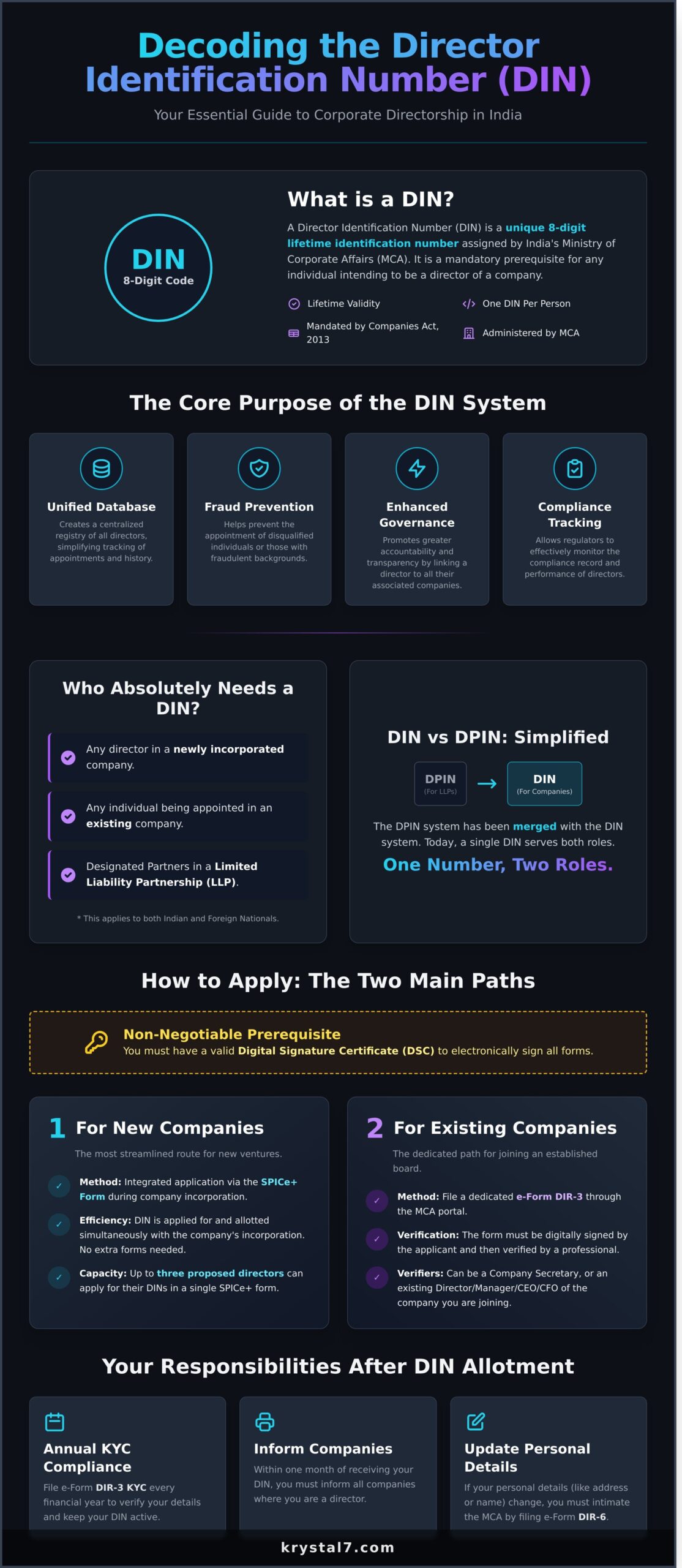
A Director Identification Number (DIN) is a unique 8-digit number assigned for life to any individual intending to become a director of a company in India. The simple answer to what is a director identification number din is that it’s a mandatory prerequisite for holding a directorship, ensuring every director has a distinct, verifiable identity in the country’s corporate records.
Think of it like a PAN card, but exclusively for your role in corporate governance. This requirement is legally mandated under Section 153 of the Companies Act, 2013, and is administered by the Ministry of Corporate Affairs (MCA) to create a transparent and accountable corporate environment. Crucially, an individual can only ever be allotted one DIN, regardless of the number of directorships they hold across different companies.
The Core Purpose of the DIN System
The DIN system was introduced to bring Krystal-Clear transparency to corporate leadership. Its primary objectives are to streamline governance and protect stakeholder interests by:
- Creating a Unified Database: It establishes a comprehensive, centralized database of all directors, making it easy to track their appointments and history.
- Preventing Fraud: It helps prevent the appointment of individuals with fraudulent backgrounds or those who have been disqualified from holding directorships under the law.
- Enhancing Corporate Governance: By linking an individual to all their associated companies, the DIN system promotes greater accountability and transparency.
- Tracking Compliance: It allows regulators to effectively monitor the compliance record and performance of directors across their entire corporate portfolio.
Who Absolutely Needs a DIN in India?
Navigating compliance can feel complex, but understanding who needs a DIN is straightforward. It is an absolute must-have for:
- Any individual intending to become a director in a newly incorporated company.
- Any individual being appointed as a director in an existing company.
- Designated Partners in a Limited Liability Partnership (LLP).
This rule applies universally, whether you are an Indian national or a foreign national looking to take on a leadership role in an Indian company.
DIN vs. DPIN: Is There a Difference?
You may have previously heard of a DPIN (Designated Partner Identification Number). Historically, LLPs required a DPIN while companies required a DIN. To simplify this process, the MCA has integrated the two systems. Today, the DIN you obtain serves both purposes. This means a single identification number allows you to act as a director in a company and a designated partner in an LLP, removing unnecessary red tape and bringing clarity to your compliance journey.
How to Apply for a Director Identification Number: The Two Main Paths
Securing your Director Identification Number is a foundational step in your corporate journey, but the process can seem complex. At its core, the application method depends on a simple question: are you becoming a director in a brand-new company or an existing one? Answering this determines your path. Understanding how to apply is the practical answer to the question, what is a director identification number din?
Before you begin either process, there is one non-negotiable prerequisite: you must have a valid Digital Signature Certificate (DSC). This is used to electronically sign the forms, ensuring their authenticity. Regardless of the path, you will also need to provide basic personal information, including your full name, father’s name, date of birth, and address.
Path 1: For New Companies (Integrated SPICe+ Form)
This is the most common and streamlined route for entrepreneurs launching a new venture. When you incorporate a new company using the integrated SPICe+ (Simplified Proforma for Incorporating Company Electronically Plus) form, the DIN application is built directly into the process. This seamless integration allows up to three proposed directors to apply for and be allotted their DINs simultaneously with the company’s incorporation, removing extra steps and paperwork.
Path 2: For Existing Companies (E-Form DIR-3)
If you are joining the board of an established, already-incorporated company, your path involves a dedicated form. You must file the e-Form DIR-3 through the Ministry of Corporate Affairs (MCA) portal. This process requires careful attention to detail, as the form must be digitally signed by you and then verified by a Company Secretary in full-time practice or by an existing Director, Manager, CEO, or CFO of the company you are joining. For a deeper look into the specifics, a guide on How to Apply for a DIN and Stay Compliant can provide further clarity on post-allotment responsibilities.
Essential Documents for a DIN Application
To ensure a smooth, hassle-free application, gathering the right documents beforehand is essential. Our experts have prepared this clear checklist to eliminate any guesswork from the process:
- Identity Proof: A self-attested copy of your PAN card is mandatory for all Indian nationals.
- Identity Proof (Foreign Nationals): A self-attested copy of your passport is mandatory for all foreign nationals applying for a DIN.
- Address Proof: A self-attested copy of a recent document like an Aadhaar card, driver’s license, utility bill (electricity or telephone), or a bank statement.
- Photograph: A recent passport-sized photograph in .JPG format.
Your Responsibilities After DIN Allotment: Staying Compliant
Securing your Director Identification Number is a crucial first step in your journey as a company director. However, the responsibilities don’t end there. To maintain your status and ensure your company remains in good standing, you must adhere to a set of ongoing compliance requirements. Understanding these obligations is just as important as knowing what is a director identification number din in the first place.
Staying proactive with these simple but mandatory tasks is the key to avoiding unnecessary penalties and ensuring you have the freedom to focus on leading your business forward.
Annual KYC Verification: The Mandatory DIR-3 KYC Form
Every director with an allotted DIN must complete an annual Know Your Customer (KYC) verification with the Ministry of Corporate Affairs (MCA). This process confirms that your personal details on record, such as your address and contact information, are current and accurate.
- Annual Deadline: This must be completed on or before 30th September of every financial year.
- Filing Methods: If your details have not changed, you can complete a simple web-based verification. If there are any changes, you must file the e-form DIR-3 KYC.
- Consequences of Non-Filing: Failure to meet the deadline results in your DIN being deactivated and a penalty of ₹5,000 once you file for reactivation.
Updating Your Personal Details with Form DIR-6
Life changes, and when it does, your official records must reflect it. As a director, you are legally obligated to report any changes to the personal information you submitted during your initial DIN application. This includes updates to your:
- Name (e.g., due to marriage)
- Residential Address
- Nationality
- Contact details (email or phone number)
You must file Form DIR-6 within 30 days of the change, attaching certified supporting documents as proof. This ensures the MCA’s database remains a reliable source of director information.
Informing Companies About Your DIN
Transparency is a cornerstone of corporate governance. Once your DIN is allotted, you have a duty to inform every company in which you are a director. The company, in turn, has a corresponding responsibility to report your DIN to the Registrar of Companies (ROC). This simple, two-step process ensures a clear and official link between you and the companies you serve, reinforcing the accountability that the DIN system was designed to create.
Navigating these compliance steps can feel like a distraction from your core business goals. For Krystal-Clear guidance and support with all your director compliance needs, our team of experts at Krystal7 is here to help you stay compliant, effortlessly.
Common DIN Issues and How to Resolve Them
Navigating the corporate compliance landscape can feel complex, but understanding common issues is the first step toward clarity. Many directors encounter challenges with their DIN, but most have straightforward solutions. This section addresses frequent pain points, providing a clear path forward and helping you maintain impeccable compliance with confidence.
My DIN is ‘Deactivated due to Non-filing of DIR-3 KYC’. What Now?
Receiving a notification that your DIN is deactivated can be unsettling, but the resolution is a well-defined process. This status typically arises from failing to complete the annual DIR-3 KYC verification. To restore your DIN to ‘Active’ status, simply follow these steps:
- Step 1: Pay the Late Filing Fee. A statutory fee (currently ₹5,000) must be paid on the Ministry of Corporate Affairs (MCA) portal for the delayed filing.
- Step 2: File the Overdue DIR-3 KYC Form. Complete and submit the e-Form DIR-3 KYC with the required details and attestations.
- Step 3: Wait for Reactivation. Once the form and fee are processed successfully, the MCA will update your DIN status back to ‘Active’.
Penalties for DIN-Related Non-Compliance
The Companies Act, 2013, enforces strict rules to ensure the integrity of the director identification system. Non-compliance can lead to significant financial penalties and legal complications. Key violations include failing to obtain a DIN, possessing multiple DINs, or not intimating your DIN to your company. Understanding what is a director identification number din is the first step, but maintaining compliance is crucial to avoid penalties that can include hefty fines and even imprisonment. Avoid penalties with Krystal7’s expert compliance services.
Surrendering or Cancelling a DIN
A DIN is a unique, lifetime identity, and it can only be surrendered under very limited and specific circumstances. An application to surrender a DIN is generally only considered if:
- A duplicate DIN was mistakenly allotted to the same individual.
- The DIN was obtained but never used for an appointment as a director in any company.
- The holder of the DIN has passed away.
It is critical to understand that an individual who is currently, or has ever been, a director of a company cannot surrender their DIN. If your situation is complex, seeking professional advice ensures the process is handled correctly and in line with statutory requirements.
Your Path to Directorship: Securing Your DIN with Confidence
Navigating the corporate landscape begins with understanding the fundamentals. As we’ve explored, a Director Identification Number is not just a regulatory requirement; it’s your official entry into corporate governance. The key takeaways are clear: securing a DIN is mandatory for every director, the application process requires precision, and ongoing compliance is essential for maintaining good standing. Grasping what is a director identification number din is the foundational step in your journey as a corporate leader.
Why navigate this crucial first step alone? Eliminate the guesswork and potential for costly errors. Let our team of seasoned experts provide the clarity you deserve. With our chartered expertise in company law, a streamlined and transparent compliance process, and dedicated advisors to guide you, your business will be built on a solid foundation from day one. We ensure every detail is handled meticulously, so you can lead with confidence.
Start your company with clarity. Get expert help with DIN and incorporation from Krystal7. Let us handle the complexities, giving you the freedom to focus on what truly matters: building your business vision.
Frequently Asked Questions About Director Identification Numbers (DIN)
How long does it take to get a DIN?
The DIN application process is commendably efficient. Once the e-Form DIR-3 is submitted with all necessary documents correctly attached and digitally signed, the Director Identification Number is typically generated and approved within just 1 to 3 business days. This streamlined timeline ensures you can move forward with your directorship responsibilities without unnecessary delays. A complete and accurate application is key to avoiding any hold-ups in this statutory process.
What is the government fee for a DIN application?
For complete transparency, the statutory government fee for filing the DIN application (e-Form DIR-3) is a one-time payment of ₹500. This fee is paid directly to the Ministry of Corporate Affairs (MCA) at the time of submission. This straightforward, one-time cost ensures there are no financial surprises, providing you with a clear and predictable path to obtaining your essential director credentials and maintaining compliance.
Is the Director Identification Number valid for life?
Yes, absolutely. A Director Identification Number is a unique identifier allotted to an individual for life. It does not expire and does not require any renewal fees or procedures. This lifetime validity simplifies compliance, as you will use the same DIN for all directorships you may hold in various companies throughout your career. Understanding what is a director identification number din means recognizing it’s a permanent part of your corporate identity.
Can a foreign national apply for and get a DIN in India?
Yes, foreign nationals who are appointed or wish to be appointed as directors in an Indian company can and must apply for a DIN. The application process is similar to that for Indian nationals but requires a copy of their passport as a primary proof of identity and address. All supporting documents for foreign nationals must be notarized and apostilled or consularised, ensuring they meet the MCA’s compliance standards for international applicants.
What happens if a person applies for more than one DIN?
It is a serious compliance violation to apply for or possess more than one Director Identification Number. The Companies Act, 2013 strictly prohibits it, and doing so can lead to significant penalties and legal consequences. If an individual mistakenly obtains a second DIN, they are legally required to surrender the duplicate number immediately to the appropriate authorities. Maintaining a single, unique DIN is crucial for good corporate governance.
Do I need a DIN to be a shareholder in a company?
No, a DIN is not required to simply be a shareholder in a company. The roles are distinct: shareholders own a part of the company, while directors are responsible for its management. The legal requirement for a Director Identification Number applies exclusively to individuals who are appointed as directors or designated partners in an LLP. You can invest and hold shares in any number of companies without ever needing a DIN.
Where can I check the status of my DIN application?
You can easily track the real-time status of your DIN application by visiting the official Ministry of Corporate Affairs (MCA) portal. Navigate to the ‘Enquire DIN Status’ service, which is typically found under the ‘MCA Services’ tab. By entering your application number (SRN), you will receive an instant update on whether your application is pending approval, has been approved, or requires resubmission, providing you with complete clarity.