
How to Choose the Right Business Structure in India: A Complete Guide
You have the vision, the drive, and the groundbreaking idea. But knowing how to choose the right business structure in India can feel like the first major hurdle. A wall of confusing acronyms appears-LLP, Private Limited, OPC-and the initial excitement is quickly replaced by critical questions. Are my personal assets at risk if the business fails? Will this choice limit my ability to get funding later? The fear of complex compliance and red tape can feel overwhelming, turning a clear dream into a complicated puzzle.
This is where clarity begins. Krystal7 Consultants brings you this comprehensive guide, designed to eliminate the guesswork and empower your decision. We provide crystal-clear explanations of each business structure, breaking down the critical differences in liability, taxation, and suitability for investment within the Indian context. You will gain the confidence to select the perfect legal foundation for your venture-one that protects your personal assets, aligns with your growth goals, and gives you the freedom to focus on what truly matters: building your business legacy.
Key Takeaways
- Your business structure is a foundational decision that directly impacts your personal liability, tax obligations, and ability to secure funding for your venture.
- Move beyond guesswork by using a strategic 5-point framework to evaluate your long-term vision, capital needs, and desired level of control.
- Learn how to choose the right business structure by comparing practical scenarios, matching different business models to their ideal legal framework.
- Avoid costly future complications by recognizing the common misconceptions that lead entrepreneurs to select a structure that hinders their growth.
Decoding the Main Business Structures in India
Choosing your business structure is the single most important foundational decision you’ll make. It’s more than just a legal formality; it’s the blueprint that dictates your personal liability, tax obligations, and your ability to raise capital for future growth. Understanding how to choose the right business structure is the first step towards building a resilient and scalable venture. India offers a spectrum of options, each designed for different business goals. Let’s bring clarity to the most common choices for today’s entrepreneurs.
Sole Proprietorship: The Simplest Start
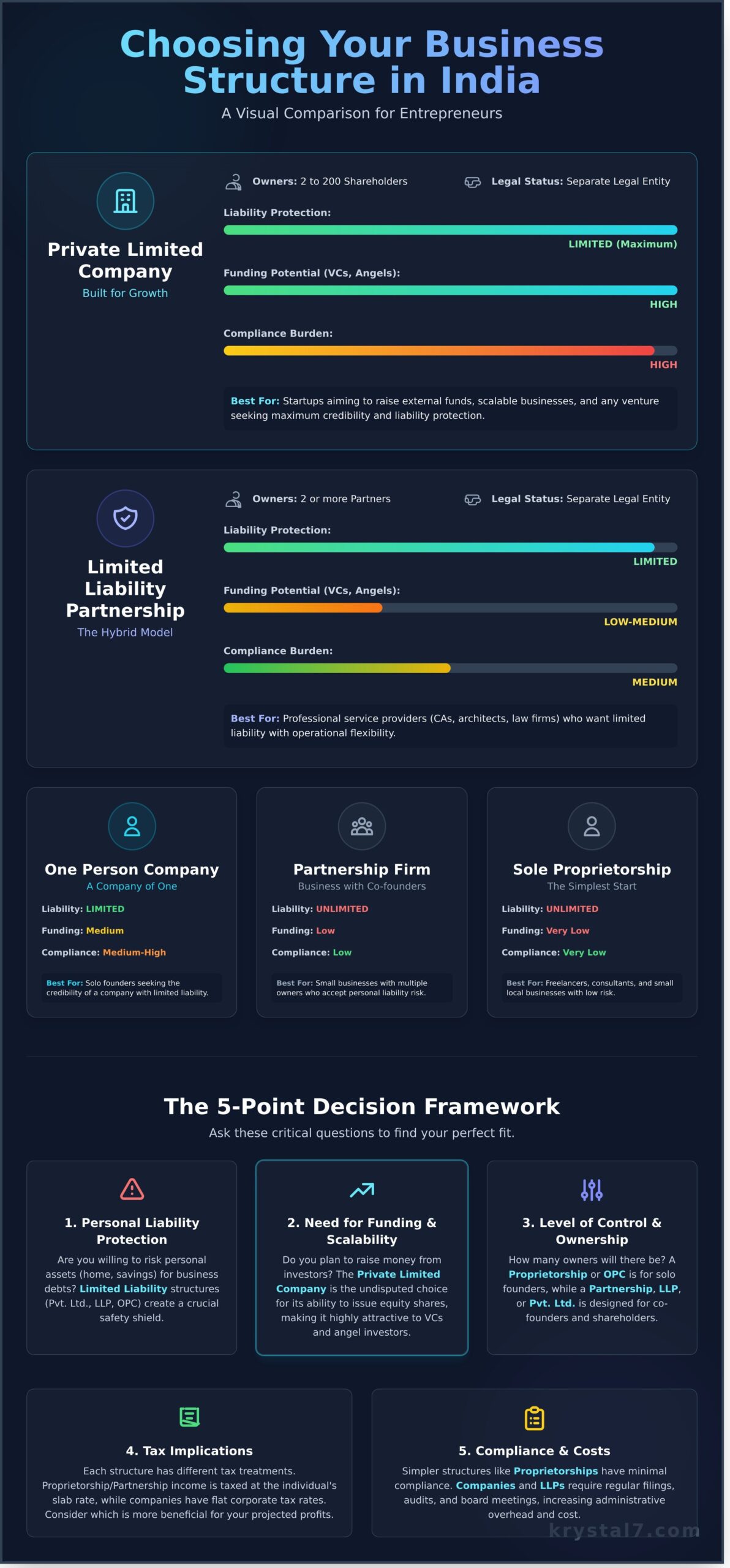
A Sole Proprietorship is an unincorporated business owned and operated by a single individual. There is no legal distinction between the owner and the business, making it the easiest and most cost-effective structure to start. However, this simplicity comes with a significant risk: unlimited personal liability. This means your personal assets are at risk to cover business debts, making it best suited for freelancers, consultants, and small, local service providers.
Partnership Firm: Business with Co-founders
When two or more individuals decide to co-own a business, they can form a Partnership Firm, governed by the Indian Partnership Act, 1932. Partners share profits, losses, and management duties according to a partnership deed. Like a proprietorship, this structure is relatively easy to set up but also carries the burden of unlimited personal liability for all partners, meaning each partner can be held responsible for the firm’s total debts.
Limited Liability Partnership (LLP): The Hybrid Model
An LLP offers the best of both worlds: the operational flexibility of a partnership and the limited liability protection of a company. In an LLP, partners’ personal assets are shielded from the business’s debts. This modern structure is a preferred choice for professional service providers like Chartered Accountants, architects, and law firms who want to collaborate without exposing their personal wealth to risk, all while navigating lower compliance requirements than a private company.
Private Limited Company (Pvt. Ltd.): Built for Growth
A Private Limited Company is a separate legal entity, distinct from its owners (shareholders). This structure offers complete protection of personal assets through limited liability and is the most credible and scalable option for businesses. Governed by the Companies Act, 2013, it is the preferred choice for startups aiming to raise external funding from angel investors or venture capitalists, though it involves higher statutory compliance.
One Person Company (OPC): A Company of One
The OPC is a unique structure that allows a single entrepreneur to run a corporate entity with limited liability protection-a key advantage over a sole proprietorship. It’s an excellent middle ground for solo founders who want the credibility of a company without the complexities of a multi-shareholder Pvt. Ltd. structure. Note that OPCs have certain restrictions on turnover and paid-up capital before they must convert to a private limited company.
Key Factors to Consider: A 5-Point Decision Framework
Choosing your company’s legal framework is far more than a formality-it’s a foundational strategic decision. This choice impacts everything from your personal liability to your ability to raise funds and your annual tax obligations. To bring Krystal-Clarity to this complex process, we’ve developed this simple framework. Answering these five key questions is the most effective way to learn how to choose the right business structure that aligns with both your current needs and your long-term vision.
1. Level of Personal Liability Protection
This is the most critical question: are you willing to risk personal assets, like your home or savings, for business debts? Structures with unlimited liability, such as a Sole Proprietorship or Partnership, blur the lines between your personal and business finances. In contrast, entities with limited liability (LLP, Private Limited Company, OPC) create a legal shield, protecting your personal assets from business risks. For most entrepreneurs, this protection is non-negotiable.
2. Need for Funding and Scalability
If your growth plan involves raising capital from angel investors or venture capitalists, your choice becomes much clearer. Investors overwhelmingly prefer the Private Limited Company structure because it allows for the straightforward issuance of shares (equity). This makes it simple to define ownership and transfer stakes. Alternative structures like LLPs and Partnerships are far less attractive for external equity funding, which can limit your venture’s scalability.
3. Tax Implications and Benefits
Each business structure is treated differently by tax authorities, directly impacting your bottom line. Income from Proprietorships and Partnerships is typically added to your personal income and taxed at individual slab rates. In contrast, a Private Limited Company or OPC is subject to a flat corporate tax rate. A detailed analysis with a tax expert is crucial to identify the most tax-efficient path for your specific business model and revenue projections.
4. Compliance Burden and Administrative Costs
How much time and administrative overhead can you realistically manage? A Sole Proprietorship offers the ultimate simplicity with minimal paperwork. An LLP requires moderate compliance, including annual filings. However, a Private Limited Company carries the highest compliance burden, demanding regular board meetings and statutory audits. While platforms like the National Single Window System have streamlined initial registration, the ongoing statutory duties remain a key differentiator.
5. Number of Owners and Management Structure
The number of founders and your desired management style are also key factors. Are you a solo visionary? A Sole Proprietorship or One Person Company (OPC) is designed specifically for you. If you’re starting with co-founders, a Partnership or LLP is a natural fit. For ventures that anticipate bringing on multiple shareholders or require a formal board of directors for governance, the Private Limited Company offers the most robust and flexible framework for growth.
Comparison at a Glance: Which Structure Fits Your Business?
Understanding the theory is one thing, but applying it to your unique vision is what brings true clarity. To remove the guesswork from the decision-making process, we’ve mapped common business scenarios to their ideal legal structures. This practical guide simplifies the complex question of how to choose the right business structure, helping you narrow down your options with confidence. Use this as a quick reference to find the path that best aligns with your strategic goals.
For the Solo Entrepreneur or Freelancer
As a solo founder, your primary choice is between maximum simplicity and robust liability protection. Your decision will set the foundation for your venture’s future.
- Choose a Sole Proprietorship for its unparalleled simplicity and low setup cost. This is the perfect starting point if you’re testing an idea and personal liability is not an immediate concern.
- Choose a One Person Company (OPC) when you want to protect your personal assets with limited liability and establish a formal corporate identity. An OPC is a powerful step up, signaling credibility and long-term vision.
For Co-founded Service Businesses
When two or more professionals collaborate, the structure must protect every partner while enabling smooth operations. The right choice here is critical for a healthy, lasting partnership.
- Choose a Partnership Firm for its straightforward setup and minimal compliance burden. It’s a traditional choice that works well when all partners have a high degree of mutual trust.
- Choose a Limited Liability Partnership (LLP) to safeguard all partners’ personal assets. The LLP is the modern, recommended choice for professional services as it combines the operational flexibility of a partnership with the vital liability protection of a company.
For Startups Aiming for High Growth and Funding
For ambitious ventures with plans for scaling, attracting investors, and building a world-class team, the choice is clear. The Private Limited Company (Pvt. Ltd.) is the undisputed structure for high-growth startups. It is the only framework that serious investors will consider, as it allows for a clean separation of ownership and management. This structure is essential for:
- Raising capital from venture capitalists and angel investors.
- Implementing Employee Stock Ownership Plans (ESOPs) to attract and retain top talent.
- Projecting an image of credibility and permanence to clients, partners, and financial institutions.
Common Mistakes to Avoid When Choosing Your Structure
The path to building a successful venture is paved with critical decisions, and your business structure is one of the most foundational. Making the right choice from the start provides clarity and saves you from future legal and financial headaches. When learning how to choose the right business structure, many entrepreneurs fall into predictable traps based on common misconceptions. Being aware of these pitfalls gives you an immediate advantage, allowing you to build your business on solid ground.
Mistake 1: Choosing Based on Cost Alone
A Sole Proprietorship is often the default choice for new entrepreneurs because it’s the cheapest and easiest to start. However, this initial saving can be deceptive. This structure offers zero liability protection, meaning your personal assets-your home, car, and savings-are at risk if the business incurs debt or faces legal action. It’s crucial to view the registration cost not as an expense, but as a vital investment in your security, credibility, and scalability. The right structure protects you and ultimately saves you money in the long run.
Mistake 2: Ignoring Future Fundraising Plans
Your legal structure must align with your business ambition. If your vision includes raising capital from angel investors or venture capitalists, starting as a Sole Proprietorship or even an LLP creates a significant roadblock. Investors require a structure that allows for clear equity distribution, which is why they almost exclusively fund Private Limited Companies. You will be forced to convert your structure later-a process that costs valuable time and money, and can delay your funding round. Align your foundation with your future from day one.
Mistake 3: Underestimating Compliance Requirements
Opting for a structure like a Private Limited Company brings immense benefits, but it also carries a commitment to statutory compliance. This includes mandatory annual filings, board meetings, and maintaining proper records for the Ministry of Corporate Affairs (MCA). Failing to comply can lead to heavy penalties and legal complications that distract you from your core mission. It’s essential to be realistic about your capacity to manage this administrative load. This is precisely where professional guidance becomes invaluable, ensuring seamless compliance so you have the freedom to focus on what you do best: growing your business.
Your Next Step: From Decision to Registration with Clarity
You have carefully weighed the options, considered your vision, and made a pivotal decision. The journey of learning how to choose the right business structure is complete. Now, it’s time to transform that choice into a legally recognized entity through registration. This crucial step involves specific documentation, name approvals, and legal filings with government bodies like the Ministry of Corporate Affairs (MCA).
While the path differs for a Sole Proprietorship versus a Private Limited Company, the objective remains the same: to establish a solid, compliant foundation for your venture. Getting this right from the start prevents future complications and sets the stage for seamless growth.
Preparing for the Registration Process
A streamlined registration begins with thorough preparation. Having your documents in order before you start can significantly accelerate the timeline and eliminate frustrating delays. This initial diligence is the first step toward operational excellence.
- Gather Key Documents: Ensure you have clear copies of your PAN card, Aadhaar card, and recent address proof (like a bank statement or utility bill) for all proposed directors or partners.
- Finalize Your Business Name: Think of a unique and memorable name for your business. It is essential to check its availability on the MCA portal to ensure it is not already taken by another company or LLP.
- Secure a Registered Office Address: For entities like a Private Limited Company or LLP, you must provide a registered office address. You will need proof, such as a utility bill and a No Objection Certificate (NOC) from the property owner.
Why Expert Guidance Gives You the ‘Freedom to Focus’
Navigating the complexities of the MCA portal, DSC applications, and statutory forms can be a daunting task, filled with legal jargon and procedural red tape. A single error in your application can lead to rejection, wasting valuable time and resources. This is where professional clarity makes all the difference.
An expert partner ensures your application is meticulously prepared and filed correctly the first time. We handle the statutory requirements, provide clear communication at every stage, and remove the guesswork from the process. This allows you to bypass the administrative hassle and channel your energy where it matters most: building your business. It’s not just about registration; it’s about gaining the Freedom to Focus on your vision.
Let us handle the complexities. Get started with your company registration.
Build Your Venture on a Foundation of Clarity
Choosing the right legal entity is the foundational pillar of your business journey in India. Mastering how to choose the right business structure is not just a legal formality-it is the first strategic step towards building a resilient and scalable enterprise. By carefully evaluating your long-term vision against the practical realities of liability, compliance, and funding needs, you can avoid common pitfalls and set your venture up for sustainable growth.
The path from decision to registration can seem complex, but you do not have to navigate it alone. We transform complexity into clarity, ensuring your business is built correctly from day one. With our Chartered expertise for error-free registration, transparent pricing with no hidden costs, and dedicated advisors to guide you at every step, you gain the freedom to focus on your vision. Start your business with Krystal-Clear confidence. Explore our incorporation packages.
Your legacy starts now. Let’s build it together with confidence.
Frequently Asked Questions
Can I change my business structure later on?
Absolutely. As your business grows and your vision evolves, your initial structure may no longer be the best fit. You can convert a Sole Proprietorship to a Private Limited Company, or an LLP to a PLC, to accommodate new funding or liability needs. This strategic process involves specific legal and compliance steps, but it provides the crucial flexibility to adapt your business for future success. We ensure this transition is seamless and aligned with your goals.
What is the cheapest business structure to set up in India?
The Sole Proprietorship is the most cost-effective and simplest business structure to establish in India, with minimal registration formalities and lower compliance costs. However, it’s vital to look beyond the initial setup price. This structure offers no liability protection, mixing personal and business assets. For long-term growth and security, other options might be more suitable despite a higher initial investment. We provide clarity on the total cost of ownership for each structure.
Do I need a physical office to register a company?
No, a dedicated commercial office is not a mandatory requirement to register your company. You can use a residential address as your registered office, provided you have a No Objection Certificate (NOC) from the property owner. This offers great flexibility for startups and remote businesses. This streamlined approach allows you to establish your legal entity without the immediate overhead of a physical office, giving you the freedom to focus on building your venture from day one.
How long does it take to register a Private Limited Company in India?
Typically, registering a Private Limited Company in India can be completed within 7 to 15 working days. This timeline depends on the swift approval of your proposed company name and the processing times at the Ministry of Corporate Affairs (MCA). With all documents in order and a streamlined process, our team works efficiently to navigate the formalities, ensuring your company is incorporated without unnecessary delays so you can start your operations and pursue your vision.
What is the difference between a Director and a Shareholder?
Gaining clarity on these roles is key. A Director is appointed to manage the company’s day-to-day operations and make strategic decisions on its behalf. In short, they run the company. A Shareholder, on the other hand, is an owner of the company who holds shares (equity). Their primary role involves voting on major corporate decisions and appointing directors. It is common in private companies for an individual to be both a director and a shareholder.
Is an LLP better than a Private Limited Company?
The “better” choice depends entirely on your business goals. A Limited Liability Partnership (LLP) offers operational flexibility and lower compliance, making it ideal for professional services firms. A Private Limited Company (PLC) is preferred for businesses aiming to raise equity funding, offer employee stock options, and build a scalable venture. Understanding how to choose the right business structure means aligning the entity’s features with your long-term ambitions for growth and investment.