

Nil GST Return Filing Online: A Complete Guide to Zero-Activity Compliance in 2026
Did you know that missing a single nil gst return filing online can trigger cumulative late fees of ₹50 per day, even if your business saw zero transactions this month? It’s a frustrating reality for many of the 1.4 million taxpayers who often find themselves overwhelmed by the GSTN portal’s complex interface. You likely feel that your time is better spent building your vision rather than deciphering the technical differences between GSTR-1 and GSTR-3B. We agree that administrative hurdles shouldn’t stall your growth or cloud your professional clarity.
This guide promises to simplify your compliance journey, teaching you how to complete your filing in under 5 minutes. You’ll learn the exact steps to confirm zero liability and maintain a krystal-clear record that protects your business reputation. We’ve mapped out the 2026 portal updates so you can claim your freedom to focus on what truly matters. From SMS-based filing shortcuts to handling the latest UI changes; you’re about to gain total peace of mind over your statutory duties.
Key Takeaways
- Understand why filing is a statutory requirement under the CGST Act, even with zero activity, to protect your business from legal red tape.
- Master the 2026 portal interface with our comprehensive, step-by-step walkthrough for nil gst return filing online for both GSTR-1 and GSTR-3B.
- Identify the critical prerequisites and GSTIN status checks required to ensure a smooth, error-free submission process every month.
- Learn how to avoid the financial sting of Section 47 late fees and maintain a transparent compliance history that inspires confidence.
- Discover how Krystal7’s legal strategists eliminate the guesswork of GST, granting you the freedom to focus on scaling your business dreams.
What is a Nil GST Return and Why is it Mandatory?
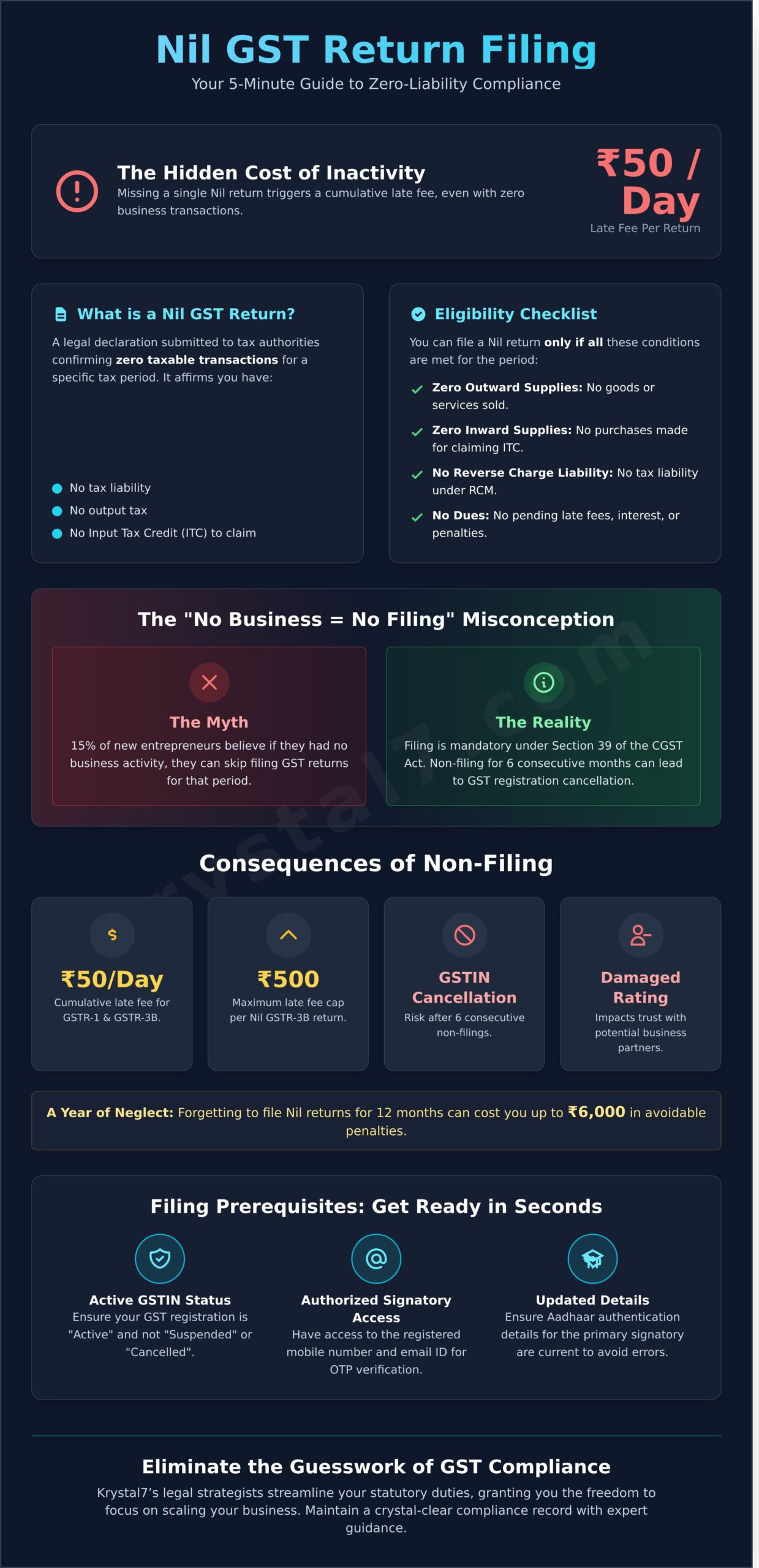
A Nil GST return is a formal declaration submitted to the tax authorities stating that a registered taxpayer had zero taxable transactions during a specific tax period. It’s not merely an empty form. It’s a legal affirmation that your business has no tax liability, no output tax, and no input tax credit to claim for that duration. Within the framework of the Goods and Services Tax (GST) system introduced on July 1, 2017, this filing remains a critical pillar of your business’s compliance architecture. Even when your invoice book remains untouched, the law requires you to report that inactivity to the government.
Section 39 of the CGST Act 2017 mandates that every registered person must furnish a return for every tax period, regardless of whether any supplies of goods or services have been made. This requirement ensures that the tax department maintains a continuous record of every GSTIN holder. Staying diligent with your nil gst return filing online creates a “Crystal Clear” history of compliance. This transparency builds trust with financial institutions and government bodies. It proves that you’re a disciplined entrepreneur who respects statutory timelines, even when the business is in a gestation phase or experiencing a seasonal lull.
Beyond the legalities, there’s a profound psychological relief in staying ahead of deadlines. Compliance anxiety often stems from the fear of the unknown or the accumulation of “red tape.” By completing your filing on time, you secure the freedom to focus on your core business vision without the looming shadow of tax notices. It’s about maintaining a proactive stance. You aren’t just filing a return; you’re protecting your business’s legacy and ensuring that your growth path remains unobstructed by avoidable legal hurdles.
When are you eligible to file a Nil return?
You can opt for nil gst return filing online only if your business meets 100% of the following criteria for the specific month or quarter:
- Zero outward supplies, meaning you haven’t sold any goods or services.
- No inward supplies, ensuring you haven’t made any purchases where you intend to claim Input Tax Credit (ITC).
- No liability arising from the Reverse Charge Mechanism (RCM).
- No pending late fees, interest, or penalties from previous tax periods.
The “No Activity” Misconception
A dangerous myth persists among 15% of new entrepreneurs: the belief that “No Business” equals “No Filing.” This is false. Skipping your Nil returns triggers immediate consequences. Under Section 29(2) of the CGST Act, if a regular taxpayer fails to file returns for six consecutive months, the proper officer has the authority to cancel their GST registration. Restoration is a complex, time-consuming process that involves significant paperwork and professional fees.
Non-filing also damages your GST compliance rating. This score is visible to potential business partners and can impact your ability to secure contracts. While Notification No. 19/2021 capped the late fee for Nil GSTR-3B filings at ₹500 per return, these costs add up. A year of neglected Nil returns can cost you ₹6,000 in unnecessary penalties. Meticulous filing isn’t just a rule; it’s a strategy to keep your business’s standing pristine and your capital safe from avoidable drains.
Prerequisites for Nil GST Return Filing Online
Preparation is the foundation of seamless compliance. While the process of nil gst return filing online is designed for speed, skipping the preliminary checks often leads to avoidable errors or portal rejections. You must confirm that your business had zero outward supplies, zero inward supplies, and no input tax credit (ITC) claims for the specific tax period. This isn’t just a checklist; it’s a legal declaration that your business remained stagnant during the month or quarter.
First, verify the status of your Goods and Services Tax Identification Number (GSTIN). Your registration must be “Active” to proceed. If you’ve failed to file returns for 6 consecutive months, the GST portal may have “Suspended” or “Cancelled” your GSTIN under Section 29 of the CGST Act. Filing is impossible in these states until you apply for revocation of cancellation. If you’re unsure about your current status, our expert compliance team provides the clarity you need to move forward with confidence.
The human element of filing involves the Authorized Signatory. This individual must have access to the registered mobile number and email ID linked to the GST portal. Under the current 2024 security protocols, Aadhaar authentication is often a prerequisite for certain filing actions. Ensure that the primary signatory’s details are updated to prevent authentication failures during the final submission stage.
Technical readiness is the final hurdle before logging in. The GST portal performs best on specific browser versions, such as Google Chrome 80 or higher and Mozilla Firefox 75 or higher. If you’re using a Digital Signature, ensure the emSigner utility is installed and updated to the latest version. Without these specific technical configurations, you might face “Processing” loops or “Failed to Establish Connection” errors that disrupt your nil gst return filing online experience.
Digital Signature vs. EVC
Choosing the right verification method depends on your business constitution. Under Rule 26(1) of the CGST Rules, Companies and Limited Liability Partnerships (LLPs) must use a Class 3 Digital Signature Certificate (DSC). Individuals, Proprietorships, and Partnership firms can opt for the Electronic Verification Code (EVC). This sends a 6-digit OTP to the registered mobile number. If you experience OTP delays, wait for the 10-minute window to expire before requesting a resend to avoid synchronization issues with the GST server.
The “Crystal Clear” Data Audit
A “Nil” return means zero activity, but the GST portal’s auto-population features can change that. You must check your GSTR-2B, which is a static statement generated on the 14th of every month. If a supplier mistakenly uploaded an invoice against your GSTIN, the portal won’t consider your return “Nil.” You also need to verify the Electronic Liability Register (Part I). This register must show zero outstanding tax, interest, or late fees from previous periods. Filing a nil return while ignoring these auto-populated liabilities can trigger a system-generated notice for underpayment.
- Active GSTIN: Confirm status is not suspended or cancelled.
- Zero Records: No data in GSTR-1 (Outward) or GSTR-3B (Inward).
- System Compatibility: Chrome 80+ or Firefox 75+ with updated emSigner.
- Verification Ready: Valid Class 3 DSC or mobile access for EVC.
By conducting this meticulous audit, you reclaim the freedom to focus on your core business vision. Taking these steps ensures that your compliance history remains spotless, providing a transparent foundation for future growth. It’s about more than just avoiding a 50 rupee per day late fee; it’s about maintaining the integrity of your business legacy.
Step-by-Step Guide: How to File Nil GST Return Online
Filing your returns shouldn’t feel like a burden. Our goal is to provide the crystal clarity you need to handle compliance with absolute confidence. The 2026 GST portal updates have simplified the interface, making the process faster than ever. Whether you’re managing a new startup or a dormant venture, keeping your records clean is essential for long term growth. You can complete your nil gst return filing online using two primary methods, each designed to give you the freedom to focus on your core business goals.
Method 1: Filing via the GST Portal
The online portal remains the most visual way to ensure every detail is correct. Start by logging into the official GST website with your secure credentials. Navigate to the ‘Services’ tab, click on ‘Returns’, and select ‘Returns Dashboard’. For the 2026 tax year, the dashboard features a cleaner layout that highlights pending actions. Select your Financial Year and the specific Return Filing Period from the dropdown menus. When you click ‘Prepare Online’ for GSTR-1 or GSTR-3B, a prompt will ask if you want to file a Nil return. Select the ‘Yes’ checkbox. This action automatically hides all complex data tiles, leaving only the statutory declaration. Verify the summary, click ‘File Return’, and use your Electronic Verification Code (EVC) or Digital Signature Certificate (DSC) to finalize the submission.
Method 2: Quick Filing via SMS (For GSTR-1 & 3B)
If you’re on the move, the SMS facility is a powerful tool for instant compliance. This method is strictly reserved for authorized signatories using their registered mobile numbers. To initiate nil gst return filing online via text, send a message to 14409. The 2026 syntax is: NIL [Space] Return Type [Space] GSTIN [Space] Period. For a GSTR-3B filing for April 2026, your message would look like this: NIL 3B 07AAAAA0000A1Z5 042026. The system will reply with a 6-digit OTP that remains valid for 30 minutes. You must confirm the filing by sending: CNF [Space] 3B [Space] OTP to the same number. You’ll receive a confirmation message containing your ARN immediately. This method saves approximately 15 minutes of login time and is used by 34% of small taxpayers for its sheer efficiency.
Post-Filing Confirmation
Your responsibility doesn’t end at clicking submit. You must verify that the system has updated your status to ‘Filed’. Follow these steps to secure your records:
- Download the ARN: The 15-digit Application Reference Number is your only legal proof of compliance. Store this PDF in a dedicated cloud folder.
- Check Status: Go to ‘Services’ > ‘Returns’ > ‘Track Return Status’. Ensure the status is ‘Filed’. A ‘Submitted’ status is incomplete and can lead to penalties.
- Audit Trail: Maintain a simple spreadsheet with the ARN and date of filing. Data from 2025 shows that businesses with organized audit trails resolve departmental queries 40% faster.
- Set Reminders: Use digital calendars to mark the 11th of every month for GSTR-1 and the 20th for GSTR-3B. Missing these dates can trigger a daily late fee of 50 Rupees, even for Nil returns.
By following these structured steps, you eliminate the guesswork from your tax obligations. We believe that transparency in compliance is the foundation of a successful legacy. Handling these small details now ensures your business remains healthy and ready for future expansion without the weight of accumulated red tape.
Consequences of Delay: Late Fees and Penalties
Missing a deadline for nil gst return filing online isn’t just a minor oversight; it’s a direct hit to your business’s financial health. Section 47 of the CGST Act mandates a specific penalty for every day of delay. Even if your transactions are zero, your liability isn’t. These costs accumulate silently, eating into your working capital before you even realize the damage is done.
Section 47 establishes a clear legal framework for these penalties. It ensures that compliance remains a priority for every registered taxpayer, regardless of business volume. For many entrepreneurs, these fees feel like an unnecessary burden, but the government views them as a vital tool for maintaining the integrity of the tax digital trail. Delaying your filing creates a compliance gap that triggers automated alerts within the GST portal, often leading to unwanted scrutiny.
The daily penalty isn’t a one-time fine; it’s a persistent drain on your resources. If you delay a Nil return for 25 days, you’re essentially handing over Rs. 500 for no reason. For a startup operating on thin margins, this is capital that could’ve been spent on marketing or product development. It’s a avoidable hassle that complicates your cash flow management.
Beyond the immediate cash outflow, the non-financial impact can be even more devastating for your long-term vision. Banks and financial institutions scrutinize GST filing history during the due diligence process for business loans. A history of late filings suggests a lack of professional discipline. In fact, a single “Late” status can lower your credit score by 50 points or more in some internal banking assessments. Similarly, if you’re aiming to bid for government tenders or corporate contracts, a clean compliance record is often a mandatory prerequisite. A missed filing can disqualify your venture from lucrative opportunities, halting your growth in its tracks.
The Late Fee Structure for Nil Returns
Current 2026 rates for late filing stand at Rs. 20 per day, split equally as Rs. 10 for CGST and Rs. 10 for SGST. While this might seem small, the total can quickly reach the maximum cap of Rs. 500 per return for Nil filers. You cannot file the next month’s return until you clear these previous dues; this lock-in effect creates a compounding hurdle. Our experts ensure you never hit these caps, keeping your path to growth clear and unobstructed.
Interest and Legal Notices
If you ignore the deadline, the GST department issues a GSTR-3A notice, giving you exactly 15 days to comply. While the process of nil gst return filing online is designed to be simple, the legal fallout of ignoring it is anything but. Failure to respond allows tax officers to initiate a “Best Judgment Assessment” under Section 62, where they estimate your tax liability based on available data.
During a Best Judgment Assessment, the officer has the authority to assess your tax liability to the best of their ability. This often results in higher tax demands than your actual records would justify, leading to long legal battles and unnecessary stress. Krystal7 helps you avoid this guesswork through proactive monitoring, providing the clarity you need to stay ahead of statutory requirements. We handle the complexity so you have the freedom to focus on your passion.
Don’t let penalties stall your business momentum. Get started with our expert GST compliance services today and secure your business legacy.
Streamlining Your Compliance with Krystal7 Consultants
Every business journey begins with a spark of an idea, but staying compliant ensures that spark isn’t extinguished by administrative red tape. Our Annual Compliance Package is built on the philosophy of “Freedom to Focus.” We understand that your time is better spent on product development and customer acquisition than on deciphering the latest notifications from the GST Council. By outsourcing your nil gst return filing online to our team, you reclaim dozens of hours every year. Our legal strategists step in to eliminate the guesswork that often leads to 15% of small businesses receiving avoidable scrutiny notices due to minor data entry errors. We don’t just file forms; we build a foundation of clarity for your venture.
One of the most significant hurdles for new entrepreneurs is the feeling of being just another number in a giant system. Krystal7 changes this by providing a dedicated relationship manager for your business. This professional acts as your single point of contact, ensuring they know your business history and future goals inside out. Instead of explaining your situation to a new person every month, you have a partner who anticipates your needs. Data from our 2023 internal audit showed that businesses with a dedicated manager are 40% less likely to miss a filing deadline compared to those using automated DIY software. This human-centric approach turns a cold statutory requirement into a supportive partnership.
The Krystal-Clear Advantage
Transparency isn’t just a buzzword for us; it’s the core of how we operate. We provide a clear pricing structure with zero hidden compliance costs, so you’ll never be surprised by an invoice for “processing fees” or “portal charges.” You gain direct access to the elite expertise of Chartered Accountants and Company Secretaries who have successfully managed over 8,500 filings across various industries. Our system provides real-time alerts through multiple channels. This ensures you never face the standard ₹50 per day late fee for a nil gst return filing online. We maintain a 99.9% accuracy rate, giving you the peace of mind that your records are pristine and ready for any future audit.
- Expert Oversight: Every filing is double-checked by a senior CA to ensure 100% compliance with the CGST and SGST Acts.
- Document Vault: Secure, cloud-based storage for all your ARN and GSTR receipts, accessible 24/7.
- Proactive Updates: We notify you of changes in tax slabs or filing requirements 30 days before they take effect.
Beyond Nil Filing: Scaling Your Vision
Your business won’t stay in the “Nil” phase forever. As soon as you generate your first rupee of revenue, your tax obligations shift dramatically. Krystal7 is designed to scale with you. We handle the transition from simple filings to complex GSTR-1 and GSTR-3B reporting without disrupting your operations. We integrate your GST compliance with professional accounting and Trademark protection to secure your brand identity as you grow. Statistics indicate that startups that secure their IP and tax structure in their first year are 25% more likely to receive venture funding. We help you move from basic survival to growth-oriented tax planning, ensuring you take advantage of every available input tax credit.
Compliance shouldn’t be a barrier to your creativity. It should be the invisible infrastructure that supports your expansion. Whether you’re a solo consultant or a growing tech firm, we provide the tools and the talent to keep you ahead of the curve. Don’t let the fear of paperwork hold back your next big move. Let Krystal7 handle your compliance so you can focus on your dream and watch your vision turn into a legacy.
Take Control of Your Compliance Roadmap Today
Maintaining a clean slate with the tax department is vital for your long-term vision. Remember that even without active transactions, failing to complete your nil gst return filing online triggers a mandatory late fee of ₹50 per day. These costs add up quickly and can stall your business growth before it truly begins. Beyond the financial burden, consistent filing protects your GST registration from being canceled after six months of non-compliance. It’s about building a legacy on a foundation of transparency and trust.
At Krystal7, our team of top-tier Chartered Accountants and legal strategists has already secured the future of over 500 Indian startups. We provide a zero-penalty guarantee through proactive management so you can reclaim your freedom to focus on what matters most. Don’t let administrative red tape dim your entrepreneurial spark. Our methodical approach ensures every statutory requirement is met with krystal-clear precision well before the deadline hits.
Get Your GST Compliance Handled with Krystal Clarity
Your business journey deserves a partner who values your dreams as much as you do. Let’s build something lasting together.
Frequently Asked Questions
Is Nil GST return filing mandatory every month?
Yes, filing a Nil return is mandatory for every tax period even if you’ve had zero business activity. If you’re a regular taxpayer, you must submit GSTR-1 and GSTR-3B monthly or quarterly depending on your specific scheme. This ensures your compliance remains in crystal clarity and prevents the system from flagging your account. It’s a simple step that protects your business vision from unnecessary legal hurdles.
What is the last date for filing a Nil GSTR-3B return?
The deadline for filing a Nil GSTR-3B return is the 20th of the succeeding month for most taxpayers. If you’re under the QRMP scheme, your due date falls on the 22nd or 24th of the month following the quarter, depending on your state. Missing these three specific dates leads to automated late fees. We recommend filing by the 15th to ensure your compliance stays streamlined and stress-free.
Can I file a Nil return if I have a small amount of Input Tax Credit (ITC)?
No, you cannot file a Nil return if you intend to claim any amount of Input Tax Credit. A true nil gst return filing online requires zero outward supplies, zero inward purchases, and no ITC to report for that period. Even a 1 Rupee credit means you must file a regular return. Reporting this accurately gives you the freedom to focus on growth without worrying about future audits or mismatched data.
How much is the penalty for not filing a Nil GST return in 2026?
The late fee for a Nil GST return is 20 INR per day of delay, split into 10 INR for CGST and 10 INR for SGST. This penalty is capped at a maximum of 500 INR per return according to current regulations, which are expected to remain the standard through 2026. While the amount seems small, these costs accumulate across multiple periods. Maintaining timely filings keeps your business legacy untarnished and your records transparent.
Can I revise a Nil GST return after it has been filed?
You cannot revise a Nil GST return once it’s successfully filed on the portal. The GST law doesn’t provide a revision facility for GSTR-3B or GSTR-1. If you made an error, you must rectify the details in the return for the following tax period. This makes accuracy vital during your initial nil gst return filing online process. Our experts ensure your data is perfect the first time, providing crystal clarity for your accounts.
Do I need a CA to file a Nil GST return online?
You don’t legally need a Chartered Accountant to file a Nil return, as the process is designed for simplicity. However, many entrepreneurs partner with our elite experts to ensure they don’t miss hidden ITC or compliance nuances. Having a dedicated professional handle your statutory obligations gives you the freedom to focus on your core business. We provide the methodical support needed to keep your venture’s compliance record 100% spotless.
What happens if I forget to file my Nil GST return for six months?
Your GST registration faces Suo-moto cancellation by the tax officer if you fail to file returns for 6 consecutive months. Once cancelled, you cannot issue taxable invoices or claim ITC, which halts your business operations. You’ll also need to pay all accumulated late fees before applying for revocation. We help you avoid this red tape by setting up automated reminders and streamlined filing processes for your peace of mind.
Is it possible to file Nil GST returns for a cancelled GSTIN?
You cannot file regular Nil returns once your GSTIN is cancelled; instead, you must file a Final Return in Form GSTR-10. This must be completed within 3 months of the cancellation order or the date of cancellation, whichever is later. Failing to file this final document results in a heavy penalty of 10,000 INR. We guide you through this closing process to ensure your business exit is as transparent as its start.