
Trademark Search Online India: The Comprehensive 2026 Guide to Brand Protection
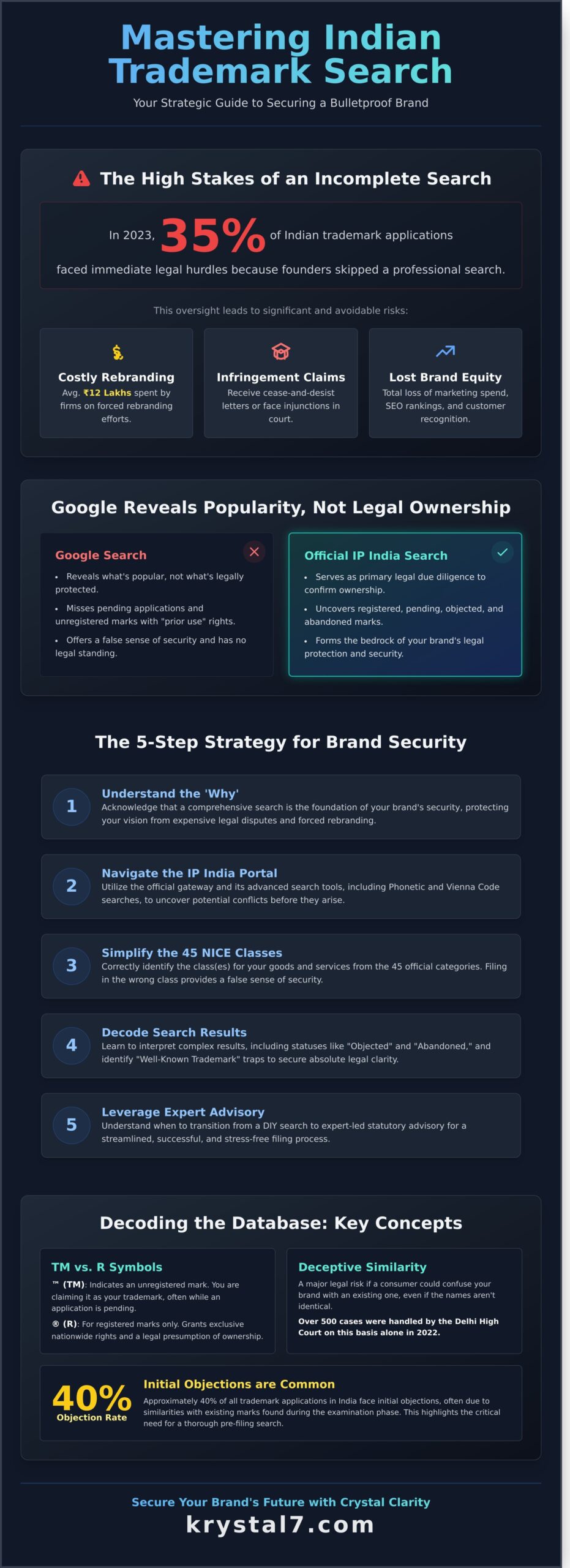
Did you know that 35% of Indian trademark applications filed in 2023 faced immediate legal hurdles because the owners skipped a professional trademark search online india? It’s incredibly frustrating to invest your heart into a brand name only to be met with a rejection notice or a costly infringement claim. You want to build a legacy, not get trapped in a cycle of administrative guesswork and confusion over the 45 different trademark classes.
We understand that the pressure to launch quickly often leads to overlooked details, but your business dream deserves a foundation of krystal-clear transparency. This guide empowers you to master the Indian trademark database. You’ll identify a unique brand name with absolute legal clarity before you spend a single rupee on filing fees. We’re going to break down the complexities of the search process and provide a methodical 5-step strategy to ensure your 2026 brand protection is bulletproof, giving you the freedom to focus on what you do best.
Key Takeaways
- Understand why a comprehensive search is the bedrock of your brand’s security, protecting your vision from expensive legal disputes and forced rebranding.
- Navigate the official IP India gateway using advanced search criteria like Phonetic and Vienna Codes to uncover potential conflicts before they arise.
- Simplify the 45 NICE classes to ensure your application is filed accurately, providing the clarity you need to build a lasting business legacy.
- Learn to decode complex database results and “Well-Known Trademark” traps when conducting a trademark search online india to secure absolute legal clarity.
- Gain the freedom to focus on your growth by understanding when to transition from a DIY search to expert-led statutory advisory for a streamlined filing process.
Why an Online Trademark Search is the Foundation of Your Indian Business
Your brand name is the heartbeat of your venture. Launching without a comprehensive trademark search online india is a gamble that high-growth startups simply cannot afford. This process serves as your primary legal due diligence. It ensures your chosen identity doesn’t collide with existing rights. The Indian trademark law, specifically the Trade Marks Act 1999, provides the rigid framework for this protection. It’s the difference between building a lasting legacy and receiving a cease-and-desist letter three months after your launch. We believe every business dream deserves a foundation of “Crystal Clarity” before a single rupee is spent on marketing.
Skipping this step leads to staggering financial losses and unnecessary anxiety. Data from a 2023 industry report shows that mid-sized Indian firms spend an average of ₹12 lakhs on rebranding when legal conflicts arise. This figure includes replacing physical signage, reprinting packaging, and the total loss of digital SEO equity. Beyond the money, the psychological toll can derail a founder’s momentum. Performing a search provides the “Freedom to Focus” on scaling your operations. You’ll move forward with the confidence that your brand is uniquely yours, secured against future litigation and ready for market dominance.
The Difference Between a Google Search and a Trademark Search
A Google search reveals who is popular, but it doesn’t reveal who has legal ownership. You might find zero results for a name on a search engine, yet that name could be registered in the Indian Trademark Registry. This distinction is vital for long-term compliance.
- Unregistered Trademarks: These rely on “prior use” under common law. They’re harder to defend but can still block your registration if the owner proves they used the name first.
- Registered Trademarks: These grant the owner exclusive nationwide rights and a legal presumption of ownership.
- TM vs. R Symbols: The ‘TM’ symbol indicates you’ve claimed the mark and your application is pending. The ‘R’ symbol is reserved strictly for marks successfully registered with the Controller General of Patents, Designs, and Trademarks.
Legal Risks of Infringement in the Indian Market
Indian courts are increasingly protective of intellectual property rights. In 2022, the Delhi High Court handled over 500 cases involving “Deceptive Similarity” alone. This legal concept applies even if your name isn’t identical to another. If a consumer could reasonably confuse your brand with an existing one, you’re at risk of an injunction. A 2023 study found that 40% of trademark applications in India face initial objections due to similarities with existing marks.
Consider a 2021 case where a Bengaluru-based food delivery startup was forced to change its entire identity because its logo was 15% similar to an established national player. A thorough trademark search online india identifies these “look-alike” and “sound-alike” threats before they become liabilities. This proactive approach secures your market position. It builds investor confidence from day one. When you have “Crystal Clarity” regarding your brand’s availability, you’re not just avoiding a lawsuit; you’re protecting your company’s future value.
Step-by-Step Guide: How to Conduct a Trademark Search Online in India
Conducting a trademark search online india is the first step toward securing your brand’s future. You’ll start by visiting the official gateway maintained by Intellectual Property India. This portal serves as the definitive database for every registered, pending, and abandoned mark in the country. It’s a powerful tool that brings crystal clarity to your brand’s path, ensuring you don’t invest in a name that’s already claimed.
The process begins by selecting the “Public Search” option. You’ll need to input your proposed name in the “Search String” field. Precision is vital here. You must also select the correct “Class” for your business. India follows the NICE Classification system, which divides all goods and services into 45 distinct categories. If you’re selling software, you’ll likely look at Class 9; for consulting services, Class 35 is your target. Entering the wrong class is a common mistake that leads to empty results, giving you a false sense of security.
Once you hit search, the system generates a list of marks. Don’t just look for “Registered” statuses. You must analyze “Objected,” “Refused,” or “Abandoned” entries too. An “Objected” status, which appears in roughly 33% of initial filings, shows that the Registry has already found issues with similar marks. This data helps you pivot early, saving you from future legal red tape. After reviewing the matches, you can download the results to create a comprehensive search report for your permanent legal records.
Wordmark Search vs. Phonetic Search: Which One Matters?
A Wordmark search identifies exact textual matches, but it isn’t enough on its own. Phonetic searches are critical because they catch “sound-alike” competitors. For example, a search for “Krystal” must include “Crystal” or “Kristal” to be truly thorough. Courts often rule that phonetic similarity leads to consumer confusion. If your brand includes a logo, you’ll use the Vienna Code search. This system categorizes figurative elements, like a “lion” or a “mountain,” using a six-digit numerical code to find visually similar designs.
Navigating the IP India Portal Interface in 2026
The 2026 portal update offers a more streamlined experience, yet technical hurdles remain. To avoid the common “session expired” error, ensure you don’t leave the page idle for more than 300 seconds. You can filter results by the five regional registries: Mumbai, Delhi, Chennai, Kolkata, and Ahmedabad. This is helpful if you want to see if a local competitor is gaining ground. Understanding the status columns is essential. A “Withdrawn” status means the previous applicant gave up, potentially clearing the way for your vision to thrive. If these technical steps feel like a distraction from your core mission, our dedicated advisors can handle the entire search and analysis for you.
A successful search provides the freedom to focus on growth without the looming fear of infringement notices. By meticulously checking the “Search String” against all 45 classes, you’re not just filing a form; you’re building a legacy on a secure foundation. It’s about replacing guesswork with statutory certainty. When you use the trademark search online india tool effectively, you gain the professional reassurance that your business dream is protected from day one.
Understanding Trademark Classes: The NICE Classification System Simplified
Every brand name needs a specific legal “home” in the registry to be enforceable. This home is defined by the NICE Classification System, an international framework adopted by India under the Trademarks Act, 1999. It divides all possible trade activities into 45 distinct categories. Choosing the right class isn’t just a clerical step; it’s a strategic decision that determines the boundaries of your legal monopoly. If you register your mark in the wrong class, your protection becomes a paper shield that won’t stop competitors in your actual industry.
Statistical data from the Intellectual Property India annual reports suggests that nearly 30% of trademark objections arise due to incorrect class selection or vague descriptions. Modern business models rarely fit into a single box, making “multi-class” applications increasingly popular. You can file a single application using Form TM-A to cover multiple classes. While this streamlines your paperwork, remember that government fees apply per class. For a private limited company, the fee is currently ₹9,000 per class, so precision saves both time and capital.
Class 1-34: Protection for Physical Goods
Classes 1 through 34 cover tangible products. If you manufacture or sell physical items, this is where your focus should stay. For example, Class 3 is the essential destination for cosmetics and cleaning preparations, while Class 5 is the mandatory home for pharmaceuticals and dietary supplements. Apparel brands must secure Class 25, which covers footwear, headwear, and clothing. To ensure your trademark search online india yields accurate results, you must look beyond the broad class heading. You need to provide specific descriptions, such as “hosiery and readymade garments” rather than just “clothing,” to avoid broad conflicting claims during the examination phase.
Class 35-45: Protection for Services
Service-based entities operate within Classes 35 to 45. This is where most modern startups find their primary protection. Class 35 is a powerhouse class, covering advertising, business management, and retail store services. It’s often paired with Class 42, which is the “Tech Class” for software development, SaaS, and IT consulting. Most tech-enabled startups need at least two classes to achieve crystal clarity in their protection. For instance, right after completing your Pvt Ltd Company Registration, you might register in Class 42 for your proprietary code and Class 35 for your marketplace operations. This layered approach provides the freedom to focus on growth without fearing brand infringement. An integral part of a trademark search online india strategy is identifying these overlaps early to prevent expensive legal hurdles later. Don’t make the mistake of assuming a software brand only needs a tech class; if you’re also managing a platform for others to sell, Class 35 is non-negotiable for full security.
Decoding Search Results: What to Do When You Find a Match
Finding a match during your trademark search online india isn’t a signal to abandon your brand. It’s a call for strategic clarity. You must first identify if the match is a ‘Well-Known Trademark.’ Under Section 11(6) of the Trade Marks Act 1999, the Registrar grants extraordinary protection to marks like ‘Tata’ or ‘Amul.’ These names are off-limits across all 45 classes. Even if your business operates in a completely unrelated sector, using these names will trigger an immediate rejection to prevent brand dilution.
Your next step involves scrutinizing the ‘Used Since’ versus ‘Proposed to be Used’ dates. This data is vital. If a competitor filed in 2023 as ‘Proposed to be Used’ but you have documented sales and invoices dating back to 2021, you possess ‘Prior User’ rights. Indian trademark law frequently rewards the entity that first entered the marketplace over the one that simply reached the filing office first. This distinction provides the legal leverage needed to contest a conflicting application.
Assess the legal weight of your mark using the spectrum of distinctiveness. Arbitrary marks, such as ‘Apple’ for computers, receive the highest level of protection because the word has no connection to the product. Suggestive marks like ‘Netflix’ are also highly defensible. Conversely, descriptive marks like ‘Sweet Chocolate’ face a 90% rejection rate. The Registrar views these as generic terms that no single business should monopolize. If your search reveals a descriptive match, it’s time to pivot.
Strategic pivoting saves your application from costly delays. If a direct match exists, consider creating a ‘Composite Mark’ by adding a unique logo or a distinctive prefix. This shift often moves a brand from a high-risk category to a registrable one. You gain the freedom to focus on your vision while we handle the technical complexities of your filing.
The Doctrine of Honest Concurrent Use
Section 12 of the Trade Marks Act provides a vital shield for businesses. It allows the registration of identical or similar marks by different owners if the use was honest and concurrent. If a ‘Sunrise’ bakery has operated in Kerala for 10 years and another ‘Sunrise’ bakery has existed in Punjab for the same period, both can potentially coexist. This rule protects 15% of small businesses from ‘Trademark Bullies’ who try to claim national exclusivity after years of localized operation.
Prohibited Marks Under the Trade Marks Act
Certain marks are legally barred from registration regardless of their uniqueness. Section 9 prohibits names that are scandalous, obscene, or likely to hurt the religious sentiments of any class of citizens. Additionally, Geographical Indicators like ‘Darjeeling’ for tea or ‘Chanderi’ for silk cannot be trademarked by private individuals. ‘Deceptively Similar’ marks cause 65% of all mandatory objections. If your brand name sounds or looks like an existing trademark to the point of confusing a consumer, the Registrar will block it to maintain market transparency.
If these search results feel like a maze, our legal strategists can provide the krystal-clear guidance you need to protect your legacy. Consult our experts for a comprehensive trademark report
Beyond the Search: Securing Your Brand with Krystal7 Consultants
Performing a basic trademark search online india provides a preliminary glimpse into the public registry. However, it doesn’t account for the 45,000 trademarks filed monthly in India. Many entrepreneurs find their applications stalled because they missed confusingly similar marks that a simple keyword search didn’t catch. Krystal7 turns this uncertainty into a strategic advantage. We don’t just look for exact matches. We analyze phonetic similarities, translation risks, and international classifications to ensure your brand stands on solid ground. Our report isn’t just a list of names. It’s a roadmap for your brand’s safety.
Relying on a DIY search often leads to a 40% higher chance of receiving an examination report with objections. These legal hurdles can delay your registration by 12 to 18 months. Our legal strategists use advanced proprietary tools to dig deeper than the public portal allows. We identify potential conflicts before they become expensive legal battles. This proactive approach saves you from the heartbreak of rebranding after you’ve already invested in marketing and signage.
The Krystal7 Trademark Advantage
Our team consists of top-tier Chartered Accountants and legal strategists who bring elite expertise to every filing. We’ve seen how 35% of self-filed applications fail due to incorrect class selection or vague descriptions of goods. We eliminate that risk through meticulous attention to detail. Our process is built on Krystal-Clear transparency. You won’t see a hidden fee or a surprise surcharge on your invoice. From the initial trademark search online india to the moment you hold your registration certificate, we provide clarity you can build on. We handle the complexity so you don’t have to worry about the fine print.
If the Registrar issues an objection, you have exactly 30 days to file a response. If you miss this window, your application is marked as abandoned. Krystal7 manages these critical deadlines. Our legal experts draft precise rebuttals and represent you in hearings if necessary. We also offer the option to integrate your IP protection into our Annual Compliance Package. This ensures your trademark remains active and your business stays compliant with all statutory requirements without you lifting a finger.
Starting Your Brand Journey Today
Your brand is more than a logo; it’s a legacy. We provide a structured roadmap that moves you from a name search to a protected asset. By handling the red tape and administrative burden, we give you the Freedom to Focus on your business vision. We’ve helped over 500 startups secure their identity in the last 24 months. We treat your business dream with the same respect you do. Our goal is to be a genuine partner in your growth, not just a service provider.
- Step 1: Comprehensive search and risk analysis.
- Step 2: Strategic class selection and application drafting.
- Step 3: Constant monitoring and status updates.
- Step 4: Expert handling of any legal objections.
- Step 5: Delivery of your final registration certificate.
Don’t leave your brand’s future to chance. A single oversight today can lead to a lawsuit tomorrow. Let our experts provide the professional oversight your venture deserves.
Secure Your Brand Legacy for 2026 and Beyond
Building a successful venture starts with a name, but protecting it requires a strategic trademark search online india. You’ve learned that navigating the 45 distinct NICE classes is the first step to avoiding costly legal disputes. It’s not just about finding a direct match. You need to identify phonetically similar marks that could trigger a 100% rejection rate from the registry. Our team of top-tier Chartered Accountants and Legal Strategists handles the complex multi-stage filing process for you. We provide a dedicated relationship manager to every client to ensure your vision stays on track. Transparency isn’t just a word for us, it’s how we work. You’ll get krystal-clear pricing with zero hidden fees. This gives you the freedom to focus on your core business growth. Don’t leave your brand’s future to guesswork when you can have 100% transparency. Your venture deserves the security of professional oversight during the 18-month registration cycle. We’re here to turn your business dreams into a protected reality.
Secure Your Brand Name with a Professional Trademark Search Today
Frequently Asked Questions
Is the trademark search online in India free to use?
Yes, the official IP India portal provides a public search tool at zero cost to all users. You can perform a trademark search online india by visiting the government website and selecting the “Public Search” option from the menu. This database allows you to check availability across 45 different classes. It’s a vital first step to ensure your business dream has the clarity it needs before you invest in branding.
What happens if my proposed brand name is already registered in a different class?
You can often register the same name if it operates in a completely unrelated industry or class. Under the Trade Marks Act 1999, trademarks are categorized into 45 classes to prevent consumer confusion. For example, a “Krystal” brand for electronics in Class 9 won’t usually block a “Krystal” brand for clothing in Class 25. However, if the existing mark is “well-known,” the Registry might still reject your application to protect their established legacy.
How long does it take for a trademark to show up in the public search database?
A new application typically appears in the IP India database within 24 to 48 hours of filing. The system updates daily to reflect the thousands of new filings processed by the five regional offices in India. If you don’t see your application after 2 days, check your payment status or acknowledgment receipt. This transparency ensures you have the freedom to focus on your growth while the legal formalities are processed by the registry.
Can I perform a trademark search for a logo or just a brand name?
You can search for both word marks and device marks, which include logos, using the Vienna Code classification system. While a word search checks for text similarities, a logo search requires specific codes like 26.01.01 for circles or 03.01.08 for lions. Performing a comprehensive trademark search online india for both elements reduces the risk of future legal hurdles. Our legal strategists recommend this dual approach to ensure your entire visual identity is secure.
What is the difference between an ‘Objected’ and a ‘Refused’ status in search results?
An ‘Objected’ status means the examiner has raised preliminary concerns, while ‘Refused’ means the application has been officially rejected after a hearing. Statistics show that roughly 30 percent of applications receive an initial objection under Section 9 or 11. You have 30 days to file a response to an objection. A refusal is more serious and often requires an appeal to the High Court within 90 days of the final order.
What should I do if my trademark search reveals a phonetic match?
You should reconsider your brand name or seek legal advice if a phonetic match exists, as it often leads to rejection. The “Deceptive Similarity” rule means names like “Krystal” and “Crystal” are viewed as identical by the Registry. In 2023, over 15,000 applications were blocked because they sounded too similar to existing marks. Choosing a unique, coined name provides the krystal-clear transparency needed to avoid these common and expensive compliance traps.
Do I need a lawyer to perform a trademark search in India?
While you can use the free portal yourself, hiring a legal strategist ensures you don’t miss complex legal conflicts. Professional advisors use specialized tools to identify phonetic, visual, and conceptual similarities that a basic search might overlook. About 40 percent of self-filed applications face objections that could have been avoided with an expert pre-filing report. We provide this chartered expertise so you can build your venture on a solid, legal foundation.
How often should I conduct a trademark search for my existing brand?
You should conduct a “watch” search every 15 to 30 days to monitor the Trademark Journal for infringing marks. The Journal is published every Monday, and you only have 4 months to file an opposition against a conflicting application. Regular monitoring protects your brand’s integrity and prevents others from riding on your success. This proactive approach gives you the security to thrive without worrying about unauthorized competitors stealing your hard-earned market share.