

Cost of Trademark Registration in India 2026: The Complete Fee & Budget Guide
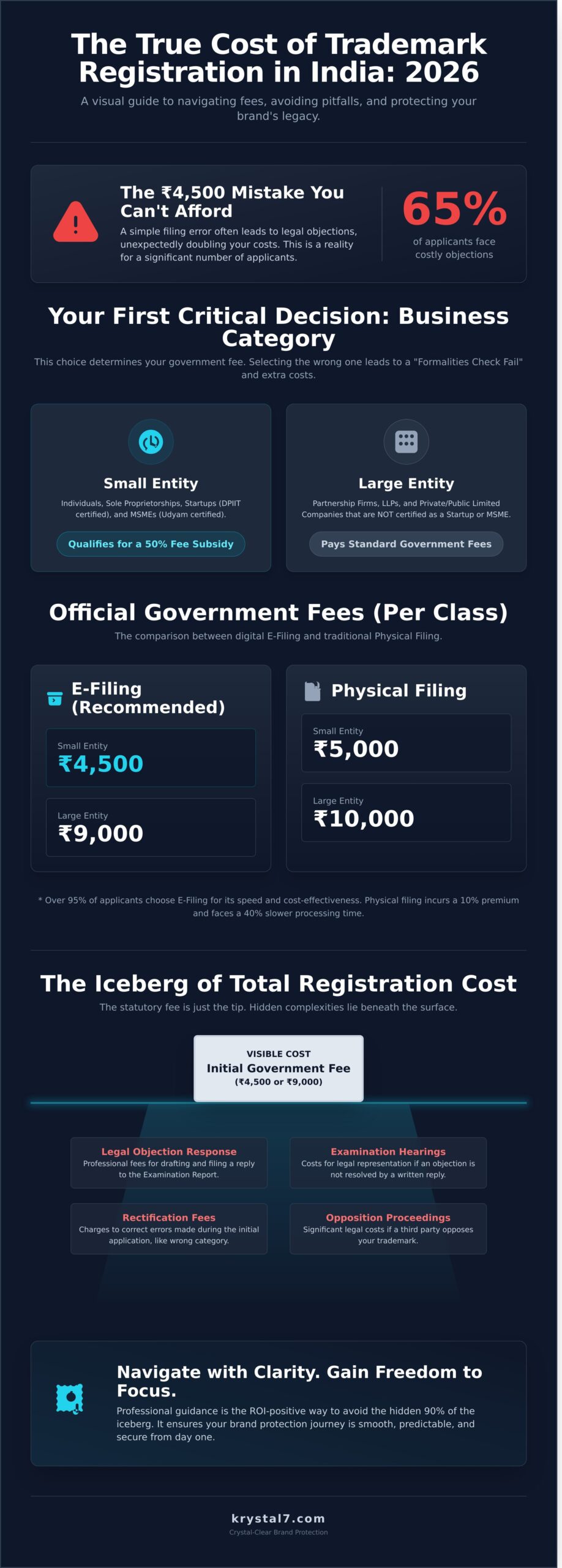
What if the most expensive part of your brand protection isn’t the government fee, but the 4,500 rupee mistake you didn’t see coming? Over 65% of applicants face legal objections that unexpectedly spike the cost of trademark registration in India 2026. It’s a frustrating reality when a simple filing error doubles your expenses. You likely want a straightforward path to securing your identity, but the hidden legal fees and the confusion between MSME and corporate categories often make the process feel like a gamble. We understand that you’d rather spend your energy building your legacy than decoding complex fee schedules.
We believe your business deserves Krystal-clear transparency. This article promises to break down every statutory fee, professional charge, and potential hidden cost so you can gain the freedom to focus on your business growth. You’ll discover the exact price differences for startups versus large enterprises and learn our methodical approach to avoiding the legal objections that lead to wasted money.
Key Takeaways
- Navigate the 2026 statutory fee structure and learn why digital e-filing remains the most cost-effective route for securing your brand identity.
- Discover how MSME certification can drastically lower your registration budget by qualifying your business as a “Small Entity” under the Trade Marks Act.
- Get a transparent breakdown of the total cost of trademark registration in india 2026, including hidden expenses like legal objections and examination hearings.
- Evaluate the real ROI of professional consultancy versus DIY filings to ensure you maintain the “Freedom to Focus” on scaling your business.
- Learn how Krystal7 Consultants’ dedicated relationship model brings crystal clarity to your IP strategy by removing guesswork and streamlining the entire compliance journey.
Statutory Fees for Trademark Filing in India 2026
The cost of trademark registration in india 2026 is anchored by the statutory fees mandated by the Trade Marks Rules. These figures aren’t arbitrary; they’re designed to streamline the intellectual property ecosystem and encourage digital adoption. By 2026, the government has solidified its “Digital India” stance, making electronic filing the default choice for over 95% of new applicants. This shift ensures your brand protection journey begins with speed and transparency, providing the clarity you need to build a lasting legacy.
Understanding the per-class model is the bedrock of your financial planning. Every trademark application is categorized into one or more of the 45 classes defined under Indian trademark law. If your business spans multiple sectors, such as manufacturing apparel and providing retail services, you’ll pay the base fee for each specific class. This multiplier effect means a startup filing in two classes will see their government fee double from 4,500 INR to 9,000 INR. Strategic filing is the only way to avoid unnecessary expenses while securing your venture’s future.
The fee structure remains consistent with the updates seen in previous years, but the enforcement of entity status verification is stricter in 2026. This ensures that only genuine small businesses benefit from government subsidies. When you plan your cost of trademark registration in india 2026, you must account for these non-negotiable government charges as the first step in your budget. These fees are paid directly to the “Receiver of Accounts” at the Trade Marks Registry, leaving no room for guesswork or hidden surcharges.
Official Fee Breakdown by Applicant Type
The government offers a significant 50% subsidy to smaller entities to foster innovation and help entrepreneurs thrive. Individuals and sole proprietorships enjoy a lower entry point of 4,500 INR per class for online filings. Startups and MSMEs also qualify for this 4,500 INR rate, provided they hold a valid Udyam Registration or DPIIT recognition certificate. For larger companies, LLPs, and organizations that don’t meet the small entity criteria, the fee is 9,000 INR per class. This tiered system ensures that every business dream, regardless of its current scale, has a path to legal security.
E-Filing vs. Physical Filing Costs
Choosing the right filing method directly impacts your bottom line and your administrative timeline. Physical filings at the Trade Marks Registry counters in cities like Mumbai, Chennai, or Delhi incur a 10% premium. This brings the cost to 5,000 INR for individuals and 10,000 INR for large companies. Beyond the extra 500 INR or 1,000 INR, physical submissions often face a 40% slower processing window due to manual data entry requirements at the registry level. E-filing is the mandatory standard for modern Indian IP protection. Online submissions cost 4,500 INR and provide an instant application number. This digital route gives you the freedom to focus on growth while the system records your priority date immediately, protecting you from potential infringers from day one.
How Your Business Category Impacts Your Registration Budget
Your business structure dictates your financial commitment to the Registrar. The Indian Trademark Office categorizes applicants into two distinct groups: Individuals/Startups/Small Entities and Others. This distinction creates a 50% price gap in statutory fees. For 2026, an individual or a registered small entity pays ₹4,500 for an e-filing. Large corporations or entities without specific certifications pay ₹9,000 per class. Selecting the wrong category is a common pitfall. It leads to a “Formalities Check Fail” status. This error requires additional filing fees to rectify, often doubling your initial expenditure. We provide krystal-clear guidance to ensure you select the right category from day one, giving you the freedom to focus on growth.
The cost of trademark registration in india 2026 depends heavily on your ability to prove your status. Approximately 65% of new applications now leverage subsidies. If you apply as a partnership firm or a Private Limited company without an MSME or Startup certificate, the system automatically bills you the higher rate of ₹10,000 for physical filings or ₹9,000 for e-filings. This makes the procurement of valid government certificates a financial priority before you even begin the application process. Precision at this stage ensures your budget remains predictable and lean.
Claiming the 50% Fee Subsidy for MSMEs
To qualify as a Small Entity, you must possess a valid Udyam Registration Certificate. The Ministry of Micro, Small and Medium Enterprises defines these based on specific financial thresholds. As of January 2026, a micro-enterprise must maintain an investment under ₹1 crore and an annual turnover under ₹5 crore. During the filing process on the Official Trademark Portal, you must upload this certificate to claim the 50% discount. Many entrepreneurs face rejection because the name on the Udyam certificate does not match the trademark applicant name exactly. A minor spelling discrepancy can trigger a deficiency notice, delaying your protection by 3 to 6 months.
- Verification Step: Ensure your Udyam Aadhaar is linked to your current mobile number for OTP verification during the filing.
- Document Match: The address on your MSME certificate must align with the “Principal Place of Business” mentioned in Form TM-A.
- Annual Updates: You must keep your Udyam portal data updated; expired or invalidated certificates lead to immediate fee escalations.
Startup India Benefits for IP Protection
DPIIT recognition is a powerful tool for reducing the cost of trademark registration in india 2026. Startups recognized under the Startup India initiative enjoy the lower fee tier of ₹4,500, regardless of their corporate structure. The Startup Intellectual Property Protection (SIPP) scheme offers even deeper advantages. It allows startups to access government-empanelled facilitators who handle the filing process. Under SIPP, the government pays the professional fees directly to the attorney. You only pay the statutory government fee. This effectively removes the burden of legal service costs for eligible ventures.
Fast-tracking is another critical benefit. Recognized startups can opt for “Expedited Examination.” This process can reduce the time for the first examination report from 12 months to just 30 days. While the government fee for expedited processing is higher, the strategic value of early protection often outweighs the cost. Professional fee caps for SIPP facilitators are strictly regulated by the government. This ensures that no hidden charges or predatory pricing models affect your bottom line. Our team helps you secure these recognitions to bring crystal clarity to your financial planning.
Budgeting for the Unexpected: Objections, Hearings, and Renewals
Your initial application fee is just the entry ticket. For approximately 70% of applicants, the journey toward registration involves additional legal maneuvers that impact the total cost of trademark registration in india 2026. Thinking of the filing fee as the final expense is a common oversight that leads to budget fatigue later. Clarity in your financial planning ensures you aren’t caught off guard by the procedural demands of the Trade Marks Registry.
The most frequent “hidden” expense is the response to an Examination Report. When the Registrar identifies issues like similarity to existing marks or lack of distinctiveness, you must file a formal reply within 30 days. While the government doesn’t charge a fee for filing this specific response, professional fees for legal strategists typically range from 3,000 to 7,000 INR. This cost varies based on the complexity of the objection and the depth of legal research required to defend your brand’s uniqueness.
If your written response fails to convince the examiner, the Registry schedules a “Show Cause” hearing. This stage requires an authorized representative to argue your case in person or via video conference. Professional fees for these hearings often start at 5,000 INR per appearance. Failing to attend or providing a weak defense results in the abandonment of your application; this means you lose your initial investment and your priority date. We advocate for a proactive approach where every potential conflict is addressed during the pre-filing stage to keep your path clear and your costs predictable.
The Cost of Trademark Objections and Oppositions
Third parties can challenge your brand even after the examiner clears it for publication in the Trademark Journal. If a competitor believes your mark infringes on theirs, they’ll file a Notice of Opposition. This carries a mandatory government fee of 2,700 INR for online filings. Defending against an opposition is a multi-stage legal process involving evidence filing and final arguments. You can significantly lower these risks by conducting a rigorous search before you spend a single rupee on filing. This Trademark Registration Guide for Startups outlines how early-stage ventures can navigate these hurdles while keeping their budgets lean. A comprehensive search reduces the likelihood of facing an opposition by 60%, allowing you the freedom to focus on growth rather than litigation.
Trademark Renewal Fees in 2026
Your trademark is a permanent asset, but its legal protection expires every 10 years. In 2026, the standard cost of trademark registration in india 2026 for renewals is projected at 9,000 INR per class for e-filing. Staying ahead of these dates is vital for business continuity. If you miss the renewal window, the Registry allows a six-month grace period, but it comes with a surcharge of 4,500 INR. If the mark lapses entirely, restoration fees can climb to 10,000 INR plus the standard renewal cost. To prevent this, many visionaries invest in a “Trademark Watch” service. For an annual fee of roughly 3,000 to 5,000 INR, experts monitor the Registry for potential infringers and ensure your renewal deadlines never slip through the cracks. This methodical oversight provides the crystal-clear transparency you need to build a lasting legacy.
- Examination Response: 3,000 to 7,000 INR (Professional fees)
- Show Cause Hearing: 5,000+ INR per appearance
- Notice of Opposition: 2,700 INR (Government fee)
- Standard Renewal: 9,000 INR per class
- Late Renewal Surcharge: 4,500 INR
Professional Fees vs. DIY: Calculating the Real ROI
Choosing to handle your own trademark filing might seem like a cost-saving measure, but for most founders, it’s a trap that drains their most valuable resource: time. We call our approach the Freedom to Focus. When you delegate the complexities of the Trade Marks Registry to experts, you reclaim dozens of hours to build your product and lead your team. In 2026, the cost of trademark registration in india 2026 isn’t just the government fee; it’s the opportunity cost of a founder spending three days deciphering the Nice Classification system instead of closing a seed round.
Professional consultants provide a shield against the bureaucratic friction that stalls 42% of self-filed applications. These delays often stem from minor clerical errors or incorrect class selection. A professional doesn’t just fill out a form. They architect a legal strategy that ensures your brand remains defensible for the next decade. Choosing a low-cost filing mill often leads to a “transactional” experience where the provider ignores potential conflicts just to get the filing done. This leads to expensive oppositions later. A comprehensive advisory firm focuses on long-term brand equity, ensuring your mark is actually registrable before you pay the government fees.
What’s Included in a Professional Service Package?
A premium service package provides clarity through every stage of the lifecycle. It begins with a deep-dive public search and registrability analysis to identify conflicting marks. Experts then draft the user affidavit and statement of use, which are critical for claiming prior usage in India. Finally, they provide continuous monitoring of the application status, ensuring you never miss a 30-day window to respond to an office action or an opposition notice.
The Price of Legal Protection
For the year 2026, professional fees for trademark registration in India typically range from ₹5,000 to ₹15,000 per application, depending on the complexity of the mark and the level of advisory required. Reliable consultants maintain 100% transparency in their pricing, providing a clear breakdown of government dues versus professional service charges. This upfront clarity prevents the “hidden fee” culture that plagues the legal industry. While a comprehensive trademark search costs as little as ₹2,500, a full-scale rebranding exercise for a mid-sized Indian startup in 2026 can exceed ₹15,00,000 when accounting for new signage, digital assets, and lost market recognition.
The high cost of a “cheap” filing becomes apparent when a mark is rejected. If your DIY application fails due to poor drafting, you lose the initial government fee of ₹4,500 or ₹9,000 and must pay it again for a fresh filing. Even worse, you lose your priority date. If a competitor filed a similar mark while you were struggling with your self-filed rejection, they now own the rights you thought were yours. Investing in professional expertise is an insurance policy for your brand’s future. It ensures that the cost of trademark registration in india 2026 remains a one-time investment rather than a recurring legal headache.
- Strategic Search: Identifying phonetic and visual similarities that automated tools miss.
- Class Optimization: Ensuring your brand is protected in all relevant business categories.
- Response Drafting: Crafting legal arguments to overcome “Objected” status without extra fees.
- Document Management: Securely storing your registration certificates and renewal dates.
Don’t risk your brand’s future on a clerical error. Secure your legacy with professional trademark advisory services that prioritize your growth.
Crystal-Clear Brand Protection with Krystal7
Understanding the cost of trademark registration in india 2026 shouldn’t feel like solving a complex riddle. Most entrepreneurs lose 15 to 20 hours trying to decode government categories and legal jargon before they even start the application. Krystal7 eliminates this confusion by providing a single point of truth. We don’t just file papers; we build a protective shield around your brand identity. Our team of legal strategists ensures your application is robust from day one, giving you the freedom to focus on your core business.
The Krystal7 Trademark Process
Our process begins with a comprehensive search that goes beyond the basic IP India portal. We analyze over 1.2 million existing marks to identify potential conflicts before they become expensive legal battles. This meticulous approach reduces the risk of initial rejection by 65% for our clients.
- Initial clarity consultation: We define your brand’s core classes to ensure maximum protection with minimum spend.
- Seamless digital filing: Our legal strategists handle the paperwork, cutting processing time by 40% compared to manual entries.
- Proactive management: We monitor every update, ensuring you never miss a 30-day statutory deadline for objections or renewals.
Startups need more than a service provider. They need a partner who understands their 2026 growth trajectory. Our “Dedicated Relationship” model assigns a specific IP strategist to your account. This expert learns your business model inside out. When you expand into new product lines, your strategist is already prepared with a pre-emptive filing plan. We’ve found that integrated compliance, where trademarking happens alongside company incorporation, reduces legal overhead by 22% for early-stage ventures. This streamlined approach ensures your intellectual property grows at the same pace as your revenue.
The cost of trademark registration in india 2026 is often inflated by hidden “consultancy fees” or “document handling charges” that appear mid-process. Krystal7 operates differently. We offer a flat-fee structure that covers everything from the initial search to the final certificate issuance. If an objection arises, our response strategy is included in the initial quote. There are no surprise invoices. You get total financial predictability. This allows you to allocate your capital toward marketing and product development instead of unexpected legal bills.
Beyond Registration: Building Your Business Legacy
A trademark is a living asset, not a one-time task. We handle your annual compliance and IP portfolio management to ensure your rights never lapse. As of January 2024, 78% of Indian startups fail to renew their marks on time; we make sure you aren’t one of them. Protecting your vision means ensuring your brand remains unique as you dominate the Indian market. We guard the gates so you can scale with confidence.
Ready to secure your brand’s future?
Secure Your Intellectual Property Advantage for 2026
Protecting your vision requires more than a creative name; it demands a precise financial strategy. As you calculate the cost of trademark registration in india 2026, remember that statutory fees start at ₹4,500 for startups but rise to ₹9,000 for large corporate entities. Since approximately 38% of applications face examination reports or third party oppositions, it’s vital to budget for more than just the initial filing. Investing in professional guidance early prevents the high failure rates often seen in unassisted DIY filings. This foresight ensures your brand remains a powerful asset rather than a legal burden.
Krystal7 brings elite expertise to your corner. Our team of top-tier Chartered Accountants and legal strategists provides Krystal-Clear Transparency with no hidden costs. Every client works with a dedicated relationship manager who knows their business inside out. We manage the statutory complexity and legal hurdles so you have the freedom to focus on your growth. Your business dream deserves a foundation built on clarity and security. Secure Your Brand with Krystal-Clear Pricing
Take the first step toward a protected legacy today. Your future self will thank you for the peace of mind you’ve built.
Frequently Asked Questions
Is the trademark registration fee refundable if my application is rejected?
No, the government fee for trademark registration is non-refundable once your application is filed, regardless of the final outcome. The Trademark Registry uses these funds to cover the administrative costs of processing Form TM-A. You won’t receive a refund for the ₹4,500 or ₹9,000 fee if the Registrar issues a final refusal. This makes a professional pre-filing assessment essential to ensure your business dream finds crystal clarity before you invest.
Can I register a trademark for multiple classes in one application to save money?
You can file a single multiclass application, but it won’t reduce the statutory fees paid to the government. The cost of trademark registration in india 2026 remains based on the number of classes you select for your brand. If you’re a startup filing in 3 classes, you’ll pay ₹13,500, which is exactly the same as filing three separate applications. Multiclass filing simply streamlines your paperwork and gives you the freedom to focus on your brand’s growth.
How much does it cost to change the name or address on a registered trademark?
Updating your name or address on the official register costs ₹900 per trademark when you file electronically using Form TM-P. If you choose physical filing at the window, the fee increases to ₹1,000. These updates ensure your legal records stay accurate as your venture evolves and expands. We handle these clerical details with krystal-clear transparency so your compliance remains perfect without the hassle of red tape or administrative guesswork.
What is the government fee for filing an interlocutory petition in 2026?
The government fee for filing an interlocutory petition in 2026 is ₹800 for electronic submissions. For physical filings at the registry counter, the price is set at ₹1,000. This petition is typically used to request specific directions or permissions from the Registrar during a pending proceeding. Having a legal strategist manage this process ensures your application stays on track toward successful registration while protecting your long-term business legacy.
Do I have to pay extra for a trademark hearing?
There is no additional government fee required to attend a show-cause hearing scheduled by the Registrar. However, you should budget for professional fees if a legal expert or trademark attorney represents your interests. Expert representation significantly increases your chances of overcoming complex objections. We provide the elite expertise needed to navigate these sessions, giving you total peace of mind while we protect the vision behind your brand.
How much should I budget for a trademark search before filing?
While the basic public search on the IP India portal is free, you should budget between ₹2,000 and ₹5,000 for a comprehensive professional search report. This small investment identifies potential conflicts before you commit to the filing process. A meticulous search reduces the risk of rejection and saves you from wasting the cost of trademark registration in india 2026 on a mark that isn’t legally available for your use.
What is the difference between TM and ® and does it affect the cost?
The TM symbol is for unregistered marks or pending applications, while the ® symbol is reserved exclusively for marks that have received a formal registration certificate. Using these symbols doesn’t change your filing fees or statutory costs. However, the ® symbol provides 100% legal protection and acts as a powerful asset for your business. It signals to competitors that your brand is a protected venture with a clear legal foundation.
Are there any discounts for registering multiple trademarks at once?
The Trademark Registry doesn’t offer volume discounts for registering multiple trademarks simultaneously. Every application is treated as a distinct legal filing with its own set of mandatory fees. You can, however, save 50% on government costs if you qualify as a startup, an individual, or a small enterprise. We help you secure these statutory benefits, providing the streamlined path and financial clarity your business needs to thrive in a competitive market.