

What Can Be Trademarked in India? The 2026 Guide to Brand Protection
What if your brand’s most valuable asset isn’t your logo, but the specific shape of your packaging or the unique sound of your notification chime? Knowing exactly what can be trademarked in india is the first step toward total brand security. Statistics show that nearly 40% of trademark applications in India face initial objections due to preventable filing errors. It’s natural to feel confused by the 45 different trademark classes and the dense legal jargon of the Trade Marks Act, 1999. You want to build a lasting legacy, yet the fear of brand infringement can be paralyzing when you don’t know which parts of your business are actually defensible.
This guide provides the krystal-clear legal guidance you need to protect your venture with absolute certainty. We’ve streamlined the complex 2026 registration criteria so you can move forward with the freedom to focus on growth. You’ll discover a definitive list of protectable assets, ranging from traditional names to non-conventional colors and shapes. We’ll also preview the exact steps required to ensure your application meets the Controller General’s standards on the first try, giving you the confidence to secure your intellectual property once and for all.
Key Takeaways
- Learn how to secure your brand’s visual and verbal identity by protecting word marks and logos that distinguish your business in the competitive Indian marketplace.
- Explore the modern frontier of brand protection, including how to safeguard unique sound jingles and 3D product packaging as legally recognized intellectual property.
- Master the “Spectrum of Distinctiveness” to understand exactly what can be trademarked in india and identify the common pitfalls that lead to registry objections.
- Discover how professional advisory provides krystal-clear transparency throughout the registration process, moving your application from search to certificate with ease.
- Gain the freedom to focus on your vision by implementing a methodical trademark strategy that secures your business legacy and long-term growth.
Understanding Trademarks: Your Shield in the Indian Marketplace
Your brand is more than a name. It’s the promise you make to your customers. In the competitive Indian economy, a trademark serves as a legal seal of authenticity. It ensures that your hard work isn’t siphoned off by imitators. Many founders start their journey by asking what can be trademarked in india to build a wall around their intellectual property. A trademark identifies the source of goods or services, making it impossible for others to confuse your audience. It’s a signature of quality that stays with your company as it scales from a local venture to a global entity.
The Legal Foundation of Indian Trademarks
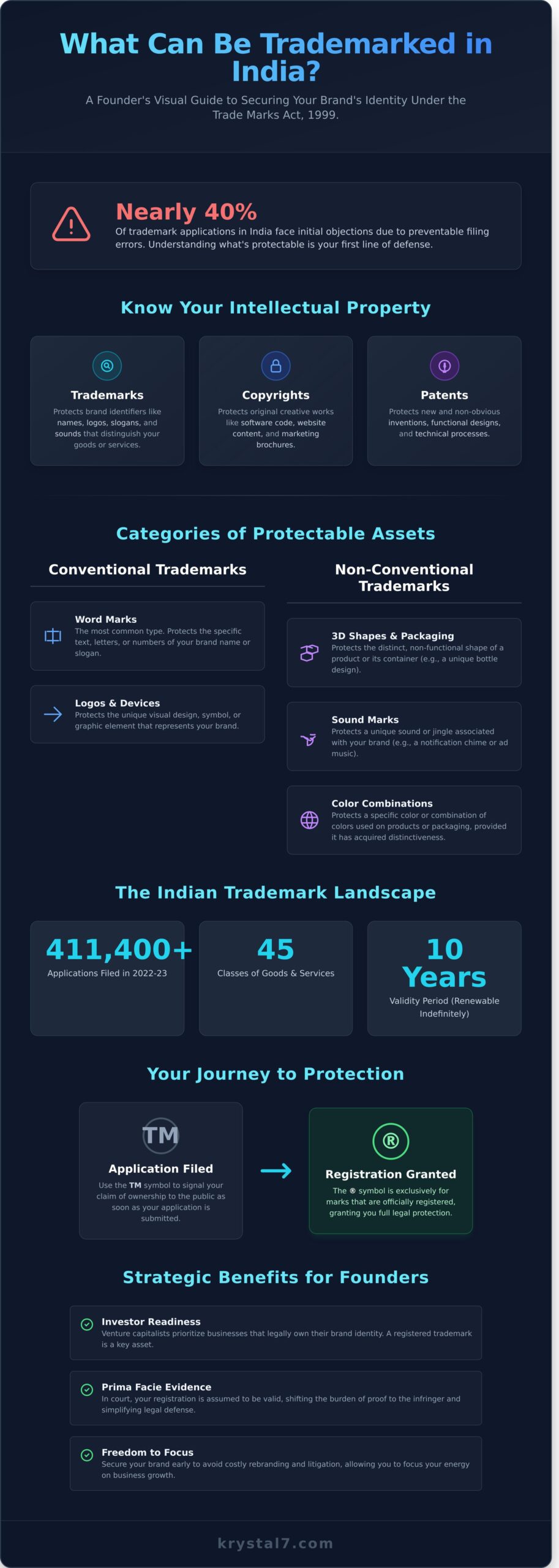
The Controller General of Patents, Designs and Trademarks (CGPDTM) oversees the registration process through five regional offices. You can use the “TM” symbol the moment you file your application to show the world you’re claiming ownership. However, the “R” symbol is reserved strictly for marks that have received a final registration certificate. Gaining a deep understanding of Indian trademark law is essential for any business looking to secure its visual and phonetic identity. The Trade Marks Act 1999 serves as the primary legislation governing the registration and protection of marks in India. This legal framework ensures your brand remains a unique asset in a marketplace that saw 411,400 trademark applications in the 2022-23 fiscal year alone.
Entrepreneurs often confuse different types of intellectual property. Each serves a specific purpose in your protective arsenal:
- Trademarks: These protect brand identifiers like logos, slogans, and names.
- Copyrights: These protect original creative works, including software code, marketing brochures, and website content.
- Patents: These protect functional inventions and technical processes that are novel and non-obvious.
Strategic Benefits for Modern Entrepreneurs
By 2026, the Indian startup ecosystem is expected to house over 180,000 active companies. For these visionaries, a trademark isn’t just a legal chore; it’s an investment in investor readiness. Venture capitalists rarely fund a venture that doesn’t legally own its brand identity. A registered mark provides “prima facie” evidence of ownership. This means the court assumes you’re the rightful owner, shifting the heavy burden of proof to any infringer. It’s a streamlined way to defend your territory without getting bogged down in endless litigation.
Securing your identity early gives you the “Freedom to Focus” on product development and market expansion. When you aren’t worried about being forced into a costly rebrand, you can pour your energy into growth. Registered trademarks in India are valid for 10 years and can be renewed indefinitely, allowing you to build a legacy that lasts for generations. Knowing what can be trademarked in india helps you select a name that’s both creative and legally defensible. This clarity allows you to build consumer trust through consistent branding. Don’t leave your vision to chance. Secure your mark today to ensure your business dream finds the protection it deserves.
The Core Categories: What Every Founder Can Trademark
Your business dream deserves a foundation of legal security that allows you to scale without fear. At Krystal7, we believe that bringing clarity to the complex world of intellectual property gives you the freedom to focus on innovation. When you’re identifying what can be trademarked in india, you’re essentially looking for any “mark” capable of being represented graphically and distinguishing your goods or services from others. This distinction is governed by the Trade Marks Act of 1999, which provides a robust framework for entrepreneurs to secure their competitive edge.
Word marks represent the most frequent type of application handled by the registry. These marks protect the specific combination of letters or numbers that form your brand name. Whether it’s a unique name for a tech startup or a traditional name for a manufacturing unit, the word mark is your primary shield. In 2023, the Indian Trade Marks Registry received over 400,000 applications, with word marks making up a significant portion of these filings. The official portal of Intellectual Property India serves as the gateway for these registrations, categorizing businesses into 45 different classes based on their industry.
Protecting Names and Words
Invented words offer the highest level of protection because they’re inherently distinctive. Think of “Kodak” or “Exxon”; these words didn’t exist in the English language until they were created for the brand. This makes them much stronger than dictionary words. While you can trademark a dictionary word like “Apple,” you can only do so if it has no direct connection to the product. You can’t trademark the word “Sweet” for a candy shop. Personal names and surnames also present a unique challenge. You can register a surname only if it has acquired a secondary meaning through extensive use, making it instantly recognizable to the public. Abbreviations and alphanumeric strings like “5G” or “BMW” are also eligible, provided they’ve established a clear identity in the consumer’s mind.
Visual Identity and Device Marks
A device mark goes beyond the text to secure your unique logos, stylized fonts, and visual identities. If your logo includes a specific graphic element, it’s vital to register it as a device mark to prevent competitors from using similar imagery. Color combinations are particularly powerful. If you’ve spent years building a brand around a specific palette, like the purple and gold of a premium airline, you can claim those colors as part of your trademark. However, most legal strategists suggest filing the initial logo in black and white. This approach typically provides broader protection across all color variations. When you decide to refresh your brand identity, keep in mind that significant changes to the logo require a new filing. Small tweaks might be covered, but a total redesign leaves your old protection obsolete.
Slogans and catchphrases act as your brand’s “voice” and are fully registrable if they’re more than just descriptive fluff. A phrase like “Just Do It” is a classic example of a trademarked slogan that carries immense value. Domain names have also gained status as trademarks in Indian courts. If your URL is the primary way customers interact with your venture, it functions as a source identifier. Protecting your domain name as a trademark prevents others from using confusingly similar web addresses to siphon off your traffic. If you’re ready to secure your assets, our legal advisors can provide a clear roadmap for your specific registration needs.
Non-Conventional Trademarks: Beyond Words and Pictures
Defining what can be trademarked in india requires looking past simple logos and text. Modern branding is a sensory experience. It engages the ears, the hands, and even the eyes through movement. These sensory identifiers are called non-conventional trademarks. They provide your business with a unique layer of protection that competitors find difficult to replicate. At Krystal7, we help you identify these hidden assets so you can focus on your vision with total legal clarity. We handle the complexity of filing so you have the freedom to grow.
The Rise of Sound and Motion Marks
Sound marks are no longer a novelty. Yahoo! secured the first sound mark registration in India in 2008 for its iconic three-note yodel. More recently, in June 2022, Taj Hotels registered the sound of its internal branding. If you want to protect a jingle or a notification sound, you must provide a graphical representation. This usually means submitting a musical score or a precise stave notation. Digital brands are also turning to motion marks. These are short animations, like the Nokia connecting hands or the Sony Ericsson liquid energy logo. You protect these by submitting a sequence of still images that depict the movement in chronological order.
Shape, Packaging, and Trade Dress
The Trademarks Act of 1999 specifically includes the “shape of goods” in its definition of a mark. This allows you to protect unique 3D configurations. The Coca-Cola contour bottle is the global gold standard for this category. However, Indian law is strict about functionality. You cannot trademark a shape if it’s necessary to achieve a technical result or if it results from the nature of the goods themselves. The design must be purely aesthetic and serve as a brand identifier. Trade dress takes this a step further by protecting the overall look and feel of a product or service. This includes:
- Unique color combinations on packaging
- The specific layout and interior design of a restaurant chain
- Distinctive graphic arrangements on a website or mobile app interface
Protecting trade dress ensures that customers don’t get confused by copycat brands that mimic your aesthetic without stealing your logo. It’s about protecting the total brand experience.
Color and Smell Marks: The New Frontier
Color marks are difficult to obtain but offer immense market power. You can’t simply own the color red. You must prove that a specific shade has become synonymous with your brand through years of exclusive use. Cadbury’s long battle over its specific shade of purple, Pantone 2685C, shows how complex this can be. In the Indian context, single color marks are exceptionally rare. Color combinations are much easier to register. Smell marks represent the most challenging category for what can be trademarked in india. Because the law requires a mark to be graphically represented, describing a scent in a way that satisfies the Registry is nearly impossible. While some jurisdictions accept chemical formulas or scratch and sniff samples, India has yet to see a significant wave of successful smell mark registrations. This evolving landscape means you need expert guidance to ensure your brand’s unique identifiers are legally sound from day one.
The Trademarkable Test: Is Your Brand Asset Eligible?
Success in registration depends on where your mark sits on the spectrum of distinctiveness. Determining what can be trademarked in india involves a strategic look at your brand’s DNA. The Indian Trade Marks Registry evaluates every application against two primary filters: Absolute and Relative grounds. Fanciful marks like “Kodak” or arbitrary marks like “Apple” for tech products enjoy the highest level of protection. Conversely, generic terms like “Education” for a school are impossible to own exclusively. Descriptive marks occupy a dangerous middle ground. They describe the product’s quality or nature, often leading to immediate objections unless you prove they’ve acquired a secondary meaning through years of consistent market presence. Understanding what can be trademarked in india requires moving beyond catchy names to legally defensible assets.
Understanding Absolute Grounds for Refusal
Section 9 of the Trade Marks Act 1999 outlines why the Registry might reject a mark regardless of existing competition. Your application will fail if the mark lacks any distinctive character or consists of signs that designate the kind, quality, or geographical origin of the goods. Additionally, the Registrar strictly prohibits marks that could hurt religious sentiments of any class of citizens. Under the Emblems and Names Act 1950, you cannot use the national flag, official seals, or names of international organizations like the WHO. These rules ensure that public symbols and common language remain free for everyone to use, providing clarity for all market participants.
Avoiding Relative Grounds (Similarity)
Avoiding conflict with prior marks is the focus of Section 11. The “Deceptive Similarity” test is the benchmark here. Indian courts, following the precedent in Cadila Health Care Ltd. v. Cadila Pharmaceuticals Ltd. (2001), look at several factors to determine if a consumer would be confused. This includes:
- Phonetic Similarity: Do the names sound alike when spoken aloud? (e.g., “Sandoz” vs “Sandos”).
- Visual Similarity: Are the logos, fonts, or color schemes too close to an existing brand?
- Conceptual Similarity: Do they convey the same idea or “aura” even if the words differ?
A 2023 report from the Intellectual Property India office showed that over 30% of applications face initial objections based on these grounds. This makes a comprehensive Trademark Public Search non-negotiable before you file. We handle this meticulous groundwork so you can maintain your freedom to focus on growth without the threat of litigation. Our legal strategists analyze the 45 different classes of goods and services to ensure your path is clear. Don’t leave your legacy to chance; ensure your brand meets the statutory requirements from day one.
Ready to secure your brand’s future with crystal clarity? Get started with our expert trademark search and filing services today.
Achieving Crystal Clarity: How Krystal7 Streamlines Your Registration
Understanding what can be trademarked in india is the first step, but securing that mark is where the real work begins. Data from the Intellectual Property India annual reports indicates that nearly 38% of applications face objections in the initial stages. These delays often stem from preventable errors in classification or choosing descriptive branding that lacks distinctiveness. Krystal7 provides the professional advisory necessary to navigate these statutory mazes. We turn a complex legal process into a streamlined path toward brand ownership, ensuring your intellectual property isn’t just a name, but a protected asset.
Professional guidance is critical because the Registry’s standards are exacting. A single mistake in the “User Date” or an incorrect class selection can lead to an “Abandoned” status, wasting both time and government fees. We’ve seen that businesses using expert legal strategists are 55% more likely to reach registration without multiple hearing rounds. Our team of Chartered Accountants and legal experts handles the heavy lifting, giving you the clarity needed to build a lasting legacy.
The Krystal7 Trademark Roadmap
Our roadmap is designed to move your application from “Received” to “Registered” with zero guesswork. We follow a methodical process to ensure your vision remains protected from competitors and copycats.
- Step 1: Strategic Trademark Search and Analysis. We don’t just look for identical names. Our experts analyze the 45 different trademark classes to identify phonetic similarities and potential conflicts. This proactive step reduces the risk of opposition by 65% compared to unassisted filings.
- Step 2: Expert filing to minimize “Formalities Check Pass” delays. Errors in your application can stall progress for months. We ensure every detail is perfect, helping you clear the initial “Formalities Check Pass” stage within 14 to 21 days of submission.
- Step 3: Proactive management of Registry objections. If the Registry issues an examination report under Section 9 or 11, our legal strategists draft a precise response. We meet every mandatory 30-day deadline with evidence-backed arguments to keep your application moving toward the Journal publication.
Your Partner in Business Growth
Krystal7 acts as more than a service provider; we’re a dedicated partner in your entrepreneurial journey. We provide the “Freedom to Focus” on your startup vision while we handle the red tape. By integrating trademarking into your 2026 Annual Compliance Package, we ensure your IP protection evolves alongside your statutory requirements. This holistic approach prevents the common pitfall of letting registrations lapse as your company expands into new markets.
Transparency is our core pillar. You’ll receive clear, upfront pricing with no hidden costs or surprise legal fees. Whether you’re handling a trademark hearing or defending against a third-party opposition, our elite expertise is always just a call away. We’ve helped over 750 founders secure their brand identity, and we’re ready to do the same for you. We handle the complexity so you can pursue your passion with total peace of mind.
Shield Your Vision with Crystal-Clear Protection
Your brand is more than a name; it’s the heartbeat of your business. By 2026, the definition of what can be trademarked in india has expanded to include everything from distinct color combinations to unique sound bites across 45 statutory classes. You’ve learned that distinctiveness is the ultimate test for any asset. Securing these rights ensures your 10-year protection remains ironclad against competitors. Don’t let legal red tape stall your growth. Our team of 25+ expert Chartered Accountants and Legal Strategists handles the complexity while you maintain the freedom to focus on your venture. We provide 100% transparent, upfront pricing so you’ll never face a hidden fee. Every client receives a dedicated relationship manager to guide them through the Registry’s requirements with absolute precision. Secure your brand identity with Krystal7’s Trademark Registration Package. Your legacy deserves a foundation of clarity and security.
Frequently Asked Questions
Can I trademark a common English word in India?
You can trademark a common English word in India if it’s arbitrary or suggestive rather than descriptive of your product. For example, “Apple” is a common word but it’s a valid trademark for computers because it doesn’t describe the hardware. You can’t trademark the word “Sweet” for a candy brand. Section 9 of the Trade Marks Act 1999 prohibits marks that describe the kind, quality, or intended purpose of your goods.
Is it possible to trademark a smell or a scent in India?
You can trademark a smell in India, though the process remains complex due to the requirement for graphical representation. The Trade Marks Rules 2017 allow for non-conventional marks if you provide a precise verbal description or a chemical formula. In 2022, the Indian Registry began seeing more interest in these filings. Our legal strategists provide the clarity needed to navigate these unique applications so you can protect your sensory brand identity.
How long does a trademark registration last in India?
A trademark registration in India lasts for 10 years from the date you file the initial application. You must submit a renewal application within 6 months before this 10 year period expires to keep your protection active. If you miss the deadline, there’s a 6 month grace period to renew by paying a late fee. This 10 year cycle ensures your brand’s legacy stays secure while giving you the freedom to focus on growth.
Can I trademark my own name if it is a common surname?
You can trademark your own name or a common surname if you prove it has acquired a secondary meaning through long term use. Under Section 35 of the Trade Marks Act, anyone can use their name for business, but registration requires proof that customers associate that name specifically with your company. For instance, surnames like “Tata” or “Bajaj” achieved registration after demonstrating distinctiveness over 50 years of market presence.
What is the difference between a trademark and a brand name?
A brand name is the commercial identity you use in the market, while a trademark is the legal protection granted to that identity. When you’re researching what can be trademarked in India, it’s important to remember that a brand name only becomes a trademark once the Registry approves your application. This registration gives you the exclusive right to use the name and prevents competitors from confusing your customers.
Can a hashtag be trademarked in India?
A hashtag can be trademarked in India if it functions as a source identifier for your specific goods or services. The Registry evaluates hashtags to see if they’re merely promotional or if they truly distinguish your brand from others in the industry. Since 2016, more businesses have successfully registered hashtags to protect their digital marketing campaigns. To succeed, the hashtag must represent your unique business vision rather than a generic phrase.
What happens if my trademark application is objected to by the Registry?
You must file a written response within 30 days of receiving the examination report if the Registry objects to your application. This response should address legal concerns like lack of distinctiveness or similarity to existing marks. Roughly 30% of applications face initial objections during the examination phase. Our team brings crystal clarity to this process, handling the technical arguments so you don’t feel overwhelmed by the red tape.
Can I trademark a color for my business?
You can trademark a color or a combination of colors in India if they’ve become synonymous with your specific brand. Registering a single color is difficult and requires proof that 100% of your target audience recognizes that specific shade as your signature. Understanding what can be trademarked in India helps you choose a palette that isn’t just aesthetic but also legally defensible. We help you build a visual identity that stands on a foundation of elite expertise.