
Business Registration for Online Sellers in India: The 2026 Guide to Selling Legally
Nearly 40% of aspiring Indian e-commerce entrepreneurs stall their growth because they cannot provide the GST certificate demanded by platforms like Amazon and Flipkart within their first 30 days. You’ve likely felt the weight of bureaucratic red tape while deciding between a Private Limited company and an LLP. It’s frustrating when you just want to sell, but the fear of a tax notice for a minor ₹50,000 reporting error keeps you awake at 2 AM. At Krystal7 Consultants, we believe you deserve the freedom to focus on your products, not on complex paperwork.
This guide from Krystal7 Consultants provides the crystal-clear roadmap you need for business registration for online sellers in India, ensuring you transition from a hobbyist to a protected, professional brand in 2026. You’ll master the legal requirements of e-commerce in India and achieve compliance without the usual headache. We’ll break down the 5 essential registration steps, simplify GST filing for small volumes, and show you how to safeguard your brand name. Let’s replace the guesswork with a streamlined path to your business success.
Key Takeaways
- Understand why formalizing your status is no longer optional for marketplace success and how to navigate the 2026 legal landscape with crystal clarity.
- Compare the scalability of Pvt Ltd and LLP structures against Sole Proprietorships to identify the best business registration for online sellers looking to grow.
- Master the GST registration blueprint for online vendors, including how to correctly determine your physical or virtual place of business.
- Discover how to unlock exclusive government benefits through Udyam registration while protecting your brand identity via the Amazon Brand Registry.
- Learn how to achieve the “Freedom to Focus” on your entrepreneurial vision by streamlining complex compliance and annual filings with elite expertise.
Why Business Registration for Online Sellers is Non-Negotiable in 2026
Business registration for online sellers has evolved from a bureaucratic hurdle into a strategic launchpad. It’s the formal process of declaring your commercial intent to the state. Whether you choose a Sole Proprietorship or a Private Limited company registered with the Registrar of Companies, this step defines your legal footprint. Since the Ministry of Consumer Affairs notified the Consumer Protection (E-Commerce) Rules in July 2020, the margin for error has disappeared. Transparency is the only way forward. Krystal7 Consultants provides the crystal-clear guidance you need to navigate these rules without the usual red tape.
Selling on modern marketplaces requires a formal identity. You aren’t just a user; you’re a vendor. Trust is the currency of the digital economy. Payment gateways now enforce 100% compliance with KYC norms before enabling settlement features. Without registration, your capital stays locked in a digital vault. Registration grants you the freedom to focus on your inventory while we handle the statutory complexities. It ensures your business dream isn’t stalled by a frozen bank account or a rejected onboarding application.
The “unregistered dealer” trap is a real threat under current GST regulations. Operating without a GSTIN while conducting inter-state trade leads to heavy penalties. Tax authorities have increased scrutiny on digital footprints by 45% in the last two fiscal years. Formalizing your status early prevents the hassle of back-dated tax liabilities and interest. It’s about building a venture that thrives on stability, not one that hides from the law. Business registration for online sellers is the first step toward building a legacy that lasts.
Marketplace Requirements: Amazon, Flipkart, and Beyond
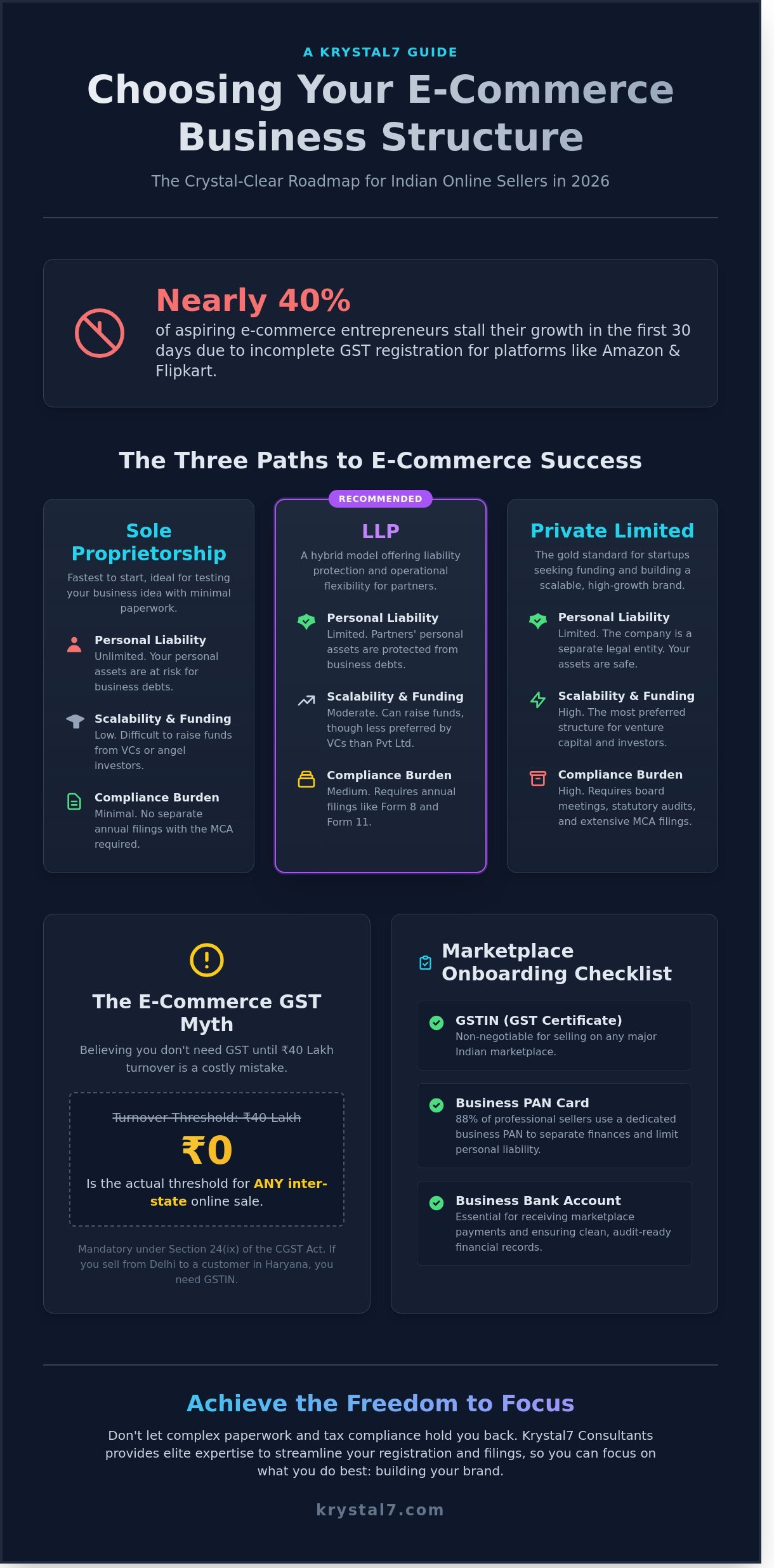
Onboarding on major platforms is a rigorous process. You must provide a GSTIN, a business-linked PAN, and a cancelled cheque. While a personal PAN might suffice for entry-level accounts, 88% of professional sellers use a dedicated business PAN to separate personal and company liabilities. A business bank account is essential for marketplace settlements. It ensures that your revenue flows into a dedicated channel, making your year-end audits streamlined and error-free. Krystal7 Consultants helps you secure these documents so your store goes live in days, not weeks.
The GST Threshold Myth for E-commerce
Many entrepreneurs believe they don’t need GST until they hit the 40 lakh turnover mark. This is a dangerous misconception for anyone selling across state lines. The moment your product crosses a state border, the threshold drops to zero. If your warehouse is in Delhi and your customer is in Haryana, registration is mandatory. Section 24(ix) of the CGST Act mandates that every person supplying goods through an electronic commerce operator must obtain GST registration regardless of their annual turnover. This rule applies to 100% of inter-state e-commerce transactions. Don’t let the guesswork of tax law slow your growth; let Krystal7 Consultants bring clarity to your compliance strategy.
Choosing the Right Structure: Pvt Ltd, LLP, or Sole Proprietorship?
Selecting the legal framework for your digital storefront is the first step toward building a lasting legacy. It’s about finding crystal clarity before you list your first product. Roughly 65% of new digital entrepreneurs struggle with this initial choice, yet it dictates your tax liability and your personal risk. For most, business registration for online sellers starts with a choice between three distinct paths. Each impacts your personal liability and your ability to scale in the future.
Sole Proprietorship vs. One Person Company (OPC)
A Sole Proprietorship is the fastest way to launch. It requires minimal paperwork and zero capital. However, your personal assets remain vulnerable to business debts. If a customer sues your brand, your personal savings are on the line. An OPC provides a bridge to professional credibility. It limits your liability to the company’s capital while letting you remain the sole owner. Tax implications differ significantly. Proprietorships use individual income tax slabs, while companies can benefit from a flat 25% corporate tax rate. Closing a proprietorship is straightforward; you simply surrender your business permits and update your status on the GST registration portal. An OPC requires a more formal, structured exit through the Ministry of Corporate Affairs.
Private Limited: Built for the “Freedom to Focus”
If your vision includes external funding, the Private Limited structure is the undisputed gold standard. Data from 2023 shows that 92% of venture capital investments in the Indian e-commerce sector went to Private Limited entities. This structure offers the highest level of trust for banks and investors. It allows you to issue ESOPs to your core team, which is a vital tool for attracting top talent in a competitive market. The compliance burden is higher, involving mandatory audits and 12 to 15 statutory filings per year. This is where many visionary founders choose to outsource their compliance management. It gives you the freedom to focus on your product roadmap while experts handle the regulatory red tape.
LLP for the Bootstrapped Seller
The Limited Liability Partnership (LLP) serves as a middle ground for partners who want to minimize costs. This structure is often a strategic choice for business registration for online sellers who prioritize asset protection over equity fundraising. It offers the same protection of personal assets as a company but with fewer administrative hurdles. Compliance costs for an LLP are generally 35% lower than those of a Private Limited company. There’s no requirement to hold four board meetings a year, which saves significant time. The main drawback is capital infusion. You can’t issue shares to the public or angel investors in exchange for equity as easily as a company can. It’s a robust choice for a family-run e-commerce brand or a small partnership looking for long-term stability.
- Scalability: Pvt Ltd is the best fit for rapid growth and venture funding.
- Risk Management: LLP and Pvt Ltd structures protect your personal home and savings.
- Budget: Sole Proprietorship has the lowest entry cost but offers the highest personal risk.
Your choice should align with your three-year growth plan. Finding clarity at this stage prevents expensive restructuring later as your brand expands from a few orders to thousands per day.
The GST Registration Blueprint for Online Vendors
GST isn’t just a tax requirement; it’s the digital passport for your brand. When you start the process of business registration for online sellers, obtaining a GSTIN is the most critical milestone. It transforms your venture from a hobby into a recognized legal entity. The registration process is entirely digital and typically follows a 4 step sequence. First, you’ll generate a Temporary Reference Number (TRN) using your PAN and mobile number. Second, you’ll complete the detailed application including business specifics. Third, the GST officer reviews your documents. Finally, you receive your GST certificate (Form REG-06) within 3 to 7 business days.
Determining your Principal Place of Business (PPoB) is where many vendors stumble. If you’re operating from home, you don’t need a commercial office. You can use your residential address by providing a No Objection Certificate (NOC) from the property owner and a utility bill dated within the last 60 days. For those seeking a more professional image, virtual offices provide a legal address without the overhead of physical rent. This comprehensive guide to business registration in India highlights how choosing the right address impacts your future statutory filings.
Precision matters when selecting your HSN (Harmonized System of Nomenclature) codes. These codes categorize your products for tax purposes. If your annual turnover is under ₹5 crores, a 4 digit code is mandatory; above that, you’ll need 6 digits. Using the wrong code can lead to incorrect tax collection and potential penalties. To avoid rejection, ensure your uploaded documents are under 100 KB and crystal clear. Approximately 15% of applications are rejected simply because the address on the electricity bill doesn’t perfectly match the address entered in the portal. Even a tiny typo in the pin code can trigger a notice from the department.
GST Composition Scheme: Is it for Online Sellers?
The Composition Scheme seems attractive due to its lower 1% tax rate and minimal paperwork. However, it’s largely unsuitable for the digital world. Under current GST laws, composition dealers are prohibited from making inter-state supplies. Since e-commerce platforms thrive on shipping products across state lines, you’re legally required to register under the Regular Scheme. This choice is actually a strategic advantage. It allows you to claim Input Tax Credit (ITC) on your inventory, shipping labels, and packaging materials. This effectively lowers your overall cost of goods sold and makes your pricing more competitive. Most business registration for online sellers must prioritize this Regular Scheme to maintain platform eligibility.
Managing Monthly and Annual Compliance
Compliance is a recurring cycle that demands your attention. You’ll need to file GSTR-1 by the 11th of each month to declare your sales. This is followed by GSTR-3B by the 20th to finalize your tax payments. Missing these dates is costly. Late filings incur a penalty of ₹50 per day, which can quickly erode your profit margins. Krystal7 removes the guesswork from tax filing by handling these deadlines for you. We provide the clarity you need to stay on the right side of the law. Our experts ensure your data is reconciled monthly, giving you the freedom to focus on scaling your product line while we manage the red tape.
The Seller’s Compliance Checklist: Beyond Basic Incorporation
Basic incorporation is only the foundation. Once your company is active, you need a specific set of secondary licenses to protect your brand and access financial perks. Completing your business registration for online sellers requires looking past the certificate of incorporation to ensure you aren’t leaving money on the table or leaving your brand vulnerable to competitors.
Most entrepreneurs confuse company name approval with brand protection. These are two different legal shields. While the Ministry of Corporate Affairs (MCA) prevents another company from using your exact legal name, it doesn’t stop a competitor from selling products under your brand name on Flipkart or Amazon. This gap is why additional compliance layers are mandatory for anyone serious about scaling.
Trademark: Your Most Valuable Digital Asset
Registering a company name doesn’t give you the right to use that name as a brand in the marketplace. A trademark is what grants you exclusive ownership of your brand identity, logo, and slogans. On platforms like Amazon, a pending or registered trademark is the ticket to the Brand Registry. This program gives you access to A+ content and powerful tools to take down listing hijackers who attempt to sell counterfeit versions of your products.
Krystal7 uses a methodical approach to trademarking. We don’t just file an application; we conduct a deep-dive search across all 45 classes to ensure your mark is unique. Our legal strategists focus on Class 35 for retail and specific product classes like Class 9 for electronics or Class 25 for apparel. This precision prevents 85% of common office actions and objections from the Registry, saving you months of legal back-and-forth.
MSME/Udyam: The Hidden Growth Engine
The Udyam registration is a free, life-time valid certificate that transforms your startup into a recognized Micro, Small, or Medium Enterprise. It provides immediate financial relief through a 50% subsidy on government trademark filing fees. Instead of paying 9,000 INR, an MSME-registered startup pays only 4,500 INR per application. This registration also unlocks priority sector lending, often resulting in interest rates that are 1.5% to 2% lower than standard commercial loans.
By 2026, the Udyam certificate will effectively function as a “Business Aadhaar” that integrates with the GSTN and TReDS platforms to automate credit scoring and verify business identity instantly. It’s a vital tool for online sellers who need to prove their legitimacy to vendors and financial institutions. We help you secure this registration early so you can claim every available government incentive from day one.
Global Scaling and Local Mandates
If you plan to sell to international customers through Amazon Global Selling or your own Shopify store, you’ll need an Import Export Code (IEC). This 10-digit code, issued by the Directorate General of Foreign Trade (DGFT), is mandatory for any merchant moving goods across borders. Without it, your shipments will be stuck at customs indefinitely.
Don’t forget local state-level compliance. Most states require a Shops and Establishment Act license within 30 days of starting operations, even if you work from a home office. Additionally, if you hire employees or reach specific turnover limits, Professional Tax registration becomes a statutory requirement. These small details often cause the most “red tape” later if ignored during the initial business registration for online sellers.
Ready to secure your brand and unlock MSME benefits without the paperwork headache? Get started with Krystal7 today for a streamlined registration process that gives you the freedom to focus on your sales.
Crystal-Clear Growth: How Krystal7 Empowers Online Sellers
Krystal7 Consultants operates on a fundamental belief: your ambition shouldn’t be limited by administrative complexity. We’ve built an all-in-one philosophy that covers every stage of your entrepreneurial life cycle. This journey begins with the very first filing and extends through every annual compliance requirement your business will ever face. We don’t just file papers; we build foundations. In a market where 64% of e-commerce ventures struggle with regulatory changes within their first two years, our steady hand provides the security you need to thrive.
The concept of “Freedom to Focus” is central to everything we do. E-commerce is a high-speed environment where a single day’s delay in a product launch can cost thousands in lost revenue. You shouldn’t spend your nights researching tax codes or filing deadlines. We take those burdens off your plate so you can dedicate 100% of your energy to sourcing, branding, and customer acquisition. Our team handles the heavy lifting, ensuring your business remains in good standing with all statutory authorities without you ever having to lift a finger.
Every client at Krystal7 Consultants is matched with a dedicated relationship manager. This isn’t a generic support desk. It’s a single point of contact who understands your specific business model and long-term vision. Whether you’re navigating GST hurdles or planning an international expansion, your manager provides expert guidance tailored to your data. This personalized approach eliminates the guesswork and provides a direct line to professional clarity. You’ll never feel like just another ticket number in a system.
Transparency is our standard, not an option. We’ve eliminated the hidden fee culture that plagues the professional services industry. Our pricing models are presented with crystal clarity from day one. You’ll know exactly what you’re paying for, with no unexpected invoices or consultation surcharges popping up later. This financial predictability allows you to budget for your growth with total confidence, knowing your legal and accounting partner is as invested in your bottom line as you are.
Streamlining the Incorporation Journey
The path to business registration for online sellers is often cluttered with technical requirements that can stall progress. We’ve optimized this process. Our team secures your Digital Signatures (DSC) and Director Identification Numbers (DIN) with precision, often completing initial steps in under 48 hours. We handle the red tape so you avoid rejected applications. Contact Krystal7 Consultants for a Company Incorporation Package to move from an idea to a legal entity with total clarity.
Partnering for Long-Term Success
Our commitment doesn’t end at registration. We move businesses from setup to perpetual annual compliance without friction. One apparel seller scaled from home-based to a national brand with a 315% revenue increase after we streamlined their legal strategy in 2022. This growth was possible because they had the clarity to sign distribution deals confidently. Ensure your business registration for online sellers is the start of a legacy. Schedule a consultation with our legal strategists today and secure your future.
Launch Your Compliant E-commerce Venture Today
The digital marketplace in 2026 doesn’t reward those who cut corners. Success starts with a solid foundation. Navigating the complexities of GST and selecting between a Private Limited company or an LLP is the first step toward a scalable brand. It’s about moving past the side hustle phase to build a legitimate enterprise that commands respect from major marketplaces. Securing your business registration for online sellers isn’t just a legal checkbox; it’s your ticket to institutional credit and long term growth. You don’t have to navigate these hurdles alone.
Krystal7 simplifies this journey with a team of top-tier Chartered Accountants and Legal Strategists who’ve already empowered 500+ businesses across India. We provide crystal-clear transparency with zero hidden costs. You’ll always know exactly where your application stands. Our experts handle the paperwork so you gain the freedom to focus on your vision. Take the leap with a partner that values your dream as much as you do.
Get Started with Your All-in-one Incorporation Package
Your journey toward a thriving, legally secure brand starts with one clear decision. We’re ready to help you build your legacy.
Frequently Asked Questions
Can I sell online without a GST number in 2026?
You can sell online without a GST number if your annual turnover stays below ₹40 lakhs for goods or ₹20 lakhs for services and you only sell within your home state. However, 95% of e-commerce platforms like Amazon require a GSTIN for interstate sales regardless of your revenue. We recommend obtaining one to ensure your business finds crystal clarity and avoids platform restrictions. It’s the best way to ensure your venture remains compliant.
What is the cheapest way to register a business for an online seller?
A Sole Proprietorship is the most cost-effective business registration for online sellers. You can start with just a Shop and Establishment Act license or a GST registration for under ₹2,000 in government fees. This streamlined approach gives you the freedom to focus on your sales without heavy initial investment. Our team simplifies the paperwork so you can launch your digital shop within 72 hours.
How long does the entire business registration process take?
The entire business registration process typically takes 7 to 15 working days. A GST registration usually arrives in 3 to 5 days, while a Private Limited incorporation takes 10 to 12 days. Our chartered expertise ensures your documents are error-free to prevent 48 hour delays often caused by government queries. We handle the red tape so your journey starts with absolute clarity and zero guesswork.
Do I need a separate office space to register my online business?
You don’t need a separate commercial office space to register your online business. You can use your residential address as your registered office by providing a No Objection Certificate and a utility bill dated within the last 60 days. This flexibility allows 85% of new digital entrepreneurs to launch from home and keep overheads low. It’s a practical solution that brings clarity to your initial setup costs.
Can I change my business structure from Sole Proprietorship to Pvt Ltd later?
You can certainly change your business structure from a Sole Proprietorship to a Private Limited company later. Most sellers transition through a formal slump sale when their annual revenue exceeds ₹50 lakhs to gain tax benefits and limited liability. We provide a clear roadmap for this transition so your business growth remains uninterrupted. This evolution ensures your venture is ready to attract investors and build a lasting legacy.
Is Trademark registration mandatory for selling on Amazon?
Trademark registration isn’t legally mandatory for selling on Amazon, but it’s required to access the Amazon Brand Registry 2.0. Having a registered mark protects your listings from 100% of unauthorized buy box hijackers. It’s a strategic move to build a long term legacy and protect your unique brand identity. Our legal strategists help you secure your brand name so you can trade with total confidence.
What happens if I sell online without registering my business?
Operating without business registration for online sellers can lead to penalties up to 10% of the tax amount due or ₹10,000. You’ll also lose access to 100% of professional payment gateways and marketplace seller accounts. Registration brings transparency to your operations and builds trust with your 2026 customer base. It’s the foundation of a legitimate venture that aims for high search engine visibility and sustainable growth.
How much does it cost to maintain annual compliance for a Private Limited company?
Annual compliance costs for a Private Limited company generally range from ₹15,000 to ₹30,000. This includes 4 board meetings, 1 annual general meeting, and filing AOC-4 and MGT-7 forms with the Registrar of Companies. Our advisory services handle these statutory requirements so you can enjoy the freedom to focus on scaling your venture. We provide upfront pricing to ensure there’s no guesswork in your annual budget.