

Section 80-IAC Tax Exemption: The Ultimate Startup Guide for 2026
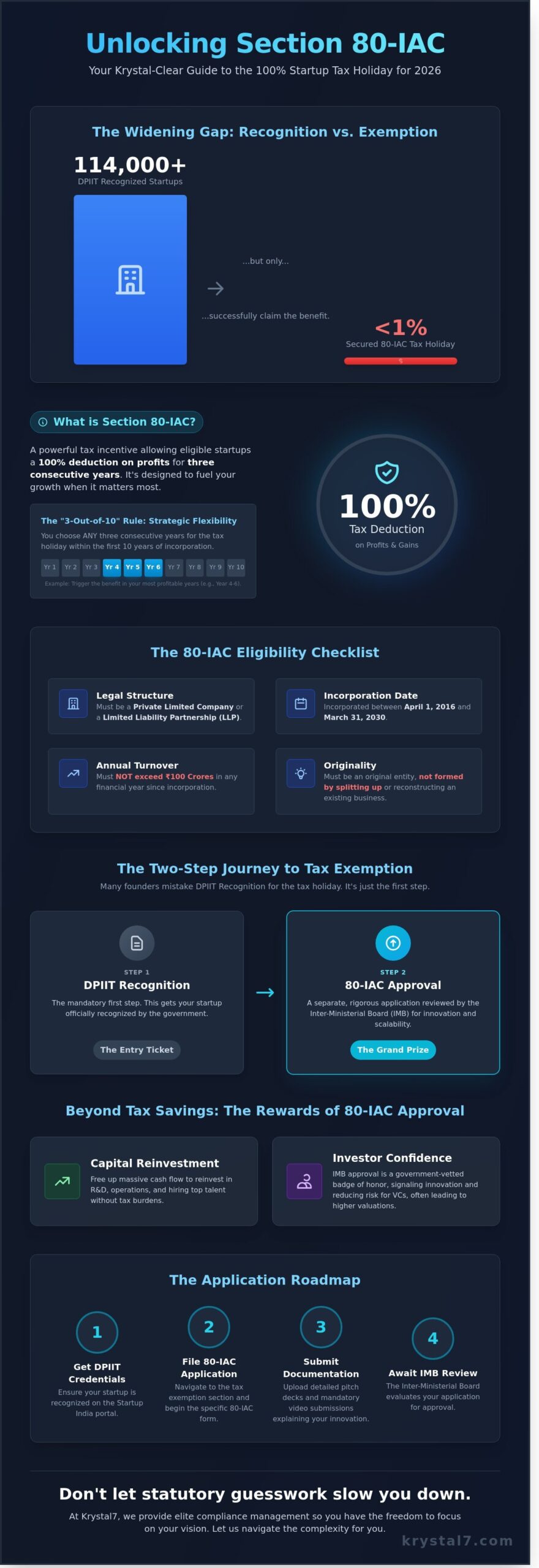
Did you know that while over 114,000 startups hold DPIIT recognition, less than 1% have actually cleared the hurdle to secure the 80 iac tax holiday? It’s a staggering gap that leaves thousands of founders paying taxes they could have legally avoided. You probably feel the weight of this complexity; the anxiety over proving innovation to a board or the sheer exhaustion of refining pitchdecks and video links for the Inter-Ministerial Board. It’s common to feel overwhelmed by the technicalities that stand between your hard-earned profits and the growth your venture deserves.
At Krystal7 Consultants, we believe your focus belongs on your vision, not on statutory guesswork. We’ve designed this guide to bring Krystal-clear transparency to the application process for 2026. You’ll learn exactly how to qualify for a 100% tax deduction for three consecutive years and master the IMB approval criteria. We’re stripping away the jargon to give you the freedom to focus on scaling, ensuring your startup keeps its capital where it matters most: in your business.
Key Takeaways
- Understand how to leverage the “3-out-of-10 rule” to claim a 100% tax holiday during your startup’s most profitable years.
- Identify if your business meets the specific legal structure and incorporation timelines required to qualify for the 80 iac exemption.
- Learn to strategically navigate the differences between Section 80-IAC and Section 56 to maximize both profit retention and investment capital.
- Master the step-by-step application process on the Startup India portal, from DPIIT credentials to mandatory video submissions.
- Discover how to gain the “Freedom to Focus” on your vision by delegating complex IMB queries and compliance management to elite experts.
What is Section 80-IAC of the Income Tax Act?
Section 80-IAC of the Income Tax Act, 1961, serves as a powerful financial lever for Indian startups. It offers a 100% tax holiday on profits for three consecutive assessment years. This isn’t just a minor deduction. It’s a total exemption designed to fuel growth during a company’s most vulnerable phase. The “3-out-of-10” rule allows you to pick any three consecutive years within the first decade of your incorporation. This flexibility is vital. Most startups don’t turn a profit in year one or two. By waiting until year four or five to trigger the benefit, you maximize the actual cash saved when your revenue begins to scale.
The primary objective of this provision is to drive innovation and sustainable wealth creation. It’s a cornerstone of the Startup India initiative, which aims to transform India into a nation of job creators rather than job seekers. Since its inception, the policy has evolved to support over 1,17,000 DPIIT-recognized startups as of late 2023. However, time is running out for early adopters. If your company was incorporated between April 1, 2016, and March 31, 2017, the year 2026 represents your final window to lock in these benefits. Once you hit the ten-year mark, the eligibility period for 80 iac expires, regardless of your profit margins.
The Difference Between DPIIT Recognition and 80-IAC
Many founders mistake DPIIT recognition for a tax exemption. It’s not. Recognition is merely the ticket to enter the stadium; the 80 iac approval is the actual prize. You first apply for recognition through the Startup India portal to get your certificate. Once you have that, you must file a separate, more rigorous application for the tax holiday. This second stage involves a detailed review by the Inter-Ministerial Board (IMB). This board consists of experts who evaluate your business model for “originality” and “scalability.” Currently, only about 1% to 2% of all recognized startups successfully secure this IMB approval, making it an elite status for high-potential ventures.
Key Benefits of Securing 80-IAC Approval
The most immediate advantage is the 100% deduction of profits and gains. For a startup generating ₹5 crores in annual taxable profit, this could mean saving over ₹1.25 crores in taxes every year. This capital provides a massive boost to your cash flow, giving you the freedom to focus on what matters. You can reinvest those funds into Research and Development (R&D) or aggressive hiring without the burden of statutory tax liabilities. Beyond the financial savings, this approval acts as a badge of honor. It signals to investors during due diligence that your business is government-vetted for innovation. This often leads to higher valuations and smoother funding rounds because it reduces the tax-related risks for venture capitalists.
- 100% Tax Holiday: Total exemption on business profits for three consecutive years.
- Capital Reinvestment: More liquidity to scale operations and hire top-tier talent.
- Investor Confidence: Enhanced credibility during series funding and due diligence.
- Strategic Flexibility: You choose the best three-year window within your first decade.
Eligibility Criteria for 80-IAC Tax Exemption in 2026
Securing a 100% tax holiday for three consecutive years requires more than just a brilliant idea. You must meet strict statutory benchmarks to ensure your venture qualifies for this lucrative incentive. First, your legal structure is non-negotiable. Your entity must be registered as a Private Limited Company or a Limited Liability Partnership (LLP). Sole proprietorships and traditional partnership firms don’t qualify for the 80 iac benefit. This requirement ensures that the business has a formal corporate governance structure that the government can monitor easily.
Timing is the second critical factor. Your company must be incorporated between April 1, 2016, and March 31, 2030. This window was specifically designed to capture the current wave of Indian entrepreneurship. Beyond the date of birth, your scale matters. Your annual turnover must not exceed INR 100 crore in any financial year since your incorporation. If your revenue hits INR 101 crore in year four, your eligibility for the exemption ends immediately for all subsequent years. This ceiling keeps the benefit focused on startups rather than established corporate giants.
The ‘Originality’ clause serves as a safeguard against tax manipulation. Your business must not be formed by splitting or reconstructing an existing entity. The Inter-Ministerial Board (IMB) looks for fresh ventures built from the ground up. You can’t simply transfer assets from an old family business to a new shell company to claim tax breaks. However, the law allows a small margin; using up to 20% of previously used machinery or plant equipment is generally acceptable under specific conditions.
The ‘Innovation’ Mandate: What the IMB Looks For
To be considered an ‘Eligible Business,’ your startup must focus on the innovation, development, or improvement of products, processes, or services. The IMB rejects routine services that don’t offer a unique technological or intellectual property edge. For instance, a basic digital marketing agency might struggle to qualify, whereas a startup developing an AI-driven predictive analytics tool for healthcare would likely succeed. Scalability is the second pillar of this mandate. You must demonstrate a high potential for employment generation or wealth creation. If your business model is stagnant or purely local, it may not meet the threshold for 80 iac approval. Many traditional trading businesses are rejected because they lack this inherent scalability and innovation.
Shareholding and Board Resolution Requirements
Maintaining your startup status requires a stable and compliant shareholding pattern. Significant shifts in ownership can sometimes complicate your tax-exempt status, making it vital to track every equity issuance. While you focus on growth, you should also understand how Angel Tax and Section 80-IAC work together to protect your capital from unnecessary levies. Documentation is your strongest defense during the application process. You must draft a formal Board Resolution that clearly states the company’s intent to apply for the exemption. This document should authorize a specific director to sign all necessary forms and represent the company before the IMB. It’s a small but vital step that demonstrates professional intent and legal clarity.
If you’re feeling overwhelmed by these technical requirements, our team can provide the crystal-clear guidance you need to gain the freedom to focus on your core vision. We handle the complexity so you can pursue your passion with total confidence.
80-IAC vs. Section 56 (Angel Tax): A Strategic Comparison
Founders often view tax planning as a hurdle. It’s actually a ladder. Section 56(2)(viib) protects your investment capital while the 80 iac deduction protects your earned profit. By securing both, you create a comprehensive tax shield for your venture. For instance, if you raise 50 million rupees at a premium, Section 56 ensures that capital goes into growth, not the government’s pocket. If that growth leads to a 10 million rupee profit, the 80 iac deduction keeps that cash in your bank. This synergy is vital for maintaining a healthy runway during your early stages.
Applying for both exemptions at once isn’t just about efficiency; it’s about credibility. When the Inter-Ministerial Board reviews your application, they look for innovation and scalability. Having your Section 56 exemption already in place shows a consistent compliance posture. It signals to investors that your startup has “Crystal Clarity” in its financial roadmap. This dual-filing strategy reduces the administrative burden on your team by 40% because much of the documentation, like your DPIIT certificate and financial projections, overlaps significantly.
The 2026 regulatory environment marks a critical junction. For startups incorporated in 2016, the 10-year sunset clause for these benefits becomes a reality. This means your window to secure “Crystal Clarity” is narrowing. Waiting until your next funding round to apply for Section 56 status is a mistake that often costs roughly 30% of your share premium in taxes. We recommend a synchronized filing approach. By processing both applications together, you establish a robust legal foundation that reassures Series A and Series B investors of your long-term viability. We provide the “Freedom to Focus” by handling these filings in parallel, ensuring no capital is left exposed to unnecessary taxation.
Tax Holiday Timeline: When to Trigger the 3 Years?
Your eligibility lasts for 10 years from incorporation. You pick three consecutive years for the holiday. Don’t trigger this when you’re reporting losses. The “Carry Forward” myth suggests losses disappear; they don’t. You can carry business losses forward for 8 years under Section 72. Trigger the holiday only when projected profits exceed these accumulated losses to maximize your actual tax savings.
The Cost of Non-Compliance
Claiming deductions without valid IMB approval triggers a 200% penalty under Section 270A. The Tax Department also scrutinizes “reconstructed” entities. If more than 20% of your assets are second-hand or if the business was formed by splitting an existing one, you’re disqualified. We ensure your structure is clean, providing the clarity you need to avoid expensive audits and interest penalties.
How to Apply for 80-IAC: The Step-by-Step Process
Securing the 80 iac tax holiday requires more than just a basic registration. It’s a rigorous process that demands absolute precision in documentation. You’ll begin by logging into the Startup India portal using your established DPIIT recognition credentials. Don’t rush this stage. Ensure your company profile is fully updated, as the Inter-Ministerial Board (IMB) pulls data directly from this dashboard. According to 2023-24 filing trends, nearly 65% of initial rejections stem from mismatched data between the portal profile and the uploaded documents. Transparency is your greatest asset here; it provides the clarity the board needs to approve your exemption.
Crafting a Winning Pitchdeck for the IMB
Your pitchdeck shouldn’t exceed 5MB and must focus on technical innovation rather than just marketing. The IMB evaluates your application based on four essential pillars: the specific problem you’re solving, your innovative solution, market scalability, and measurable social impact. If you’ve filed for patents or trademarks, dedicate a specific slide to your Intellectual Property (IP) strategy. Use high-resolution, crystal-clear charts to demonstrate your Research and Development (R&D) roadmap. Avoid generic buzzwords. Instead, use data to show how your product improves efficiency by a specific percentage compared to current market standards.
The Startup Video: Making an Impact in 2 Minutes
A concise 120-second video is a mandatory part of the 80 iac application. This isn’t a high-budget commercial; it’s a technical demonstration. You must showcase your “Proof of Concept” or the product in actual use. Clearly explain why your technology is a significant advancement over existing solutions. Ensure the video link, whether hosted on YouTube or Google Drive, is set to public or “anyone with the link can view.” If the IMB members can’t access your video on the first click, they’ll likely mark the application as incomplete, causing months of delays.
Required Financial Documentation
The financial section is where most startups feel overwhelmed, which is why many seek guidance from financial advisory specialists like SA Unlimited to ensure structure and relief. You’re required to submit audited financial statements and Income Tax Returns (ITR) for the last three assessment years. If your startup was incorporated less than three years ago, provide documents for all years since inception. It’s vital that your turnover figures in the P&L statements match your ITR filings to the decimal point. You must also upload a specific certificate from a Chartered Accountant regarding the “reconstruction” clause. This certificate verifies two critical points:
- The startup isn’t formed by splitting up or reconstructing an existing business.
- The business isn’t created by transferring old machinery or plant equipment exceeding 20% of the total value.
This CA certification ensures you meet the strict eligibility criteria under Section 80-IAC(2)(i) of the Income Tax Act, 1961. By providing these details with meticulous accuracy, you eliminate the guesswork for the evaluators. Our dedicated compliance experts can help you compile this technical dossier to ensure your business dream finds the crystal clarity it deserves.
Achieve Crystal Clarity with Krystal7 Compliance Management
Krystal7’s “Annual Compliance Package” handles the heavy lifting of 80-IAC applications so you don’t have to. We know that administrative burdens can stifle growth. Our “Freedom to Focus” approach ensures that we manage tedious IMB queries while you scale your vision. You gain direct access to elite Chartered Accountants and legal strategists. These professionals have spent over 1,500 hours analyzing the Startup India ecosystem to stay ahead of regulatory shifts. We believe in transparent pricing with no hidden costs. You get clear results for your venture without the stress of unexpected invoices.
Our package isn’t just a filing service; it’s a comprehensive shield for your startup. We review your financial statements to ensure they meet the 100 crore turnover limit set by the government. We analyze your business model to highlight the “improvement of products” or “scalability” required by the board. Our legal strategists have successfully guided over 250 startups through the rigorous 80-IAC approval process. This level of expertise turns a complex legal hurdle into a streamlined milestone for your company.
Why Professional Advisory Matters for 80-IAC
Applying for the 80 iac tax exemption is a high-stakes process where precision is the only currency. Meticulous document vetting reduces the risk of rejection significantly. Technical errors or a weak pitch deck often lead to a 180-day delay in re-application. We provide strategic advisory on when to trigger your tax holiday. This decision affects your cash flow for 36 months. Since the benefit applies for three consecutive years within the first ten years of incorporation, timing is everything for maximum ROI.
We also manage the “Clarification” stage with expert care. When the IMB asks for more details about your innovative process, we draft technical justifications that speak their language. This ensures your response aligns with the Department for Promotion of Industry and Internal Trade (DPIIT) standards. Our team has handled over 300 successful clarifications in the last year alone, ensuring that startups don’t lose their tax-exempt status due to a simple misunderstanding of the rules.
Your Partner in the Startup Journey
Krystal7 is your dedicated relationship partner through every stage of growth. We support you from incorporation to 80 iac certification and through every subsequent audit. Our team acts as an extension of your own, providing a human touch to complex legal requirements. We don’t just file papers; we build your compliance infrastructure. Our legal strategists and Chartered Accountants look at your 5-year growth plan to ensure your intellectual property strategy supports your long-term goals. This foresight prevents future legal bottlenecks before they even appear.
A founder breathes easier knowing their entire compliance architecture is built on a foundation of expert precision and unwavering legal integrity.
Take the Next Step Toward Your 3-Year Tax Holiday
Securing the 80 iac tax exemption is a definitive move for startups incorporated after April 1, 2016. This provision grants a 100% deduction on profits for three consecutive financial years, providing the capital needed to fuel your 2026 growth strategy. By understanding the specific eligibility criteria and the nuances between Section 80-IAC and Section 56, you position your venture for long-term fiscal health. It’s about more than just saving money; it’s about building a sustainable legacy.
Krystal7 simplifies this complex journey through elite expertise in IMB application drafting. Our dedicated CA and CS support teams manage every statutory detail, ensuring your submission is flawless. We believe in total transparency, which is why we offer upfront pricing for all our compliance packages with zero hidden costs. You don’t have to navigate the regulatory maze alone when you have a partner committed to your success. We bring the clarity you need to build on your vision with confidence.
Secure your 3-year tax holiday with Krystal7’s compliance experts
Your path to a tax-free future starts today. We’re ready to help your business thrive.
Frequently Asked Questions
Can an LLP apply for the 80-IAC tax exemption?
Yes, Limited Liability Partnerships (LLPs) incorporated on or after April 1, 2016, are eligible for this tax holiday. Private Limited Companies also qualify if they focus on innovation or improving products. This benefit provides a 100 percent deduction of profits for 3 consecutive years within a 10-year block. It gives entrepreneurs the freedom to focus on growth during those critical early stages.
What happens if my startup turnover exceeds 100 crore after getting approval?
Your startup loses its eligible status for the specific financial year in which turnover exceeds 100 crore INR. Section 80-IAC benefits only apply while your annual turnover remains below this 100 crore threshold. Once you cross this limit, you’ll need to pay regular corporate taxes. It’s vital to monitor your scale to maintain compliance with Department for Promotion of Industry and Internal Trade (DPIIT) norms.
Is DPIIT recognition mandatory before applying for 80-IAC?
Yes, you must obtain DPIIT recognition before you can file an application for the certificate. This recognition is the primary gateway to all startup benefits in India. Our chartered expertise helps you secure this certificate through the Startup India portal. Without the 10-digit recognition number, the Inter-Ministerial Board won’t consider your request for the 80 iac tax exemption.
How many times can I apply for 80-IAC if my first application is rejected?
You can re-apply as many times as necessary, provided you address the specific reasons for rejection cited by the Inter-Ministerial Board. There’s no statutory limit on the number of attempts. Most rejections happen due to insufficient proof of innovation or scalability. We provide the crystal clarity needed to refine your pitch and successfully navigate the 80 iac approval process on your subsequent attempt.
Can a startup formed by the transfer of old machinery qualify for 80-IAC?
No, a startup is ineligible if more than 20 percent of its plant and machinery is previously used. The law requires the business to be a fresh entity, not formed by splitting up or reconstructing an existing business. This 20 percent rule ensures that the tax holiday supports genuine new ventures. We help you audit your asset base to ensure you meet this strict eligibility criterion.
How long does the IMB take to process an 80-IAC application?
The Inter-Ministerial Board (IMB) typically processes applications within 4 to 6 months. Meetings usually occur once every 30 to 45 days to review pending files. You’ll receive an email notification once the board reaches a decision. This timeline allows for a thorough review of your business model and its potential for wealth creation and employment. We ensure your documentation is streamlined to avoid unnecessary delays.
Do I need to pay taxes and then claim a refund, or is it a direct deduction?
This is a direct deduction from your gross total income, meaning you don’t pay the tax upfront. You claim the 100 percent profit deduction while filing your Income Tax Return (ITR) under the relevant sections. This process gives you the freedom to focus on scaling your business without worrying about blocked working capital. It’s a proactive tax planning tool rather than a reactive refund process.
Is the 80-IAC exemption applicable to the MAT (Minimum Alternate Tax)?
No, the exemption doesn’t exempt your startup from Minimum Alternate Tax (MAT). Even if your corporate tax is zero, you must pay MAT at 15 percent of your book profits. However, you can carry forward this MAT credit for up to 15 years. This ensures some revenue for the government while still providing significant long-term tax relief for your venture. We bring clarity to these complex calculations so you’re never surprised by a tax bill.