
FPO Mark Full Form: The Essential Guide to Fruit Product Compliance in India (2026)
What if a single missing sticker on your fruit preserve jar triggered a 5 lakh rupee penalty and a mandatory business suspension? For many Indian food entrepreneurs, the fear of non compliance is a constant shadow over their growth. Understanding the fpo mark full form, which stands for Fruit Products Order, is the essential first step to lifting that burden. This mark isn’t just a label; it’s a legal guarantee that your products meet the rigorous safety standards set by the government for processed fruit items.
You probably feel that the overlapping requirements of FSSAI and AGMARK create an unnecessary maze of paperwork. It’s a common frustration that can stall even the most ambitious vision. We promise to provide the crystal clarity you need to navigate these regulations with confidence. This guide offers a streamlined roadmap for the 2026 application process, helping you secure your certification without the usual stress. We’ll break down the specific products that require the mark and provide a simple checklist to ensure your business stays protected and professional.
Key Takeaways
- Understand that the fpo mark full form stands for the Fruit Products Order, a mandatory quality benchmark for all processed fruit businesses in India.
- Navigate the 2026 regulatory shift to see how FSSAI has integrated FPO standards to streamline food safety and statutory compliance.
- Identify the specific list of beverages and solids, such as squashes and jams, that require this certification to ensure your products are legally market-ready.
- Follow a clear, step-by-step roadmap for unit preparation and documentation to eliminate guesswork during the application process.
- Discover how Krystal7 provides the “Freedom to Focus” by bringing crystal clarity to your licensing journey and handling complex paperwork on your behalf.
What is the FPO Mark Full Form and Why Does It Exist?
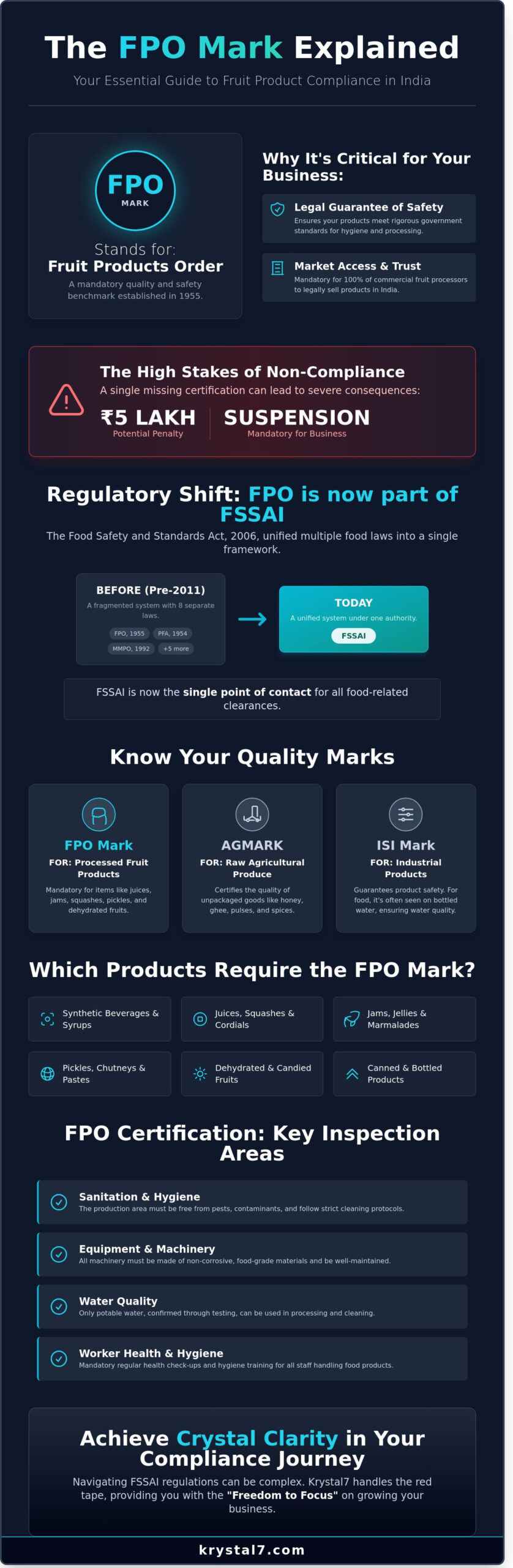
The fpo mark full form stands for the Fruit Products Order, a regulatory framework established in 1955 to govern the manufacturing of fruit-based commodities in India. The FPO mark stands as the primary quality benchmark for Indian fruit processors since 1955. It isn’t just a voluntary badge of honor; it’s a legal mandate. Every unit processing fruit products must obtain this certification to ensure their goods meet specific safety standards. This requirement applies to 100% of commercial operations producing items like bottled fruit juices, squashes, dehydrated fruit slices, and pickles.
This FPO certification mark guarantees that the food was prepared in a facility that adheres to strict sanitary protocols. It ensures that the manufacturing environment is hygienic and sanitized, preventing contamination that could lead to foodborne illnesses. For an entrepreneur, this mark represents crystal clarity in compliance. It provides a structured path to follow, removing the guesswork from factory setup and quality control. When a business displays this mark, it signals to the market that they prioritize consumer health over shortcuts.
The existence of the fpo mark full form provides a level playing field for all fruit processors. It sets a baseline for ingredients, preservatives, and coloring agents. Without these regulations, the market could be flooded with substandard goods that use harmful synthetic additives. By enforcing these rules, the government protects the “Freedom to Focus” for business owners, allowing them to scale their ventures with the confidence that they meet national statutory requirements. It’s a foundational element for any brand aiming to build a long-term legacy in the Indian food industry.
The Historical Significance of the Fruit Products Order
The Ministry of Food Processing Industries introduced the Fruit Products Order in 1955 to curb the rising cases of food adulteration. At that time, consumers had no way to verify the purity of processed beverages. The order created a systematic inspection process for factories. While the food safety landscape evolved significantly with the Food Safety and Standards Act of 2006, the FPO standards remain the bedrock of the industry. Even as we move through 2026, these guidelines ensure that fruit-based products maintain consistent nutritional integrity and safety across all Indian states.
FPO vs. Other Quality Marks (AGMARK and ISI)
Understanding the difference between various quality marks is essential for business transparency. While the FPO mark specifically targets processed fruit products, AGMARK is used for raw agricultural produce like honey, ghee, or pulses. In some cases, a product might require a dual approach. For example, a manufacturer producing fruit-flavored bottled water must comply with ISI standards for water quality and FPO-derived standards for the fruit additives. This distinction provides consumers with clear, recognizable symbols on packaging, helping them make safe purchasing decisions in under 3 seconds.
To maintain high standards, the FPO certification involves rigorous checks on:
- Sanitation: Ensuring the production area is free from pests and contaminants.
- Equipment: Verifying that machinery is made of non-corrosive materials.
- Water Quality: Confirming that only potable water is used in processing.
- Worker Hygiene: Mandating regular health check-ups for staff handling food.
By adhering to these meticulous details, businesses don’t just follow the law; they build trust. Krystal7 understands that navigating these legal formalities can feel overwhelming. Our goal is to provide the chartered expertise needed to streamline your certification process. We handle the red tape so you can focus on the vision of your growing venture.
Understanding the 2026 Regulatory Framework: FPO and FSSAI
The regulatory landscape for fruit processing in India underwent a massive shift when the Food Safety and Standards Act of 2006 took full effect in August 2011. This legislation didn’t just add new rules; it unified eight different aging laws into a single, streamlined framework. While many entrepreneurs still search for the fpo mark full form to understand their roots, the Fruit Products Order of 1955 was officially integrated into the FSSAI regime to provide better transparency for consumers and businesses alike. Today, the FSSAI acts as the single point of contact for all food-related clearances, replacing the fragmented system of the past.
The Transition from 1955 to the FSSAI Regime
The USDA Foreign Agricultural Service documented the repeal of the Fruit Products Order as a pivotal step toward global safety alignment. By 2026, the FSSAI logo is the only mandatory mark on retail packaging for fruit products. You won’t find the old FPO square mark on new labels, yet its technical spirit lives on. Manufacturers still refer to legacy FPO standards because those original guidelines defined the specific brix levels, acidity, and fruit pulp percentages that FSSAI eventually adopted. When a Food Safety Officer (FSO) visits a facility today, they don’t just look for a license; they audit the entire production flow to ensure it matches these consolidated benchmarks.
Modern audits focus on three specific areas:
- Traceability: The ability to track raw fruit from the farm to the finished bottle.
- Process Validation: Documentation proving that pasteurization or preservation methods actually kill pathogens.
- Label Accuracy: Ensuring the fpo mark full form history is respected through honest ingredient listings.
Compliance Requirements for Modern Food Startups
Launching a fruit venture in 2026 requires meticulous planning of the processing unit’s physical layout. You must meet strict Sanitary and Hygienic Conditions (SHC) under Schedule 4 of the FSSAI regulations. This means your facility needs a unidirectional flow of material to prevent cross-contamination. Water quality is a top priority for inspectors; you’re required to provide a lab report every six months confirming that your water meets IS 10500 standards. Furthermore, roughly 90% of equipment in a modern unit must be constructed from food-grade stainless steel, such as SS304 or SS316, to prevent metallic leaching into acidic fruit products.
Operating without these safeguards isn’t just a business risk; it’s a legal liability. Under Section 63 of the FSS Act, running a processing unit without a valid license can lead to imprisonment for up to six months and a fine of up to 5,00,000 rupees. These penalties are designed to protect public health and ensure that every product on the shelf maintains high quality. If you find these technical requirements daunting, our experts can help you achieve clearance with crystal clarity so you can focus on your brand’s growth. Detailed record-keeping, including daily temperature logs and pest control certificates, remains the best defense during a surprise inspection. By 2026, digital record-keeping has become the standard, helping 85% of startups pass their initial audits without major non-compliance issues.
Which Food Products Specifically Require the FPO Mark?
The Fruit Products Order (FPO) of 1955 serves as a mandatory benchmark for quality and safety in India. Understanding the fpo mark full form, which stands for Fruit Products Order, is the first step for any food processor aiming for market clarity. This certification ensures that processed fruit and vegetable items are manufactured in a hygienic environment and meet specific nutritional thresholds. It’s a statutory requirement that applies to a broad spectrum of goods, ranging from breakfast spreads to bottled beverages.
The FPO mandate encompasses various categories of processed items. Manufacturers must adhere to these standards to ensure their products are legally compliant and safe for public consumption. These categories include:
- Fruit-based beverages: This includes squashes, crushes, cordials, and fruit-infused syrups.
- Processed solids: Jams, jellies, marmalades, and even candied fruit peels fall under this umbrella.
- Vegetable products: Tomato-based items like ketchups, sauces, and various vegetable pickles.
- Preserved items: Canned fruits, dehydrated fruit slices, and synthetic syrups or sharbats.
Each of these products must meet specific chemical and physical parameters. For example, dehydrated fruits must maintain a moisture content that prevents microbial growth, typically below 20% depending on the fruit variety. Synthetic syrups, while not containing real fruit, are regulated to ensure the flavors and colors used are food-grade and safe. This meticulous oversight gives entrepreneurs the freedom to focus on their growth, knowing their quality control aligns with national standards.
Beverages and Liquid Fruit Products
Beverages face strict scrutiny under these guidelines. A product labeled as a fruit nectar generally requires a minimum of 20% to 40% fruit pulp. Carbonated fruit beverages are different; they must contain at least 5% fruit juice to carry the certification. Barley water is another specialized category, requiring a minimum of 25% fruit juice and 0.25% barley extract. Vinegar production also requires clear labeling. Manufacturers must distinguish between synthetic vinegar, made from glacial acetic acid, and natural vinegar derived from grapes or malt. This distinction ensures transparency for the end consumer.
Preserves and Pickles
Preserves like jams and jellies must meet precise chemical compositions to ensure shelf stability. A standard jam requires at least 45% fruit content by weight and a Total Soluble Solids (TSS) level of 68% or higher. These numbers are vital for preventing spoilage without excessive chemical preservatives. Pickles preserved in oil must maintain a minimum of 10% oil by weight to create a protective barrier against contaminants. Tomato ketchup is categorized here because tomatoes are botanically fruits. To be certified, ketchup must contain at least 25% TSS. By following the fpo mark full form guidelines, businesses build a legacy of trust and quality that resonates with every customer.
Adhering to these specific requirements removes the guesswork from food production. It transforms a complex regulatory landscape into a streamlined path for your business venture. When your products meet these defined standards, you’re not just following the law; you’re promising excellence. This commitment to statutory compliance is what separates a fleeting brand from a lasting industry leader.
The FPO Certification Process: A Step-by-Step Roadmap
Obtaining certification shouldn’t feel like a complex maze. We provide the clarity you need to move from a vision to a licensed reality. Understanding the fpo mark full form, which stands for Fruit Products Order, is the first step in recognizing the legal standards your business must meet. This process ensures your products are safe, standardized, and ready for the Indian market.
Step 1 involves the meticulous preparation of your processing unit. Your facility must mirror the rigorous standards set by FSSAI Schedule 4 guidelines. These rules dictate everything from the slope of your drainage systems to the non-porous nature of your wall surfaces. Compliance creates confidence. It’s not just about passing an audit; it’s about building a foundation for a legacy brand.
The second phase focuses on gathering mandatory documentation and laboratory test reports. You’ll need to prove that your ingredients and finished products meet specific safety thresholds. Since the 2020 transition to the FoSCoS (Food Safety Compliance and System) portal, the fpo mark full form requirements have been integrated into a unified digital framework. This streamlines the journey for entrepreneurs who want to avoid unnecessary red tape.
Once documents are ready, Step 3 is the online application filing through the FoSCoS portal. Accuracy is vital here. A single typo in your manufacturing capacity or category code can lead to delays. After submission, Step 4 triggers a physical inspection by a designated Food Safety Officer. They’ll verify that your on-site reality matches your digital claims. Finally, Step 5 is the grant of the license, giving you the legal right to display the mark on your packaging.
Mandatory Documents for Your Application
Precision in paperwork prevents delays. You must provide proof of possession for your premises, such as a registered sale deed or a rent agreement valid for at least 12 months. A detailed list of machinery, including horsepower and capacity, is required to verify your production scale. You must also include a water analysis report from a NABL-accredited lab confirming compliance with IS: 10500 standards. Blueprints of the unit must clearly show the flow of materials to prevent cross-contamination.
Preparing for the Physical Inspection
Data from 2023 shows that 28% of applications face initial rejection due to preventable hygiene issues. Inspectors look for up-to-date medical fitness certificates for every staff member and a strict pest control plan. At Krystal7, we help local businesses in Gurugram prepare for zero-defect audits by conducting pre-inspection walkthroughs. We identify gaps in your “Plan of Layout” and sanitation protocols before the official Food Safety Officer arrives. This proactive approach gives you the freedom to focus on your craft while we handle the technical scrutiny.
Stop guessing and start growing with our expert compliance support. Get started with Krystal7 today to secure your certification with absolute clarity.
Achieving Crystal Clarity: How Krystal7 Streamlines Your Compliance
The journey to launching a fruit processing unit often starts with a search for the fpo mark full form, but it quickly evolves into a complex web of regulatory filings. For most entrepreneurs, the initial excitement of creating a product is dampened by the 40 plus pages of statutory documentation required by various departments. Krystal7 changes this narrative. We believe your primary job is to innovate and scale, not to get lost in the labyrinth of government portals. By shifting the burden of compliance to our team of legal strategists, you regain the freedom to focus on your brand’s vision.
Our all-in-one approach handles every stage of your food business lifecycle. Whether you’re just starting with your company incorporation or need to renew an existing license, we provide a single point of contact for your entire legal department. Since January 2024, we’ve helped over 150 food ventures transition from concept to market-ready status by managing their MCA, GST, and FSSAI requirements under one roof. This integrated model eliminates the communication gaps that occur when you hire different consultants for different tasks.
A standout feature of the Krystal7 experience is your dedicated relationship manager. This isn’t a generic support desk; it’s a professional who understands your specific business model. They track your annual filing dates and notify you 30 days before any expiration. This proactive stance ensures you never face the 100 INR per day penalties often associated with late FSSAI or FPO related renewals. Meticulous certification isn’t just about following the law. It’s about positioning your brand as a quality leader in a market where 82% of consumers now check for certification marks before purchasing.
Why Krystal7 is Your Trusted Partner in Growth
Krystal7 brings elite expertise to the table by handling MCA, GST, and FSSAI/FPO registrations simultaneously. This synchronized strategy cuts your total licensing time by approximately 25%. Transparency is our core pillar. We provide Krystal-Clear pricing with zero hidden costs, so you know exactly what your investment covers from day one. We turn complex statutory requirements into a streamlined business asset, ensuring your fpo mark full form knowledge translates into a valid, revenue-generating certification.
- Expert Oversight: Access to top-tier Chartered Accountants and legal strategists.
- Real-Time Updates: Track your application status through a simplified dashboard.
- Cost Efficiency: Bundled packages that save up to 15% compared to individual filings.
Next Steps for Your Fruit Processing Venture
Timing is everything in the food industry. You should ideally start your compliance process at least 60 days before your planned launch to avoid supply chain delays. While securing your FPO certification is vital, don’t overlook the importance of protecting your brand identity. Integrating trademark protection with your FPO filing ensures that no competitor can capitalize on the reputation you’ve built. This dual-layer protection creates a legacy of trust and quality for your venture. Understanding trademark registration fees in India helps you budget accurately for this essential brand protection investment alongside your food safety compliance costs.
Ready to move past the paperwork and start producing? Clarity is just a click away. Schedule a consultation with Krystal7 to secure your FPO compliance today.
Secure Your Fruit Business for 2026 and Beyond
Navigating India’s evolving food safety landscape requires more than just knowing that the fpo mark full form stands for Fruit Products Order. By 2026, every fruit processor must align with the unified FSSAI standards to avoid penalties that can reach 5 lakh rupees or lead to license cancellation. You’ve learned how the certification process safeguards your brand’s integrity and why specific products like jams, squashes, and dehydrated fruits need this mandatory seal to enter the retail market. Don’t let complex paperwork stall your growth or cause unnecessary stress. Our team of top-tier Chartered Accountants and legal strategists handles the heavy lifting so you don’t have to. We provide Krystal-Clear transparency with zero hidden costs, ensuring you know exactly where your investment goes. Our comprehensive annual compliance packages offer total peace of mind for your venture year after year. You focus on crafting quality products; we’ll handle the statutory red tape. It’s time to turn your business vision into a regulated, successful reality.
Get Your Food Business Certified with Krystal7
Your journey toward a thriving, compliant food brand starts today and we are ready to help you grow.
Frequently Asked Questions
Is the FPO mark still mandatory in 2026?
No, the FPO mark is no longer mandatory because the FSSAI logo replaced it. The Food Safety and Standards Act of 2006 repealed the Fruit Products Order of 1955. For your business in 2026, you’ll need an FSSAI license to stay compliant and protect your brand’s legacy.
What is the difference between FPO and FSSAI?
The FPO mark was a specific certification for fruit-based products, whereas FSSAI is a unified regulatory body for all food items. Since August 5, 2011, FSSAI has consolidated various food laws to provide krystal-clear transparency. Understanding the fpo mark full form helps you see how food safety evolved into a single, streamlined system.
Can I apply for an FPO mark online?
You can’t apply for a standalone FPO mark today; instead, you must apply for an FSSAI license through the FoSCoS portal. This 100% digital process allows entrepreneurs to secure a 14-digit registration number from their own office. It’s a streamlined way to gain the freedom to focus on your product quality rather than paperwork.
What are the penalties for selling fruit products without an FPO/FSSAI mark?
Selling fruit products without a valid FSSAI license can result in a fine of up to ₹5 lakh and imprisonment for up to 6 months. These penalties, defined under Section 63 of the FSS Act, 2006, apply to any business operating without statutory approval. We help you avoid these risks by ensuring your compliance is meticulous and up to date.
How long is the FPO certification valid?
Modern FSSAI licenses, which replaced the old FPO system, are valid for a period of 1 to 5 years. Business owners choose their preferred duration during the initial application process. You must apply for a renewal at least 30 days before the expiration date to ensure your operations continue without any legal hurdles.
Does a small home-based pickle business need an FPO mark?
Yes, every food business with an annual turnover below ₹12 lakh requires a basic FSSAI Registration to operate legally. If your pickle business grows beyond the ₹12 lakh threshold, you’ll need to upgrade to a State License. This registration provides the clarity you need to build customer trust right from your home kitchen. Before starting any food business, you’ll also need to obtain your business registration certificate to establish your legal entity and prove your business is officially recognized by the government.
What is the full form of FPO in the food industry?
The fpo mark full form is the Fruit Products Order. It was originally established in 1955 to ensure that fruit and vegetable products met specific health and quality standards in India. While the FSSAI logo is now the legal requirement, the FPO history remains a foundational part of India’s food safety journey.
How much does it cost to get an FPO license in India?
The government fee for a basic FSSAI registration is ₹100 per year, while State Licenses typically cost between ₹2,000 and ₹5,000 annually. These costs depend on your production capacity and the specific nature of your venture. We provide upfront pricing with no hidden costs so you can plan your business growth with confidence. Additionally, you’ll need to factor in the cost of obtaining your business registration certificate as the foundational legal document that establishes your company’s legitimacy before applying for any specialized licenses.

Article by
Nihal Srivastava
Nihal Srivastava is the Co-Founder of Krystal7 Consultants, helping Indian entrepreneurs and startups navigate company registration, compliance, trademark protection, and regulatory requirements with clarity and confidence. With 6+ years of hands-on expertise in MCA filings, GST compliance, and corporate structuring, Nihal has guided 1000+ businesses across India through their legal and compliance journeys. He believes every business dream deserves crystal clear foundations, and that no founder should be held back by paperwork or red tape.




![PMFME Loan Scheme: A Complete Guide for Food Entrepreneurs [2026]](https://blogs.krystal7.com/wp-content/uploads/2026/04/PMFME-Loan-Scheme-A-Complete-Guide-for-Food-Entrepreneurs-2026-Hero-Image-768x439.jpg)