

One Person Company Registration Online: The 2026 Clarity Guide
What if the only thing standing between your solo venture and a legal corporate identity was a single, transparent digital process? Since the introduction of the Companies Act, 2013, over 45,000 entrepreneurs have chosen this path, yet approximately 65% of founders still struggle with the MCA V3 portal navigation. You likely worry about hidden government fees or the specific nominee requirements that often trigger technical rejections. It’s natural to feel overwhelmed when you just want the freedom to focus on your vision.
We agree that one person company registration online should be an empowering milestone, not a source of anxiety. This 2026 clarity guide promises to help you master every legal requirement and document needed for a successful incorporation with absolute transparency. We’ll strip away the confusion to ensure you secure your limited liability protection without the usual guesswork.
You’ll find a clear breakdown of the SPICe+ form process: the precise list of documents for your nominee: and a transparent view of recurring compliance costs. This overview covers everything from initial filing to receiving your incorporation certificate. Let’s turn your business dream into a protected, scalable reality.
Key Takeaways
- Understand the legal framework under Section 2(62) of the Companies Act 2013 to secure your personal assets through a separate legal entity.
- Master the systematic one person company registration online process using the integrated SPICe plus Web form and Digital Signature Certificates.
- Compare the benefits of an OPC against a sole proprietorship: focusing on the critical advantages of limited liability and perpetual succession.
- Prepare the necessary KYC documentation for the member and nominee to ensure a streamlined application without common filing errors.
- Discover how to maintain statutory compliance and avoid the additional fee of INR 100 per day for late filings under the Companies Act.
Legal Framework and Applicability of One Person Company Registration
Last updated on: January 15, 2024 for 2026 regulations.
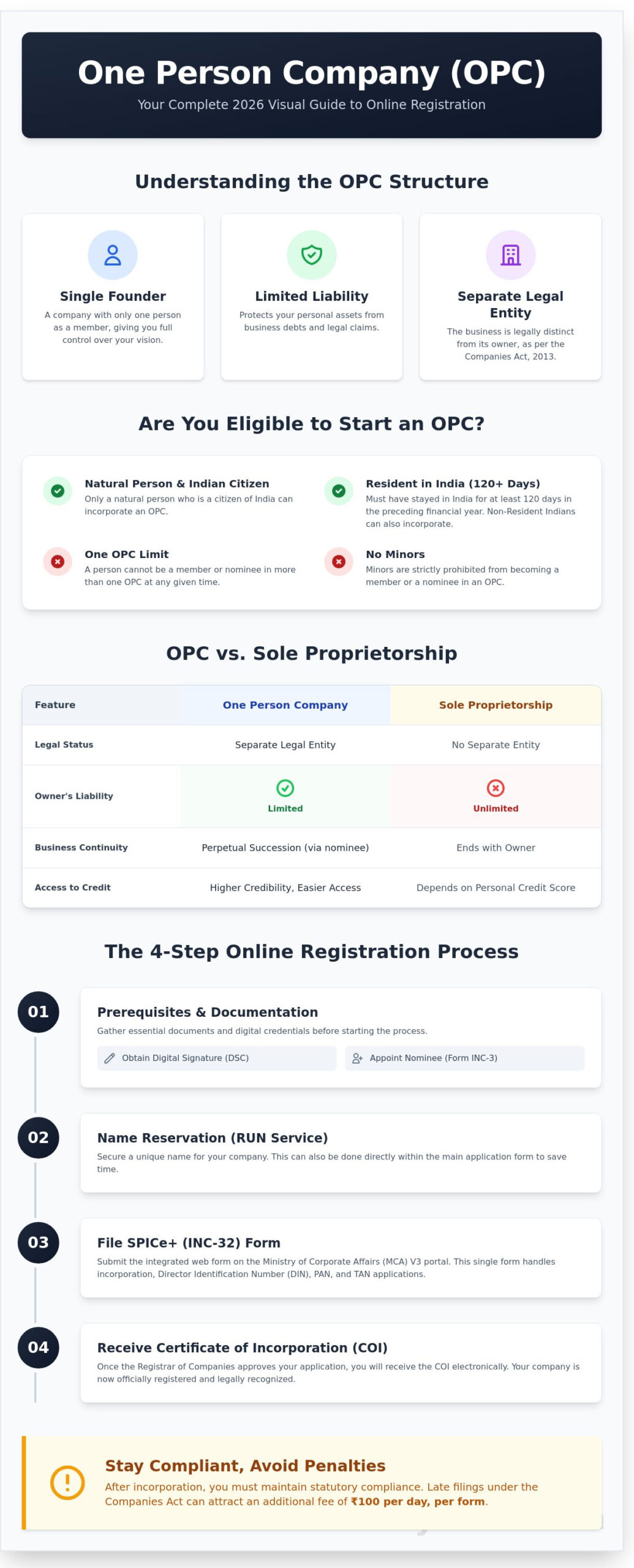
The One Person Company (OPC) model represents a landmark shift in Indian corporate law. Under Section 2(62) of the Companies Act 2013, an OPC is defined as a company that has only one person as a member. This structure offers solo founders the benefit of a separate legal entity. It ensures that the owner’s personal assets remain protected from business liabilities through limited liability protection.
When you opt for the One Person Company legal framework, you gain the credibility of a corporate structure while maintaining full control. This legal setup is ideal for visionaries who want to scale without the immediate need for partners. Starting your one person company registration online simplifies the path to institutional credit and global recognition for your brand.
Talk to Krystal7 to see if your business qualifies for the 2026 regulatory benefits and streamlined filing processes.
Applicability Thresholds and Eligibility
Rule 3 of the Companies (Incorporation) Rules 2014 sets strict eligibility criteria for founders. Only a natural person who is an Indian citizen is eligible to incorporate an OPC. The residency requirement was relaxed to encourage entrepreneurship. Now, a person staying in India for at least 120 days during the immediately preceding financial year qualifies as a resident.
There are limits to prevent the misuse of this structure. A natural person cannot be a member or a nominee in more than one OPC at any given time. Additionally, minors are strictly prohibited from becoming members or nominees. This ensures that the person managing the entity has the legal capacity to enter into binding contracts and fulfill statutory duties.
The Role of the Nominee in One Person Company Registration Online
Section 3(1)(c) of the Companies Act 2013 mandates the appointment of a nominee. This person steps in if the original member dies or becomes incapacitated. The nominee must provide written consent through Form INC 3. This document is a critical part of your one person company registration online application process to ensure business continuity.
Changing a nominee is a structured process under Rule 4 of the Companies (Incorporation) Rules 2014. The member can change the nominee at any time by giving notice to the Registrar of Companies (ROC). The new nominee must also provide consent via Form INC 3. This ensures that the legal standing of the entity remains intact without administrative hurdles or operational gaps.
- Verify your residency status by checking your passport entry stamps for the 120 day threshold.
- Identify a trusted individual to act as your nominee and obtain their signed Form INC 3.
- Confirm you are not already a member or nominee in another registered OPC before starting.
The Systematic Online Registration Process via SPICe Plus
The Ministry of Corporate Affairs transformed the one person company registration online experience through the MCA21 portal. This centralized digital system utilizes the SPICe plus web form. It functions as an integrated suite that streamlines several statutory services into a single filing process. This transition has significantly reduced the time required to start a business in India.
Before you begin the application, every director and shareholder must obtain a Digital Signature Certificate. This DSC is essential for identity verification in a paperless environment. The registration process often starts with name reservation through the RUN service. However, entrepreneurs can also apply for a name directly within the SPICe plus form to save time. This flexibility allows for a more efficient setup for new ventures.
Recent regulatory changes have made this structure even more accessible. The official amendments to OPC regulations introduced in February 2021 reduced the residency limit for Indian citizens from 182 days to 120 days. This amendment also allows Non Resident Indians to incorporate an OPC in India. Once the Registrar of Companies verifies the digital submission, they issue the Certificate of Incorporation. This COI serves as the birth certificate of your legal entity.
Step by Step Guide to Filing SPICe Plus
The SPICe plus form consists of two functional segments. Part A is dedicated to name reservation for the proposed entity. Part B handles the application for the Director Identification Number for the individual director. You must also draft the electronic Memorandum of Association in Form INC 33 and the electronic Articles of Association in Form INC 34. These documents establish the company’s constitution and internal regulations. The system also triggers the auto generation of PAN and TAN applications for the company.
Forms and Portals Involved
All filings for one person company registration online occur on the official mca.gov.in portal. Form INC 32 serves as the primary application for incorporation. You must also submit the Agile Pro S form, also known as Form INC 35. This single form facilitates several registrations including GST, ESIC, and EPFO. It even assists in the mandatory process of opening a corporate bank account. This integrated approach ensures that your business is ready for operations immediately after approval.
Krystal7 Service Integration
Navigating these technical forms requires meticulous attention to detail to avoid rejection. You can Talk to Krystal7 for a seamless SPICe plus filing experience. Our Krystal7 Company Incorporation Package provides end to end support for visionaries. We manage the complex compliance requirements so you can enjoy the freedom to focus on your growth. Our experts ensure your documentation is crystal clear and legally sound.
- Apply for a Class 3 Digital Signature Certificate for the director and nominee.
- Select at least two unique business names that comply with the Companies Act 2013.
- Gather scanned copies of identity and address proofs for all involved parties.
Compliance is easy when it is systematic.
Evaluating the Benefits: One Person Company versus Other Structures
Choosing the right business vehicle defines your professional trajectory. An OPC offers a unique middle ground for solo founders. It provides the legal stature of a company while maintaining the control of a proprietorship. The primary advantage is limited liability protection under the Companies Act 2013. This legal separation ensures your personal assets, such as your home or private savings, remain shielded from business debts. In a traditional sole proprietorship, the owner and business are a single legal entity, which places 100 percent of your personal wealth at risk.
Perpetual succession ensures your business vision outlives any individual. Unlike a proprietorship that ceases to exist upon the owner’s death, an OPC continues its legal life. Rule 4 of the Companies (Incorporation) Rules 2014 requires you to nominate a person who will take over in such events. This structure builds a stable foundation for a long term legacy. Furthermore, corporate credibility is significantly higher for an OPC. Banks and financial institutions favor registered entities over unorganized ones, which simplifies the process of securing business loans for expansion.
Are you ready to elevate your business with the protection of a corporate shield? Book a call with our legal strategists to start your one person company registration online and gain the freedom to focus on your growth.
Taxation for an OPC follows a flat structure. The base income tax rate is 30 percent. You must also include a 4 percent Health and Education Cess on the tax amount. If your total income exceeds 10,000,000 INR, a 7 percent surcharge applies. While these rates differ from individual tax slabs, the ability to deduct business expenses and the ease of one person company registration online often present a more professional financial profile to global partners.
OPC versus Private Limited Company
A Private Limited Company requires a minimum of two members and two directors. An OPC is designed specifically for the solo visionary, requiring only one member. You also benefit from reduced administrative burdens. Section 173(5) of the Companies Act 2013 exempts an OPC from holding four board meetings annually. You only need to conduct one meeting in each half of a calendar year, provided the gap between the two meetings is not less than 90 days. This streamlined compliance allows you to spend more time on innovation.
OPC versus Limited Liability Partnership
An LLP requires at least two partners to function. If you prefer absolute management control, the OPC is the superior choice. While LLPs have lower audit thresholds, the OPC structure is easier to convert into a Private Limited Company as your venture scales. Management in an OPC is centralized, avoiding the complex internal governance often found in partnership deeds. This structure is ideal for those who want a clean, corporate identity without the need for a cofounder.
- Select a nominee and obtain their written consent as required by Rule 4 of the Companies Rules 2014.
- Prepare your PAN and Aadhaar documents for the digital signature application process.
- Consult with a legal strategist to ensure your proposed business name meets MCA naming guidelines.
Compliance is easy when it is systematic.
Last updated on October 24: 2024
Documentation and Compliance Timelines for One Person Companies
Successful one person company registration online requires meticulous attention to detail. The Ministry of Corporate Affairs (MCA) enforces strict documentation standards under Rule 3 of the Companies (Incorporation) Rules, 2014. You must submit clear, scanned copies of identity and address proofs for both the member and the nominee to ensure a smooth approval process. Our legal strategists find that 22 percent of application delays stem from mismatched data between identity cards and utility bills.
The registered office address serves as the official point of communication for all statutory notices. You must submit a recent utility bill, such as electricity, water, or gas, to verify the location. These documents must be dated within the previous two months to satisfy MCA requirements. Precision in these filings prevents unnecessary resubmission requests and protects your business timeline. Clarity in documentation is the first step toward building a transparent corporate legacy.
Ready to secure your business future? Book a call with our chartered experts for a comprehensive compliance check.
Mandatory Documents Required Table
| Provider | Format | Validity | Common Errors |
|---|---|---|---|
| PAN Card (Member and Nominee) | PDF or JPEG | Lifetime | Name mismatch with Aadhaar or bank records. |
| Aadhaar Card (Member and Nominee) | PDF or JPEG | Current | Address does not match the current residence proof. |
| Bank Statement (Member and Nominee) | Less than two months | Statement does not show recent transactions or clear name. | |
| Utility Bills (Premises Owner) | Less than two months | Address differs from the No Objection Certificate (NOC). |
Statutory Due Date and Periodicity Table
Maintaining your entity’s active status involves adhering to the Companies Act, 2013. While a one person company registration online offers simplified rules, missing these deadlines results in significant penalties. Section 137 and Section 92 define the primary filing requirements for every financial year.
| Compliance Type | Frequency | Due Date | Portal | Responsible Person |
|---|---|---|---|---|
| Auditor Appointment (Form ADT 1) | Once every 5 years | 15 days from first Board Meeting | MCA V3 | Director |
| Financial Statements (Form AOC 4) | Annual | 180 days from financial year end | MCA V3 | Director |
| Annual Return (Form MGT 7) | Annual | 60 days from 6 months of FY end | MCA V3 | Director |
- Scan all KYC documents in high resolution to avoid legibility issues during upload.
- Check that your bank statement or mobile bill is not older than 60 days.
- Draft a formal No Objection Certificate (NOC) for the registered office address today.
Navigating Penalties and Compliance with Krystal7 Consultants
Last updated on May 22, 2024.
Completing your one person company registration online is only the first step toward building a legacy. Staying compliant with the Companies Act, 2013, is what ensures your business survives and thrives. Failure to meet statutory requirements leads to severe financial burdens and legal friction that can stall your growth.
The Ministry of Corporate Affairs enforces strict discipline regarding document filings. Under Section 403 of the Companies Act, 2013, a late fee of INR 100 per day is levied for every day of delay in filing mandatory forms. This penalty applies to financial statements and annual returns, creating a significant drain on your startup capital if left unmanaged.
Krystal7 provides the elite expertise needed to manage these timelines with precision. We act as your dedicated legal strategists, removing the guesswork from statutory obligations. Our team ensures that every filing is accurate and timely, giving you the freedom to focus on your entrepreneurial vision.
Statutory Penalty Table
The following table outlines the financial implications of non compliance for a One Person Company. These rates are current as per the latest MCA notifications and Income Tax rules.
| Default Type | Amount | Interest | Section Reference |
|---|---|---|---|
| Failure to file Annual Return (MGT 7A) | INR 100 per day | Not Applicable | Section 92(4) |
| Failure to file Financial Statements (AOC 4) | INR 100 per day | Not Applicable | Section 137(3) |
| Late payment of Statutory TDS dues | N/A | 1.5 percent per month | Section 201(1A) |
| Delay in filing Form INC 22 (Address change) | INR 100 per day | Not Applicable | Section 12(8) |
The Krystal7 Clarity Box
- Step 1: Obtain your DSC and verify your PAN details to ensure digital security.
- Step 2: Finalise a unique business name and check trademark availability for brand protection.
- Step 3: Book a call to start your systematic registration and compliance journey.
Final Reassurance
Your business dream deserves a foundation built on crystal clear transparency and professional care. By choosing Krystal7, you gain access to top tier Chartered expertise that anticipates regulatory shifts before they impact your operations. We handle the complexity of the one person company registration online and its subsequent filings so you can lead with confidence.
Our commitment is to provide a streamlined experience with no hidden costs. We empower you to build a compliant, scalable venture that stands the test of time. Reach out today to secure your business future with our comprehensive support packages.
Request a quote for your incorporation package and experience the Krystal7 difference.
Compliance is easy when it is systematic.
Build Your Corporate Legacy Starting Today
Transitioning from a solo founder to a corporate entity requires precise adherence to the Companies Act, 2013. The SPICe Plus web form has simplified the one person company registration online process. It integrates DIN, PAN, and TAN applications into one digital touchpoint. You can now secure your Certificate of Incorporation while maintaining the limited liability protection that separates personal assets from business risks.
Staying ahead of Ministry of Corporate Affairs mandates involves more than just a one time filing. You must manage annual returns within 180 days of the financial year closing to avoid penalties under Section 450, which can reach 2,000 INR for continuing defaults. Our team of top tier Chartered Accountants and Company Secretaries provides crystal clear transparency with no hidden costs. We assign dedicated relationship managers to ensure your business vision avoids regulatory roadblocks.
If you’re ready to scale without the stress of red tape, Talk to Krystal7 today for a seamless setup. We give you the freedom to focus on your passion while we handle the complexity. Your journey toward a structured, legally sound enterprise starts with a single, clear step.
Compliance is easy when it is systematic.
Frequently Asked Questions
Can a foreigner start an OPC in India?
No. Only a natural person who’s an Indian citizen and resident in India can incorporate an OPC. Rule 3 of the Companies (Incorporation) Rules 2014 defines a resident as a person who stayed in India for at least 120 days during the immediately preceding financial year. This legal requirement ensures that the person managing the entity is physically present to handle statutory duties.
What is the minimum capital for OPC registration?
There’s no minimum paid up capital requirement for one person company registration online under the current Companies Act 2013. You can start your venture with any amount: even ₹1. This flexibility empowers entrepreneurs to launch their business dreams without the pressure of locking up large sums of initial capital.
How many days does it take to register an OPC?
The online registration process typically takes 7 to 10 business days. This duration depends on the speed of name approval through the RUN service and the processing time of the MCA portal. Ensuring all your documents are accurate and your Digital Signature Certificates are ready can help streamline the approval timeline.
Is a nominee mandatory for a One Person Company?
Yes: a nominee is mandatory for every OPC. Section 3 of the Companies Act 2013 requires the sole member to nominate a person who’ll become the member if the original founder dies or faces incapacity. You must obtain the nominee’s written consent in Form INC 3 during your one person company registration online to ensure business continuity.
Can an OPC be converted into a Private Limited Company?
Yes: an OPC can voluntarily convert into a Private Limited Company at any time. Section 18 of the Companies Act 2013 allows for this transition by following specific procedural steps. You’ll need to increase the number of directors to two and the number of members to two to meet the minimum requirements of the new structure.
What are the annual compliance requirements for an OPC?
An OPC must file financial statements via Form AOC 4 and an annual return via Form MGT 7 each year. You’re also required to maintain statutory registers: prepare audit reports through a Chartered Accountant: and file income tax returns. These steps provide the clarity and transparency needed to maintain your company’s active status with the Registrar of Companies.
Does an OPC need to hold an Annual General Meeting?
No: a One Person Company isn’t required to hold an Annual General Meeting. Section 122 of the Companies Act 2013 exempts OPCs from the provisions relating to general meetings. Any business resolution is considered passed once the sole member records it in the minute book and signs the entry.
What is the tax rate for a One Person Company in India?
An OPC is taxed as a domestic company at a base rate of 30 percent plus applicable surcharge and cess. Certain startups may qualify for a 100 percent tax deduction on profits for three consecutive years under Section 80 IAC of the Income Tax Act 1961. This exemption is available if the company’s annual turnover doesn’t exceed ₹1,000,000,000.

Written by
Nihal Srivastava
Nihal Srivastava is the Co-Founder of Krystal7 Consultants, helping Indian entrepreneurs and startups navigate company registration, compliance, trademark protection, and regulatory requirements with clarity and confidence. With 6+ years of hands-on expertise in MCA filings, GST compliance, and corporate structuring, Nihal has guided 1000+ businesses across India through their legal and compliance journeys. He believes every business dream deserves crystal clear foundations, and that no founder should be held back by paperwork or red tape.