

Filing Form AOC:4 Financial Statement: A Step by Step Guide for 2026
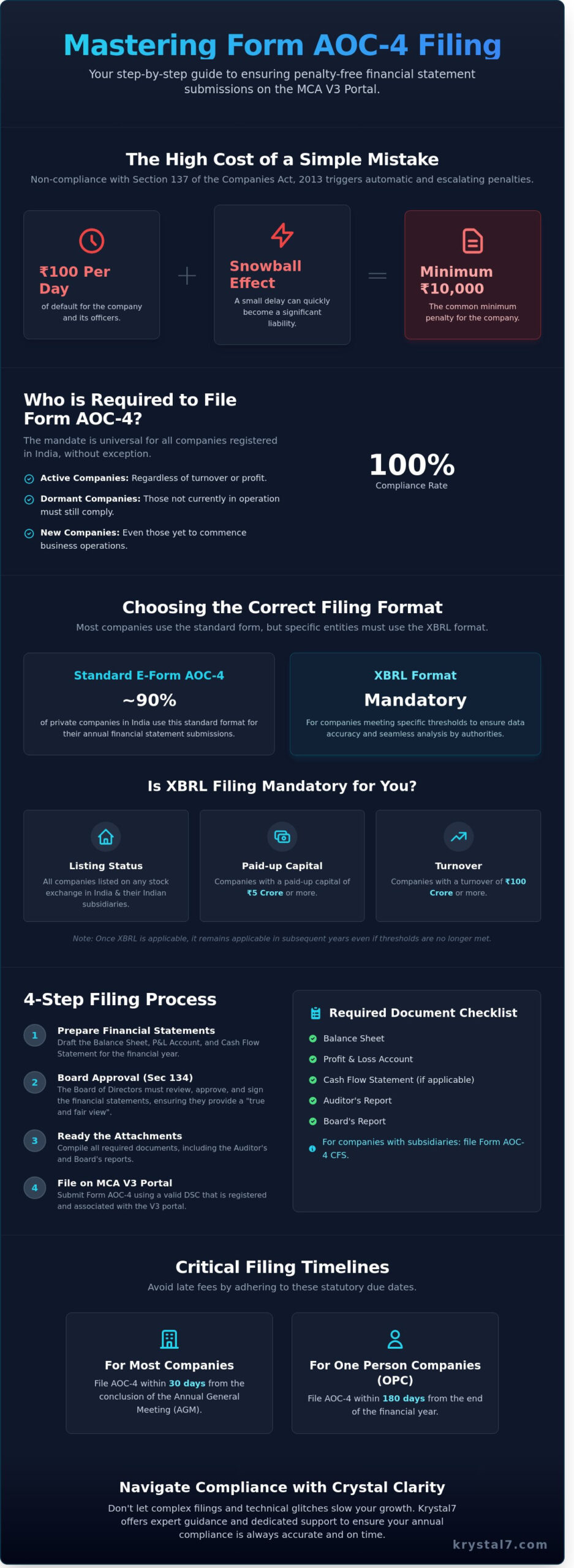
What if a simple clerical error on the MCA portal cost your company more than its annual audit fees? A single oversight during the submission process triggers an automatic penalty of INR 100 per day under Section 137 of the Companies Act, 2013, which often snowballs into a minimum fine of INR 10,000 for the entity. We know that managing the transition to the V3 portal while untangling XBRL requirements feels like an exhausting uphill battle.
It’s frustrating to face technical glitches when the clock is ticking on a mandatory deadline. Our expert guide will empower you to master the complexities of filing form AOC-4 financial statement, ensuring your business stays compliant and completely penalty-free. You deserve the freedom to focus on your growth without the constant anxiety of statutory defaults.
You’ll discover the exact document checklist required for a successful submission and learn how to identify the correct applicability thresholds for your specific company type. We’ll also walk through a methodical step by step process to ensure your financial reporting remains crystal clear and audit-ready.
Key Takeaways
- Understand the statutory requirements under Section 137 of the Companies Act 2013 to ensure your business remains compliant with the Registrar of Companies.
- Identify whether your company falls under the XBRL filing mandate based on listing status or specific Indian subsidiary thresholds.
- Navigate the step by step preparation and board approval process for filing form aoc-4 financial statement on the MCA V3 portal with absolute precision.
- Learn the critical timelines for standard companies and One Person Companies to avoid heavy penalty exposure and late fees.
- Discover how Krystal7 brings crystal clarity to your annual filings through dedicated relationship managers and expert statutory guidance.
Understanding Filing Form AOC 4 Financial Statement and Applicable Laws
Last updated on January 15, 2026.
Form AOC 4 is the primary digital vehicle for submitting financial statements to the Registrar of Companies. It serves as the official record of a company’s fiscal performance and compliance status for the preceding financial year. This document ensures that stakeholders and regulatory bodies have crystal clarity regarding the entity’s operations and financial health.
The statutory requirement for this filing is found in Section 137 of the Companies Act, 2013. This section must be read alongside Rule 12(1) of the Companies (Accounts) Rules, 2014. Before you begin the filing form aoc 4 financial statement process, the Board of Directors must review and approve the accounts under Section 134. This approval guarantees that the statements provide a true and fair view of the company’s state of affairs.
The Legal Mandate for Annual Filing
Every company registered in India must file its financial statements annually. This mandate applies to 100 percent of active entities, regardless of their turnover or profit margins. Even companies that haven’t commenced business operations or those currently in a dormant state must comply to avoid heavy penalties. It’s a non negotiable requirement for maintaining active status on the Ministry of Corporate Affairs records.
If your company holds subsidiaries, Section 129(3) of the Act requires the preparation of consolidated financial statements. These group accounts provide a holistic view of the business’s financial position across all its ventures. For these specific cases, the Ministry of Corporate Affairs prescribes Form AOC 4 CFS. This ensures that the group’s overall economic impact is transparent and accessible to all regulators.
MCA V3 Portal and E Filing Ecosystem
The transition to the MCA V3 portal has completely changed the landscape of annual filings. This web based ecosystem demands high precision and technical readiness from every director and professional. A critical component of the filing form aoc 4 financial statement process is the use of Digital Signature Certificates (DSC). These certificates act as the digital identity of the authorized signatories.
You must ensure that the DSCs of the signing directors are both registered and associated with the V3 portal before attempting a submission. This technical step prevents unauthorized filings and enhances the security of your corporate data. By managing these technical complexities, we give you the freedom to focus on your business vision. You can explore our Annual Compliance Services to ensure a smooth and error free transition to the latest portal standards.
- Verify that the Board of Directors has formally approved the financial statements as per Section 134.
- Check the validity and V3 portal association of all required Digital Signature Certificates.
- Identify if your entity requires a standalone Form AOC 4 or the consolidated AOC 4 CFS based on your subsidiary status.
Compliance is easy when it is systematic.
Last updated on June 15, 2025.
Applicability Thresholds and XBRL Requirements
The Ministry of Corporate Affairs (MCA) defines clear paths for corporate reporting to ensure transparency across the Indian business ecosystem. Approximately 90 percent of private companies in India use the standard electronic form for their annual submissions. However, larger entities must adopt the XBRL format for filing form aoc-4 financial statement data. This digital standard uses a specific taxonomy to ensure data accuracy and allows for seamless analysis by statutory authorities.
The XBRL requirement applies to three specific categories of companies as per the Companies (Filing of Documents and Forms in Extensible Business Reporting Language) Rules, 2015. Threshold 1 includes all companies listed with any stock exchange in India and their Indian subsidiaries. Threshold 2 covers companies with a paid up capital of INR 5 crore or more. Threshold 3 applies to any company with a turnover of INR 100 crore or more. Once a company triggers these XBRL limits, it must continue using this format even if its capital or turnover decreases in subsequent years.
Documents Required for a Successful Filing
Accuracy in your attachments is vital for a smooth approval process on the MCA portal. The core documents include the Balance Sheet, Profit and Loss Account, and the Cash Flow Statement. You must also include the Auditor’s Report and the Board’s Report as required under Section 134 of the Companies Act, 2013. These documents provide the crystal clarity needed for stakeholders to assess the health of your venture and ensure your filing form aoc-4 financial statement remains compliant.
| Document Name | Provider | Format | Validity | Common Errors |
|---|---|---|---|---|
| Financial Statements | Management | PDF or XBRL | Current FY | Unsigned copies: missing dates |
| Auditor’s Report | Statutory Auditor | PDF or XBRL | Current FY | Missing UDIN: incorrect CARO details |
| Board’s Report | Board of Directors | Current FY | Missing DIN: incomplete disclosures | |
| MGT 9/Extract | Company Secretary | Current FY | Incorrect shareholding data |
Small Company and OPC Exemptions
The law recognizes that smaller businesses need the freedom to focus on growth without excessive red tape. One Person Companies (OPCs) benefit from the proviso to Section 137(1). They only need to file their financial statements within 180 days from the close of the financial year. Additionally, OPCs and small companies are not required to include a Cash Flow Statement in their filing form aoc-4 financial statement package.
Small companies are defined under Section 2(85) of the Act. As per the latest notification, a small company is a private entity with paid up capital up to INR 4 crore and turnover up to INR 40 crore. These entities enjoy simplified disclosure requirements to reduce their administrative burden. You can book a call to verify if your entity qualifies for these specific relaxations.
- Identify your company category based on the latest turnover and capital thresholds.
- Collate signed copies of the Auditor report and Board report before the filing deadline.
- Confirm if your subsidiary status with a listed parent triggers an XBRL requirement.
Compliance is easy when it is systematic.
Step by Step Guide to Filing Form AOC 4 on MCA V3
The journey toward compliance begins with the preparation of the balance sheet and profit and loss account. Directors must approve these documents in a formal Board Meeting as per Section 134 of the Companies Act, 2013. Once the Board signs off, the company must conduct its Annual General Meeting (AGM) to adopt these accounts. This adoption must occur within 6 months of the financial year closing to avoid statutory defaults.
For the actual filing form aoc-4 financial statement, you must access the MCA V3 portal. Unlike the older V2 system, V3 utilizes web forms that you fill directly in your browser. You start by entering the Corporate Identification Number (CIN) to prefill company details. This process ensures data consistency and reduces manual entry errors. It provides the clarity you need to move forward with confidence.
Is your company turnover above INR 40,00,00,000? Get a compliance check from our expert legal strategists to ensure your 2026 filings are flawless.
Pre filing Checklist and Professional Certification
Before you begin the upload, verify that the statutory auditor has signed the physical copies of the financial statements. For companies that do not meet the small company criteria under Section 2(85), professional certification is mandatory. This applies if your paid up capital exceeds INR 4,00,00,000 or turnover exceeds INR 40,00,00,000. A practicing Chartered Accountant or Company Secretary must verify the filing form aoc-4 financial statement to ensure accuracy.
Technical errors often disrupt the upload process on the V3 portal. Common issues include “DSC not registered” or “Validation failed” messages. You should clear your browser cache and ensure the latest version of the MCA confession tool is installed. Meticulous preparation at this stage gives you the freedom to focus on your business growth rather than technical hurdles.
Post filing Actions and Record Keeping
After you submit the form and pay the required fees, the portal generates a Service Request Number (SRN). You must track this SRN to ensure the status changes from “Pending for IC” to “Approved”. Under Section 128 of the Companies Act, 2013, every company must maintain its books of account and relevant papers for at least eight financial years. This is not just a suggestion: it is a statutory requirement.
Keeping these records in a systematic manner protects your business legacy. It ensures that any future regulatory inquiry or audit is handled with crystal clarity. Digital copies of the filed AOC 4 and the SRN receipt should be stored in a secure, accessible location. This methodical approach transforms compliance from a burden into a streamlined business process.
- Verify if your company meets the INR 40,00,00,000 turnover threshold for professional certification.
- Schedule your Board Meeting at least 21 days before the AGM to approve the financial statements.
- Ensure all Directors have active Digital Signature Certificates (DSC) registered on the MCA V3 portal.
Compliance is easy when it is systematic.
Due Dates, Fees, and Penalty Exposure
Last updated on October 24, 2023
Timely submission is the bedrock of corporate transparency. For most companies, the countdown begins immediately after the Annual General Meeting. You must complete the filing form aoc-4 financial statement within 30 days of this meeting. This timeline ensures that shareholders and regulators access the latest financial data without unnecessary delays.
One Person Companies follow a different rhythm. They must file within 180 days from the end of the financial year. Since OPCs aren’t required to hold an AGM, this fixed window provides clarity for solo entrepreneurs. It’s a streamlined process designed to reduce the administrative burden on small entities.
If you miss these windows, Section 403 of the Companies Act, 2013 triggers additional fees. These costs scale based on the duration of the delay. The portal calculates these fees automatically during the upload process. Avoiding these extra costs requires a proactive approach to your annual closing cycle.
| Compliance Type | Frequency | Due Date | Portal | Responsible Person |
|---|---|---|---|---|
| AOC-4 Filing (Regular) | Annual | 30 Days from AGM | MCA21 V3 | Director or Company Secretary |
| AOC-4 Filing (OPC) | Annual | 180 Days from FY End | MCA21 V3 | Director |
The High Cost of Non-Compliance
The financial burden of delay is steep. Under Section 137(3), a daily penalty of INR 100 applies for every day the default continues. This accumulation happens without a ceiling for the company. It’s a significant drain on resources that could otherwise support business growth.
Directors face personal liability and potential prosecution. Section 137(3) empowers the Registrar to initiate legal action against the officers in default. This legal pressure ensures businesses prioritize their statutory obligations. Staying compliant protects both your capital and your professional reputation.
| Default Type | Amount | Interest | Section Reference |
|---|---|---|---|
| Delay in Filing Form AOC-4 Financial Statement | INR 100 per day | N/A | Section 137(3) |
| Default by Director/Officer | INR 10,000 to INR 1,00,000 | N/A | Section 137(3) |
Talk to Krystal7 to secure your compliance status today and avoid heavy penalties.
What Happens if the AGM is Not Held?
An unheld AGM doesn’t pause your filing duties. You must file unadopted financial statements within 30 days of the latest date the AGM should have been held. This rule prevents companies from hiding financial health by simply delaying meetings. You must explicitly state the reasons for not holding the meeting in the attachment.
You should also file Form GNL-1 to seek an extension for the AGM from the Registrar if valid reasons exist. Maintaining a clean record requires following the ROC Compliance Checklist to avoid compounding legal issues. Systematic tracking of these dates is the only way to ensure your business remains in good standing with the Ministry of Corporate Affairs.
- Verify your AGM date against the 30 day filing window to avoid daily penalties.
- Calculate potential additional fees using the Section 403 schedule if your deadline has passed.
- Review director KYC status to ensure the Digital Signature Certificate is active for final submission.
Compliance is easy when it is systematic.
Navigating Filing Form AOC-4 Financial Statement with Krystal7
Krystal7 brings Krystal Clear Transparency to your annual compliance cycle. Our process ensures that filing form aoc-4 financial statement remains a streamlined task rather than an annual burden. We provide a dedicated relationship manager who understands your specific business structure and history. This personal touch eliminates the guesswork often found in automated platforms.
Our team utilizes a methodical approach for XBRL conversion. We map your financial data with 100 percent accuracy to the MCA taxonomy. This precision prevents common validation errors that lead to form rejections on the MCA V3 portal. By choosing Krystal7, you gain access to elite chartered expertise that prioritizes your company’s statutory health.
The Krystal7 Clarity Box
- Verify if your company meets XBRL thresholds under Rule 3 of the Companies XBRL Rules, 2015 for the current financial year.
- Ensure your Class 3 Digital Signature Certificate is active and correctly registered on the MCA V3 portal.
- Schedule your Board Meeting at least 21 days before your intended AGM date to comply with Section 101 of the Companies Act, 2013.
Late filings trigger a penalty of INR 100 per day under Section 403 of the Companies Act, 2013. These costs accumulate quickly and can impact your company’s standing. Proactive filing with Krystal7 saves your business from the red tape of compounding offenses. You get the freedom to focus on growth while we handle the technical rigors of filing form aoc-4 financial statement.
Final Thoughts on Compliance Management
Professional management of your statutory filings builds a legacy of trust with stakeholders. Our legal strategists and CAs ensure every disclosure meets the highest standards. We don’t just file forms: we protect your business reputation. Elite expertise is your best defense against regulatory scrutiny and unnecessary financial loss.
The peace of mind that comes with systematic filing is invaluable. It’s about more than just checking a box: it’s about building a sustainable venture. Krystal7 stands as your trusted partner in this journey, ensuring clarity at every step.
Talk to Krystal7 for a comprehensive compliance check today. We’ll review your turnover and state specific requirements to ensure you’re ready for the 2026 filing season.
Compliance is easy when it is systematic.
Secure Your Company’s Standing for 2026
Managing the filing form aoc-4 financial statement remains a critical pillar of corporate governance under Section 137 of the Companies Act, 2013. You must complete this process within 30 days of your Annual General Meeting to avoid steep financial consequences. Failure to comply results in an initial penalty of 10,000 INR, plus a daily fine of 100 INR for continued default. The transition to the MCA V3 portal demands technical precision and updated XBRL tagging for eligible entities. It’s essential to verify your data early to prevent last minute portal glitches or document errors.
At Krystal7, we bring elite chartered expertise to your compliance workflow. Our team ensures your submissions are error free with 100 percent transparency and no hidden costs. You’ll work with a dedicated relationship manager who understands your specific business needs. This personalized support gives you the freedom to focus on growth while we handle the statutory red tape. Let us bring crystal clarity to your financial reporting today.
Get a compliance check for your company today
Compliance is easy when it is systematic.
Frequently Asked Questions
What is the last date for filing form AOC 4 for the financial year 2025:26?
The last date for filing form AOC 4 financial statement for the financial year 2025:26 is 30 October 2026. This deadline applies to most companies as they must file within 30 days of their Annual General Meeting. Since the statutory limit to hold an AGM is 30 September 2026, the filing window closes in late October.
One Person Companies follow a different timeline under Section 137(1) of the Companies Act: 2013. These entities must complete their filing by 27 September 2026. This date is exactly 180 days from the closure of the financial year. Missing these dates leads to immediate daily penalties.
Can I file form AOC 4 without holding an Annual General Meeting?
You can file the form even if your company fails to hold an Annual General Meeting. In such cases, the documents must be filed within 30 days from the date the meeting should have been held. You must attach a statement explaining the reasons for not holding the meeting to ensure transparency with the Registrar.
The filing will be recorded as provisional until the meeting actually takes place. This approach provides the clarity needed to maintain basic compliance while you resolve internal delays. It’s a vital step to avoid the heavier penalties associated with complete non filing.
Is it mandatory to attach a Cash Flow Statement in form AOC 4 for all companies?
A Cash Flow Statement is not mandatory for every company type. Under Section 2(40) of the Companies Act: 2013, Small Companies, One Person Companies, and Dormant Companies are exempt from this requirement. These entities only need to submit the Balance Sheet and Profit and Loss account.
All other private and public limited companies must include the statement. It provides a crystal clear view of liquidity and cash movements during the year. For these larger entities, the document is a non negotiable part of the filing form AOC 4 financial statement process.
What is the penalty for filing form AOC 4 after the due date?
The penalty for filing form AOC 4 financial statement after the due date starts with an additional fee of INR 100 per day. According to Section 137(3), the company also faces a fixed penalty of INR 10,000. If the delay continues, a daily fine of INR 100 applies, capped at INR 2,00,000.
Company officers including Managing Directors and CFOs face personal liability. They can be fined INR 10,000 plus INR 100 for every day the default persists. This personal penalty is capped at INR 50,000 for each individual in default.
Who is authorized to sign the AOC 4 e form?
The e form must be signed by at least two directors of the company. One of these signatories must be the Managing Director if the company has appointed one. The Chairperson can also sign if the Board provides specific authorization for that purpose.
For companies that have appointed a Chief Financial Officer and a Company Secretary, these professionals must also sign. Their digital signatures validate the accuracy of the financial data. This multi level signing process ensures that the leadership remains accountable for the reported figures.
What is the difference between AOC 4 and AOC 4 XBRL?
AOC 4 is the general form for most companies, whereas AOC 4 XBRL uses a specialized digital reporting language. Companies with a paid up capital of INR 5,00,00,000 or more must use the XBRL format. It’s also mandatory for companies with a turnover of at least INR 100,00,00,000.
XBRL allows for automated analysis of financial data by the Ministry of Corporate Affairs. This format ensures higher transparency and easier comparison across different industries. Most small and medium enterprises continue to use the standard AOC 4 version for their annual submissions.
Can I revise a filed form AOC 4 if I discover an error later?
You can revise a previously filed form by following the procedure under Section 131 of the Companies Act: 2013. This is allowed if the financial statements or the Board report don’t comply with the law. You’ll need to obtain an order from the National Company Law Tribunal before filing the revised version.
A company can only revise its records once in a financial year. The revised filing must be accompanied by a copy of the Tribunal order and a detailed explanation of the changes. This ensures that the public record remains accurate and trustworthy for all stakeholders.
Is professional certification mandatory for a Small Company filing AOC 4?
Professional certification is not mandatory for a Small Company when filing form AOC 4 financial statement. Rule 8 of the Companies (Registration Offices and Fees) Rules: 2014 provides this exemption. Directors can file the form using only their own digital signatures without a Chartered Accountant or Company Secretary certification.
This exemption gives small business owners the freedom to focus on growth while reducing compliance costs. It simplifies the administrative burden for entities that meet the turnover and capital thresholds of a Small Company. For larger entities, professional certification remains a compulsory safeguard for data integrity.

Written by
Nihal Srivastava
Nihal Srivastava is the Co-Founder of Krystal7 Consultants, helping Indian entrepreneurs and startups navigate company registration, compliance, trademark protection, and regulatory requirements with clarity and confidence. With 6+ years of hands-on expertise in MCA filings, GST compliance, and corporate structuring, Nihal has guided 1000+ businesses across India through their legal and compliance journeys. He believes every business dream deserves crystal clear foundations, and that no founder should be held back by paperwork or red tape.




![PMFME Loan Scheme: A Complete Guide for Food Entrepreneurs [2026]](https://blogs.krystal7.com/wp-content/uploads/2026/04/PMFME-Loan-Scheme-A-Complete-Guide-for-Food-Entrepreneurs-2026-Hero-Image-768x439.jpg)