

Section 80 IAC Tax Exemption: The Complete Guide to 100 Percent Startup Tax Holidays
What if your startup could legally retain 100 percent of its profits for 1,095 days without paying a single rupee in corporate tax? While the Department for Promotion of Industry and Internal Trade has recognized over 1,25,000 startups as of March 2024, only a tiny percentage successfully secure the 80 iac tax exemption. This gap exists because many founders mistake simple registration for tax clearance, leaving vital capital on the table that could fund their next phase of growth.
You’ve likely felt the anxiety of staring at complex legal forms or the fear that one minor documentation error will lead to a rejection from the Inter Ministerial Board. It’s exhausting to build a vision while fighting through layers of red tape. We understand that you want the freedom to focus on your product rather than getting lost in statutory fine print.
This guide provides the crystal clarity you need to secure your financial future by mastering Section 80 IAC of the Income Tax Act, 1961. We’ll show you how to obtain IMB approval and claim a 100 percent tax holiday for three consecutive years. You’ll get a step by step breakdown of eligibility thresholds, including the INR 100 Crore turnover limit, mandatory documents, and the specific roadmap to ensure your compliance is flawless.
Key Takeaways
- Understand the strict eligibility thresholds for Private Limited Companies and LLPs to ensure your entity qualifies for significant tax savings.
- Discover the exact process to secure your 80 iac tax exemption and enjoy a three year window of zero tax on your startup profits.
- Learn how to build a high impact pitch deck that effectively demonstrates your innovation to the Inter Ministerial Board.
- Stay ahead of mandatory filing deadlines and Section 44AB audit requirements to keep your tax holiday active and avoid costly penalties.
- Implement a systematic record keeping framework to maintain a clear audit trail for ten years and protect your business growth.
Understanding the Legal Framework of 80 IAC Tax Exemption
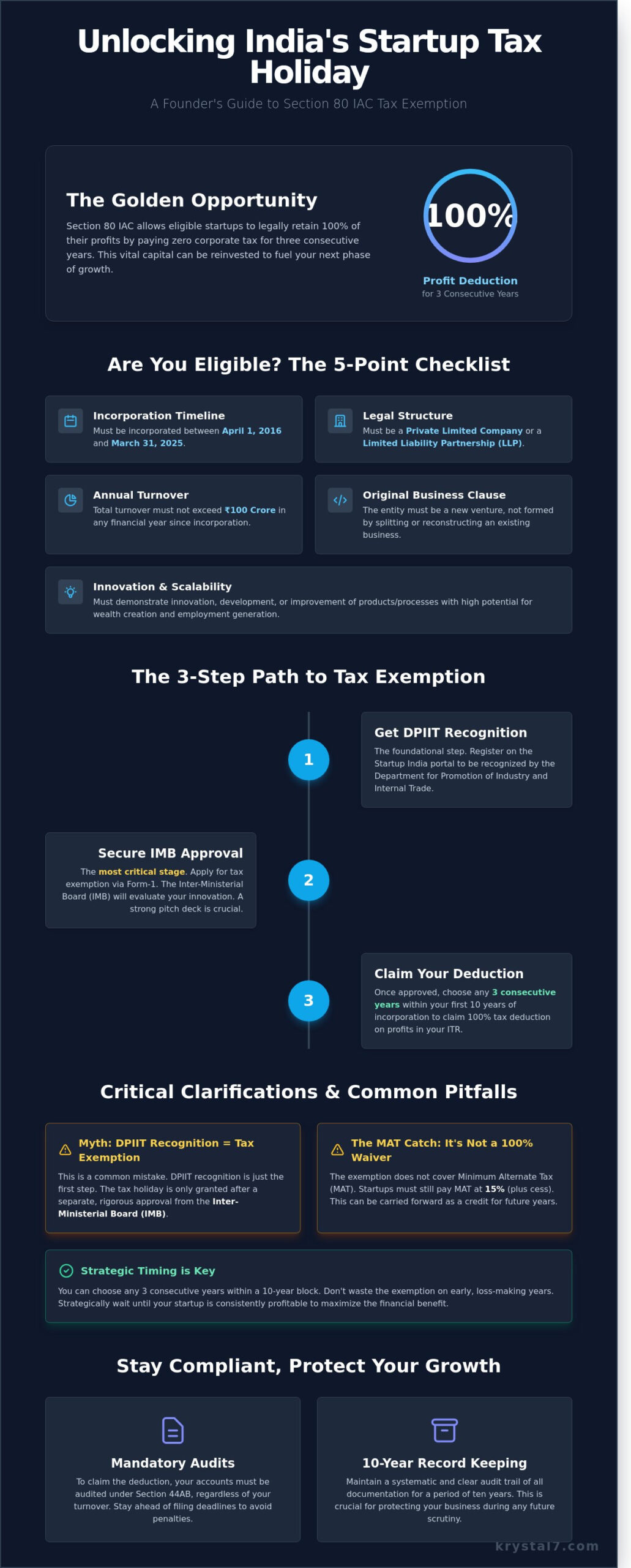
Section 80 IAC of the Income Tax Act, 1961, serves as a powerful growth lever for Indian startups. This provision allows for a 100 percent deduction of profits and gains derived from an eligible business for three consecutive assessment years. It’s designed to help founders reinvest capital into scaling operations rather than immediate tax outflows. This incentive represents the gold standard of fiscal support for the Indian startup ecosystem.
Many founders confuse DPIIT recognition with the 80 iac tax exemption. While DPIIT recognition provides basic benefits like self certification, the Inter Ministerial Board (IMB) must specifically approve your application for the tax holiday. The IMB evaluates the innovative nature and scalability of the business before granting this elite status. Only a small percentage of DPIIT recognized entities successfully secure IMB approval.
Talk to Krystal7 for a compliance check to see if your startup qualifies for this 100 percent tax holiday.
Statutory References and Notifications
The application process is governed by Rule 12AD of the Income Tax Rules, 1962. This rule mandates the filing of Form 1 through the online portal. The legal definition of an eligible startup is found in G.S.R. notification 127 (E) issued on 19 February 2019. This notification sets the criteria for turnover, age of the entity, and the requirement for innovation or improvement of products.
The Finance Act, 2024, recently extended the incorporation deadline for eligible startups to 31 March 2025. This extension provides a critical window for new ventures to structure their operations for tax efficiency. It’s essential to ensure your certificate of incorporation falls within the dates specified by the latest Finance Act to maintain eligibility for the 80 iac tax exemption.
The Three Year Tax Holiday Explained
Startups have the flexibility to choose any three consecutive assessment years within a block of ten years. This block begins from the year the entity is incorporated. Most advisors suggest waiting for the business to reach a stable profit phase before triggering the claim. Claiming the deduction during initial years of heavy R&D or losses provides no real financial advantage.
- The exemption applies to 100 percent of business profits.
- The total turnover must not exceed INR 100 crore in any previous year.
- The entity must be a company or a limited liability partnership.
It’s vital to remember that the exemption does not cover Minimum Alternate Tax (MAT). Under Section 115JB, startups must still pay MAT at a rate of 15 percent plus applicable surcharge and cess. However, MAT credit can be carried forward and set off in future years when the company moves out of the tax holiday period.
- Verify your DPIIT recognition status and ensure all data is current.
- Review your financial projections to identify the optimal three year window for the claim.
- Gather your innovation proof and pitch deck for the IMB application.
Compliance is easy when it is systematic.
Eligibility Criteria and Applicability Thresholds
To claim the 80 iac tax exemption: your startup must meet strict timelines. The entity must be incorporated between April 1: 2016: and March 31: 2025. This window is defined under Section 80 IAC(4)(ii) of the Income Tax Act: 1961. While there were discussions regarding 2026 extensions: the current statutory deadline remains March 31: 2025.
Only specific legal structures qualify for this benefit. You must operate as a Private Limited Company or a Limited Liability Partnership (LLP). Sole proprietorships or traditional partnership firms don’t qualify for these deductions. This ensures that the entities have a formal corporate structure capable of handling statutory compliance.
Your total turnover must stay within defined limits. The annual turnover must not exceed Rs. 100 Crore in any financial year since incorporation. This threshold is monitored strictly by the Income Tax Department. If your revenue crossed this mark in any previous year: the eligibility for the tax holiday permanently ceases.
The business must be a fresh creation. It shouldn’t be formed by splitting up or reconstructing an existing business. This “Original Business” rule under Section 80 IAC(4)(i) ensures the tax holiday supports genuine new ventures rather than restructured old ones. Transferring an existing business to a new shell company will lead to disqualification.
Innovation and Scalability Requirements
Your startup must be an “Eligible Business” as recognized by the Inter Ministerial Board. This requires proof of innovation: development: or improvement of products or processes. The business model should show high potential for wealth creation or employment generation. You must provide evidence that your service enhancement is significantly better than existing market solutions.
Common Disqualifications to Avoid
Many startups lose eligibility due to technical errors. One major trap is using second hand machinery. If the value of previously used plant or equipment exceeds 20 percent of the total value: the exemption is denied. This rule prevents old businesses from re branding as startups to claim tax benefits.
You must secure DPIIT recognition before applying for the 80 iac tax exemption certificate. Applying to the Inter Ministerial Board without this prior recognition leads to immediate rejection. Always verify your equipment audit reports before filing to ensure you hold the permitted percentage of new assets.
Talk to Krystal7
Is your turnover approaching Rs. 100 Crore? You should talk to Krystal7 for an eligibility audit of your startup to ensure you don’t miss out on these benefits. We provide the clarity you need to navigate complex tax filings with confidence.
- Verify your incorporation date falls within the April 2016 to March 2025 window.
- Audit your fixed asset register to ensure second hand machinery is below 20 percent.
- Confirm your DPIIT recognition status is active before approaching the Inter Ministerial Board.
Compliance is easy when it is systematic.
Step by Step Process to Secure 80 IAC Approval
Securing the 80 iac tax exemption requires a methodical approach to satisfy the Inter Ministerial Board. Your entity must be a private limited company or a limited liability partnership incorporated after 1st April 2016 but before 1st April 2025. This timeline is strictly enforced by the Department for Promotion of Industry and Internal Trade.
Step 1 involves obtaining DPIIT recognition through the Startup India portal. You’ll need to submit your certificate of incorporation and a brief write up on your business activities. This recognition is a prerequisite for the tax holiday application under Section 80 IAC of the Income Tax Act, 1961.
Step 2 requires preparing an exhaustive pitch deck and proof of innovation. You must demonstrate how your product or service is significantly better than existing solutions. The board focuses on your potential for job creation and wealth generation through scalable technology or intellectual property.
Step 3 is filing Form 1 online through the National Single Window System. This digital platform streamlines the process by centralizing compliance requirements. Ensure all financial statements and board resolutions are correctly uploaded to avoid technical delays in processing.
Step 4 involves responding to Inter Ministerial Board queries. The board often asks for deeper insights into your technology or market traction. Timely responses are vital to keep your application moving through the system as delays can lead to file closure.
Drafting the Innovation Pitch
Highlighting uniqueness is critical. You should explain the specific problem your startup solves and why current market solutions fail. Use concrete metrics like a 25 percent reduction in waste or a 40 percent improvement in energy efficiency to prove your value. The IMB looks for high potential of employment generation or wealth creation as defined in Notification No. G.S.R. 127(E).
Common mistakes include failing to provide a proof of concept or having a business model that mimics existing traditional businesses. Data shows the board rejects approximately 65 percent of applications that lack a clear technological edge. You must quantify your scalability by projecting user growth or revenue milestones over the next three years to show commercial viability.
The IMB Review and Approval Timeline
The processing time for an 80 iac tax exemption application typically ranges from 4 to 9 months. This duration depends on the volume of applications and the clarity of your initial submission. The board meets periodically to review cases and may request additional documents regarding your patent filings or trademark registrations.
If the board requires a virtual presentation, you’ll receive a notification on your registered email. This is your chance to explain your vision directly to the experts. Once approved, you can download the final certificate from the Startup India portal. This document allows you to claim a 100 percent tax holiday for three consecutive years within your first ten years of operations.
Talk to Krystal7 today to evaluate your startup’s eligibility for this tax holiday. Our legal strategists can help you draft a pitch deck that meets every statutory requirement.
Last updated on October 24, 2023.
Compliance Timelines: Forms: and Penalty Exposure
Securing the 80 iac tax exemption is a significant milestone, yet the journey does not end with approval. Startups must maintain a rigorous compliance calendar to ensure the Inter Ministerial Board (IMB) and the Income Tax Department do not revoke the benefit. Precision in annual filings is the only way to safeguard your 100 percent tax holiday from statutory challenges.
The core requirement for continuing the exemption is the timely submission of Form 10CCB. Under Rule 18BBB of the Income Tax Rules, 1962, this audit report must be filed by a Chartered Accountant. It certifies that the startup has satisfied all conditions of Section 80 IAC for the relevant financial year. Missing this deadline often leads to the immediate disqualification of the deduction for that assessment year.
Audit requirements under Section 44AB also apply to startups claiming the 80 iac tax exemption. Even if your turnover is below the typical ₹10 Crore threshold for digital businesses, the specific requirements of the tax holiday necessitate a formal audit. This ensures that the entity has not been formed by splitting up or reconstructing an existing business, a violation of Section 80 IAC(4)(i) that carries retrospective tax liabilities.
Ensure your annual filings are 100 percent accurate for the IMB. Book a call with our tax strategists to safeguard your exemption.
Compliance and Due Date Table
Adhering to the Assessment Year 2026 cycle requires proactive planning. The following table outlines the essential filings for startups registered under the IMB framework. Failure to meet these dates results in the loss of the deduction under Section 80 IAC for the specific year.
| Compliance Type | Frequency | Due Date | Portal | Responsible Person |
|---|---|---|---|---|
| Form 10CCB (Audit Report) | Annual | September 30, 2026 | Income Tax Portal | Chartered Accountant |
| Tax Audit Report (Section 44AB) | Annual | September 30, 2026 | Income Tax Portal | Chartered Accountant |
| Income Tax Return (ITR 6) | Annual | October 31, 2026 | Income Tax Portal | Director |
Penalty and Interest Table
The Income Tax Act imposes strict financial consequences for non compliance. If the tax authorities determine that a startup has misreported its eligibility or failed to file on time, the following penalties and interest charges under Section 270A and Section 234 apply. These costs can quickly erode the financial benefits of the startup tax holiday.
| Default Type | Amount | Interest | Section Reference |
|---|---|---|---|
| Under reporting of income | 50% of tax payable | N/A | Section 270A |
| Misreporting of income | 200% of tax payable | N/A | Section 270A |
| Late filing of ITR | ₹5,000 (if income > ₹5 Lakhs) | 1% per month | Section 234A |
| Shortfall in advance tax | N/A | 1% per month | Section 234B |
Violating the “no splitting up” rule post approval is particularly dangerous. If an investigation reveals the startup used second hand plant or machinery exceeding 20 percent of the total value, the exemption is cancelled. This triggers a demand for the full tax amount plus interest from the date the exemption was first claimed.
Talk to Krystal7 to conduct a pre audit compliance check and protect your startup from penalty exposure.
- Review your fixed asset register to ensure second hand machinery remains below the 20 percent threshold.
- Schedule your Section 44AB audit at least two months before the September deadline.
- Verify that your IMB certificate details match your current business activities exactly.
Compliance is easy when it is systematic.
Documentation and Record Keeping Requirements
Maintaining a meticulous audit trail is a statutory necessity for any startup claiming the 80 IAC tax exemption. Under Section 149 of the Income Tax Act, 1961: the tax department can reopen assessments for up to ten years if the income escaping assessment exceeds INR 50,00,000. Founders must preserve every record related to product development: patent filings: and technical whitepapers to justify the innovation claim during a scrutiny.
Digital storage serves as the most reliable method for maintaining these statutory records. You should store all documents in encrypted cloud environments with version control. This ensures that when an Assessing Officer requests proof of your “new business” status: you can instantly produce the valuation report of plant and machinery. Remember that the value of previously used machinery must not exceed 20 percent of the total value to satisfy Section 80 IAC requirements.
Documents Required Table
| Document Name | Provider | Format | Validity | Common Errors |
|---|---|---|---|---|
| Memorandum of Association | MCA | Life of Entity | Objects clause does not mention innovation or scalability. | |
| Annual Reports | Auditor | Annual | Turnover figures do not match ITR 6 or audited balance sheets. | |
| DPIIT Certificate | DPIIT | 10 Years | Certificate is expired or the entity category has changed. |
Record Keeping for Future Audits
Verification of R&D expenses requires more than just simple invoices. You need to maintain project logs: developer timesheets: and testing reports that link specific costs to the eligible business defined in the Inter Ministerial Board application. These records prove your startup did not violate the “no splitting up” rule under Section 80 IAC(4) of the Income Tax Act.
Founders must also keep a detailed register of fixed assets to track the 20 percent threshold for second hand machinery. If your startup uses imported machinery: keep the bill of entry and customs clearance documents as primary evidence. These documents verify that the equipment was never used in India before your incorporation date: protecting your 80 IAC tax exemption status during a detailed audit.
- 1. Verify your incorporation date falls within the eligible window of April 1, 2016, to March 31, 2025.
- 2. Prepare a 5 slide deck focusing on product innovation and commercialization potential.
- 3. Contact Krystal7 to review your Form 1 application before submission to the Inter Ministerial Board.
If you are unsure whether your current documentation meets the strict standards of the Income Tax Department: we can help. Book a call with Krystal7 today to ensure your startup is fully prepared for the 80 IAC application process.
Compliance is easy when it is systematic.
Claim Your Three Year Tax Holiday
Securing the 80 iac tax exemption transforms your startup’s financial trajectory by providing a 100 percent deduction on profits. This benefit applies to DPIIT recognized entities incorporated between April 1, 2016, and March 31, 2025, with an annual turnover not exceeding INR 1,000,000,000. Navigating the Inter Ministerial Board requirements demands precision to avoid application rejection or unnecessary delays.
Our team of elite Chartered Accountants and legal strategists provides the clarity you need to succeed. We offer direct assistance with IMB clarifications and ensure your documentation aligns perfectly with Section 80 IAC of the Income Tax Act, 1961. You can expect transparent pricing with no hidden costs as we work to protect your venture’s capital. We handle the technical complexities so you can stay focused on building your legacy.
Don’t leave your tax savings to chance. Request a quote for your 80 IAC application today and take the first step toward long term fiscal health. Your business dream deserves a foundation of crystal clear compliance. We’re here to turn regulatory hurdles into strategic advantages for your growing company.
Compliance is easy when it is systematic.
Frequently Asked Questions
Can a partnership firm claim the 80 IAC tax exemption?
No, a traditional partnership firm cannot claim the 80 iac tax exemption. Under Section 80 IAC of the Income Tax Act, 1961, only a Private Limited Company or a Limited Liability Partnership (LLP) qualifies for this benefit. The entity must be incorporated between April 1, 2016, and March 31, 2025. If you operate as a standard partnership, you must convert to an eligible structure to access these 100 percent tax holiday benefits.
Is it possible to claim 80 IAC benefits for all 10 years of startup life?
You cannot claim the 80 iac tax exemption for the entire 10 year period. The law allows you to choose a block of 3 consecutive assessment years within the first 10 years from your date of incorporation. This flexibility lets you wait until your startup becomes profitable before triggering the tax holiday. Most founders wait until year 4 or 5 when revenue stabilizes, giving them the freedom to focus on scaling without immediate tax burdens.
What is the difference between 80 IAC and Angel Tax exemption under Section 56?
The 80 iac tax exemption provides a 100 percent deduction on business profits, while Section 56(2)(viib) handles Angel Tax on share premiums. To get the 80 IAC benefit, you need a certificate from the Inter Ministerial Board. For the Section 56 exemption, you only need a declaration via Form 2 to the DPIIT. Both require DPIIT recognition, but 80 IAC has much stricter eligibility criteria regarding innovation and scalability for your business model.
Can I apply for 80 IAC if my startup is not yet profitable?
Yes, you can apply for the 80 iac tax exemption certificate even if your startup is currently reporting losses. Securing the Inter Ministerial Board approval early is a smart strategic move. While the actual tax deduction only applies when you generate a net profit, having the approval ready ensures you can claim the holiday the moment your venture turns black. This proactive approach brings crystal clarity to your long term tax planning and financial roadmap.
What happens to the 80 IAC exemption if my startup is acquired?
The 80 iac tax exemption typically remains valid if the startup is acquired through a share purchase, as the legal entity stays intact. However, if the acquisition involves a slump sale or a merger, specific conditions under Section 72A of the Income Tax Act must be met to carry forward tax benefits. You should consult a legal strategist to ensure the eligible startup status isn’t compromised during the restructuring process. This protects your hard earned tax holidays.
How many times can I apply for 80 IAC if my first application is rejected?
There’s no statutory limit on how many times you can apply after a rejection. If the Inter Ministerial Board denies your 80 iac tax exemption request, they usually provide specific reasons for the failure. You can refine your business pitch, highlight your innovation more clearly, and resubmit the application. Many startups succeed on their second or third attempt after addressing technical gaps in their original filing. Persistence is key to securing this valuable fiscal benefit.
Do I need a separate audit for claiming 80 IAC deductions?
Yes, you must obtain a specific audit report in Form 10CCB to claim the 80 iac tax exemption. This is a mandatory requirement under Rule 18BB of the Income Tax Rules, 1962. A Chartered Accountant must certify that your startup fulfills all the conditions of an eligible business. This report must be filed electronically on the income tax portal at least one month before the due date for filing your tax return. Accuracy here is vital for compliance.
Can a service based startup qualify for the 80 IAC tax holiday?
A service based startup can qualify for the 80 iac tax exemption if it demonstrates significant innovation or scalability. The DPIIT requires proof that your service uses high technology or a creative intellectual property to solve a problem. Simple consulting or traditional service models without a unique technological edge rarely get approval. Your business must show a high potential for employment generation to satisfy the Inter Ministerial Board requirements. For entrepreneurs seeking additional funding options beyond tax benefits, exploring the Stand Up India loan scheme for women and SC/ST entrepreneurs can provide valuable capital for business growth. Clarity on your innovation is essential.

Article by
Nihal Srivastava
Nihal Srivastava is the Co-Founder of Krystal7 Consultants, helping Indian entrepreneurs and startups navigate company registration, compliance, trademark protection, and regulatory requirements with clarity and confidence. With 6+ years of hands-on expertise in MCA filings, GST compliance, and corporate structuring, Nihal has guided 1000+ businesses across India through their legal and compliance journeys. He believes every business dream deserves crystal clear foundations, and that no founder should be held back by paperwork or red tape.