

How to Choose a Company Structure in India: A 2026 Founder Guide
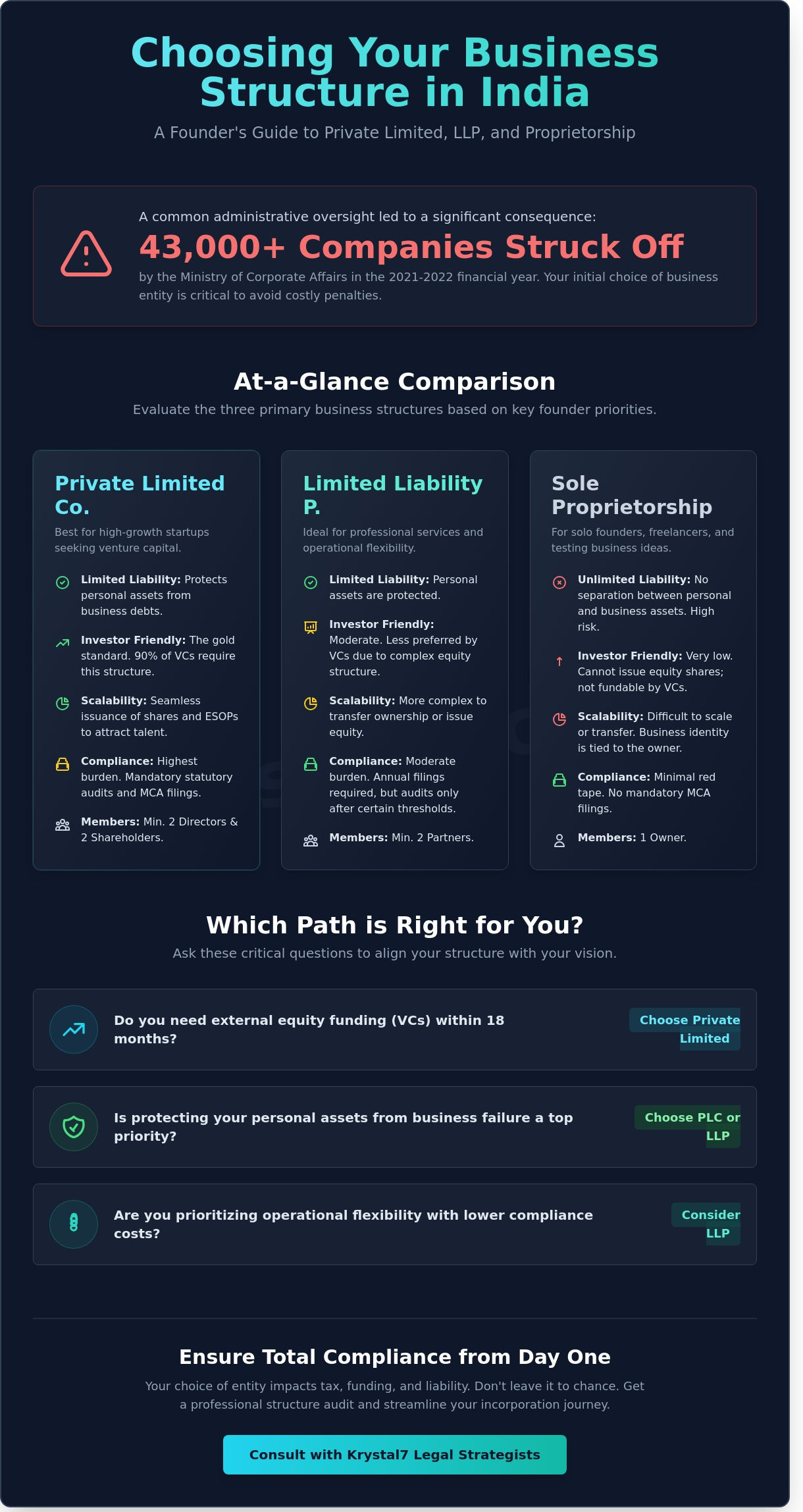
Your choice of business entity on day one can cost you more in ROC penalties than your actual startup capital within the first 24 months. Understanding how to choose a company structure is critical because the Ministry of Corporate Affairs struck off over 43,000 companies in the 2021 to 2022 financial year. It’s a high price to pay for a simple administrative oversight.
You likely started with a vision of growth, not a desk buried in statutory filings. It’s natural to feel overwhelmed by the technical gap between a Limited Liability Partnership and a Private Limited Company. At Krystal7 Consultants, we understand that you want the freedom to focus on your venture without the constant shadow of legal guesswork or complex tax thresholds.
This guide provides the clarity you need to select a framework that protects your personal assets while optimizing your tax outflow. You’ll discover the ideal legal setup for your 2026 business goals while ensuring total compliance with the Companies Act 2013. We’ll preview annual compliance costs, compare tax benefits, and provide a clear roadmap to your legal registration.
Key Takeaways
- Understand how your choice of legal entity directly impacts your tax liability and your ability to secure venture capital funding.
- Compare the high growth potential of a Private Limited Company against the operational flexibility offered by a Limited Liability Partnership.
- Master the essential selection criteria for how to choose a company structure based on your founder count, capital needs, and long term compliance costs.
- Identify critical statutory thresholds for GST and MCA filings to ensure your business remains compliant with the Companies Act 2013.
- Discover the structured process for reserving a unique company name and achieving crystal clarity during the incorporation journey.
Last updated on May 22, 2024.
Understanding the Impact of Your Business Structure Selection
Your business structure is the legal identity that defines your tax liability and operational freedom. It serves as the bedrock for every strategic decision you make. Selection influences your ability to raise venture capital or secure debt funding from financial institutions. Your choice determines the extent of personal liability protection for directors and partners. Statutory requirements vary significantly between a Private Limited Company and a Sole Proprietorship. Choosing the right path early prevents the high cost of conversion later.
Deciding on Business Entities in India involves weighing compliance costs against growth potential. While a proprietorship has minimal red tape, it offers no protection against business failure. A registered company under the Companies Act 2013 provides a professional image that attracts elite talent and global partners. Knowing how to choose a company structure allows you to align your legal framework with your long term vision.
The Role of Limited Liability in Asset Protection
Corporate veils protect personal assets from business debts. This legal fiction ensures that the company is a separate entity from its owners. In a proprietorship, your personal bank accounts and property are at risk if the business defaults. An LLP registered under the Limited Liability Partnership Act 2008 offers a safer alternative. It limits your losses to the capital you contributed. Legal precedents consistently uphold this separation, provided you maintain proper statutory records and avoid commingling funds.
Fundability and Scalability Considerations
Investors almost exclusively prefer the Private Limited Company structure. Statistics show that 90% of venture capital firms in India require this format before signing a term sheet. It allows for the seamless issuance of shares under Section 62 of the Companies Act 2013. This structure facilitates equity dilution without disrupting daily operations. Formal entities also build trust with banks and international vendors. They provide a transparent trail of compliance through regular MCA filings. When you understand how to choose a company structure, you position your brand for rapid expansion and institutional investment.
Scalability requires a framework that supports Private Limited Company registration and LLP compliance services. A robust structure makes it easier to issue ESOPs to key employees. This helps in retaining talent while conserving cash flow during early stages. Clear ownership records ensure that share transfers remain straightforward during mergers or acquisitions. Systematic record keeping under Rule 24 of the LLP Rules 2009 or the Companies Act ensures your due diligence is always investor ready.
- Evaluate if your business model requires external equity funding within the next 18 months.
- Review your personal asset portfolio to determine the necessity of a limited liability shield.
- Consult with our legal strategists to compare compliance costs across different entity types.
Compliance is easy when it is systematic.
Detailed Comparison of Primary Business Entities in India
Understanding how to choose a company structure starts with evaluating the legal frameworks that govern Indian businesses. Each entity offers specific advantages for capital raising, tax efficiency, and operational ease. Your choice today determines your compliance burden and scalability for years to come. Clarity in these early stages ensures your business remains audit ready and attractive to future stakeholders.
Private Limited Company: Features and Suitability
The Private Limited Company remains the gold standard for high growth startups. Section 149(1) of the Companies Act 2013 mandates a minimum of two directors. You also need at least two shareholders to complete the incorporation process. This structure creates a clear distinction between ownership and management, which is vital for scaling.
Every company must appoint a statutory auditor under Section 139 regardless of its turnover or capital. This ensures high transparency for investors and financial institutions. The registration process begins with obtaining Digital Signature Certificates for all directors. You must then apply for Director Identification Numbers via Form DIR 3 under Rule 9 of the Companies (Appointment and Qualification of Directors) Rules 2014.
This structure is ideal for those seeking venture capital as it provides a clear path for equity dilution. Book a call with our experts to evaluate your eligibility for startup India benefits and tax holidays.
Limited Liability Partnership: The Flexible Alternative
The Limited Liability Partnership Act 2008 governs these entities. It provides a separate legal identity distinct from the Companies Act. Deciding how to choose a company structure involves comparing these lower compliance costs against your projected revenue and funding needs.
LLPs offer significant cost benefits for professional service firms and small businesses. There is no requirement for a minimum capital contribution. Mandatory audits only apply if turnover exceeds ₹40,00,000 or capital contribution exceeds ₹25,00,000 under Rule 24 of the LLP Rules 2009. This threshold provides relief to smaller ventures during their initial years.
Internal governance relies on the LLP Agreement under Section 23 of the Act. This document allows partners more freedom to define their roles and profit sharing ratios than rigid statutory articles. It is the perfect middle ground for businesses that want limited liability without the heavy paperwork of a traditional company.
One Person Company for Solo Founders
Section 2(62) of the Companies Act 2013 defines the One Person Company. It allows a single founder to enjoy corporate status and limited liability. This structure bridges the gap between a sole proprietorship and a private limited company by offering legal protection to the individual owner. It is particularly suited for consultants and solo entrepreneurs who want to build a brand legacy under a corporate umbrella.
Mandatory Documents Required Table
| Document | Provider | Format | Validity | Common Errors |
|---|---|---|---|---|
| PAN Card | Income Tax Department | Scanned PDF | Permanent | Name mismatch with Aadhaar records. |
| Aadhaar Card | UIDAI | Scanned PDF | Permanent | Mobile number not linked for OTP verification. |
| NOC from Landlord | Property Owner | Signed PDF | Current | Missing witness signatures or incorrect dates. |
| Utility Bill | Service Provider | Scanned PDF | < 2 Months | Address does not match the NOC exactly. |
Statutory Compliance Framework and Eligibility Thresholds
Every business entity in India operates under the regulatory oversight of the Ministry of Corporate Affairs: MCA. This governing body ensures that companies maintain transparency and protect stakeholder interests through strict adherence to the Companies Act 2013. When you evaluate how to choose a company structure: your decision must account for the recurring administrative effort required to stay in good standing with the law.
Compliance isn’t a one time event: it’s a continuous commitment to statutory discipline. The MCA mandates that every Private Limited Company and Limited Liability Partnership follows specific filing cycles. These rules ensure that your business remains a “going concern” in the eyes of the government and financial institutions.
Thresholds for Mandatory Registration and Audit
Eligibility for specific tax and audit regimes depends on your annual turnover and capital contribution. For Goods and Services Tax: GST: registration becomes mandatory when turnover from services exceeds ₹20,00,000 or goods exceed ₹40,00,000. These limits provide a buffer for micro enterprises: but once crossed: the compliance burden increases significantly.
Audit requirements vary by entity type. Under Rule 24 of the LLP Rules 2009: an LLP must get its accounts audited if its turnover exceeds ₹40,00,000 or its contribution exceeds ₹25,00,000. In contrast: every Private Limited Company must undergo a statutory audit by a Chartered Accountant from its first year of incorporation: regardless of turnover. This distinction is a critical factor in how to choose a company structure for early stage startups.
Mandatory Due Date and Compliance Table
Staying ahead of deadlines prevents heavy penalties and the risk of director disqualification. Form AOC 4: for financial statements: must be filed within 30 days of the Annual General Meeting: AGM: as per Section 137 of the Companies Act 2013. Form MGT 7: the annual return: is due within 60 days of the AGM under Section 92.
| Compliance Type | Frequency | Due Date | Portal | Responsible Person |
|---|---|---|---|---|
| ROC Annual Filing: AOC 4 | Annual | 30 days from AGM | MCA V3 | Director |
| ROC Annual Filing: MGT 7 | Annual | 60 days from AGM | MCA V3 | Director and CS |
| GST Returns: GSTR 3B | Monthly | 20th of next month | GST Portal | Authorized Signatory |
| Income Tax Filing: ITR 6 | Annual | 31st October | IT Portal | Director |
- Review your current year turnover to check if you have crossed the ₹20,00,000 GST threshold.
- Verify if your LLP contribution is above ₹25,00,000 to prepare for a mandatory audit.
- Schedule a consultation to map your compliance calendar for the upcoming financial year.
Compliance is easy when it is systematic.
Selection Criteria: Matching Your Business Goals to a Legal Entity
Choosing the right path requires looking at your five-year vision rather than just today’s budget. You must evaluate how to choose a company structure based on the number of founders and your immediate capital needs. A sole proprietorship requires zero formal capital; however, it offers no protection for personal assets. If you plan to raise equity capital from external investors, the structure must support share issuance under the Companies Act 2013.
Startups often ask if the INR 15,000 to INR 25,000 annual compliance cost of a Private Limited Company is justifiable for a new venture. For a business aiming for scale, this cost is a small price for the Freedom to Focus on growth. Without this structure, you cannot issue ESOPs under Section 62(1)(b) of the Companies Act 2013 or secure venture capital funding. The long-term benefit of limited liability and global recognition far outweighs the monthly bookkeeping expenses.
Not sure which path fits your 2024 growth plan? Talk to Krystal7 for a personalized roadmap and a comprehensive compliance check.
Scenario Based Selection: From Freelancer to Enterprise
For a solo consultant, a Sole Proprietorship is the fastest start. If you want limited liability while remaining the only owner, an One Person Company (OPC) under Section 2(62) of the Companies Act 2013 is the professional choice. It allows you to maintain full control while presenting a corporate face to enterprise clients.
Tech startups must prioritize the Private Limited structure. It is the only entity venture capitalists trust for equity dilution and intellectual property holding. This structure provides the Krystal Clear Transparency required for Series A and Series B funding rounds. It ensures that the business remains a separate legal entity, protecting founders from business debts.
Family businesses often prefer the Limited Liability Partnership (LLP) governed by the LLP Act 2008. It provides the stability of a corporate body with the internal flexibility of a partnership deed. This structure is ideal for professional firms or multi-generational businesses that do not plan to go public or seek external equity investors.
Mandatory Penalty and Interest Exposure Table
Ignoring statutory timelines leads to compounding financial drains. The following table outlines the risks of non-compliance under the Companies Act and GST laws.
| Default Type | Amount | Interest | Section Reference |
|---|---|---|---|
| Late filing of Annual Return (MGT 7) | INR 100 per day | Not applicable | Section 92(4) of Companies Act 2013 |
| Late filing of Financial Statements (AOC 4) | INR 100 per day | Not applicable | Section 137 of Companies Act 2013 |
| Delay in GSTR 3B filing | INR 50 per day (INR 20 for Nil) | 18 percent per annum | Section 47 of CGST Act 2017 |
| General Penalty (where no specific penalty is provided) | Up to INR 10,000 plus INR 1,000 per day for continuing default | Not applicable | Section 450 of Companies Act 2013 |
- Audit your current founder count and 12-month funding goal to determine if equity dilution is necessary.
- Calculate the potential liability risk of your industry to decide between a Proprietorship and a Limited Liability structure.
- Book a call with a legal strategist to review your draft
Streamlining Your Incorporation Journey with Krystal7
Starting a business requires more than just a great idea. It demands a solid legal foundation. Krystal7 provides the professional expertise needed to understand how to choose a company structure that aligns with your long term vision. We eliminate the administrative red tape; allowing you to focus on growth while we handle the statutory filings.
We exclude hidden fees from our service agreements. Our incorporation packages are built on a foundation of absolute transparency. You’ll receive upfront pricing for all government fees and professional charges. This ensures your budget remains intact from day one. Our team handles the complexity so you can pursue your passion with total peace of mind.
Book a call with our legal strategists to start your registration today.
The Step by Step Registration Process
We begin with name approval through the Reserve Unique Name (RUN) service or SPICe+ Part A portal. This ensures your chosen name complies with Rule 8 of the Companies (Incorporation) Rules, 2014. We conduct exhaustive checks to prevent identity conflicts with existing brands or trademarks.
Our legal strategists draft the Memorandum of Association (MoA) and Articles of Association (AoA). These documents follow the specific formats in Table A to J of Schedule I of the Companies Act, 2013. We customize these bylaws to protect your interests and define clear operational boundaries for directors.
We file SPICe+ Part B for final incorporation. This single window form simultaneously processes your Permanent Account Number (PAN) and Tax Deduction and Collection Account Number (TAN). It streamlines the entire statutory setup into one efficient motion; reducing the total processing time to approximately 7 to 10 business days.
Once your Certificate of Incorporation arrives, Krystal7 manages your transition to active operations. This includes GST registration under the CGST Act, 2017 and setting up your Annual Compliance Management system. We ensure you meet every deadline; from filing Form AOC 4 to MGT 7. Our advisors provide ongoing guidance on how to choose a company structure for your specific scale as you grow.
Ready to scale? Talk to Krystal7 about a compliance check for your new venture.
Krystal7 Clarity Box: Immediate Next Steps
- Identify your founding team and their specific capital contribution amounts in INR.
- Verify if your proposed brand name is available on the MCA and Trademark registries to avoid legal blocks.
- Book a call with a Krystal7 strategist to finalize your entity type and tax registration needs.
Compliance is easy when it is systematic.
Build Your Business on a Foundation of Clarity
Selecting the right legal framework is the most critical decision a founder makes. Whether you opt for a Private Limited Company to attract venture capital or an LLP for professional services, your choice dictates your tax liability and statutory burden. Understanding how to choose a company structure requires balancing current turnover with future scale. For instance, companies exceeding a turnover of INR 10 crore must navigate mandatory tax audits under Section 44AB of the Income Tax Act, 1961. Making the wrong choice early leads to expensive conversion costs later.
Krystal7 Clarity Box: Immediate Next Steps
1. Identify 12 month funding targets to determine the best entity type.
2. Gather KYC documents for all directors including PAN and Aadhaar cards.
3. Schedule a consultation to map out your statutory compliance calendar.
You don’t have to navigate these legal complexities alone. Krystal7 provides access to top tier Chartered Accountants and legal strategists who ensure incorporation is seamless. We offer Krystal clear transparency with zero hidden costs. Every business receives a dedicated relationship manager for personalized guidance. When you evaluate how to choose a company structure, clarity is your greatest asset. Talk to Krystal7 about your incorporation needs today and gain the freedom to focus on your vision.
Compliance is easy when it is systematic.
Systematic planning is key not just for corporate compliance, but for long-term personal goals. For entrepreneurs whose vision includes eventual financial independence abroad, it can be helpful to explore Digital Guides on lifestyle and cost of living in potential destinations.
Frequently Asked Questions
What is the difference between a Private Limited Company and an LLP in India?
A Private Limited Company is governed by the Companies Act 2013 and uses a share based structure, which is ideal for startups seeking venture capital. An LLP operates under the Limited Liability Partnership Act 2008 and is managed by partners without the complexity of mandatory board meetings. When you evaluate how to choose a company structure, consider that LLPs have lower compliance burdens because they don’t require a statutory audit until turnover exceeds ₹40,00,000 or contribution exceeds ₹25,00,000.
Can a single person start a company in India?
You can start a company alone by registering a One Person Company (OPC) under Section 2(62) of the Companies Act 2013. This structure provides the benefits of limited liability while allowing a single individual to maintain 100 percent control. It’s a popular choice for solo founders who want the credibility of a corporate entity without needing a second director or shareholder at the start.
How much does it cost to register a Private Limited Company in 2026?
Registering a Private Limited Company in 2026 involves government fees ranging from ₹6,000 to ₹15,000, depending on the authorized share capital. Under the SPICe+ (INC 32) filing system, companies with an authorized capital up to ₹15,00,000 enjoy zero Central Government fees for incorporation. You’ll also need to budget for professional fees, stamp duty, and digital signature certificates to ensure crystal clear transparency in your startup costs.
Is it mandatory to have a physical office for company registration?
A physical registered office is mandatory under Section 12 of the Companies Act 2013 to receive official communications from the ROC. You must provide proof of address, such as a utility bill not older than 2 months and a No Objection Certificate (NOC) from the owner. If you’re a remote founder, Krystal7 can help you identify compliant virtual office solutions that meet all statutory requirements and provide the freedom to focus on growth.
What happens if I fail to file my annual returns with the ROC?
Failing to file annual returns like Form MGT 7 and financial statements in Form AOC 4 leads to an additional fee of ₹100 per day per form under Section 403. If the default continues for 3 years, directors face disqualification for 5 years under Section 164(2). The company may also be struck off the register by the ROC under Section 248, which can halt your business operations and impact your professional legacy.
Can I convert my LLP into a Private Limited Company later?
You can convert an LLP into a Private Limited Company by following the procedure under Section 366 of the Companies Act 2013. This process requires the consent of all partners and a public advertisement in two newspapers to notify creditors. Understanding how to choose a company structure includes knowing that your entity can evolve as your funding needs and scale of operations grow from a partnership to a corporate entity.
Do I need a separate GST registration for every state I operate in?
You need a separate GST registration in every state where you have a business vertical or a fixed place of business under Section 22 of the CGST Act 2017. If your aggregate turnover exceeds ₹20,00,000, or ₹10,00,000 for specified hill states, registration becomes mandatory. Operating across state lines without proper registration can lead to penalties equal to 100 percent of the tax due or ₹10,000, whichever is higher.
What are the minimum requirements for a Director in an Indian company?
Every Indian company must have at least one director who has stayed in India for a total period of not less than 182 days during the financial year, as per Section 149(3). A Private Limited Company requires a minimum of 2 directors, while an OPC needs only 1. Each director must obtain a Director Identification Number (DIN) and a Digital Signature Certificate (DSC) before the incorporation process begins to ensure legal compliance.

Article by
Nihal Srivastava
Nihal Srivastava is the Co-Founder of Krystal7 Consultants, helping Indian entrepreneurs and startups navigate company registration, compliance, trademark protection, and regulatory requirements with clarity and confidence. With 6+ years of hands-on expertise in MCA filings, GST compliance, and corporate structuring, Nihal has guided 1000+ businesses across India through their legal and compliance journeys. He believes every business dream deserves crystal clear foundations, and that no founder should be held back by paperwork or red tape.