

Documents for Company Incorporation: The Complete 2026 Legal Guide
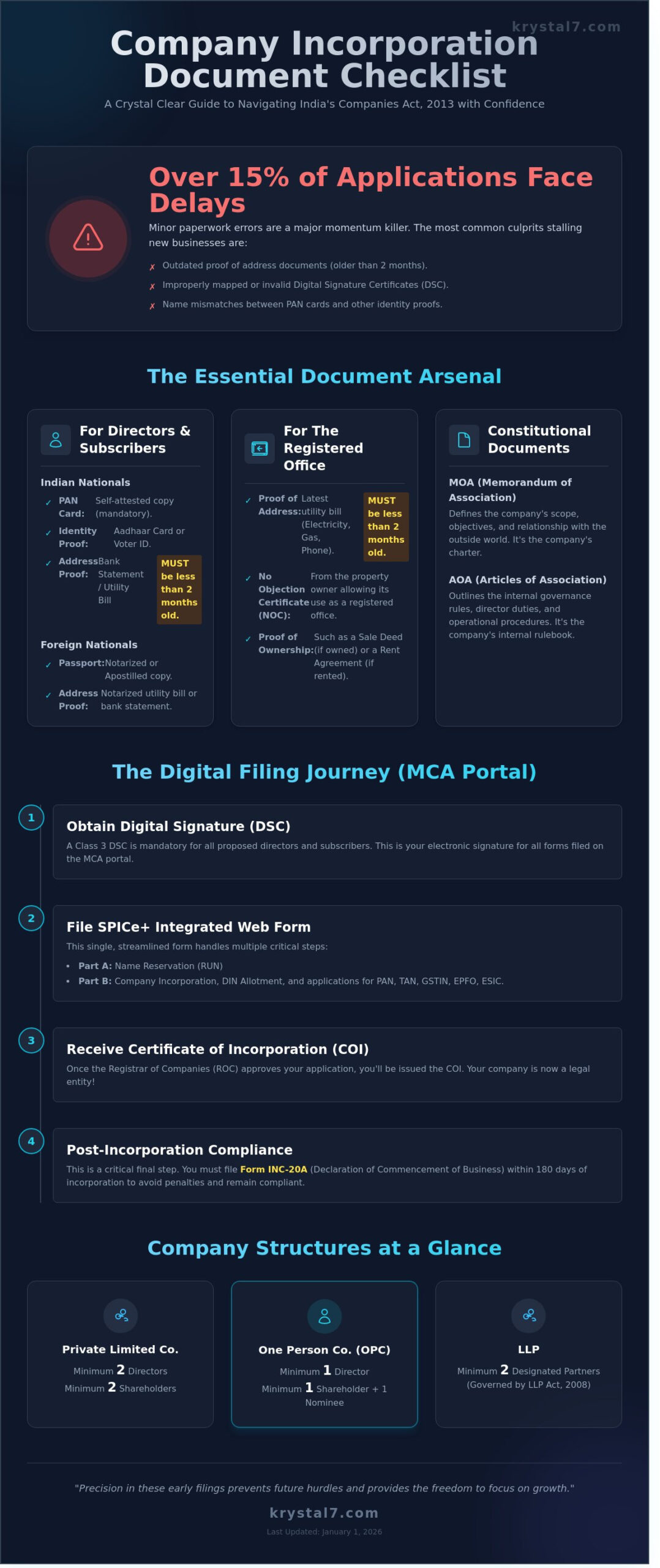
Over 15 percent of new company applications face delays or resubmissions simply because a single proof of address was outdated or a digital signature was improperly mapped. This statistic highlights a frustrating reality for many entrepreneurs: minor paperwork errors can stall your momentum before you even issue your first invoice.
You’ve likely felt the anxiety of staring at conflicting checklists, wondering if a small mistake will lead to a formal government rejection. It’s exhausting to navigate the complex requirements for documents for company incorporation while trying to focus on your actual business strategy. We believe you deserve a process that’s transparent and entirely free from administrative guesswork.
This guide provides the crystal clarity you need to master the essential documents for company incorporation with absolute confidence. We’ll outline the precise statutory forms, identity proofs, and constitutional drafts required to register your business in India. You’ll gain a streamlined path to your Certificate of Incorporation and the freedom to focus on your entrepreneurial journey.
Key Takeaways
- Gain crystal clarity on the Companies Act 2013 to draft your MOA and AOA with professional precision. These constitutional documents define your business scope and internal governance rules.
- Identify the mandatory identity proofs for directors: including the essential PAN requirement for Indian nationals. This guide outlines the exact documents for company incorporation needed to ensure a seamless registration process.
- Master the integrated SPICe plus web form to streamline your name reservation: DIN allotment: and tax registrations. Learn how to navigate the MCA portal efficiently to save time and reduce administrative complexity.
- Understand the critical steps following your registration: such as obtaining your Certificate of Incorporation and filing Form INC 20A. Learn to manage post incorporation risks to give your business the freedom to focus on growth.
Legal Framework and Thresholds for Company Incorporation Documents
Last updated on January 1, 2026
The Companies Act 2013 stands as the primary pillar for all Indian business formations. It dictates the exact nature of documents for company incorporation required to establish a legal entity. These papers serve as the mandatory evidence filed with the Registrar of Companies (ROC) to prove your venture meets statutory standards. Understanding Incorporation (business) principles is vital for any visionary entrepreneur looking to build a lasting legacy. Our role is to provide the crystal clarity you need to move from a dream to a registered reality.
The Krystal7 Clarity Box: Immediate Next Steps
- Verify the availability of your proposed business name on the MCA portal to avoid rejection.
- Ensure all directors have valid PAN and Aadhaar records linked to their current mobile numbers.
- Collect a utility bill dated within the last two months for the proposed registered office address.
Ready to secure your business name? Talk to Krystal7 for a professional compliance check on your proposed entity structure.
Statutory Rules and Applicability
Rule 13 of the Companies (Incorporation) Rules 2014 governs the signing of the Memorandum and Articles of Association. This rule ensures that every subscriber provides a clear intent to form the company. For electronic filings, Digital Signature Certificates (DSC) are mandatory for all subscribers and witnesses. The ROC acts as the central authority for document verification; they ensure that every filing aligns with the latest MCA circulars and notifications.
Applicability thresholds vary based on your chosen structure. A Private Limited Company requires a minimum of two directors and two shareholders. In contrast, a One Person Company (OPC) allows a single individual to manage the entity with one nominee. Limited Liability Partnerships (LLPs) follow the LLP Act 2008 and require at least two designated partners. These distinctions change the specific documents for company incorporation you must prepare and submit.
Paid up capital thresholds significantly influence your initial setup costs. While there is no longer a minimum capital requirement for private companies, the authorized capital determines the stamp duty payable to the state government. For example, a company registered in Delhi with an authorized capital of INR 1,00,000 will face different duty structures than one starting with INR 15,00,000. Precision in these early filings prevents future legal hurdles and provides the freedom to focus on your core growth.
Compliance is easy when it is systematic.
Essential Identity and Address Proofs for Directors and Subscribers
The Ministry of Corporate Affairs requires specific documents for company incorporation to verify the identity of every stakeholder. For Indian residents, the Permanent Account Number (PAN) is the most critical document under Section 139A of the Income Tax Act, 1961. It serves as the primary identifier for tax and compliance purposes. Foreign nationals must provide a valid passport which often requires notarization or an apostille depending on their country of origin.
If you are looking to expand globally, you might also want to Register your business with the SBA to understand how US requirements differ from Indian statutory norms. In India, address proofs like bank statements or mobile bills must be less than two months old. This rule ensures that the director’s current residence is active and verifiable.
Accuracy in these submissions is vital because even a minor typo can trigger a Resubmission (RSUB) status. For a broader view of the ecosystem, refer to our comprehensive company registration guide to align your documentation with your business structure.
Talk to Krystal7 for a document audit before you file your application to avoid technical rejections and delays in your business journey.
Table: Documents Required for Incorporation
| Document Name | Provider/Issuer | Format and Validity | Common Errors |
|---|---|---|---|
| PAN Card | IT Department | Self attested PDF | Name mismatch with Aadhaar |
| Aadhaar Card | UIDAI | Self attested PDF | Blurred QR code or photo |
| Bank Statement | Scheduled Bank | Less than 60 days old | Missing bank logo or stamp |
| Utility Bill | DISCOM or Gas Co | Less than 60 days old | Address mismatch with NOC |
Proof of Registered Office Address
Rule 25 of the Companies (Incorporation) Rules, 2014, mandates clear proof of the registered office address. If the property is owned, you must submit the latest property tax receipt or sale deed. For leased premises, a notarized rent agreement is necessary. Every application must include a No Objection Certificate (NOC) signed by the property owner as per the title deed.
Acceptable utility bills include electricity, piped gas, or landline phone bills. These documents must not be older than two months from the date of filing the SPICe plus form. Common errors include submitting mobile phone bills or insurance premium receipts, which the MCA does not accept as valid address proof for the registered office.
- Verify that the name on your PAN matches your Aadhaar and bank records exactly.
- Download a fresh bank statement that is less than 30 days old to ensure it stays valid during the processing period.
- Obtain a signed No Objection Certificate from your property owner on their letterhead or a plain sheet as per local requirements.
Compliance is easy when it is systematic.
Constitutional Documents: Drafting the MOA and AOA with Precision
The Memorandum of Association (MOA) acts as the fundamental charter of your business. It defines the boundary of your corporate activities and your relationship with shareholders. Under Section 4 of the Companies Act 2013, the MOA must state the company name, registered office state, and the main objects for which the entity is formed. The Articles of Association (AOA) serve as the internal management rulebook. Section 5 of the Companies Act 2013 provides the framework for these internal regulations, covering aspects like share transfers and board proceedings.
Modern filings use electronic versions known as eMOA via Form INC 33 and eAOA via Form INC 34. This digital shift ensures that documents for company incorporation are processed with crystal clarity. While Indian regulations are specific, global standards often align on these core pillars. For instance, those looking to set up a limited company in the UK will find similar requirements for constitutional documents. Krystal7 ensures your drafting is precise to prevent future litigation or operational blocks.
Digital Signature Certificates (DSC)
The Ministry of Corporate Affairs (MCA) mandates the use of Class 3 Digital Signature Certificates. This is the only acceptable level of electronic signature for secure filings. Certifying Authorities (CA) licensed by the Controller of Certifying Authorities issue these encrypted tokens after rigorous identity verification. Foreign subscribers must follow additional steps. They need to get their identity documents apostilled or notarized in their home country before submission. This process ensures legal validity across international borders and provides the security your venture deserves.
Subscriber Sheets and Witnessing
The subscription clause requires every subscriber to sign the MOA and AOA in the presence of a witness. Under the Companies Act 2013, a professional witness such as a Chartered Accountant or Company Secretary must verify these signatures. Each subscriber must provide their name, address, and occupation details clearly. If a corporate entity is a subscriber, it must provide a Board Resolution. This document authorizes a specific person to sign on behalf of the company. These rigorous checks prevent identity fraud and ensure every business dream finds a firm legal footing. Using the correct documents for company incorporation eliminates the guesswork often found in DIY filings.
Krystal7 Clarity Box
- Verify that your business objects in the MOA are broad enough to cover future expansion.
- Ensure all subscribers have a valid Class 3 DSC before starting the SPICe plus filing.
- Check that the witness to the subscriber sheet is a practicing professional with a valid membership number.
Compliance is easy when it is systematic.
Statutory Forms and the Digital Filing Process on the MCA Portal
Last updated on October 24, 2025.
The MCA V3 portal has streamlined the submission of documents for company incorporation through a consolidated digital interface. Under Rule 38 of the Companies (Incorporation) Rules, 2014, the SPICe plus (INC 32) web form acts as a single window for ten different services. This integrated process eliminates the need for multiple physical filings, allowing founders to handle name reservation, Director Identification Number (DIN) allotment, and PAN or TAN applications simultaneously. The workflow is divided into Part A for name approval and Part B for the actual registration, ensuring clarity at every stage of the legal journey.
Table: Due Dates and Filing Periodicity
| Compliance Type | Frequency | Due Date | Portal and Responsible Person |
|---|---|---|---|
| Name Reservation (Part A) | One time | 20 days from approval | MCA V3 Portal; Director |
| SPICe plus Filing (Part B) | One time | Within 60 days of name approval | MCA V3 Portal; Director |
| Commencement of Business (INC 20A) | One time | Within 180 days of incorporation | MCA V3 Portal; Director |
Preparing the right documents for company incorporation ensures that the SPICe plus form passes through the Central Processing Centre without resubmission queries. Ready to start your journey with absolute certainty? Book a call for a professional compliance check of your incorporation forms.
Integration of AGILE PRO S and Statutory Registrations
Rule 38A introduces the AGILE PRO S form (INC 35), which is a mandatory attachment for every new company. This form automates the application for GSTIN, EPFO, and ESIC registration, ensuring your business is ready to hire and trade immediately. In specific states like Maharashtra or Karnataka, this form also facilitates Professional Tax registration. By linking these services, the MCA ensures that 100% of new entities have a bank account and tax identity from the moment of birth. This methodical approach provides the freedom to focus on your vision while the portal handles the complex web of inter departmental data sharing.
INC 9 and Self Declarations
Section 7(1)(c) of the Companies Act, 2013, requires a formal declaration from every subscriber and first director. These individuals must confirm they have not been convicted of any offense related to the promotion, formation, or management of a company in the preceding five years. On the V3 portal, the INC 9 form is now auto generated based on the information provided in the SPICe plus form. It requires authentication via a Digital Signature Certificate (DSC) rather than a physical affidavit. For anyone establishing a private limited company in India, these declarations are critical. Any false statement can lead to severe penalties under Section 448 for fraud, making meticulous verification of your history essential.
- Apply for Digital Signature Certificates (DSC) for all proposed directors immediately.
- Draft your main objects clause to ensure it aligns with the NIC code selected in Part A.
- Check the availability of your proposed name on the MCA portal to avoid rejection.
Compliance is easy when it is systematic.
Post Incorporation Compliance and Penalty Risks for New Entities
Once the Registrar of Companies issues the Certificate of Incorporation (COI) and the 21 digit Corporate Identity Number (CIN), your entity is officially born. However, the legal journey doesn’t stop with receiving your documents for company incorporation. You must transition from registration to active compliance immediately to avoid severe regulatory friction. Failure to act within the first 180 days can lead to the immediate strike off of your new venture.
Section 10A of the Companies Act, 2013, mandates the filing of Form INC 20A. This is the Declaration of Commencement of Business. You can’t legally start business operations or exercise any borrowing powers until this form is approved. To file it, you must first open a corporate bank account. All subscribers must then deposit their agreed share capital into this account before the 180 day window expires.
Most banks require the COI, PAN, and a formal Board Resolution to open an account. Under Section 56, the company must issue physical share certificates to subscribers within 60 days of incorporation. These certificates are vital documents for company incorporation records and require the payment of appropriate stamp duty according to relevant State Stamp Acts.
Table: Penalty and Interest Exposure
| Default Type | Amount | Interest/Daily Fine | Section Reference |
|---|---|---|---|
| Failure to file Form INC 20A | INR 50,000 for company | INR 1,000 per day for directors | Section 10A |
| Failure to notify Registered Office | INR 1,000 per day | Max INR 1,00,000 | Section 12(8) |
| Non issuance of Share Certificates | INR 50,000 to INR 5,00,000 | Varies by duration | Section 56(6) |
Record Keeping and Statutory Registers
Under Section 88, you must maintain the Register of Members at your registered office. Section 170 requires the Register of Directors and Key Managerial Personnel to be updated and available for inspection. These records provide the legal trail of ownership and management authority. While the Common Seal is now optional under the Companies (Amendment) Act, 2015, any seal adopted by the board must be kept in safe custody of a director or the Company Secretary.
Book a call with Krystal7 to manage your post incorporation filings and protect your business vision from early stage legal bottlenecks.
Final Conclusion
The document journey from collecting initial identity proofs to receiving the COI is a significant milestone. Professional oversight prevents common errors like mismatched addresses or incorrect object clauses that trigger future litigation. By following a structured timeline for bank account opening and capital injection, you secure your legal standing. Precision in the early stages creates the freedom to focus on your core business growth.
- Verify your 21 digit CIN on the MCA portal within 24 hours of receipt.
- Open a corporate bank account and deposit share capital within 60 days.
- File Form INC 20A before signing any commercial contracts or hiring staff.
Compliance is easy when it is systematic.
Launch Your Venture with Strategic Precision
Navigating the Companies Act, 2013 requires more than just a checklist. You must ensure every detail in your MOA and AOA aligns perfectly with Section 4 and Section 5. Errors in the documents for company incorporation often lead to costly rejections on the MCA portal or severe penalties under Section 448 for material omissions. Precision in identity proofs and digital signatures is your first step toward a legitimate business legacy.
Our team of Chartered Accountants and Legal Strategists brings elite expertise to your filing process. We’ve helped numerous Gurugram startups secure their Certificate of Incorporation through meticulous audits and transparent pricing. You deserve the freedom to focus on your vision while we handle the statutory red tape. There are no hidden costs: only a streamlined path to sustainable growth.
Don’t let legal ambiguity stall your progress. Talk to Krystal7 for a crystal clear document audit and ensure your entity is built on a foundation of total compliance. Your business dream deserves a partner who values clarity as much as you do. We’re ready to help you move from paperwork to profit.
Compliance is easy when it is systematic.
Frequently Asked Questions
What are the primary documents for company incorporation in India?
The primary documents for company incorporation include identity proof, address proof, and registered office evidence. You’ll need a PAN card and Aadhaar for Indian nationals, while a Passport is mandatory for foreign subscribers under Rule 16 of the Companies (Incorporation) Rules, 2014. You must also provide a recent bank statement or utility bill not older than 60 days.
Can I register a company if I do not have a physical office yet?
You can’t register a company without a physical address because Section 12 of the Companies Act, 2013, requires a registered office for receiving official communications. If you don’t have a commercial space, you can use a residential address or a virtual office service. Ensure you have a No Objection Certificate from the owner and a utility bill like electricity or gas.
Is a PAN card mandatory for foreign directors during incorporation?
A PAN card isn’t mandatory for foreign directors if they don’t possess Indian income. Instead, they must provide a notarized and apostilled copy of their Passport as proof of identity. This requirement is specified under Rule 16 of the Companies (Incorporation) Rules, 2014. It’s essential to ensure the Passport is valid and the copy is clearly legible to avoid rejection.
How long are the identity and address proofs valid for MCA filing?
For MCA filing, your address proofs like bank statements or electricity bills must be less than 2 months old. This 60 day limit is strictly enforced under Rule 16 of the Companies (Incorporation) Rules, 2014. If your documents for company incorporation are dated beyond this period, the Registrar of Companies will likely flag the application for resubmission.
What happens if I submit incorrect documents for company incorporation?
If you submit incorrect documents for company incorporation, the Registrar of Companies will mark your application as Sent for Resubmission. You typically get two opportunities to rectify errors in the SPICe+ portal without paying additional government fees. If you fail to correct the documents within the 15 day window provided, your application might be rejected, leading to a forfeiture of the filing fees.
Do I need to physically sign the MOA and AOA in 2026?
You don’t need to physically sign the MOA and AOA in 2026. These documents are filed electronically using Class 3 Digital Signature Certificates through the SPICe+ system. This digital process streamlines the filing and ensures the integrity of the documents for company incorporation. Physical signatures are only required for subscribers located in countries not part of the Hague Convention.
What is the cost involved in procuring these documents?
The cost depends on the number of directors and the authorized share capital. Obtaining a Class 3 Digital Signature Certificate usually costs between INR 2,000 and INR 4,000 per director. Stamp duty for the MOA and AOA varies by state: for example, Delhi charges INR 200 for INR 1,00,000 capital. Professional fees for legal strategists usually range from INR 5,000 to INR 15,000.
Can a person be a director in multiple companies with the same documents?
Yes, a person can be a director in up to 20 companies using the same set of documents. Once your Director Identification Number is generated through Form DIR, 3 or SPICe+, it remains valid for your lifetime. You don’t need to submit new identity proofs for every new venture, provided your KYC details are updated annually through Form DIR, 3 KYC.

Article by
Nihal Srivastava
Nihal Srivastava is the Co-Founder of Krystal7 Consultants, helping Indian entrepreneurs and startups navigate company registration, compliance, trademark protection, and regulatory requirements with clarity and confidence. With 6+ years of hands-on expertise in MCA filings, GST compliance, and corporate structuring, Nihal has guided 1000+ businesses across India through their legal and compliance journeys. He believes every business dream deserves crystal clear foundations, and that no founder should be held back by paperwork or red tape.