

FPO Mark Product Images: Legal Requirements and Compliance Guide 2026
Last updated on May 20, 2024.
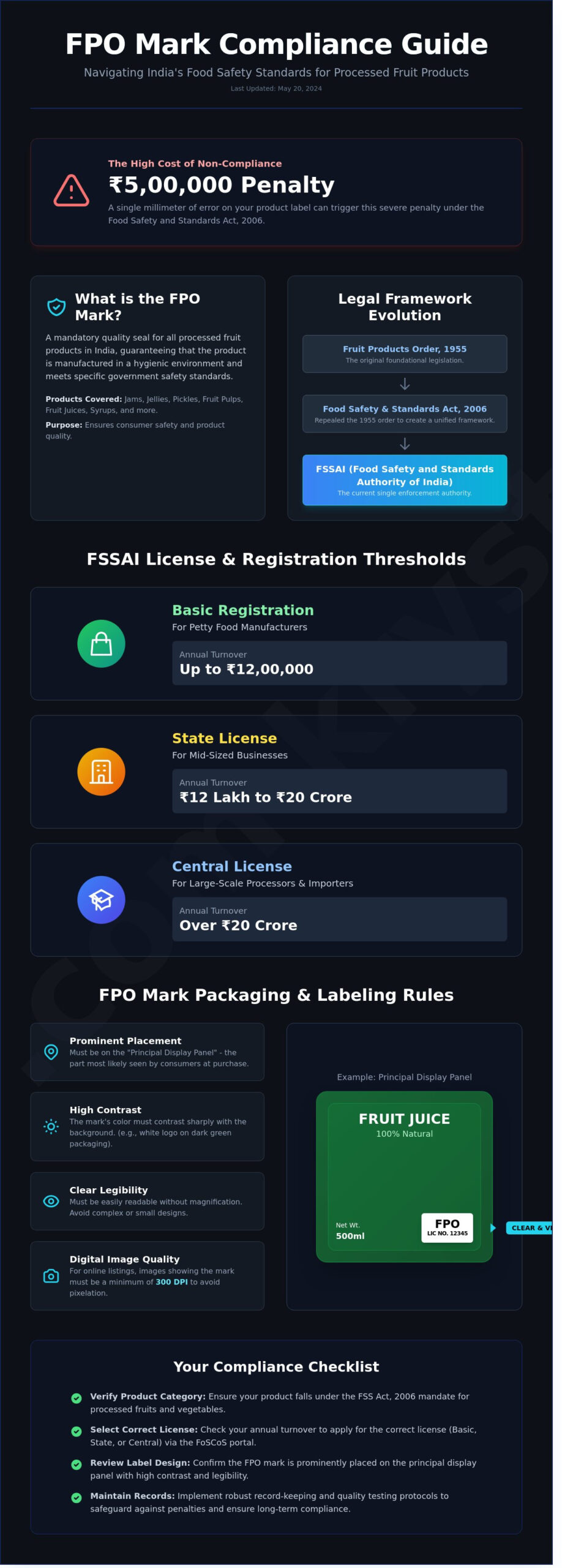
A single millimeter of error on your product label can trigger a ₹5,00,000 penalty under current Indian food laws. You’ve likely spent months perfecting your recipe and branding, yet the technicalities of fpo mark product images feel like a maze of red tape. It’s frustrating to face confusion between FPO and FSSAI standards, especially when incorrect logo placement leads to rejected batches.
We understand that you want to focus on your vision, not on deciphering complex gazette notifications. This guide provides crystal clarity on the statutory requirements for FPO mark product images. You’ll learn exactly how to transition to modern food safety standards in India while maintaining total compliance and protecting your business from unnecessary risks.
We’ll explore the specific color specifications, mandatory dimensions, and the legal framework under the Food Safety and Standards Act, 2006. This breakdown ensures your packaging design is ready for successful statutory registration and helps you avoid the high costs of mislabeling.
Key Takeaways
- Learn the statutory foundations of the Fruit Products Order 1955 to align your business with professional quality standards.
- Discover the exact placement and visibility rules for fpo mark product images to ensure your packaging remains compliant with display panel requirements.
- Master the FoSCoS registration process through a clear step by step guide designed to bring crystal clarity to your licensing journey.
- Stay ahead of statutory deadlines and annual return dates to avoid penalties while maintaining the freedom to focus on your growth.
- Implement robust record keeping and quality testing protocols to safeguard your products from seizure and ensure long term compliance.
Last updated on October 15, 2025.
Understanding the FPO Mark and Applicable Food Laws
The FPO mark is the mandatory quality seal for all processed fruit products sold in India. It serves as a statutory guarantee that a product is manufactured in a hygienic environment and adheres to specific safety standards. When you are developing fpo mark product images for online retail, showing this seal clearly is a legal requirement for consumer transparency.
The Ministry of Food Processing Industries originally managed this certification to regulate the fruit processing industry. This system ensures that products like fruit juices and canned fruits meet the standards defined by the government. It provides a crystal clear signal to customers that your brand values quality and safety.
Legal Framework and Statutory Evolution
The Fruit Products Order 1955 served as the primary legislation for fruit processing for over fifty years. It established strict rules for the sanitation of manufacturing plants and the quality of raw materials. This historical order laid the foundation for modern food safety practices in the country.
The legal landscape shifted with the introduction of the Food Safety and Standards Act 2006. Section 97 of this Act repealed several older laws, including the Fruit Products Order 1955, to create a unified regulatory framework. This consolidation aims to streamline compliance for food business operators across all states.
Currently, the Food Safety and Standards Authority of India (FSSAI) manages the enforcement of these integrated standards. Obtaining a valid FPO mark certification is essential for businesses to maintain legal standing. Your fpo mark product images must always match the approved label designs to prevent any compliance risks.
Talk to Krystal7 to secure your FSSAI license and ensure your labels are compliant. Request a quote for our expert advisory services today.
Applicability Thresholds for Food Businesses
This certification is mandatory for a specific range of processed fruit and vegetable items. This includes daily essentials like jams, jellies, pickles, and fruit pulps. It also covers more specialized products such as fruit cereal flakes and synthetic syrups that contain fruit extracts.
Statutory requirements vary based on the scale of your operations as defined by the FSSAI (Licensing and Registration of Food Businesses) Regulations 2011. Petty food manufacturers with an annual turnover up to INR 12,00,000 require only a basic registration. This simple process helps small scale entrepreneurs enter the market with confidence.
Large scale processors with a turnover exceeding INR 20,00,00,000 must apply for a Central License. Businesses falling between these two figures generally require a State License. Regardless of the size, having accurate fpo mark product images on your marketing material is a non negotiable part of professional compliance.
- Verify if your product falls under the list of items mandated by the FSS Act 2006.
- Check your annual turnover to select the correct license category: Basic, State, or Central.
- Ensure the FPO mark on your packaging follows the exact color and size specifications.
Compliance is easy when it is systematic.
Guidelines for FPO Mark Product Images and Packaging Labels
The Food Safety and Standards (Packaging and Labelling) Regulations: 2011 dictate that the FPO mark must occupy a prominent space on the principal display panel. This area is the part of the package most likely to be seen by the consumer at the time of purchase. Your fpo mark product images must reflect this placement accurately to meet ecommerce listing standards. The Food Safety and Standards Authority of India oversees these requirements to ensure that fruit based products meet specific quality metrics. Visibility is not optional: it is a statutory mandate.
Contrast plays a vital role in compliance. If your product uses dark green packaging: a white or silver FPO mark is necessary. The logo must be legible without the aid of magnification. For digital listings: the fpo mark product images should be captured at a minimum of 300 DPI. This prevents pixelation that could lead to a rejection by regulatory inspectors or online marketplaces. Clear imagery provides the clarity your customers need to trust your brand quality and safety standards.
If you are unsure about your current label layout: you can Talk to Krystal7 for a comprehensive packaging compliance review. Our experts handle the complex statutory details so you have the freedom to focus on growing your business.
Technical Specifications for Logo Design
The size of the mark depends on the surface area of the principal display panel. For containers with a capacity of 500 milliliters or more: the logo height should be at least 3 millimeters. Smaller packs require a minimum height of 1 millimeter to ensure legibility. You are strictly prohibited from altering the logo shape. Incorporating brand colors into the mark or adding decorative elements is a violation of the Food Safety and Standards Act: 2006. The logo must remain an independent: recognizable symbol of quality that stands out from your brand design.
Common Errors in Product Image Labeling
A frequent mistake involves using low resolution files that blur the certification mark. This makes it impossible for consumers to verify the authenticity of the product. Another error is placing the mark in areas obscured by packaging folds: seals: or price stickers. Many businesses fail to update their labels to include the mandatory 14 digit FSSAI license number alongside the FPO mark. Since the transition from the Fruit Products Order: 1955: the FSSAI number is a critical requirement for legal validity. Missing this detail can lead to penalties under Section 54 of the Act.
- Verify your logo dimensions against the latest FSSAI packaging standards for your specific container size.
- Audit your digital product gallery to ensure the FPO mark is visible and not obscured by shadows or folds.
- Update all label templates to include the 14 digit FSSAI license number as required by current law.
Compliance is easy when it is systematic.
Compliance Thresholds and Statutory Due Dates
Every food business operator must identify their specific category based on production capacity or annual turnover. This classification dictates the frequency of your filings and the ultimate validity of your license. Maintaining updated fpo mark product images requires strict adherence to the Food Safety and Standards (Licensing and Registration of Food Businesses) Regulations: 2011. Failure to file returns on time can lead to a penalty of INR 100 per day: as per Clause 2.1.13 of the FSS Regulations.
Due dates for annual returns vary depending on the type of license held by the entity. For instance: a manufacturer with a Central License faces different timelines compared to a small scale processor. Systematic tracking of these dates is the only way to prevent the sudden suspension of business operations. You should also integrate these timelines with your broader Annual Compliance for Private Limited Company to ensure total corporate transparency.
Statutory Due Date Table
The FoSCoS portal serves as the primary interface for all digital filings. It’s the central hub where processors submit production data and safety audits. Missing these windows often triggers automated notices from the regulator: which can impact your brand reputation and retail presence.
| Compliance Type | Frequency | Due Date | Portal | Responsible Person |
|---|---|---|---|---|
| FSSAI Annual Return (Form D1) | Annual | 31st May | FoSCoS | Nominated Person |
| Half Yearly Return (Form D2) | Half Yearly | 30th Sept / 31st March | FoSCoS | Quality Manager |
| Water Analysis Report | Annual | As per License Date | Offline/FoSCoS | Plant Head |
| Product Testing (Form E) | Annual | As per License Date | FoSCoS | Technical Officer |
Documents Required for Certification
Accurate documentation is the foundation of a successful application. When preparing your fpo mark product images for digital submission: ensure all physical assets match the technical specifications in your blueprints. You’ll also need to provide valid Company Registration documents to prove the legal existence of your manufacturing unit.
| Provider | Format | Validity | Common Errors |
|---|---|---|---|
| Architect/Engineer | Blueprints (PDF) | Permanent | Non scaled drawings or missing exit points |
| Machinery Vendor | List of Machinery | Current | Missing horsepower or capacity data |
| NABL Laboratory | Water Analysis Report | 12 Months | Testing for wrong parameters or expired lab NABL status |
| Management | Recall Plan | Annual Review | Vague contact details or no mock drill records |
Precision in these documents ensures that your audit process remains streamlined and hassle free. If your processing capacity exceeds 2 metric tonnes per day: the scrutiny level increases significantly. Krystal7 provides the clarity you need to manage these thresholds without the guesswork.
Step by Step Process for Food Business Registration
Securing a food business license is a structured journey that begins at the Food Safety Compliance System known as FoSCoS. This digital portal streamlines the entire application cycle. You must first create a profile to log in and access the dashboard. Clarity in this initial phase prevents administrative delays later.
You must select the appropriate application category based on your business location and annual turnover. Businesses earning less than INR 12,00,000 annually fall under the registration category. If your turnover exceeds this threshold or you operate across state borders, you must apply for a State or Central License under Section 31 of the Food Safety and Standards Act, 2006. This ensures your venture remains legally sound from day one.
The next phase involves uploading digital copies of all required documents. This includes the proposed label artwork for your products. Your fpo mark product images must be clearly visible in these uploads to ensure the authorities can verify compliance with the Food Safety and Standards (Packaging and Labelling) Regulations, 2011. Finally, you pay the statutory fees in INR via the secure online payment gateway to submit your file for review.
Navigating the FoSCoS Portal
Precision is vital when selecting the Kind of Business or KoB on the portal. This selection dictates the specific regulations your business must follow. You will fill Form A for basic registration or Form B for licenses. Using the wrong form is a common error that leads to immediate rejection of the application.
The portal provides a transparent system to track your application status in real time. If a Food Safety Officer issues a query or requests additional data, you must respond within the stipulated time. Prompt action helps you avoid the red tape of reapplication. This systematic approach gives you the freedom to focus on your vision while we handle the complexity.
Finalizing the Product Image Approval
The authority conducts a rigorous verification of your label artwork. They check the placement and dimensions of your fpo mark product images to ensure they meet legal standards. It is a mandatory requirement to place the FSSAI logo and license number directly adjacent to the FPO mark for consistency and consumer trust.
Validators also scrutinize all claims made on the packaging. Any mention of nutritional value or health benefits must align with verified lab reports. This level of detail ensures that your brand projects honesty. Transparency is not just a word for us: it is how we ensure your business remains compliant and ready to thrive in a competitive market.
- Calculate your total annual turnover to determine if you need a Registration, State License, or Central License.
- Review your label artwork to ensure the FPO mark and FSSAI logo are placed correctly according to 2026 standards.
- Gather digital copies of your premise possession proof and identity documents for a seamless FoSCoS upload.
Compliance is easy when it is systematic.
Penalties for Default and Record Keeping Requirements
Failing to display the FPO mark correctly on your fpo mark product images isn’t just a minor design oversight. It’s a significant legal breach under the Food Safety and Standards Act: 2006. Food safety officers possess the statutory power to seize your entire inventory if labeling standards don’t meet the 2026 requirements. This enforcement ensures that only verified: safe products reach the consumer market.
Accuracy in your fpo mark product images is vital for passing surprise audits and maintaining your brand reputation. If your digital fpo mark product images do not match the physical labels found in retail stores: you risk immediate seizure of stock. Precision in compliance protects your business from the heavy hand of regulatory intervention.
Statutory Penalty Table
| Default Type | Amount in INR | Interest | Section Reference |
|---|---|---|---|
| Misbranded Food Items | Up to INR 3,00,000 | N/A | Section 52: FSS Act: 2006 |
| Business without FSSAI License | Up to INR 5,00,000 | N/A | Section 63: FSS Act: 2006 |
| Failure to Comply with Directions | Up to INR 2,00,000 | N/A | Section 55: FSS Act: 2006 |
| Substandard Food Penalty | Up to INR 5,00,000 | N/A | Section 51: FSS Act: 2006 |
Mandatory Record Keeping
Maintaining a detailed record of production and quality testing is a statutory mandate for every food business operator. You must retain production logs and raw material invoices for a minimum period of one year or the shelf life of the product: whichever is longer. These documents prove the authenticity of the FPO mark used on your packaging.
Your business must also maintain a formal Recall Plan as per the FSS (Food Recall Procedure) Regulations: 2017. This plan outlines how you’ll retrieve products if a safety issue is detected. Additionally: you must keep statutory registers for monthly pest control and weekly sanitation audits as required under Schedule 4 of the FSS (Licensing and Registration) Regulations: 2011.
- Verify your license category to ensure it matches your current production volume.
- Audit your current packaging images against the 2026 FSSAI labeling guidelines.
- Book a call with our compliance experts to review your statutory registers.
Don’t let regulatory red tape stall your growth. Book a call with Krystal7 to ensure your food business meets all 2026 regulatory standards and secures its future in the market.
Compliance is easy when it is systematic.
Take the Next Step Toward Total Regulatory Clarity
Navigating the specific requirements for fpo mark product images requires a meticulous eye for detail and a deep understanding of the Food Safety and Standards Act, 2006. You’ve learned that processed fruit products must display the FPO mark to signify quality and safety. Compliance isn’t just about avoiding the penalties defined under Section 52, it’s about building a legacy of trust with your consumers. Every label and digital image acts as a promise of quality that your brand makes to the market.
Don’t let the complexity of food laws stall your business growth. Our team provides chartered expertise in food safety regulations to ensure your packaging meets every statutory requirement. We offer a transparent approach with no hidden costs in compliance management. Every client receives a dedicated relationship manager to provide the clarity you need to move forward with confidence. Talk to Krystal7 for expert food compliance advisory and gain the freedom to focus on your vision.
Krystal7 Clarity Box: Immediate Next Steps
- Audit your current product labels against the 2026 FSSAI image standards.
- Verify that your FPO mark dimensions meet the minimum 3mm requirement.
- Schedule a compliance review to prevent potential fines of up to ₹5,00,000 for misbranding.
Compliance is easy when it is systematic.
Frequently Asked Questions
What is the full form of the FPO mark in the food industry?
The FPO mark stands for the Fruit Products Order. This certification was established under the Fruit Products Order: 1955, to ensure that fruit based products meet specific quality standards in India. It applies to items like jams, juices, and pickles to guarantee they are manufactured in a hygienic environment. This mark provides clarity to consumers about the safety of processed fruits.
Is the FPO mark still mandatory for fruit products in 2026?
It’s no longer mandatory for fruit products because it was replaced by the FSSAI logo. Following the Food Safety and Standards Act: 2006, all previous food laws were consolidated. You must now use the FSSAI mark as per the Food Safety and Standards (Packaging and Labelling) Regulations: 2011, to stay compliant. This transition ensures a streamlined process for all food businesses.
How do I download the high resolution FPO mark for my product images?
You can download the official logo from the FSSAI Food Safety Compliance System (FoSCoS) portal. When preparing your fpo mark product images, ensure the logo meets the size specifications defined in the FSSAI manual. Using a high resolution file prevents pixelation and ensures your packaging remains compliant with digital display standards for online commerce. It’s essential for maintaining professional brand aesthetics.
What is the difference between FPO and FSSAI marks?
The FPO mark was a specific quality certification for fruit products, whereas the FSSAI mark is a comprehensive food safety license. The FSSAI mark covers all food categories under one unified regulator. This change simplifies compliance for businesses by removing the need for multiple certifications like FPO, PFA, or MFA under different ministries. It gives entrepreneurs the freedom to focus on growth.
Can I sell processed fruit products without an FPO or FSSAI mark?
You can’t sell processed fruit products without a valid FSSAI registration or license. Section 31 of the FSS Act: 2006, requires every food business operator to display their license number and the FSSAI logo on the packaging. Operating without this certification can lead to the immediate closure of your business premises and legal action. It’s a non negotiable requirement for all food ventures.
How much is the penalty for incorrect placement of the FPO logo?
The penalty for incorrect placement or misbranding of the logo can reach INR 3,00,000 under Section 52 of the FSS Act: 2006. If the product is found to be misleading to consumers, the Adjudicating Officer may also order the withdrawal of the entire batch from the market. Precision in your fpo mark product images is essential to avoid these heavy financial losses and legal hurdles.
Which government body issues the FPO certification in India?
The Food Safety and Standards Authority of India (FSSAI) is the primary government body that issues food certifications today. While the Ministry of Food Processing Industries previously managed the Fruit Products Order: 1955, all regulatory powers were transferred to FSSAI. This authority operates under the Ministry of Health and Family Welfare to streamline food safety across the country. It brings crystal clarity to food regulation.
How long is the FPO registration valid for a food business?
FSSAI registration or license validity ranges from 1 year to 5 years based on the period you select during the application process. You must apply for renewal at least 30 days before the expiry date to avoid late fees. Failure to renew on time results in a penalty of INR 100 for every day the renewal is delayed beyond the expiry date. Systematic record keeping helps you track these dates.
Compliance is easy when it is systematic.

Article by
Nihal Srivastava
Nihal Srivastava is the Co-Founder of Krystal7 Consultants, helping Indian entrepreneurs and startups navigate company registration, compliance, trademark protection, and regulatory requirements with clarity and confidence. With 6+ years of hands-on expertise in MCA filings, GST compliance, and corporate structuring, Nihal has guided 1000+ businesses across India through their legal and compliance journeys. He believes every business dream deserves crystal clear foundations, and that no founder should be held back by paperwork or red tape.





![PMFME Loan Scheme: A Complete Guide for Food Entrepreneurs [2026]](https://blogs.krystal7.com/wp-content/uploads/2026/04/PMFME-Loan-Scheme-A-Complete-Guide-for-Food-Entrepreneurs-2026-Hero-Image-768x439.jpg)