

Annual Compliance for Private Limited Company: The Ultimate 2026 Checklist
Running a Private Limited Company in India comes with incredible opportunities for growth and innovation. However, it also brings a set of mandatory legal responsibilities known as annual compliance. For many entrepreneurs, navigating these requirements can feel like a complex and time-consuming distraction from their core business goals. But it doesn’t have to be. This guide is designed to give you crystal-clear understanding and a simple, actionable checklist to master your company’s legal duties, avoid costly penalties, and gain the freedom to focus on what you do best-growing your business.
What is Annual Compliance? (And Why It’s Your Business’s Best Friend)
Simply put, annual compliance refers to the set of mandatory tasks and filings that your Private Limited Company must complete each financial year to remain in good legal standing. These requirements are primarily laid out by India’s Companies Act, 2013, and the Income Tax Act. Think of it as a regular health check-up for your company, ensuring everything is transparent, documented, and legally sound.
But why does it matter so much? Beyond just avoiding fines, consistent compliance is a powerful asset. It builds immense trust with banks, potential investors, and even your clients. A company with a clean compliance record is seen as reliable, well-managed, and professional. In the long run, good compliance makes your business more valuable, credible, and prepared for future growth opportunities. Just as protecting your intellectual property through trademark registration fees is an investment in your brand’s future, maintaining proper compliance is an investment in your company’s long-term success.
The Core Pillars of Company Compliance
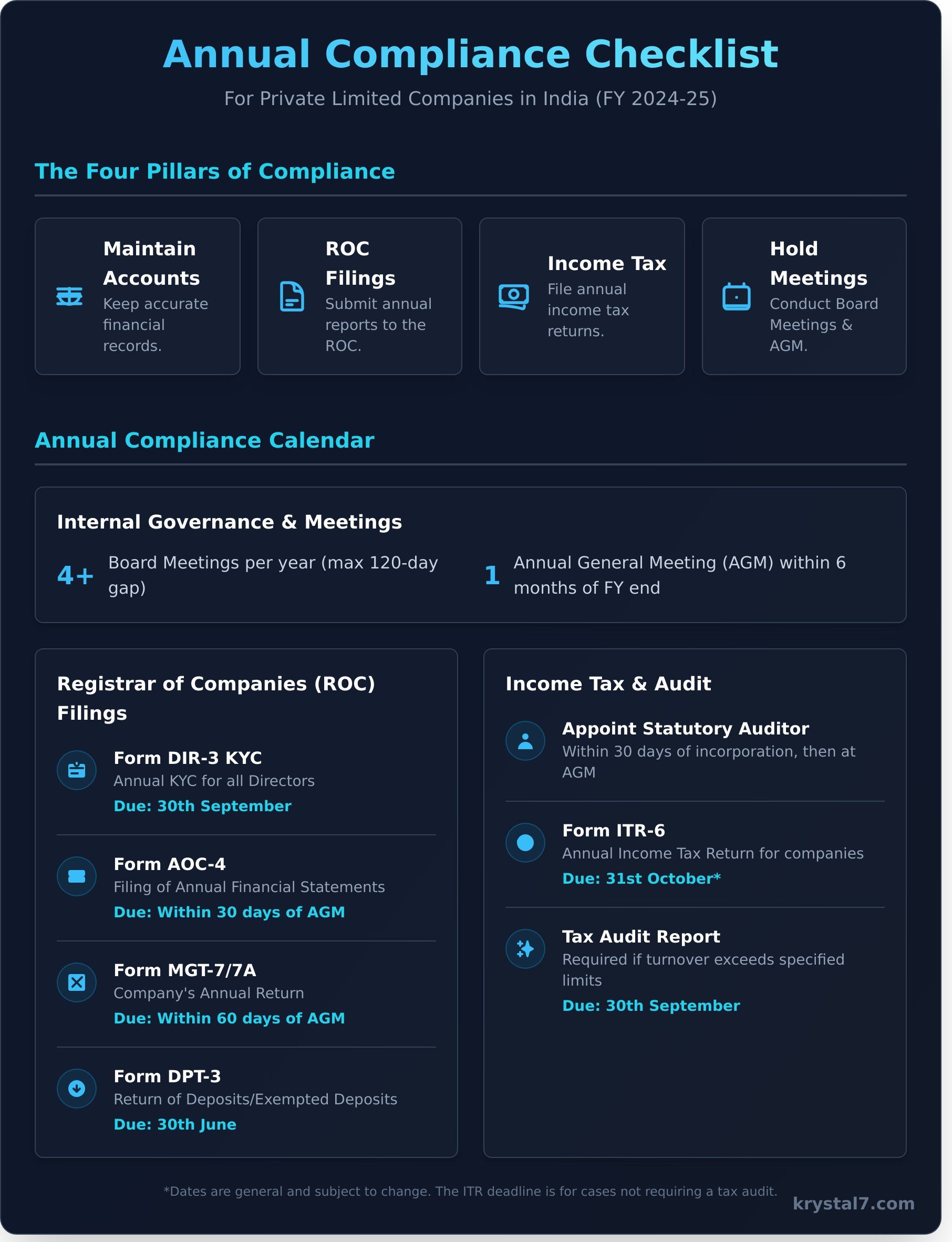
Annual compliance can be broken down into four essential pillars that form the foundation of your company’s legal health:
-
Maintaining Proper Books of Accounts: Keeping accurate and updated financial records throughout the year is the starting point for all compliance.
-
Filing Key Documents with the Registrar of Companies (ROC): The ROC is the government body that oversees companies. You must submit specific forms and reports to them annually to update them on your company’s financial and operational status.
-
Submitting Annual Income Tax Returns: Just like individuals, companies must file their income tax returns with the tax authorities every year.
-
Holding Required Meetings: The law mandates that companies hold regular Board Meetings and an Annual General Meeting (AGM) for shareholders to discuss key business matters.
The Ultimate Annual Compliance Checklist for Private Limited Companies
To make the process straightforward, we’ve broken down every essential task into a simple, manageable checklist. Follow these steps to ensure nothing is missed and your company stays compliant throughout the year.
Phase 1: Company Meetings & Records
Before any filings can happen, your company must conduct its internal governance activities as required by law.
-
Conduct Board Meetings: You must hold a minimum of four Board Meetings in a calendar year, with a gap of no more than 120 days between any two meetings.
-
Hold an Annual General Meeting (AGM): Every company must hold one AGM within six months of the financial year-end. This is where shareholders approve the annual accounts and discuss the company’s performance.
-
Prepare Minutes and Maintain Registers: All meetings must have their proceedings documented in official minutes. Additionally, you must maintain statutory registers (like the register of directors and shareholders) at your registered office.
Phase 2: Registrar of Companies (ROC) Filings
These are the most critical annual filings that provide the government with a snapshot of your company’s health and structure. Understanding ROC compliance for private limited company requirements is essential for maintaining your business in good legal standing.
-
Form DIR-3 KYC: This is an annual KYC (Know Your Customer) filing for every individual who holds a Director Identification Number (DIN). It confirms their personal details with the ROC.
-
Form DPT-3: This form is used to declare any outstanding loans or money received by the company that are not considered deposits. It’s a mandatory filing for all companies.
-
Form AOC-4: This is the form for filing your company’s annual financial statements, including the Balance Sheet and Profit & Loss Account, with the ROC after they are adopted at the AGM.
-
Form MGT-7/7A: This is the company’s Annual Return, which contains details about the company’s directors, shareholders, and share capital as of the financial year-end.
Phase 3: Income Tax & Audit Filings
These compliances are related to your company’s tax obligations and financial verification.
-
Appointment of Statutory Auditor: The first statutory auditor must be appointed within 30 days of incorporation. Subsequently, an auditor is appointed at the AGM to audit the company’s financial accounts.
-
Filing Form ITR-6: This is the official Income Tax Return form for companies. It must be filed annually, declaring the company’s income and taxes for the financial year.
-
Tax Audit Report: If your company’s turnover exceeds the limits specified under the Income Tax Act (e.g., ₹10 crore if less than 95% of transactions are digital), you must get your accounts audited by a Chartered Accountant and file a Tax Audit Report.
Your Annual Compliance Calendar: Key Due Dates for FY 2025-26
Missing deadlines can lead to heavy, compounding penalties. Use this simple calendar to stay ahead of all your important filing dates. Please note that these are general deadlines and can be subject to change by government notifications.
Table: Mandatory Filings and Deadlines
| Compliance | Form | Due Date (General) |
|---|---|---|
| Director KYC | Form DIR-3 KYC | 30th September |
| Annual General Meeting (AGM) | N/A | 30th September |
| Filing of Financial Statements | Form AOC-4 | Within 30 days of AGM |
| Filing of Annual Return | Form MGT-7/7A | Within 60 days of AGM |
| Income Tax Return Filing | Form ITR-6 | 31st October (for non-audit cases) |
The High Cost of Non-Compliance: What’s at Stake?
Failing to meet your annual compliance obligations is not something to be taken lightly. The consequences go far beyond a simple warning. It’s not just about the fines; it’s about safeguarding your company’s very future.
-
Heavy Daily Penalties: Late ROC filings attract significant additional fees for every day of delay, which can quickly add up to a substantial amount.
-
Director Disqualification: Directors of a company that fails to file its financial statements or annual returns for three consecutive years can be disqualified.
-
Company Strike-Off: The Registrar of Companies has the power to strike the name of a non-compliant company from the official register, effectively dissolving it.
-
Loss of Credibility: A poor compliance history makes it extremely difficult to secure business loans, attract investors, or win government tenders. Similarly, protecting your brand identity through understanding trademark registration fees in India is crucial for maintaining your company’s competitive edge and market position.
Achieve Krystal-Clear Compliance and Freedom to Focus
Stop letting the stress of forms, deadlines, and legal jargon drain your time and energy. You started your business to pursue a vision, not to get buried in paperwork. Let our team of experts handle the complexity so you can get back to what matters. Our all-in-one compliance package is designed to cover every single requirement on this checklist, giving you complete peace of mind. You’ll get a dedicated relationship manager who understands your business and proactive reminders so you’re always prepared and on time. Secure Your Company’s Future with Our Compliance Package.
Frequently Asked Questions
Is annual compliance mandatory for a company with no business activity?
Yes, absolutely. A company must fulfill its annual compliance requirements regardless of whether it has conducted any business or generated revenue. Even a dormant company has to file its ROC returns and income tax returns (as a ‘Nil’ return).
What is the penalty for not filing the annual return on time?
The penalty for late filing of Form MGT-7/7A is ₹100 per day of delay until the filing is completed. There is no upper limit on this penalty, so it can become a significant financial burden.
What is the difference between AOC-4 and MGT-7 forms?
Form AOC-4 is used to file the company’s financial statements (Balance Sheet, P&L Statement). Form MGT-7 is the Annual Return, which contains information about the company’s management, shareholders, and overall structure.
Can a director file compliance forms themselves without a CA or CS?
While directors can access the MCA portal, most annual forms like AOC-4 and MGT-7 must be certified by a practicing professional, such as a Chartered Accountant (CA) or a Company Secretary (CS), making professional assistance essential.
How much does professional annual compliance service cost in India?
The cost can vary based on the company’s transaction volume and complexity. However, many firms offer affordable annual packages that bundle all necessary services for a fixed, transparent fee.
Is an audit compulsory for every private limited company?
Yes, every Private Limited Company is required to have its accounts audited by a statutory auditor, irrespective of its turnover or profit.
Staying compliant is a non-negotiable part of running a successful company in India. By understanding the requirements and partnering with a trusted expert, you can transform this legal obligation into a strategic advantage that protects and strengthens your business. Don’t leave your company’s future to chance. Get Your All-in-One Annual Compliance Package Today! Our team of expert Chartered Accountants and Company Secretaries is here to provide you with Krystal-Clear pricing, a dedicated advisor, and the freedom you need to focus on your dream.

Article by
Nihal Srivastava
Nihal Srivastava is the Co-Founder of Krystal7 Consultants, helping Indian entrepreneurs and startups navigate company registration, compliance, trademark protection, and regulatory requirements with clarity and confidence. With 6+ years of hands-on expertise in MCA filings, GST compliance, and corporate structuring, Nihal has guided 1000+ businesses across India through their legal and compliance journeys. He believes every business dream deserves crystal clear foundations, and that no founder should be held back by paperwork or red tape.