

Private Limited Company Registration: A Step-by-Step Guide for 2026
Starting a new venture is an exciting journey, but the legal formalities can often feel overwhelming. If you’re an entrepreneur in India, you’ve likely heard that a Private Limited Company is the most popular and credible business structure. But what does it actually take to register one? This guide provides crystal clarity on the entire process. Here, you will learn the complete process, required documents, and costs to register your private limited company in India, hassle-free.
Why a Private Limited Company is the Top Choice for Startups
Before diving into the paperwork, it’s crucial to understand why so many entrepreneurs choose the Private Limited Company structure. It’s more than just a legal requirement; it’s a strategic foundation for growth, credibility, and security. This structure offers a unique combination of liability protection and scalability, making it the ideal choice for serious businesses aiming to attract investment and build a lasting legacy.
Key Benefits of a Private Limited Company
-
Limited Liability: This is perhaps the most significant advantage. It means your personal assets (like your home, car, or savings) are protected from business debts and liabilities. The financial risk is limited to the capital you’ve invested in the company.
-
Separate Legal Entity: A private limited company is considered a separate legal person in the eyes of the law. It can own assets, incur debts, and enter into contracts in its own name, distinct from its owners.
-
Easier Funding: If you plan to raise capital, this structure is preferred by venture capitalists, angel investors, and banks. It allows for the easy issuance of shares to investors and the creation of employee stock option plans (ESOPs).
-
Enhanced Credibility: Operating as a registered private limited company builds immense trust with suppliers, customers, employees, and financial institutions. It signals that your business is legitimate, professional, and built for the long term.
Is This Structure Right for You? A Quick Checklist
Wondering if this is the right path for your vision? Consider these questions:
-
Are you planning to seek investment or issue stock options to employees in the future?
-
Do you want to protect your personal savings and assets from potential business risks?
-
Is your primary goal to build a scalable, long-term business with a professional image?
If you answered "yes" to these questions, a Private Limited Company is very likely your best option for a strong and secure business foundation.
Private Limited Company Registration Process: A Simplified Guide
The government’s registration process can seem complex, but it becomes much clearer when broken down into manageable steps. We’ve stripped away the jargon to give you a straightforward roadmap. Following this checklist will help you navigate the process efficiently and avoid common pitfalls.
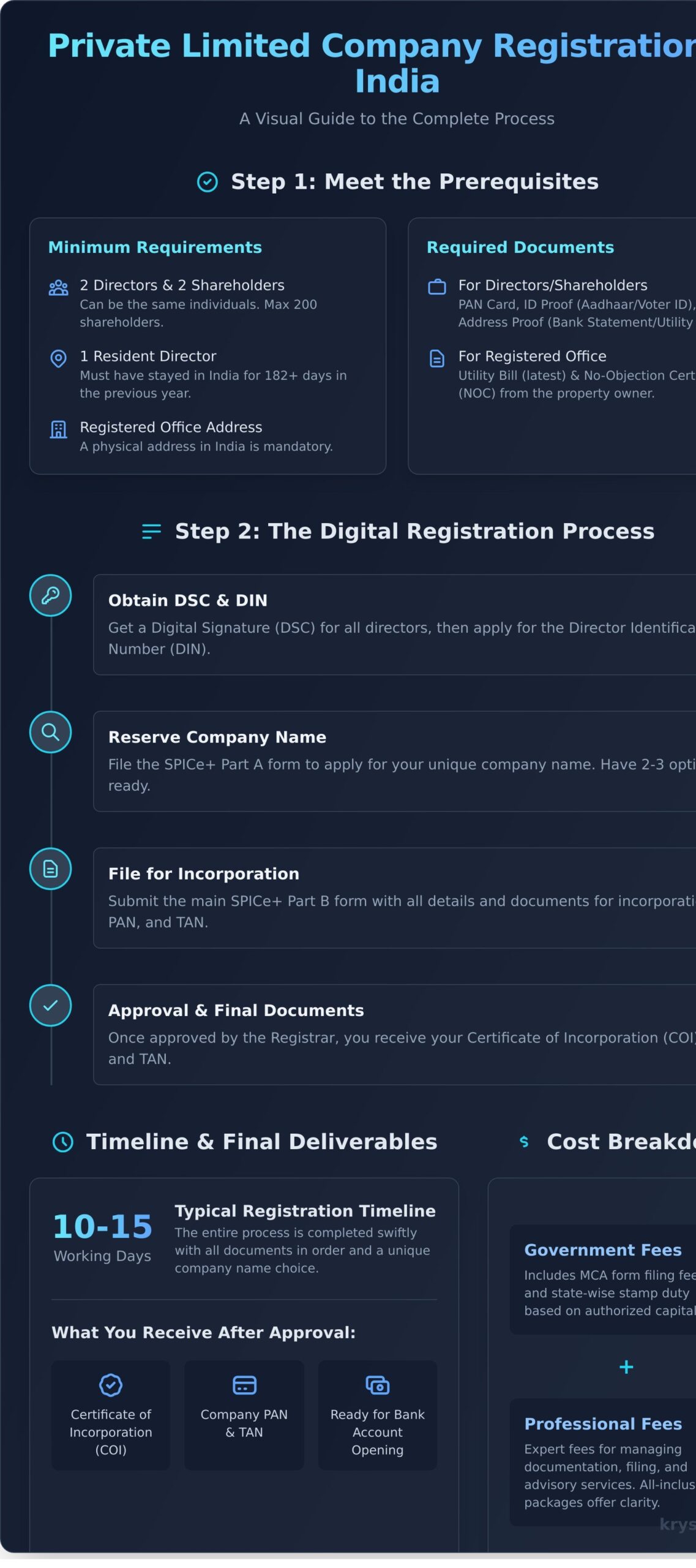
Step 1: Meet the Minimum Requirements
Before you begin, ensure you meet the basic criteria set by the Ministry of Corporate Affairs (MCA):
-
Directors: A minimum of two individuals are required to act as directors.
-
Members (Shareholders): You need a minimum of two shareholders, which can be the same individuals as the directors. The maximum is 200.
-
Resident Director: At least one of the directors must be a resident of India, meaning they have stayed in India for at least 182 days in the previous calendar year.
-
Registered Office Address: You must have a physical address in India to serve as the official registered office of the company.
Step 2: Gather Your Documents
Having your documentation in order is key to a smooth process. Ensure all documents are clear, valid, and up-to-date.
-
For Directors/Shareholders: You will need a copy of their PAN card, an ID proof (Aadhaar Card, Voter ID, or Passport), and an address proof (latest bank statement or utility bill).
-
For the Registered Office: A recent utility bill (electricity or water) for the office address and a No-Objection Certificate (NOC) from the property owner are required.
Step 3: The Digital Registration Steps
The entire registration is now done online through the MCA portal:
-
Obtain Digital Signature Certificate (DSC): A DSC is the digital equivalent of a physical signature. All proposed directors must have a valid Class-3 DSC.
-
Apply for Director Identification Number (DIN): DIN is a unique identification number assigned to an individual who is a director of a company.
-
Reserve Your Company Name: You’ll file the SPICe+ Part A form to apply for your chosen company name. It’s wise to have a couple of options ready in case your first choice is unavailable.
-
File for Incorporation: Once the name is approved, you will file the main SPICe+ Part B form, which includes the application for incorporation, DIN, PAN, and TAN.
Step 4: What You Get After Approval
Once the Registrar of Companies approves your application, you will receive several crucial documents electronically:
-
Certificate of Incorporation (COI): This is your company’s official birth certificate, containing the Corporate Identification Number (CIN).
-
Company PAN and TAN: Your new business will be automatically allotted a Permanent Account Number (PAN) and a Tax Deduction and Collection Account Number (TAN).
-
Bank Account Opening: With the COI and other documents, you can now approach any bank to open a corporate current account in your company’s name.
Feeling overwhelmed by the steps and paperwork? Don’t let compliance complexities slow down your dream. Let our experts handle the entire process for you.
Understanding the Costs & Timelines
One of the biggest concerns for any new entrepreneur is the investment of time and money. A transparent understanding of the costs and timelines helps in planning your launch effectively. Here’s a clear breakdown of what you can expect.
Breakdown of Company Registration Fees
The total cost can be divided into two main categories:
-
Government Fees: This includes the official fees for filing forms with the MCA and stamp duty, which varies from state to state based on your authorized capital.
-
Professional Fees: This is the fee charged by consultants like Chartered Accountants or Company Secretaries for their expertise in managing the documentation, filings, and providing guidance. Krystal7 offers all-inclusive packages with no hidden costs, ensuring you know the exact investment upfront.
How Long Does the Process Take?
With all documents in order and a unique name choice, the entire process typically takes about 10-15 working days from start to finish. Delays can sometimes occur if the proposed name is rejected or if there are issues with the submitted documents. Working with an experienced professional significantly minimizes these delays and ensures a faster, more streamlined registration.
Why Choose Krystal7 for Your Company Registration?
Your vision deserves your full attention. We handle the complex web of legal paperwork so you have the freedom to focus on what truly matters: building your business. Our team of seasoned Chartered Accountants and legal experts ensures your company registration is not just a transaction, but a seamless, compliant, and supportive experience. We believe in clarity, transparency, and becoming a genuine partner in your entrepreneurial journey.
Our All-in-One Incorporation Package Includes:
-
2 Director Identification Numbers (DINs) and Digital Signatures (DSCs)
-
Company name approval and reservation
-
Drafting of the Memorandum of Association (MOA) & Articles of Association (AOA)
-
All-inclusive government registration fees and stamp duty
-
Application for your company’s PAN and TAN
Frequently Asked Questions
What is the minimum capital required to start a private limited company?
There is no minimum capital requirement to start a private limited company in India. You can start with any amount of authorized capital, although it is common to start with ₹1,00,000.
Can I register a company at my home address?
Yes, you can use your residential address as the registered office address for your company, provided you can furnish the required documents like a utility bill and a No-Objection Certificate (NOC) from the owner.
Can a foreign national be a director in an Indian private limited company?
Yes, a foreign national can be a director. However, it is mandatory for at least one director on the board to be a resident of India.
What are the annual compliances I need to manage after registration?
After incorporation, a private limited company must comply with annual requirements like holding board meetings, filing annual returns with the Registrar of Companies (ROC), and filing income tax returns.
What is the difference between a Director and a Shareholder?
Directors are responsible for managing the day-to-day affairs of the company. Shareholders are the owners of the company who have invested capital. In many startups, the directors and shareholders are the same people.
How do I choose a unique name for my company?
Your company name should not be identical or too similar to an existing company or registered trademark. It should also be in line with the guidelines provided by the Ministry of Corporate Affairs. It’s best to check the MCA portal for name availability before applying.
Embarking on your business journey should be empowering, not bogged down by paperwork. By choosing the right structure and the right partner, you set the stage for success. We are here to bring the clarity and support you need to turn your vision into a registered, compliant, and thriving reality. Start your business with crystal clarity. Register Your Company Now and take the first confident step towards building your legacy.

Article by
Nihal Srivastava
Nihal Srivastava is the Co-Founder of Krystal7 Consultants, helping Indian entrepreneurs and startups navigate company registration, compliance, trademark protection, and regulatory requirements with clarity and confidence. With 6+ years of hands-on expertise in MCA filings, GST compliance, and corporate structuring, Nihal has guided 1000+ businesses across India through their legal and compliance journeys. He believes every business dream deserves crystal clear foundations, and that no founder should be held back by paperwork or red tape.





![PMFME Loan Scheme: A Complete Guide for Food Entrepreneurs [2026]](https://blogs.krystal7.com/wp-content/uploads/2026/04/PMFME-Loan-Scheme-A-Complete-Guide-for-Food-Entrepreneurs-2026-Hero-Image-768x439.jpg)