

PF Registration for Startups in India: A Krystal-Clear Guide (2026)
What if the biggest threat to your startup’s growth isn’t a competitor, but a compliance deadline you didn’t even know existed? We agree that for most Indian entrepreneurs, the thought of navigating the Shram Suvidha portal or calculating statutory dues feels like a heavy distraction from your true vision. However, managing pf registration for startups india early in your journey is more than just a legal box to check; it’s a strategic move to secure elite talent in a competitive 2026 market.
In this guide, you’ll learn how to navigate mandatory thresholds, calculate monthly contribution liabilities, and leverage EPF benefits to build a loyal team. We’ll provide a clear roadmap that moves you from compliance guesswork to statutory mastery. You’ll discover how to streamline the administrative red tape by partnering with experts, finally giving you the freedom to focus on scaling your business to its full potential.
Key Takeaways
- Identify exactly when your startup hits the 20-employee mandatory threshold and how to calculate headcount to stay compliant with the EPF Act.
- Master the process of pf registration for startups india using the Shram Suvidha portal to ensure your business is legally protected from day one.
- Learn to manage monthly contributions and ECR filings by the 15th of each month to avoid interest penalties and administrative damages.
- Explore how offering social security benefits can transform your startup’s culture and help you retain visionaries in a competitive 2026 market.
- Discover how partnering with Krystal7 Consultants removes the burden of red tape, giving you the freedom to focus on scaling your venture.
Why PF Registration for Startups in India is a Strategic Move
The Employees’ Provident Funds and Miscellaneous Provisions Act, 1952 remains the cornerstone of social security in India. In 2026, the Employees’ Provident Fund Organisation (EPFO) has evolved into a fully digital ecosystem, making pf registration for startups india a proactive business strategy rather than a reactive compliance task. It functions as a mandatory savings scheme where both you and your employees contribute toward a long term financial cushion.
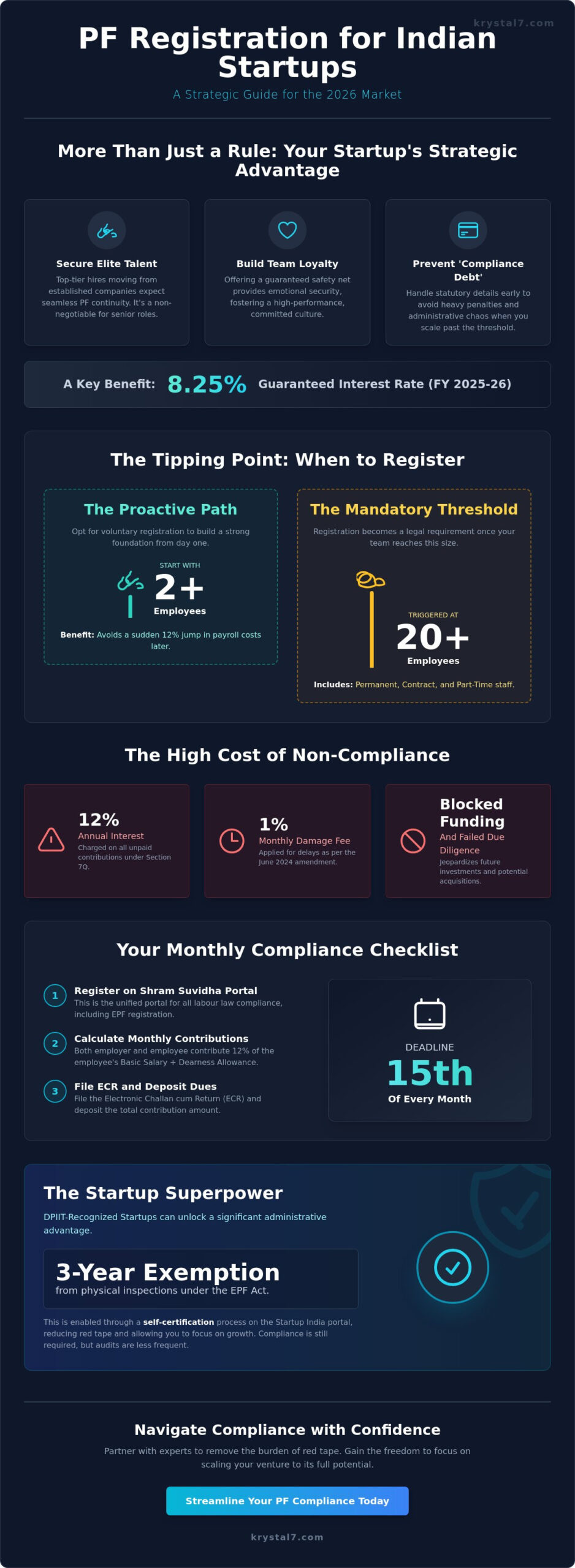
Founding a startup involves inherent risks, and your early team members feel that uncertainty. Offering PF provides emotional security by ensuring they have a guaranteed safety net with an 8.25% interest rate for the 2025-26 financial year. It signals a “Krystal-Clear” commitment to their welfare, proving that you value their future as much as their current output. This transparency builds the trust necessary to sustain a high performance culture during the volatile early stages of growth.
By automating your social security obligations early in your business lifecycle, you gain the “Freedom to Focus” on your core product. Early adoption prevents the “compliance debt” that often crushes scaling companies when they suddenly hit headcount thresholds. We believe that handling these statutory details correctly from day one is the hallmark of a visionary founder who is building a legacy, not just a venture.
The Talent Magnet: Why Senior Hires Demand EPF
Top tier talent moving from an established private limited company india expects seamless PF continuity. They understand that EPF is one of the most tax efficient savings instruments available under current Indian laws. A robust PF setup helps you bridge the “startup risk” gap, significantly improving your offer acceptance rates when recruiting senior leaders. It ensures their retirement corpus remains uninterrupted, making your startup a viable long term career destination.
Startup India Self-Certification Benefits
If your business is recognized by the DPIIT, pf registration for startups india unlocks unique administrative advantages. You can avail of a 3-year exemption from inspections under several labour laws, including the EPF Act, through the Startup India portal. You should link your company registration with the portal to access these “self-certification” features. This does not mean you can ignore compliance; instead, it reduces the “red tape” and frequency of physical audits, allowing you to manage filings through a streamlined digital interface.
Eligibility Criteria: When Does PF Registration Become Mandatory?
Under the EPF Act, 1952, the trigger point for mandatory registration is reaching a headcount of 20 employees. This count includes all categories of staff: permanent, contract, or part-time. Some founders mistakenly believe they can avoid pf registration for startups india by splitting their business into two separate entities. The EPFO uses the “test of functional integrity” to club such units, often leading to heavy back-dated penalties and legal disputes that can cripple a young venture.
Crossing the 20-employee mark without registering triggers immediate liabilities. You’ll face a simple interest of 12% per annum on unpaid amounts under Section 7Q, plus a 1% monthly damage fee for delays as per the June 2024 amendment. Maintaining transparency in your headcount isn’t just about following rules; it’s essential for your annual compliance for private limited company. Inaccurate reporting can block your ability to raise future funding or pass professional due diligence during an acquisition.
The Voluntary Registration Advantage
You don’t have to wait for your 20th hire to start building a legacy. Startups with as few as two employees can opt for voluntary registration. This requires a mutual agreement between the employer and the majority of employees. By opting in early, you avoid the sudden 12% jump in payroll costs that happens when registration becomes forced. It also allows you to offer high-demand benefits from the day you launch, helping you secure visionaries who prioritize long term stability over short term gains.
Applicability to Different Business Structures
Whether you manage a Private Limited Company or an LLP, the 20-employee threshold remains the same. Even a One Person Company (OPC) must register if it scales its workforce to the mandatory limit. Your initial how to register decisions dictate your future statutory burden. You can check your current status or begin the process through the EPFO Establishment Registration Portal. If you’re unsure about your current headcount liability, it’s wise to consult an expert advisor before a small error becomes a costly penalty.
Step-by-Step PF Registration Process for Indian Startups
Your journey toward pf registration for startups india begins with a Class 3 Digital Signature Certificate (DSC). This digital key allows the authorized signatory to sign documents electronically on government portals. It ensures that your application remains authentic and legally binding under the Information Technology Act.
Once your DSC is ready, you’ll visit the Shram Suvidha Portal. This platform acts as the central command center for your labour law obligations in 2026. You’ll need to create a unique user ID and password to access the unified registration module.
The core of the process involves filling out the Common Registration Form (CRF). This intelligent form collects data for both EPF and ESIC simultaneously to save you from redundant data entry. It asks for specific details about your business activities, ownership, and bank accounts.
After uploading your documents and signing the form with your DSC, you’ll hit the final submission button. The EPFO system then processes the data and issues your Establishment ID. This alphanumeric code serves as your permanent identity for all future PF interactions and filings.
Digital Documents Checklist (2026 Edition)
Having your paperwork ready prevents frustrating delays. You’ll need to upload clear, digital copies of the following documents:
- PAN and Aadhaar of the employer and all directors or partners.
- The Certificate of Incorporation (COI) from your how to register phase.
- Proof of address for the startup, such as a recent utility bill or lease agreement.
- A cancelled cheque that clearly shows the entity’s bank account details.
Common Pitfalls in the Online Application
The most frequent reason for rejection is a name mismatch between your PAN and EPFO records. Even a small spelling error or an extra space can cause the system to flag your application. You must ensure that every character matches your official tax records exactly.
Choosing the wrong National Industrial Classification (NIC) code is another common hurdle. These codes categorize your business activity and determine your specific compliance requirements. At Krystal7 Consultants, we provide “Crystal Clarity” by auditing your documents before submission to ensure your application sails through the portal without hiccups.
Post-Registration Compliance: Monthly Returns and Deadlines
Completing your pf registration for startups india is just the beginning of your journey toward statutory excellence. You must now manage the monthly contribution cycle, which involves a 12% deduction from the employee’s basic salary and dearness allowance. As an employer, you match this 12% contribution, though your portion is split: 8.33% directed to the Employee Pension Scheme (EPS) and 3.67% to the EPF account.
Every new team member requires a Universal Account Number (UAN) to track their life long savings. You generate these numbers through the EPFO portal by providing the employee’s KYC details and bank information. Managing these numbers accurately ensures that your payroll remains “Krystal-Clear” and transparent for your entire workforce.
The Electronic Challan-cum-Return (ECR) is the digital file you must upload to the EPFO portal every month. It details the wages earned and the specific contributions made for every employee on your roster. Automating these payroll cycles early on gives you the “Freedom to Focus” on your startup’s growth while maintaining a perfect compliance record.
Key Deadlines and Penalties for 2026
The 15th of each month is the non-negotiable deadline for depositing PF contributions and filing the ECR. Missing this date by even 24 hours triggers automatic interest under Section 7Q of the EPF Act at a simple interest rate of 12% per annum. You’ll also face penal damages under Section 14B, which, following the June 2024 amendment, carries a uniform penalty of 1% per month on the outstanding amount.
Consistent, on-time filing is essential for your annual compliance for private limited company status. Banks and investors frequently scrutinize these payment receipts during due diligence rounds. If you want to avoid the stress of manual tracking, you can outsource your monthly PF compliance to our expert team.
Managing Employee KYC and UAN Transfers
Aadhaar seeding is mandatory for all UANs in 2026 to ensure seamless digital withdrawals and transfers. You cannot file the ECR for an employee whose Aadhaar is not verified and linked to their UAN. This “digital-first” requirement from the EPFO helps prevent duplicate accounts and speeds up the settlement process for your staff.
When you hire talent from other firms, you must facilitate the “transfer-in” of their previous PF balance. This process is now largely automated through the EPFO portal, but it requires proactive verification from your side. Maintaining open, honest communication with your employees about their social security benefits builds a culture of trust and long term loyalty.
Streamlining Startup Payroll with Krystal7 Consultants
Founders often find themselves overwhelmed by the sheer volume of red tape involved in Indian labour laws. Krystal7 Consultants acts as a genuine partner for visionaries who want to trade the anxiety of compliance for the freedom to focus on growth. We believe that your energy belongs on scaling your product, not on deciphering the latest EPFO circulars or troubleshooting portal errors.
Our elite team of Chartered Accountants and legal strategists helps you move from guesswork to statutory mastery. We manage the entire lifecycle of pf registration for startups india, from the initial DSC setup to the monthly ECR filings and UAN helpdesk support. This end to end service ensures that your payroll remains compliant, transparent, and ready for any future investor due diligence.
Transparency is a brand pillar for us, which is why we offer upfront pricing with no hidden costs. Gurgaon startups prefer our methodical approach because it replaces uncertainty with Crystal Clarity. We handle the meticulous details of employee KYC and Aadhaar seeding so you can build your legacy without the fear of statutory penalties.
Beyond Registration: Integrated Compliance
Compliance shouldn’t exist in a silo. We provide an integrated approach that links your PF obligations with GST, TDS, and specific funding requirements. For example, maintaining clean compliance records is often a prerequisite for founders seeking a stand up india loan to fuel their expansion. Our goal is to ensure that every statutory box is checked so your path to capital remains clear.
Every Krystal7 Consultants client works with a dedicated relationship manager who knows their business inside out. You’ll receive customized payroll reports that provide a clear view of your total CTC outflows, including employer contributions and statutory dues. This level of advisory helps you manage your burn rate with precision while ensuring your team remains protected by a robust social security net.
Get Started with Your PF Registration Today
Don’t let the hassle of manual filings or the fear of Section 14B penalties hold your venture back. Pf registration for startups india is a strategic foundation for attracting top tier talent and building a professional work culture. Let us handle the complexity while you pursue your passion with total peace of mind.
Ready to bring Krystal-Clear transparency to your startup’s payroll? Contact Krystal7 Consultants today at business@krystal7.com or visit krystal7.com for expert assistance. Our Gurgaon based advisors are always just a call away to help your business dream thrive.
Secure Your Vision with Crystal Clarity
Mastering your statutory obligations is the first step toward building a lasting legacy. You now understand that reaching the 20-employee threshold makes registration mandatory, while voluntary enrollment offers a strategic edge for early stage talent acquisition. Managing the 15th of the month deadline and Aadhaar-linked UANs ensures your startup stays protected from the 12% interest penalties under Section 7Q.
Professional pf registration for startups india shouldn’t be a source of anxiety. It’s a tool for growth that signals your commitment to employee welfare. Our elite team of Chartered Accountants and Company Secretaries has earned the trust of over 5,000 creative businesses across India. We provide upfront pricing with no hidden costs, giving you the Krystal-Clear transparency you deserve.
Ready to secure your startup’s future? Contact Krystal7 Consultants for seamless PF registration or visit krystal7.com today. Your business dream matters; let’s build it with the freedom to focus on what you do best.
Frequently Asked Questions
Is PF registration mandatory for a startup with only 5 employees?
No, PF registration is not mandatory for startups with fewer than 20 employees under the current EPF Act. You can still opt for voluntary registration if you want to offer social security benefits to your early team. This is a common strategy for founders who want to compete with larger companies for high quality talent.
What is the minimum salary limit for mandatory EPF contribution in 2026?
The statutory wage ceiling for mandatory contributions remains INR 15,000 per month as of May 2026. Employees earning more than this amount at their first job are considered “excluded employees” and are not required to join the fund. However, most startups choose to contribute on the full basic salary to provide better retirement benefits for their staff.
Can a startup apply for PF registration online without a consultant?
Yes, you can technically complete pf registration for startups india on your own through the Shram Suvidha portal. While the digital gateway is accessible, many founders face delays due to mismatched PAN details or incorrect industrial classification codes. Using a professional advisor ensures your application is methodical and avoids the hassle of repeated rejections.
What happens if a startup fails to deposit PF contributions by the 15th?
Missing the 15th of the month deadline triggers immediate financial penalties that can accumulate quickly. You’ll be liable for 12% annual interest under Section 7Q and a 1% monthly damage fee under Section 14B for every month of delay. These defaults also appear on the public EPFO portal, which can create red flags during investor due diligence.
Are international workers in Indian startups covered under PF rules?
International workers from countries that don’t have a Social Security Agreement (SSA) with India must be enrolled in the PF scheme. Unlike Indian employees, their contributions are calculated on their total salary rather than the INR 15,000 cap. It’s vital to identify these employees during onboarding to ensure your monthly ECR filings are accurate and compliant.
How does the Shram Suvidha portal simplify PF registration for new businesses?
The Shram Suvidha portal provides a unified Common Registration Form that covers both EPF and ESIC requirements in one go. This single window system eliminates the need to navigate multiple government websites or fill out redundant paperwork. It streamlines the process for new ventures, allowing you to obtain your Establishment ID much faster than traditional methods.
Can an employee opt-out of the EPF scheme if their salary is above INR 15,000?
An employee can only opt-out if their basic pay is above INR 15,000 and they have never been a member of the EPF before. They must submit Form 11 as a declaration of their “excluded” status when they join your startup. If they have an existing UAN from a previous job, they must continue their contributions regardless of their current salary level.
What documents are required to generate a UAN for a new employee?
To generate a Universal Account Number, you must have the employee’s Aadhaar number, PAN, and bank account details with a valid IFSC. Aadhaar seeding is a mandatory requirement in 2026 for all digital filings and withdrawals. You should also ensure the employee’s mobile number is linked to their Aadhaar to prevent verification errors on the EPFO portal.

Article by
Nihal Srivastava
Nihal Srivastava is the Co-Founder of Krystal7 Consultants, helping Indian entrepreneurs and startups navigate company registration, compliance, trademark protection, and regulatory requirements with clarity and confidence. With 6+ years of hands-on expertise in MCA filings, GST compliance, and corporate structuring, Nihal has guided 1000+ businesses across India through their legal and compliance journeys. He believes every business dream deserves crystal clear foundations, and that no founder should be held back by paperwork or red tape.