
How to Fix ROC Filing Mistakes After Submission: A Step-by-Step Guide for 2026
Last Tuesday, a founder named Alex discovered that a small clerical error in his annual report filing triggered a “Non-Compliant” status with the Secretary of State. It’s a high-stakes scenario where a misplaced digit or an incorrect attachment leads to significant daily penalties mandated under state corporation laws. While the term “ROC” typically refers to India’s Registrar of Companies, understanding how to fix roc filing mistakes after submission is crucial for any business, especially in the United States, to protect your company and your director status from these avoidable risks.
We understand that managing the complexities of state and federal regulatory portals, like the SEC’s EDGAR system or various Secretary of State platforms, feels overwhelming when your professional reputation is on the line. You deserve the freedom to focus on your vision without the anxiety of compliance red tape. Our team at Krystal7 Consultants provides the clarity you need to handle these legal hurdles with calm competence and precision.
This guide provides a definitive roadmap to rectify your corporate filings and restore your company’s good standing. You’ll learn the exact protocols for submitting amended filings, voluntary disclosures, and the specific steps to correct forms with material errors. We’ve mapped out the 2026 US regulatory workflow to ensure your journey back to compliance is streamlined and successful.
Key Takeaways
- Understand the MCA portal framework and why the lack of a “modify” button requires a strategic approach to status-based rectification.
- Learn how to fix roc filing mistakes after submission by following the formal legal procedure for form nullification and withdrawal.
- Gain crystal clarity on correcting specific errors in AOC-4 and MGT-7 forms, ranging from balance sheet discrepancies to shareholder details.
- Navigate the financial implications of refiling, including the latest 2026 penalty slabs and reduced rates for qualifying Small Companies.
- Protect your business from non-compliance by mastering the legal protocols under Sections 137 and 403 of the Companies Act, 2013.
Can You Edit an ROC Form After Submission? Understanding the MCA Framework
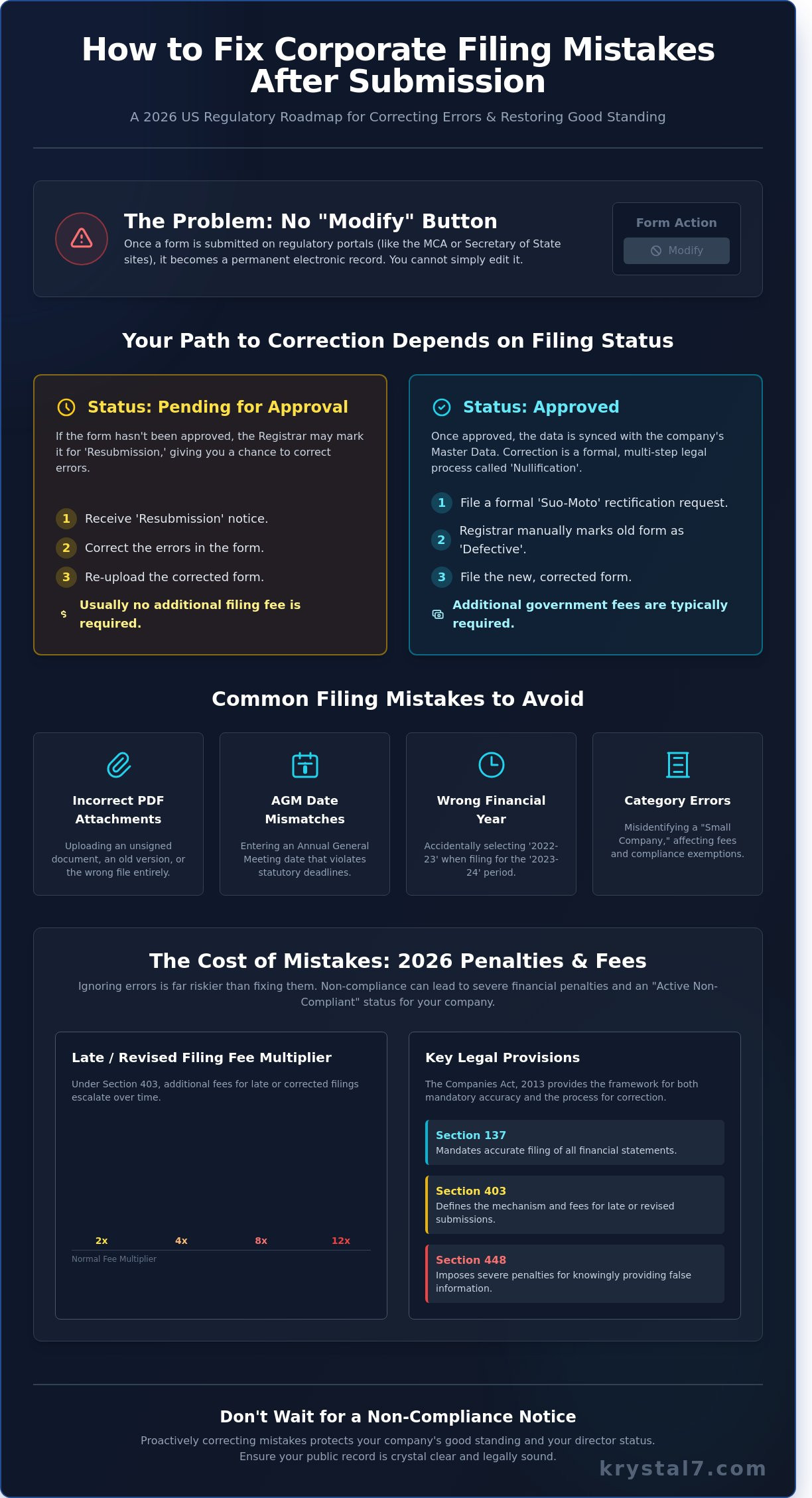
The Ministry of Corporate Affairs (MCA) portal doesn’t provide a ‘modify’ button once you’ve submitted a form and paid the fees. This design ensures the integrity of corporate records, but it leaves many founders wondering how to fix roc filing mistakes after submission. Once a document is uploaded, it becomes a permanent part of the electronic registry.
The path to correction depends entirely on the status of your form. If the status is ‘Pending for Approval,’ the Registrar might mark it for ‘Resubmission,’ allowing you to rectify errors without a fresh fee. However, if the status shows ‘Approved,’ the data has already synced with the company’s Master Data. Changing an approved form is significantly more complex and often requires manual intervention from the department.
Ignoring a mistake is far riskier than the cost of refiling or seeking a cancellation. Incorrect financial data or wrong dates can trigger ‘Active Non-compliant’ status for your Private Limited company. Under Section 448 of the Companies Act 2013, providing false information in any return can lead to severe penalties. Accuracy isn’t just a preference; it’s a statutory necessity that protects your company’s ‘Active’ standing.
Common Mistakes in ROC Filings
Clerical errors in financial figures within form AOC-4 are the most frequent issues we see. A single misplaced zero can change a profit of INR 10,00,000 into INR 1,00,00,000, creating massive tax and compliance discrepancies. These errors often happen during the manual entry of data from the audited balance sheet into the MCA e-form.
- Incorrect PDF Attachments: Uploading an unsigned document or the previous year’s audit report by mistake.
- AGM Date Mismatches: Entering an Annual General Meeting date that doesn’t align with the 6-month deadline from the end of the financial year.
- Wrong Financial Year: Selecting the 2022-23 period when you intended to file for 2023-24.
- Category Errors: Misidentifying a Small Company as a Non-Small Company, which changes the applicable filing fees and exemptions.
The Concept of ‘Nullification’ of Forms
When a mistake is discovered in an approved form, you must seek ‘Nullification.’ This process involves marking the previously filed form as ‘Defective’ or ‘Invalid’ in the MCA database. You can’t simply file a second form over the first one, as the system will reject it as a duplicate filing.
The Registrar of Companies (ROC) must manually intervene to allow a refiling. This usually requires a ‘Suo-Moto’ rectification request where the company formally admits the error. You’ll need to explain the nature of the mistake and provide the correct documents to justify the cancellation of the original filing. Understanding how to fix roc filing mistakes after submission through this route requires precise communication with the authorities.
Once the ROC approves your request, the old form is moved to a ‘Defective’ state. This clears the technical block on the portal, giving you the freedom to focus on filing the correct version. While this process might involve additional government fees, it ensures your company’s public record remains crystal clear and legally sound.
If you’ve discovered an error in your recent filings, don’t wait for a notice. Contact Krystal7 Consultants at business@krystal7.com or visit krystal7.com for expert assistance in rectifying your MCA records.
Legal Basis for Correcting Mistakes under the Companies Act, 2013
Understanding the legal framework is the first step toward achieving krystal-clear compliance. The Companies Act, 2013 provides specific pathways for entrepreneurs wondering how to fix roc filing mistakes after submission. Section 137 mandates that every company must file its financial statements accurately with the Registrar. If you discover a discrepancy in these figures after the “SRN” is generated, the law requires immediate corrective action to maintain the integrity of public records.
Section 403 acts as the primary mechanism for late or revised submissions. It allows companies to file documents after the prescribed deadline by paying additional fees, which can range from 2 times to 12 times the normal fee depending on the delay. This section ensures that while errors are costly, they aren’t permanent. Rule 10 of the Companies (Registration Offices and Fees) Rules, 2014 gives the Registrar the power to mark a document as “Defective.”
The Registrar uses this authority to call for further information or direct a complete refiling. If the ROC identifies an inconsistency during the “Technical Scrutiny” phase, they will typically grant a 15-day window for resubmission. This period is crucial for businesses to provide the correct data without facing immediate prosecution. If you’re unsure about the status of your filing, our compliance strategists can help you review your MCA dashboard for any pending alerts.
Section 448: The Risk of False Statements
Every e-form submitted on the MCA portal requires a formal ‘Declaration’ signed by a Director using their Digital Signature Certificate (DSC). Section 448 carries significant weight because it penalizes the delivery of false statements or the omission of material facts. While the law distinguishes between intentional fraud and unintentional clerical slips, the burden of proof often rests on the company. Filing a voluntary rectification request immediately after discovering an error acts as a vital “good faith” defense. It proves to the authorities that there was no intent to deceive the stakeholders or the government.
Administrative Powers of the Jurisdictional ROC
Your local ROC office, whether in Delhi, Mumbai, or Bangalore, holds discretionary power over the rectification process. They initiate the ‘Inquiry’ stage if a filed document contradicts previous records or statutory audits. The MCA V3 portal has streamlined this by introducing the Change Request Form (CRF) for specific correction scenarios. This web-based form allows for the processing of requests that do not have a dedicated e-form. In 2024, the portal also refined ‘Withdrawal’ requests, allowing companies to stop the processing of certain forms if a mistake is spotted within a narrow timeframe after submission.
Step-by-Step Procedure to Fix ROC Filing Errors
Correcting a mistake on the MCA portal requires a methodical approach to ensure your company records remain accurate. The first step is checking the current status of your filed form using the ‘Track SRN Status’ service. If the form shows ‘Approved’ or ‘Recorded’, you can’t simply overwrite the data. Understanding how to fix roc filing mistakes after submission involves a formal process of nullification or marking the previous entry as defective. This clarity prevents future legal hurdles during audits or due diligence.
STP vs. Non-STP Forms: Different Correction Paths
The path to rectification depends on whether the form was Straight Through Process (STP) or Non-STP. STP forms, such as the MGT-7A for small companies, are auto-approved by the system without manual intervention. Because these are recorded instantly, you must file a formal petition for nullification to the Regional Director or the ROC. Non-STP forms undergo manual scrutiny by MCA back-office officials. If you identify an error in a Non-STP form before approval, you can proactively contact the ROC to request a ‘Resubmission’ status, which allows you to fix errors without a full nullification process.
Essential Documentation for Rectification
Documentation is the backbone of a successful correction. You’ll need to follow these steps to prepare your application:
- Board Resolution: Hold a Board Meeting to pass a formal resolution that specifically authorizes the withdrawal or rectification of the erroneous form.
- Affidavit: Prepare an Affidavit on non-judicial stamp paper, typically valued between INR 10 and INR 100 depending on your state. This document must clearly explain the nature of the error and confirm that the correction isn’t intended to defraud any stakeholders.
- Indemnity Bond: Draft an Indemnity Bond to protect the ROC against any third-party claims that might arise from the change in records.
- Detailed Application: Write a formal letter explaining why the mistake occurred and how to fix roc filing mistakes after submission for that specific SRN.
The Physical Submission Requirement
While most compliance is digital, correcting errors often requires a physical presence at the ROC office. You or an authorized representative must submit the hard copies of your application, Affidavit, and the original payment Challan. You’ll request the Registrar to mark the original SRN as ‘Defective’ in the MCA database. Once the official updates the status to ‘Defective’, the system clears the path for a fresh filing. You’ll then need to pay the applicable filing fees again, along with any additional fees if the new filing happens after the statutory deadline. Tracking the new SRN ensures that the corrected data finally reflects in the Master Data of your company.
Managing ROC rectifications can feel overwhelming for busy entrepreneurs. At Krystal7 Consultants, we provide the elite expertise needed to navigate MCA back-office procedures with ease. Our team handles the drafting and ROC coordination, giving you the freedom to focus on your business growth. Contact Krystal7 Consultants at business@krystal7.com or visit krystal7.com for expert assistance with your compliance needs.
Correction Nuances for Specific MCA Forms
Every MCA form serves a distinct legal purpose. You can’t use a generic approach when learning how to fix roc filing mistakes after submission. Each document, from financial disclosures to auditor appointments, follows specific validation rules on the MCA V3 portal.
AOC-4 errors usually involve the Balance Sheet or the Auditor’s Report. If you find a mistake in the figures after the ROC has approved the form, you’ll likely need to file revised financial statements. MGT-7 mistakes often involve the list of shareholders or share transfer dates. These errors are critical because they affect the company’s annual return and public record accuracy.
PAS-3 filings require precision in the Return of Allotment. A wrong share price or incorrect allotment date can lead to complications during a future audit. Similarly, ADT-1 errors regarding the auditor’s DIN or their five-year tenure can invalidate the appointment. You must address these quickly to avoid penalties under the Companies Act 2013.
- AOC-4: Fixing clerical errors in the profit and loss data or the XBRL instance document.
- MGT-7: Updating the details of share transfers that occurred during the financial year.
- PAS-3: Rectifying the number of shares issued or the category of shareholders.
- ADT-1: Correcting the period of appointment or the PAN of the audit firm.
Handling Financial Data Discrepancies
Discrepancies often arise when the XBRL file contains different data than the signed PDF report. The MCA system flags these inconsistencies during the “Straight Through Process” (STP) or manual review. You must ensure your annual compliance for private limited company stays perfectly aligned across all attachments. Under Section 131 of the Companies Act 2013, companies can voluntarily revise their financial statements if they don’t comply with Section 129. This process requires a formal Board resolution and sometimes NCLT approval for past years. Understanding how to fix roc filing mistakes after submission for financial data is vital for maintaining investor trust.
Correcting Director or Shareholder Information
A wrong DIN in a filing is a major hurdle. It can stop a director from signing future e-forms and creates a mismatch in the MCA Master Data. Mistakes in the “List of Shareholders” attachment for a private limited company india can misrepresent the ownership structure. Once you file a correction or a supplementary form, the MCA portal typically updates the public record within 48 to 72 hours. This ensures that any person conducting a public search sees the most accurate data about your company’s management and stakeholders.
Don’t let filing errors jeopardize your company’s standing. Get expert guidance on MCA corrections from our dedicated professionals.
The Cost of Mistakes: Penalties and Additional Fees in 2026
Mistakes in MCA filings aren’t just paperwork errors. They represent a growing financial liability that compounds every single day. Understanding how to fix roc filing mistakes after submission quickly is vital for your company’s financial health and legal standing.
The Ministry of Corporate Affairs (MCA) applies a strict slab-based “Additional Fee” for late or corrected filings. These fees scale based on the duration of the delay. For delays up to 30 days, you might pay 2 times the normal fee, but this escalates to 12 times the normal fee for delays exceeding 180 days.
Small Companies and One Person Companies (OPCs) receive some relief under Section 446B of the Companies Act, 2013. These entities are generally liable for only 50% of the standard penalty amount. This provision protects startups and smaller ventures from the crushing weight of accidental non-compliance during their growth phase.
If the MCA discovers a mistake during a routine audit or inspection before you take action, the situation shifts from a simple late fee to a “compounding of offense.” This process requires filing a legal petition under Section 441. It involves discretionary fines and formal hearings that far exceed standard administrative costs.
Daily Penalty Calculations
- Standard Daily Rates: Late filings for Annual Returns (MGT-7) or Financial Statements (AOC-4) attract a fixed penalty of INR 100 per day.
- Penalty Caps: While the 2013 Act imposes maximum caps for Directors and Companies, these can still reach INR 2 lakh or more depending on the specific form.
- The 15-Day Window: Rectifying errors within the initial 15-day “Resubmission” (RSUB) window is the only way to avoid these cumulative daily charges.
Krystal7 Consultants’ ‘Crystal-Clear’ Compliance Audit
Our pre-filing review service identifies discrepancies in balance sheets or director details before they ever reach the MCA portal. This proactive approach ensures your filings are accurate the first time, preventing the need for costly corrections later. We bring transparency to a process that often feels like a maze of red tape.
With our “Freedom to Focus” guarantee, we handle the entire ROC liaison and filing process for you. Our team of legal strategists and Chartered Accountants manages the technicalities of how to fix roc filing mistakes after submission so you can pursue your passion. Professional assistance provides a layer of security that is always cheaper than a single ROC penalty.
Don’t let compliance errors stall your business growth or drain your capital. Contact Krystal7 Consultants at business@krystal7.com or visit krystal7.com for expert assistance today.
Take Control of Your MCA Compliance Today
A filing error on the MCA portal doesn’t have to stall your business momentum. The Companies Act, 2013, offers specific legal frameworks to rectify data inaccuracies, provided you act before the Registrar of Companies initiates suo-moto action. Taking immediate steps to resolve discrepancies protects your firm from the steep additional fees and prosecution risks that define the 2026 regulatory landscape.
Navigating the technical nuances of how to fix roc filing mistakes after submission requires a methodical approach to the MCA V3 portal. Our elite team of Chartered Accountants and Company Secretaries brings crystal clarity to these complex procedures. We handle the heavy lifting of rectification and condonation of delay, giving you the freedom to focus on scaling your venture.
Don’t let a minor administrative slip-up turn into a significant legal headache for your directors. Contact Krystal7 Consultants at business@krystal7.com for expert assistance in ROC rectification. We offer transparent, upfront pricing and specialized troubleshooting for all statutory filings. Your business dream deserves a foundation of perfect compliance, and we’re here to ensure your record remains spotless.
Frequently Asked Questions
Can I edit a form on the MCA portal after paying the fees?
You can’t edit a form on the MCA portal once the payment is successful and a Service Request Number (SRN) is generated. The system locks the document to maintain the integrity of the filing record. To resolve how to fix roc filing mistakes after submission, you must wait for the ROC to mark the form as defective or apply for a formal cancellation.
What is the fee for nullifying an ROC form in 2026?
There’s no specific government fee for submitting a nullification request as of 2026, but you’ll lose the original filing fee. The Ministry of Corporate Affairs doesn’t refund fees for forms filed with errors. You’ll need to pay the standard filing fee, which usually ranges from INR 200 to INR 600 for small companies, when you submit the new form.
Will a filing mistake lead to my Director’s disqualification?
A simple clerical error won’t lead to a Director’s disqualification under Section 164 of the Companies Act, 2013. Disqualification typically happens if a company fails to file its financial statements or annual returns for three consecutive financial years. While a single mistake isn’t fatal, persistent non-compliance can lead to penalties of up to INR 5,00,000 for the officers in default.
What happens to the money I paid for the wrong form?
The money you paid for an incorrect form is forfeited and cannot be recovered. The MCA portal doesn’t offer a refund or adjustment mechanism for fees paid against an erroneous SRN. You’ll have to make a fresh payment for the corrected filing once the previous entry is cleared from the system.
How long does it take for the ROC to approve a nullification request?
The ROC usually takes between 15 and 30 days to process and approve a nullification request. This timeline varies based on the current workload of your specific jurisdictional office, such as ROC Delhi or ROC Bangalore. Our team monitors the SRN status daily to ensure your business can move forward as soon as the system updates.
Can I file a fresh form without nullifying the old one?
You can’t file a fresh form for the same event or period if the previous incorrect form is still active in the MCA records. The portal will block the new submission and display an error message. Learning how to fix roc filing mistakes after submission requires you to first clear the old record so the system accepts the new, accurate data.
Is an affidavit mandatory for all ROC filing corrections?
Yes, you must submit an affidavit on non-judicial stamp paper to explain the error and request a correction. This document needs to be notarized and signed by an authorized Director of the company. It acts as a formal declaration that the previous filing contained mistakes and that the company is now providing the correct information.
What is the difference between a ‘Defective’ form and a ‘Cancelled’ form?
A ‘Defective’ status is assigned by the ROC official during their review if they find missing information or errors. A ‘Cancelled’ status occurs after the ROC approves a specific request from the company to nullify a form. Both statuses allow you to rectify the record, but a defective status is initiated by the regulator while cancellation is initiated by the company.
For expert assistance with your ROC filings or to resolve compliance errors, contact Krystal7 Consultants at business@krystal7.com or visit krystal7.com.

Article by
Nihal Srivastava
Nihal Srivastava is the Co-Founder of Krystal7 Consultants, helping Indian entrepreneurs and startups navigate company registration, compliance, trademark protection, and regulatory requirements with clarity and confidence. With 6+ years of hands-on expertise in MCA filings, GST compliance, and corporate structuring, Nihal has guided 1000+ businesses across India through their legal and compliance journeys. He believes every business dream deserves crystal clear foundations, and that no founder should be held back by paperwork or red tape.