

How to Manage Compliance Anxiety as a Founder: A Guide for Indian Entrepreneurs
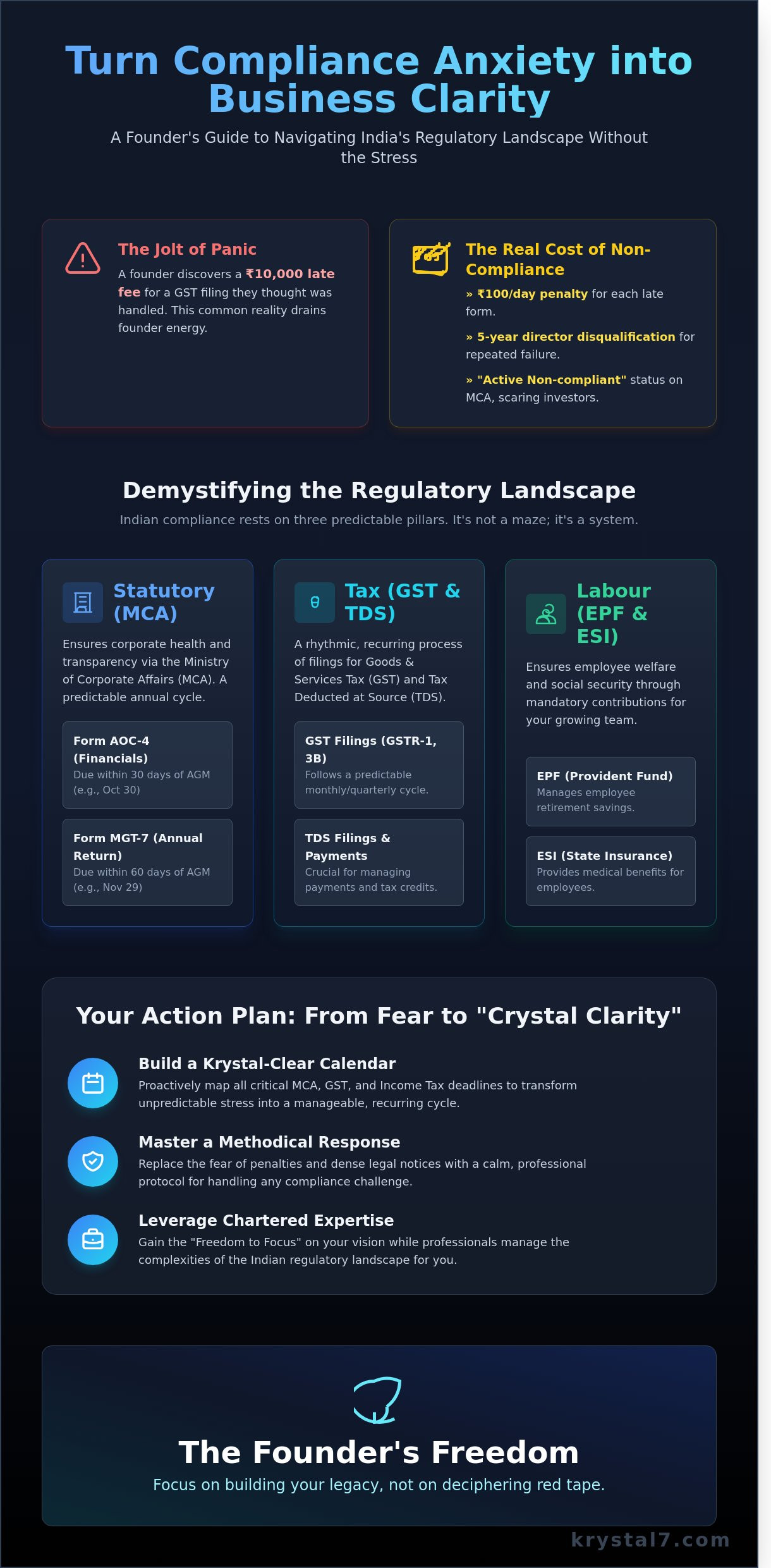
Last Tuesday, a Delhi-based founder named Rohan discovered a ₹10,000 late fee on the GST portal for a filing he thought his team had handled. That sharp jolt of panic is a reality for many Indian entrepreneurs who feel buried under the weight of the Companies Act and shifting tax mandates. It’s hard to build a legacy when you’re constantly looking over your shoulder for the next legal notice. Understanding how to manage compliance anxiety as a founder is the first step toward reclaiming your peace of mind.
You likely feel that the red tape in India is designed to slow you down rather than help you grow. It’s frustrating to spend your weekends deciphering TDS timelines or MCA requirements instead of scaling your venture. We’ve helped over 500 startups move past this overwhelm by replacing guesswork with methodical, crystal-clear systems.
This guide promises to turn your regulatory stress into business clarity with actionable steps for managing Indian statutory requirements. We’ll walk through a clear system for tracking deadlines and show you how to automate your compliance so you can finally focus on your growth.
Key Takeaways
- Understand the three pillars of Indian compliance—Statutory, Tax, and Labour—to transform unpredictable stress into a manageable, recurring cycle.
- Learn how to manage compliance anxiety as a founder by building a Krystal-clear calendar that maps out critical MCA, GST, and Income Tax deadlines.
- Master the professional protocol for handling legal notices and missed filings to replace the fear of penalties with a calm, methodical response.
- Identify the essential licenses and audit requirements for your specific business structure to ensure total regulatory transparency and “Crystal Clarity.”
- Discover how leveraging chartered expertise provides the “Freedom to Focus” on your vision while professionals manage the complex Indian regulatory landscape.
What is Compliance Anxiety and Why Does it Hit Indian Founders Hard?
Compliance anxiety is the chronic fear of missing a statutory deadline or facing legal repercussions due to an administrative oversight. For Indian entrepreneurs, this isn’t just a minor worry; it’s a constant mental weight. You might find yourself waking up at 3 AM wondering if you filed your GSTR-1 correctly or if your auditor mentioned an AOC-4 deadline you missed. Learning how to manage compliance anxiety as a founder starts with recognizing that this fear is a logical response to a complex regulatory landscape.
The Indian regulatory environment is uniquely demanding. Between the Ministry of Corporate Affairs (MCA), the GST portal, and the Income Tax Department, the sheer volume of paperwork is intense. New entrepreneurs often fall into analysis paralysis because they don’t know what they don’t know. It’s completely normal to feel overwhelmed by the Companies Act 2013. This legislation contains hundreds of sections that can confuse even seasoned professionals.
When you’re trying to build a visionary product, navigating these legalities feels like a distraction from your true purpose. We aim to provide the “Freedom to Focus” by replacing this guesswork with professional clarity. You should spend your time on product-market fit, not worrying about whether your registered office address is updated correctly.
The High Stakes: Why You Must Learn How to Manage Compliance Anxiety as a Founder
The financial cost of a mistake in India is immediate and steep. Failing to file annual returns with the ROC triggers a penalty of INR 100 per day for each form. If a company fails to file financial statements for three consecutive years, directors face disqualification under Section 164(2) of the Companies Act. This means you’re barred from the board of any company for five years. Beyond money, the reputational damage is severe. Your company status on the MCA portal changes to “Active Non-compliant,” which can scare off investors and banks instantly.
The Mental Toll: How to Manage Compliance Anxiety as a Founder and Reclaim Your Energy
Many founders view Indian compliance as an impossible maze designed to trap them. This “red tape” perception creates administrative friction that drains the creative energy you need for growth. Common anxiety triggers include receiving a GST notice or a tax demand letter in the mail. These documents often use dense legal language that sounds more threatening than it actually is. By establishing a methodical approach to these filings, you can eliminate the “fear of the unknown” and ensure your business remains a “going concern” without the constant stress.
Demystifying the Indian Regulatory Landscape to Reduce Stress
Compliance often feels like a mountain because founders view it as a series of random traps. It’s not. The Indian regulatory landscape stands on three predictable pillars: Statutory (MCA), Tax (GST and Income Tax), and Labour (EPF and ESI). These systems aren’t designed to hinder you; they’re designed to create a transparent ecosystem. Shifting your perspective from “policing” to “governance” is the first step in learning how to manage compliance anxiety as a founder. Good governance ensures your venture remains attractive to investors and healthy for the long term.
Most “scary” regulations follow a recurring, annual cycle that you can map out on a single calendar. Establishing a private limited company in India provides the most structured legal entity to support this growth. This structure offers a clear legal framework that separates your personal assets from business liabilities, providing a sense of security while you scale.
Understanding the MCA and ROC Filing Cycle
The Ministry of Corporate Affairs (MCA) requires two main annual filings that often cause the most stress. Form AOC-4 is for your financial statements, while Form MGT-7 covers your annual return. AOC-4 is generally due within 30 days of your Annual General Meeting (AGM), usually by October 30. MGT-7 follows within 60 days of the AGM, typically by November 29. The Registrar of Companies (ROC) acts as the primary auditor of your corporate health. When you understand that these forms simply document your company’s evolution and shareholding, the fear of the paperwork disappears. Transparency in these filings builds the “crystal clarity” needed for future funding rounds.
Taming the GST and TDS Monsters
Tax compliance is a rhythmic process rather than a constant crisis. Most startups operate on a monthly filing logic for GST, using GSTR-1 for sales and GSTR-3B for tax payment. This monthly pulse keeps your books updated and prevents a massive backlog at the end of the financial year. The GSTN portal and the TRACES portal for TDS work together to provide transparency. You can track exactly how much tax credit you’ve earned and ensure your vendors are also compliant.
- Monthly Deadlines: GSTR-1 is usually due by the 11th, and GSTR-3B by the 20th of the following month.
- Quarterly TDS: TDS returns (like Form 24Q or 26Q) are filed every quarter, ensuring your employees and vendors have their taxes properly credited.
- Cash Flow Tool: Regular GST reconciliation helps you identify leakages in your supply chain early.
GST compliance is actually a tool for better cash flow management. It forces you to reconcile your accounts every 30 days, which stops small errors from turning into expensive penalties. If you feel overwhelmed by these timelines, a dedicated compliance partner can help you automate these reminders. Mastering how to manage compliance anxiety as a founder starts with realizing that you don’t have to hold all these dates in your head alone.
5 Steps to Building a Krystal-Clear Compliance Calendar
Compliance anxiety often stems from the unknown. You can’t fix what you haven’t mapped out. A structured calendar acts as your roadmap, ensuring you never miss a deadline or face a penalty. This clarity is the most effective way to understand how to manage compliance anxiety as a founder while keeping your focus on growth.
Step 1: The Statutory Audit of Your Obligations
Start by gathering your foundational identity documents. You must have your PAN, TAN, and DIN (Director Identification Number) easily accessible. Differentiate between your one-time setup tasks and your recurring monthly or annual filings. For a comprehensive checklist, refer to our guide on annual compliance for private limited company to ensure nothing slips through the cracks.
Step 2: Map the “Big 4” Deadlines
Focus on the four pillars of Indian compliance. This includes Income Tax (Advance tax and annual returns), GST (GSTR-1 and GSTR-3B), ROC (Forms AOC-4 and MGT-7), and the Statutory Audit. Most Indian companies must file AOC-4 within 30 days of their Annual General Meeting (AGM). Missing these specific windows leads to compounding daily penalties that drain your capital.
Step 3: Assign Clear Ownership
Decide who is responsible for each filing. Don’t leave it to “the team” in general. Your internal accounts person might handle daily invoicing and GST data entry. Your external CA handles the final audit and ROC filings. Clear ownership prevents the “I thought you were doing it” trap that often leads to late fees and legal notices.
Step 4: Automating Reminders and Documentation
Automation is the antidote to manual memory errors. Use digital dashboards or simple calendar alerts to set multi-stage reminders. You should receive notifications 30 days, 15 days, and 7 days before any due date. Adopt a “folders-not-piles” approach to digital bookkeeping. Organize your invoices and bank statements by month in cloud storage for instant retrieval during an audit.
Step 5: Quarterly Legislative Reviews
Indian tax laws change frequently. The GST Council meets regularly, often updating rates or filing frequencies. Schedule a quarterly review with your consultant to adjust your calendar. This proactive habit shows you how to manage compliance anxiety as a founder by staying ahead of the Ministry of Corporate Affairs (MCA) updates. Consistency is the key to maintaining your peace of mind.
- Audit structure: Verify GST, MSME, and FSSAI status.
- Ownership: Define roles for internal staff vs. external experts.
- Review: Update your calendar every 90 days to reflect new laws.
Managing the Fear of Penalties and Legal Notices
The most paralyzing thought for many entrepreneurs is the “hidden bomb” – a missed filing from two years ago that is slowly ticking away. You aren’t alone in this fear. Most business owners experience a spike in heart rate when an email arrives from the GST portal or the Income Tax department. Understanding how to manage compliance anxiety as a founder starts with accepting that the Indian legal system provides specific paths for correction. It isn’t just about punishment; it’s about regularizing your business records.
The “Notice Protocol”: Don’t Panic, Just Act
If a notice arrives, your first move should be a deep breath, not a frantic phone call. Follow this structured protocol to regain control:
- Step 1: Verify Authenticity. Every valid notice from the Income Tax department must have a Document Identification Number (DIN). You can verify this on the official e-filing portal. If it doesn’t have a DIN, it’s not a valid statutory communication.
- Step 2: Identify the Section. Is it a Section 143(1) intimation, which is often just an automated calculation mismatch? Or is it a Section 61 notice under the GST Act for return scrutiny? Knowing the specific section clarifies the severity and the required timeline.
- Step 3: Consult before responding. Don’t draft an emotional response. Professional advisors act as your shield, ensuring you don’t accidentally admit to errors you didn’t commit or provide unnecessary data that triggers further audits.
The law actually recognizes that honest mistakes happen. The “Condonation of Delay” provision is a vital remedy for founders. Under Section 119(2)(b) of the Income Tax Act, you can request the department to accept late claims or returns if you can prove a genuine hardship. This legal “reset button” exists to help businesses stay on the right side of the law without facing terminal penalties for simple administrative lapses.
Budgeting for Compliance: How to Manage Compliance Anxiety as a Founder Through Planning
Startups often view compliance as an annoying cost center. In reality, it’s a high-yield insurance policy. Professional fees are typically 70% to 90% lower than the cumulative cost of compounding interest, late fees, and the legal costs of fighting a demand notice. When you plan your budget, include compliance as a non-negotiable line item.
For example, being proactive with trademark registration fees early in your journey prevents expensive rebranding or litigation costs later. This “Peace of Mind” ROI is a metric founders often overlook. When your filings are up to date, you gain the freedom to focus on your product and your team, knowing your foundation is secure. Expert advisors don’t just file forms; they provide a buffer between your vision and the complexity of the law.
If you’ve received a notice or are worried about missed filings, let our experts provide the clarity you need. Get a professional compliance health check today.
The Founder’s Freedom: Why Expert Advisory is the Ultimate Anxiety Cure
Managing a startup involves high stakes and tight deadlines. Krystal7 Consultants offers “Crystal Clarity” through dedicated relationship managers who act as your virtual compliance department. You gain access to Chartered expertise that understands your specific business model from the ground up. Your relationship manager acts as a single point of contact, ensuring you never have to repeat your business history to multiple consultants. They provide proactive alerts for upcoming deadlines like the AOC-4 or GSTR-3B so you are never caught off guard by a sudden change in tax laws.
You stop managing paperwork and start managing strategy. This partnership transforms your daily routine. It’s about achieving the “Freedom to Focus” on your core product while we handle the MCA and GST filings. Learning how to manage compliance anxiety as a founder starts with delegating these technical burdens to experts who live and breathe Indian statutory law. We handle the complexity so you can pursue your passion with total confidence.
Why a “One-Stop Solution” Beats Fragmented Freelancing
Many founders hire one freelancer for GST, another for Payroll, and a third for ROC filings. This fragmented approach often leads to dangerous data mismatches. If your payroll data doesn’t match your TDS returns on the TRACES portal, you risk receiving a notice under Section 201 of the Income Tax Act. Krystal7 provides a unified compliance view that eliminates these gaps. We ensure your records are consistent across every government portal, from EPFO to the Ministry of Corporate Affairs.
Our team handles the administrative hassle while you focus on scaling your venture. This integrated approach removes the guesswork from your monthly filing cycle. You get a clear, birds-eye view of your entire compliance status through a single partner. It’s the most efficient way to ensure that your Private Limited company or LLP stays in the good books of the regulators.
Taking the First Step Toward a Stress-Free 2026
Schedule a Compliance Health Check to identify hidden risks before they turn into expensive legal issues. Indian law imposes heavy fines for even minor delays. For example, failing to file an annual return like Form MGT-7 results in a penalty of 100 INR per day of default. These costs add up quickly and can drain your startup’s capital. A clean compliance record is also essential for fundraising because investors look for meticulous statutory records during due diligence.
Remember that you are a visionary, not a filing clerk. Reclaim your mental energy for growth and innovation. Understanding how to manage compliance anxiety as a founder means realizing that clarity is just one consultation away. Our experts are ready to turn your compliance burden into a competitive advantage. Let us build your legacy together while you focus on what you do best.
Contact Krystal7 Consultants at business@krystal7.com or visit krystal7.com for expert assistance.
Secure Your Business Legacy with Crystal Clarity
Building a successful Private Limited company in India requires more than just a great product; it demands a solid legal foundation. You can eliminate the stress of statutory compliance by implementing a 12 month calendar. Staying ahead of MCA deadlines prevents the 100 rupee per day late fees for filing forms like AOC-4 and MGT-7. Proactive planning ensures you never face the heavy interest rates that drain your capital.
The real secret of how to manage compliance anxiety as a founder is knowing when to delegate the heavy lifting to professionals. You don’t have to navigate the complexities of the Income Tax Act or labor laws alone. Moving from reactive firefighting to proactive strategy allows you to reclaim your mental energy for innovation.
Our team of top-tier Chartered Accountants and legal strategists provides upfront pricing with no hidden costs. Every client works with a dedicated relationship manager who understands your specific business goals. Stop worrying about deadlines and start focusing on growth. Contact Krystal7 Consultants for a Krystal-Clear Compliance Audit today. Your vision deserves the freedom to thrive without the weight of regulatory guesswork.
Frequently Asked Questions
What are the most common compliance deadlines for an Indian startup in 2026?
The key deadlines for Indian startups in 2026 include April 30 for Q4 TDS returns and September 30 for Income Tax audits. You must also file AOC-4 by October 30 and MGT-7 by November 29 to avoid heavy penalties. Staying ahead of these specific dates is a core strategy for how to manage compliance anxiety as a founder while keeping your business in good standing.
How much are the penalties for late ROC filing for a Private Limited Company?
Late ROC filing for a Private Limited Company attracts a fixed penalty of INR 100 per day for each form like AOC-4 or MGT-7. There’s no upper limit on this daily fine, which can quickly drain your startup’s working capital. If the delay exceeds 270 days, additional fees can reach up to 12 times the original filing cost, making timely action essential for your financial health.
Can a founder manage GST and TDS filings without a professional?
While you can technically file GST and TDS returns through the official portals, it’s often risky for founders without a dedicated finance background. Errors in GST input tax credit (ITC) or selecting incorrect TDS sections lead to notices and interest payments at 18% per annum. Delegating these tasks to experts allows you to reclaim your freedom to focus on growth while ensuring krystal-clear accuracy in every filing.
What should I do if I receive a notice from the Income Tax department?
If you receive an Income Tax notice, first verify its authenticity using the Document Identification Number (DIN) on the official e-filing portal. You should respond within the stipulated 15 to 30 day window to avoid ex-parte orders or heavy penalties under Section 271. Professional review ensures your response is legally sound and prevents further escalation, giving you the clarity needed to handle the situation calmly.
How does an Annual Compliance Package help reduce founder anxiety?
An Annual Compliance Package reduces stress by consolidating all statutory filings, from ROC returns to GST, into a single managed calendar. This proactive approach ensures you never miss a deadline or face surprise penalties from the MCA. It’s one of the most effective ways to understand how to manage compliance anxiety as a founder by offloading the mental burden to a trusted partner.
Is it possible to rectify a mistake in a previously filed MCA return?
It’s possible to rectify mistakes in MCA returns by filing a revised form or an addendum, depending on the specific error you made. For certain forms, you might need to approach the Registrar of Companies (ROC) for a re-submission if the form is still under processing. Once a form is marked as “Approved,” correcting it often requires a more complex legal process, so early detection is vital for your peace of mind.
Does Startup India registration provide any relief from compliance stress?
Startup India registration provides significant relief through self-certification for 6 labor laws and 3 environmental laws for a period of up to 5 years. This means you won’t face routine inspections, which directly lowers your administrative burden and reduces red tape. It also offers a 3 year tax holiday under Section 80-IAC, provided you meet the specific Inter-Ministerial Board criteria for innovative ventures.
What is the difference between statutory audit and tax audit in the Indian context?
A statutory audit is mandatory for all Private Limited Companies under the Companies Act, 2013, regardless of your annual turnover or profit. In contrast, a tax audit under Section 44AB of the Income Tax Act is only required if your business turnover exceeds INR 1 crore. For businesses with 95% digital transactions, this tax audit threshold increases to INR 10 crores, providing relief to many tech-enabled Indian startups.
For expert assistance with your company’s compliance needs, contact Krystal7 Consultants at business@krystal7.com or visit krystal7.com to secure your business’s future today.

Article by
Nihal Srivastava
Nihal Srivastava is the Co-Founder of Krystal7 Consultants, helping Indian entrepreneurs and startups navigate company registration, compliance, trademark protection, and regulatory requirements with clarity and confidence. With 6+ years of hands-on expertise in MCA filings, GST compliance, and corporate structuring, Nihal has guided 1000+ businesses across India through their legal and compliance journeys. He believes every business dream deserves crystal clear foundations, and that no founder should be held back by paperwork or red tape.