

The Role of a Nominee Director in OPC: A Complete 2026 Guide for Founders
On March 12, 2024, a solo founder in Delhi realized his business bank accounts were frozen because he’d neglected to update his records after a personal dispute with his family. You likely feel that defining the role of a nominee director in opc is just another complex hurdle in your registration journey. It’s natural to worry about picking the wrong person or accidentally triggering MCA penalties during a transition.
We’re here to turn that anxiety into crystal clarity. You’ll learn exactly how to choose a successor who protects your vision without interfering in your daily operations. This guide ensures your company remains legally sound while giving you the freedom to focus on your business goals.
We’ll walk through the legal duties, the succession process under the Companies Act 2013, and the simple steps to stay compliant. From understanding liabilities to meeting filing deadlines, you’ll find everything needed to build a resilient legacy. Let’s dive into the details that keep your startup secure.
Key Takeaways
- Learn why the Companies Act, 2013 mandates a nominee to ensure your business enjoys perpetual succession and remains legally resilient.
- Understand the critical role of a nominee director in opc to guarantee a seamless transition of management and fiduciary duties during emergencies.
- Identify the specific eligibility criteria for nominees, including Indian residency and citizenship requirements, to avoid common filing errors.
- Master the practical steps for appointing or changing a nominee through INC-3 forms and ROC filings during the company registration process.
- Discover how Krystal7’s “Freedom to Focus” approach handles complex compliance paperwork, giving you the clarity to grow your startup with confidence.
What is a Nominee Director in an OPC and Why is it Mandatory?
Launching a One Person Company (OPC) is a powerful way for solo entrepreneurs to build a brand with limited liability. However, because an OPC relies on a single individual, the law requires a backup plan. Understanding the role of a nominee director in opc is the first step toward building a business that lasts beyond its founder.
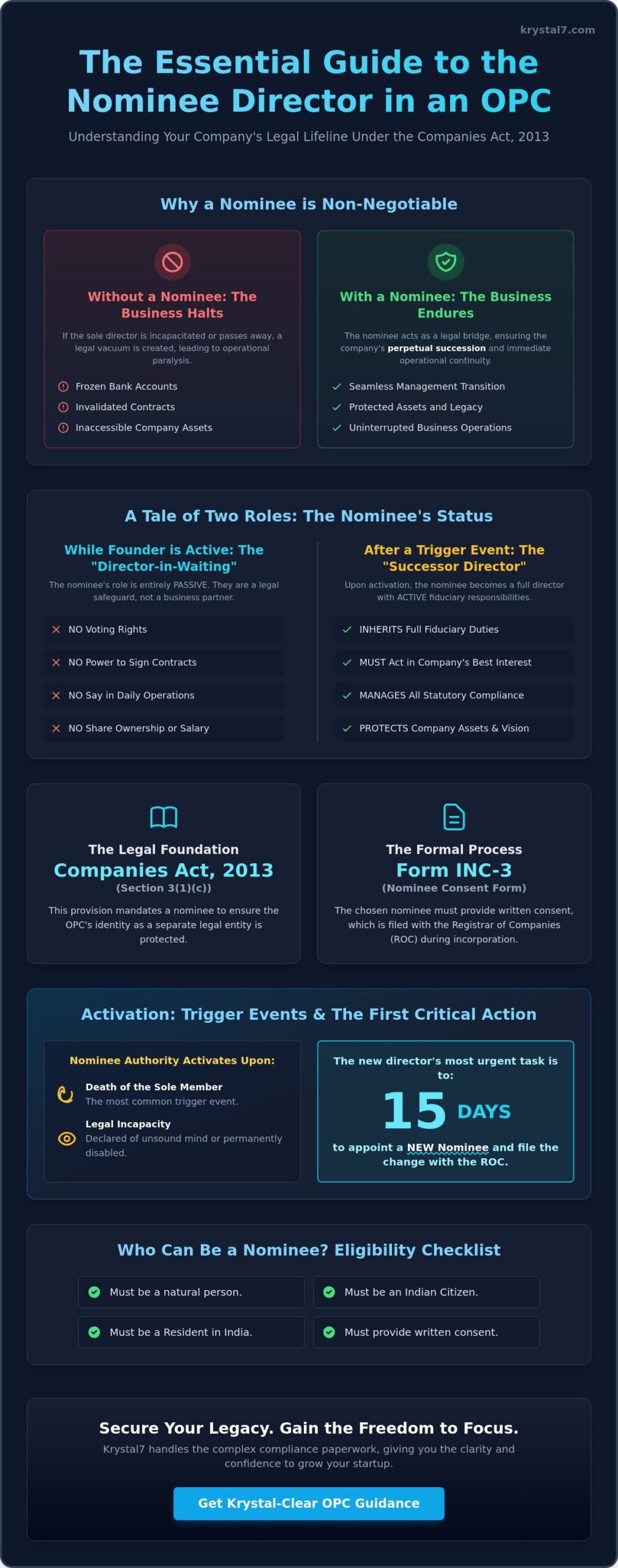
In the Indian corporate framework, every private limited company is built on the pillar of perpetual succession. This legal concept ensures that the company remains a distinct entity even if the owner is no longer there. Since an OPC has only one member, the Ministry of Corporate Affairs (MCA) mandates a nominee to prevent a legal vacuum. Without a nominee, the company’s bank accounts, contracts, and assets would freeze if the sole member passed away or became incapacitated.
The nominee acts as a legal bridge. They ensure the company doesn’t vanish overnight. This requirement isn’t just a formality; it’s a protective measure for creditors, employees, and the founder’s family. It provides clarity and a streamlined path for the business to continue its operations without messy legal battles over management rights.
The Legal Foundation: Companies Act 2013
Section 3(1)(c) of the Companies Act 2013 is the specific provision that makes a nominee mandatory. During the incorporation process, the sole member must name a person who will take over in the event of death or loss of capacity. This isn’t a verbal agreement. The law requires the nominee to provide their written consent through Form INC-3.
This document is filed with the Registrar of Companies (ROC) at the time of registration. It creates a clear record of who holds the “successor” status. By formalizing this, the law protects the company’s identity as a separate legal entity. It ensures that the business’s life isn’t tied to the physical life of the founder, allowing the venture to thrive across generations.
Nominee vs. Director: Clearing the Confusion
It’s common for founders to mistake a nominee for a business partner or a co-director. In reality, the role of a nominee director in opc is passive while the founder is active. A nominee has no voting rights, no power to sign checks, and no say in daily business decisions while the member is alive and capable. They don’t own shares and they don’t earn a salary from the company during this period.
Think of the nominee as a “director-in-waiting.” They only step into the shoes of the member when a specific trigger event occurs. Additionally, a person cannot be a regular Director and a Nominee in the same company at the same time. Their primary duty is to be ready to provide stability when the founder can’t. This distinction keeps the founder in full control of their vision while maintaining a safety net for the future.
If you need help choosing a nominee or filing Form INC-3 correctly, contact Krystal7 Consultants at business@krystal7.com or visit krystal7.com for expert assistance.
The Legal Roles and Responsibilities of an OPC Nominee
The role of a nominee director in opc is often misunderstood as a mere formality. In reality, this individual acts as the ultimate safety net for your business legacy. Their primary legal responsibility is to step into the shoes of the sole member if that member becomes unable to manage the company. This transition is governed by the Companies Act, 2013, and ensures that the business remains a “going concern” without legal interruptions.
When the nominee takes over, they inherit full fiduciary duties. They must act in the best interest of the company, protect its assets, and ensure that all statutory obligations are met. One of their first legal tasks after succession is to appoint a new nominee within 15 days. This step is critical because an OPC cannot legally exist without a designated successor.
Maintaining operational stability is equally vital. The nominee must ensure the continuity of annual compliance for private limited company standards, even during the stress of a leadership shift. This includes filing financial statements and annual returns on the Ministry of Corporate Affairs portal to avoid heavy penalties or strike-off notices.
The “Trigger Events” for Nominee Action
A nominee’s authority only activates during specific “trigger events.” Under Indian law, legal incapacity usually refers to a member being declared of unsound mind by a competent court or facing permanent physical disability that prevents decision making. Death is the most common trigger that requires immediate action.
Once a trigger event occurs, the nominee doesn’t just manage the company; they become the new sole member. They must notify the Registrar of Companies (RoC) about the change in membership through specific MCA forms. This process officially transfers the shares and the management rights to the nominee, allowing the business to continue its operations without a freeze on bank accounts or contracts.
Liabilities and Limitations of the Nominee
Many professionals hesitate to accept the role of a nominee director in opc because they fear financial risk. It’s important to understand that a nominee has zero liability for the company’s debts or legal issues while the original member is alive and capable. Their presence on the MoA and AoA is purely representative until the succession occurs.
Even after taking over, the nominee enjoys the protection of “Limited Liability.” They aren’t personally responsible for the company’s debts beyond the value of the shares they inherit. However, a nominee can refuse to take over the company at the time of the trigger event. If they choose to withdraw, the legal heirs of the deceased member must step in to appoint a new member and nominee to save the company from dissolution.
If you’re feeling unsure about how to structure these legal appointments, you can consult with a compliance expert
Who Can Be a Nominee? Eligibility and Selection Criteria in 2026
Choosing the right person to secure your company’s future is a decision that requires both legal compliance and personal trust. Under the Companies Act, 2013, the role of a nominee director in opc is reserved exclusively for natural persons. This means you cannot appoint a Private Limited company, an LLP, or any other corporate entity to act as your successor. The law ensures that a real individual remains accountable for the business operations if you are no longer able to lead.
Age and citizenship are the primary filters you must apply during selection. Your nominee must be a major, meaning they have reached 18 years of age. Minors are strictly prohibited from holding shares or acting as nominees in an OPC. Additionally, the nominee must be an Indian citizen. Whether they are a resident or a Non-Resident Indian (NRI), they must meet the residency criteria of staying in India for at least 120 days during the preceding financial year. This 120-day rule, updated from the previous 182-day requirement, offers more flexibility for founders with global family ties.
The “One Person, One OPC” rule is a vital restriction to remember. An individual can only be a member of one OPC at any given time. Similarly, they can only serve as a nominee for one OPC. If your chosen nominee is already a member of their own OPC, they can still be your nominee. However, if they eventually inherit your company and end up as a member of two OPCs, they must rectify this within 180 days by resigning from one or converting it into a Private Limited Company.
Essential Qualifications for a Nominee
Beyond basic eligibility, your nominee needs specific documentation to be recognized by the Ministry of Corporate Affairs (MCA). A valid PAN and Aadhaar card are mandatory for Indian residents to complete the INC-3 consent form. While a nominee doesn’t need a Director Identification Number (DIN) at the moment of nomination, they must apply for one immediately if they are called to take over the company. Beyond the paperwork, trust is your most valuable metric. You are handing over the keys to your legacy, so choose someone who understands the role of a nominee director in opc and shares your professional values.
Common Restrictions You Must Know
Foreign nationals are currently ineligible to be nominees in an Indian OPC, even if they reside in India. The law prioritizes Indian citizenship for this specific corporate structure. You should also consider the impact of multiple roles. If your nominee is already a member of one company and a nominee for another, they are at their legal limit. Understanding the role of a nominee director involves recognizing these boundaries to avoid future compliance hurdles.
Succession can sometimes create legal overlaps. If a person becomes a member of two OPCs through the death of the original founders, they have exactly 180 days to meet the eligibility criteria again. They cannot hold a 100% stake in two separate OPCs indefinitely. This rule ensures that the OPC remains a vehicle for individual entrepreneurs rather than a tool for creating complex corporate webs. If you need help vetting a candidate or filing the INC-3 form, contact Krystal7 Consultants at business@krystal7.com or visit krystal7.com for expert assistance.
Step-by-Step: Appointing, Changing, or Withdrawing a Nominee
Managing the role of a nominee director in opc involves specific Ministry of Corporate Affairs (MCA) procedures that ensure your business remains compliant. You don’t need to feel overwhelmed by the paperwork. Clarity starts with understanding which forms to use and when to file them.
During your company registration, you must name your nominee officially. You first obtain their written consent using Form INC-3. This document is a vital attachment to the SPICe+ (INC-32) application. It serves as legal proof that the individual agrees to take over the company’s responsibilities if necessary.
The Registrar of Companies (ROC) tracks these nominations to protect the company’s perpetual succession. If a nominee eventually steps into the shoes of the owner, they must appoint a new nominee within 15 days. This transition is recorded by filing Form INC-4. Following these steps carefully keeps your corporate shield strong and your vision protected.
How to Change Your Nominee
You have the legal right to change your nominee at any time for any reason. To do this, you must notify the company in writing and obtain fresh consent from the new person via Form INC-3. Once you receive this consent, you must file Form INC-4 with the MCA within 30 days. This update is essential for maintaining the legal role of a nominee director in opc. Missing this 30 day window leads to statutory late fees and potential penalties under Section 450 of the Companies Act.
When a Nominee Withdraws Consent
A nominee can choose to resign from their position by providing a written notice to both the member and the company. If this happens, don’t panic. You have 15 days from the date of withdrawal to appoint a replacement. You must then file Form INC-4 within 30 days of the new appointment. This process ensures your entity maintains its status, similar to the continuity found in a private limited company india structure. Keeping these records updated prevents administrative hurdles during annual filings.
Struggling with MCA forms or nominee transitions? Get expert compliance support from Krystal7 to ensure your filings are always accurate and on time.
Krystal-Clear OPC Management with Krystal7 Consultants
Managing an One Person Company involves more than just a great business idea. It requires a solid understanding of the role of a nominee director in opc as defined by the Companies Act, 2013. Krystal7 Consultants removes the guesswork from this process by handling every piece of complex paperwork. We manage the drafting of consent letters and the mandatory filings on the MCA portal with precision.
Our “Freedom to Focus” approach ensures your annual compliance stays on track without your constant intervention. We take charge of ROC filings, including AOC-4 for financial statements and MGT-7A for annual returns. You won’t have to worry about the ₹100 daily penalty for late submissions. We provide expert advisory to ensure your legal structure aligns perfectly with your long-term vision.
We offer a seamless integration of our how to register services with ongoing statutory support. Our team ensures that the role of a nominee director in opc is clearly documented and updated whenever changes occur. This proactive management keeps your business in good standing with the Ministry of Corporate Affairs at all times.
Why Gurgaon Founders Trust Krystal7
Founders in Gurgaon choose us because we provide dedicated relationship managers who know your business inside out. You won’t be passed around between different departments. We provide upfront pricing for OPC registration so you can budget with confidence. There are never any hidden costs or surprise invoices at the end of the month.
Our chartered expertise covers the full spectrum of the MCA and GST portals. We handle the technical hurdles that often overwhelm new entrepreneurs. We simplify the process of obtaining Director Identification Numbers (DIN) and Digital Signature Certificates (DSC) for you and your nominee.
Get Started with Your OPC Journey
Your venture deserves a foundation built on clarity and compliance. We help you schedule a consultation to map out your new business journey today. As your startup grows, we streamline the transition from an OPC to a Private Limited company. This ensures you can raise capital and expand without legal friction.
Ready to build your legacy? Contact Krystal7 Consultants at business@krystal7.com or visit krystal7.com for expert assistance with your business registration and compliance needs.
Securing Your Business Legacy Through 2026 Compliance
Building a legacy as a solo founder requires more than just a great idea. It demands a robust legal foundation. Appointing a nominee isn’t just a regulatory hurdle under the Companies Act; it’s a vital safeguard for your business continuity. By understanding the role of a nominee director in opc, you ensure your venture remains resilient against unforeseen events. You’ve now seen how the selection process works and how 2026 compliance standards focus on strict eligibility and transparency.
Don’t let complex MCA filings or nominee documentation slow your growth. Krystal7 Consultants brings elite expertise to your doorstep. Our team of top-tier Chartered Accountants and Company Secretaries has already supported hundreds of Gurgaon startups with krystal-clear transparency. We operate with a strict no hidden costs policy. This gives you the freedom to focus on your vision while we handle the red tape and statutory requirements.
Your entrepreneurial journey deserves the security of professional oversight. We’re here to turn your business dreams into a lasting reality with absolute clarity.
Frequently Asked Questions
Is it mandatory to have a nominee for a One Person Company in India?
Yes, it’s mandatory to appoint a nominee for every One Person Company in India according to Section 3 of the Companies Act, 2013. You must name this person in the Memorandum of Association during the registration process on the MCA portal. This ensures the company continues to exist if the sole member faces an unfortunate event.
Can a nominee be changed after the OPC is registered?
You can change your nominee at any time by providing a written notice to the company and filing Form INC-4 with the Registrar of Companies. The sole member must obtain the new nominee’s consent in Form INC-3 first. This flexibility allows you to update your succession plan as your business grows or personal circumstances change.
Does the nominee have any ownership or shares in the OPC?
The nominee doesn’t hold any ownership or shares in the OPC while the sole member is alive. Their role is strictly to step in and take over the management and shares only upon the death or legal incapacity of the original member. Understanding the role of a nominee director in opc helps founders maintain clear boundaries between current management and future succession.
What happens if the nominee dies before the sole member?
If the nominee dies before the sole member, the member must appoint a new nominee within 15 days of receiving notice of the death. You’ll need to file Form INC-4 to update the MCA records and ensure the company remains compliant with the Companies Act. This 15 day window is crucial to avoid statutory penalties.
Can a person be a nominee in more than one OPC at the same time?
An individual can only be a nominee in one OPC at any given time. Rule 3 of the Companies (Incorporation) Rules, 2014, also restricts a person from being a member in more than one OPC. This rule ensures that the simplified structure of a One Person Company isn’t used to create complex, interlocking business networks.
What is the penalty for not filing the nominee change form (INC-4) on time?
Delaying the filing of Form INC-4 beyond 30 days attracts a penalty under Section 450 of the Companies Act. The standard fine is ₹10,000, with an additional ₹1,000 for every day the default continues, up to a maximum of ₹2,00,000 for a company. Keeping track of these deadlines is vital for the smooth role of a nominee director in opc management.
Does a nominee need a DIN (Director Identification Number)?
A nominee doesn’t need a Director Identification Number at the time of being named in the incorporation documents. They only require a DIN if and when they actually take over the position of a director following the death or incapacity of the sole member. For the initial nomination, a PAN and Aadhaar are the primary identification documents needed.
Can a husband be a nominee for his wife’s OPC?
A husband can definitely be a nominee for his wife’s OPC, provided he is a natural person, an Indian citizen, and a resident in India. The law doesn’t restrict family members from acting as nominees. In fact, many Indian founders choose their spouse to ensure a seamless transition of the business legacy within the family.
For expert guidance on managing your company compliance or to handle your nominee filings, contact Krystal7 Consultants at business@krystal7.com or visit krystal7.com today.

Article by
Nihal Srivastava
Nihal Srivastava is the Co-Founder of Krystal7 Consultants, helping Indian entrepreneurs and startups navigate company registration, compliance, trademark protection, and regulatory requirements with clarity and confidence. With 6+ years of hands-on expertise in MCA filings, GST compliance, and corporate structuring, Nihal has guided 1000+ businesses across India through their legal and compliance journeys. He believes every business dream deserves crystal clear foundations, and that no founder should be held back by paperwork or red tape.