

Minimum Capital for Pvt Ltd Company in India: The 2026 Strategic Guide
Did you know that the mandatory 1 lakh rupee requirement to start a business was officially scrapped by the Companies (Amendment) Act in 2015? Many founders still worry about the minimum capital for pvt ltd company registration, fearing that high upfront costs will drain their budget before they even launch. It’s natural to feel overwhelmed by the fear of hidden MCA fees or the pressure of depositing large sums into a new bank account.
We’re here to provide the crystal-clear transparency you need to move forward with confidence. This strategic guide explains exactly how to structure your finances for maximum ROC savings while staying 100 percent compliant with current Ministry of Corporate Affairs standards. We handle the complexity so you can enjoy the freedom to focus on your business goals.
You’ll learn the practical difference between Authorised and Paid-up capital and see a clear roadmap for your initial compliance filings. Let’s turn your entrepreneurial vision into a structured, cost-effective reality.
Key Takeaways
- Understand how current MCA regulations have removed the mandatory INR 1 Lakh requirement, providing founders with greater financial flexibility from day one.
- Learn the strategic difference between authorised and paid-up capital to protect your personal liquidity while maintaining a professional corporate structure.
- Master the “10-10” strategy to structure the minimum capital for pvt ltd company effectively and minimize your initial government filing fees.
- Uncover the practical costs of incorporation, such as state-specific stamp duty nuances in Haryana, to ensure your startup is “transaction-ready” without budget surprises.
- Discover how expert financial structuring can streamline your path to ROC and GST compliance, giving you the freedom to focus on your business vision.
What is the Minimum Capital for Pvt Ltd Company in India?
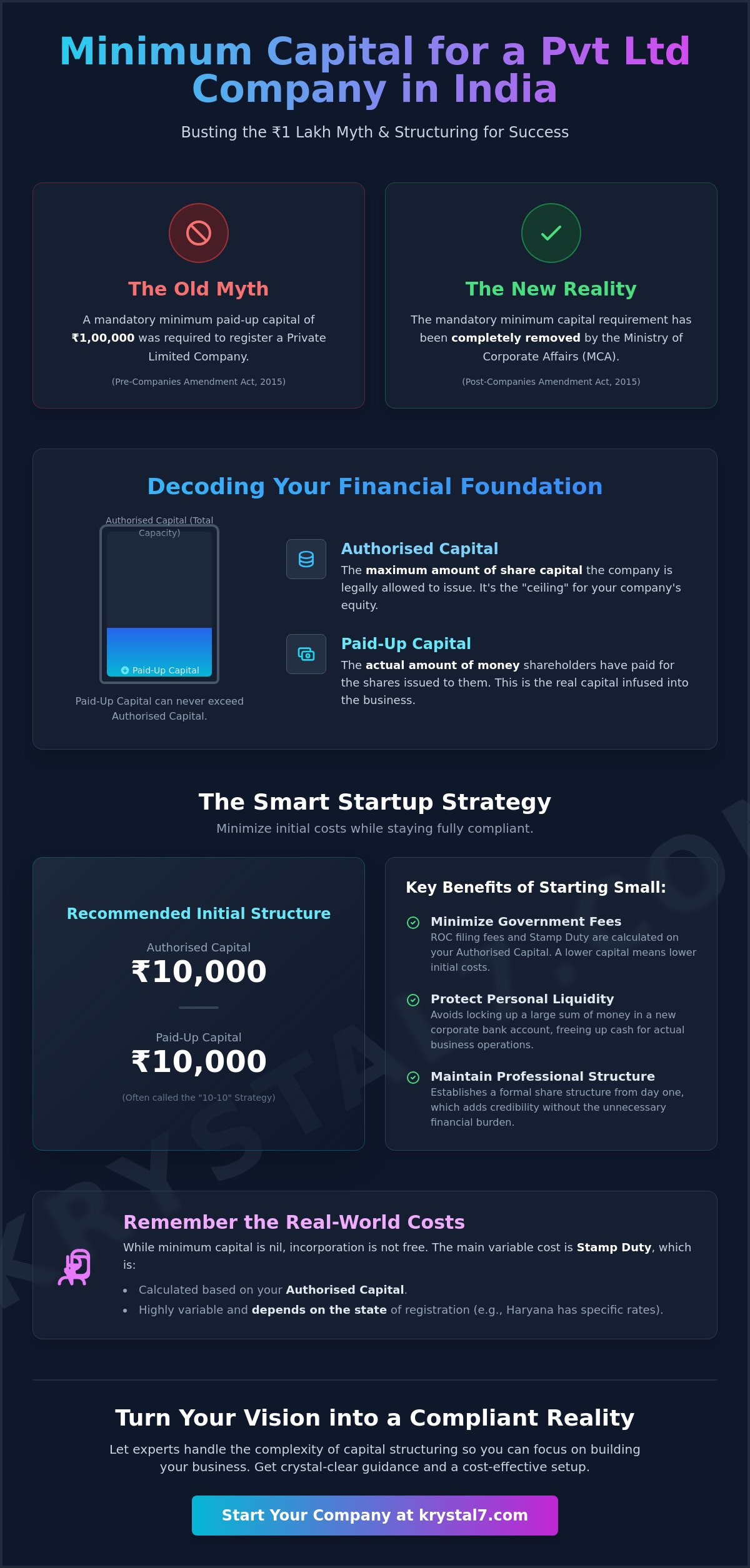
Starting a business shouldn’t feel like climbing a mountain of red tape. If you’re looking for the minimum capital for pvt ltd company registration in India, the news is better than you might think. Historically, entrepreneurs needed a hefty sum just to get through the door. That changed significantly with the Companies (Amendment) Act, 2015. This landmark legislation removed the mandatory requirement of having a minimum paid-up capital of INR 1 Lakh.
Today, the Ministry of Corporate Affairs (MCA) defines the minimum capital requirement as effectively zero. You can register a Private Limited Company in India without having to deposit a specific large sum into a bank account before incorporation. This shift aligns India with global standards; it makes it easier for tech startups and service providers to launch with limited funds. At Krystal7, we see this as a vital step toward giving every visionary the freedom to focus on their core product rather than capital hurdles.
Many new founders still believe the 1 Lakh rule exists. This myth persists because traditional consultants often quote old regulations or use 1 Lakh as a default setting for drafting documents. While the Companies Act, 2013 originally mandated a minimum capital, the 2015 update removed this barrier to foster a more vibrant startup ecosystem. Understanding this distinction brings the crystal clarity you need to plan your initial cash flow effectively.
The 2015 Amendment: A Game Changer for Startups
The removal of the minimum capital barrier was a strategic move to boost India’s “Ease of Doing Business” ranking. It allowed thousands of bootstrapped founders to formalize their ventures without locking up precious working capital. The current legal minimum capital for a private limited company is nil as per the latest MCA guidelines. This change has been particularly beneficial for service-based businesses that don’t require heavy initial infrastructure or inventory.
Why You Still Need a ‘Nominal’ Capital
Even though the law doesn’t demand a specific amount, your company must have a “Nominal” or “Authorized” capital. Shares must have a fixed value; usually Rs. 1, Rs. 10, or Rs. 100 per share. Most entrepreneurs still choose to start with an authorized capital of INR 10,000 or INR 1,00,000. This isn’t because of a legal mandate; it’s because it provides a professional structure for issuing shares to founders. A higher nominal capital often adds a layer of perceived credibility when dealing with vendors or applying for initial business licenses.
- Authorized Capital: The maximum amount of share capital the company is authorized to issue.
- Paid-up Capital: The actual amount of money the shareholders have contributed to the company.
- Stamp Duty: This is calculated based on your authorized capital and varies by state.
If you’re feeling overwhelmed by these definitions, don’t worry. Our team handles the complexity so you can pursue your passion. Contact Krystal7 Consultants at business@krystal7.com or visit krystal7.com for expert assistance in setting up your venture with the right capital structure.
Authorised vs. Paid-Up Capital: Decoding the Financial Structure
Understanding the difference between authorised and paid-up capital is the first step toward financial clarity for any founder. Authorised capital represents the maximum amount of share capital that your company is legally allowed to issue to its shareholders as per its Memorandum of Association. It acts as a legal ceiling for your equity issuance. You can think of it as the total capacity of your company’s “equity tank.”
Paid-up capital is the portion of that authorised capital for which the company has actually received payment from shareholders. It represents the real money sitting in your corporate bank account. While the law no longer mandates a specific minimum capital for pvt ltd company registration, these figures dictate your startup’s initial trajectory. Every rupee of paid-up capital must be backed by a corresponding share issued to a promoter or investor.
The relationship between these two figures determines your registration costs and your future ability to raise funds. Under the Companies Act, 2013, your paid-up capital can never exceed your authorised capital. If you plan to bring in new investors later, you might need to increase your authorised capital first by filing specific forms with the Registrar of Companies (ROC).
Authorised Capital and ROC Fees
The Ministry of Corporate Affairs (MCA) calculates your registration fees based on the authorised capital you declare during incorporation. Higher authorised capital leads to higher government fees and stamp duty. Many Indian startups choose a strategic threshold of INR 10 Lakhs for their authorised capital. This specific figure often offers a balance between reasonable registration costs and enough room to issue shares to early team members.
- Strategic Thresholds: Fees often jump significantly once you cross the INR 10 Lakh or INR 50 Lakh marks.
- Future Flexibility: Setting a slightly higher authorised capital than your immediate needs prevents the hassle of frequent ROC filings.
- Cost of Changes: Increasing this limit later requires an Ordinary Resolution and payment of additional stamp duty to the state government.
Paid-Up Capital and the Share Subscription Money
Once you register, the subscribers to the Memorandum must deposit the promised subscription money into the company’s bank account. You must complete this action within 180 days of incorporation to file the Declaration of Commencement of Business (Form INC-20A). Failing to meet this deadline can lead to heavy penalties and even the strike-off of your company name from the register.
Paid-up capital appears on your balance sheet under the “Shareholders’ Funds” section as a liability. It represents the company’s obligation to its owners. Since there is no statutory minimum capital for pvt ltd company, you can technically start with as little as INR 2. However, your paid-up capital should ideally reflect your initial working capital requirements to maintain professional credibility. If you’re unsure about the right amount to commit, our startup advisors can help you plan your equity structure for long-term growth.
The Practical Minimum: Real-World Costs of Starting a Company
While the legal requirement for a minimum capital for pvt ltd company has vanished, the practical costs of getting “transaction-ready” remain very real. You can’t start a business with zero rupees in the bank and expect to stay compliant. Founders must account for government fees, professional charges, and mandatory statutory filings that occur immediately after the Certificate of Incorporation arrives.
The Companies (Amendment) Act, 2015 provided the legislative freedom to start small. However, your initial capital must cover the Digital Signature Certificates (DSC) for all directors and the professional fees for filing SPICe+ forms on the MCA portal. These initial expenses are the foundation of your business journey, providing the clarity you need to build a sustainable venture.
We recommend founders look at their initial capital as a “readiness fund.” This fund ensures you don’t face technical defaults in your first 180 days. It gives you the freedom to focus on your product while your compliance remains rock-solid.
Stamp Duty in Haryana and Other States
Stamp duty is a state-specific subject, meaning your costs change based on where you hang your nameplate. If you register your company in Gurgaon, Haryana, with an authorized capital of INR 1 Lakh, your stamp duty for the MoA and AoA remains relatively low. In Haryana, the stamp duty for a company with capital up to INR 10 Lakh is approximately INR 60 for the MoA and INR 15 for the AoA.
Choosing your registered office address is a strategic decision that affects your initial capital outflow. States like Maharashtra or Karnataka have different fee structures that can increase your setup costs. Our experts help you bring crystal clarity to these state-level variations so there are no surprises during registration.
Current Account Minimum Balance Requirements
Your minimum capital for pvt ltd company should ideally be high enough to satisfy Indian banking norms. Most leading private sector banks in India require a Monthly Average Balance (MAB) between INR 10,000 and INR 25,000 for a current account. If your paid-up capital is only INR 1,000, you’ll struggle to maintain the account without attracting heavy penalties.
Banks also require a formal board resolution and a minimum deposit to activate your corporate banking suite. Setting your capital at a level that covers these banking requirements and your first six months of compliance filings is a smart move. You can find a detailed breakdown of these early-stage requirements in our Private Limited Company in India: The Ultimate Guide for Founders.
Don’t forget the mandatory INC-20A filing. You must file this Declaration of Commencement of Business within 180 days of incorporation. This process requires a bank statement showing that all subscribers have paid for their shares. Having sufficient capital from day one ensures this critical milestone is met without stress.
- DSC and DIN: Budget approximately INR 2,000 to INR 5,000 depending on the number of directors.
- Professional Fees: Varies based on the complexity of your capital structure.
- Bank MAB: Keep at least INR 25,000 liquid for banking operations.
- Statutory Audit: Every company must appoint an auditor within 30 days, creating an immediate professional obligation.
Strategic Allocation: Setting Capital to Minimise MCA Fees
Don’t lock your hard-earned cash into government fees before your business even starts. Setting your authorised capital unnecessarily high on day one is a common founder mistake. While you want to look big, high authorised capital leads to higher stamp duty and MCA registration fees. Smart founders focus on the minimum capital for pvt ltd company required to sustain early operations while keeping registration costs lean.
The ’10-10′ Strategy is a favorite among Indian startups. This involves setting an authorised capital of 10 Lakhs and a paid-up capital of 1 Lakh. It offers a perfect balance; you pay low upfront fees but have the flexibility to issue more shares later without immediately filing for a capital increase. This approach provides the crystal clarity you need to manage your initial cash flow effectively.
The INC-20A Filing: Your First Major Compliance
You must file the Declaration of Commencement of Business, known as Form INC-20A, within 180 days of your company’s incorporation. This isn’t optional. If you miss this deadline, the MCA imposes a flat penalty of INR 50,000 on the company. Each director also faces a personal penalty of INR 1,000 per day for every day the default continues.
To file this form, you must first deposit the agreed paid-up capital into the company’s bank account. A bank statement clearly showing the deposit of capital from each subscriber’s personal account is a mandatory attachment for this filing. Without this proof, the MCA won’t acknowledge your business as active, which can lead to the striking off of your company name.
Future-Proofing Your Capital Structure
Plan your capital to accommodate future investment rounds or debt requirements. You don’t need to pay high ROC fees today for money you might raise two years from now. You can increase your authorised capital later through a simple board resolution and shareholder approval when the actual need arises.
Consider scheduling an Annual Compliance for Private Limited Company review to assess if your current capital matches your growth trajectory. If you need to reward shareholders without draining cash, a ‘Bonus Issue’ can capitalise your reserves. Alternatively, a ‘Right Issue’ allows existing shareholders to maintain their stake while bringing in fresh minimum capital for pvt ltd company growth.
Managing these thresholds requires precision to avoid unnecessary tax traps or compliance red tape. Our team at Krystal7 helps you navigate these filings with ease, giving you the freedom to focus on your vision. Consult with our legal strategists to structure your capital correctly from the start.
How Krystal7 Consultants Simplifies Your Capital Structuring
Starting a business shouldn’t feel like a legal maze. At Krystal7, we bring crystal-clear transparency to every step of your incorporation process. While the law no longer mandates a specific minimum capital for pvt ltd company registration, the way you structure your authorized and paid-up capital impacts your future scalability. We provide the strategic foresight needed to balance your initial costs with your long-term funding goals. Our team ensures that your financial planning aligns with the latest MCA guidelines, preventing common pitfalls that stall new ventures.
Our Elite Expertise serves as a shield for Gurgaon startups against the complexities of the Companies Act 2013. We handle the intricate details of MCA filings, GST registrations, and annual compliance so you can reclaim your time. Entrepreneurs often spend over 50 hours navigating government portals and paperwork during their first year. We eliminate this burden, giving you the freedom to focus on your product and your customers. We don’t just file forms; we act as your legal strategists to optimize your capital structure.
Choosing the right authorized capital is vital because it determines your ROC fees and state-specific stamp duty. For instance, a company registered in Haryana faces different stamp duty structures than one in Delhi. We help you calculate an optimal figure that avoids overpaying today while ensuring you don’t have to pay heavy amendment fees the moment you bring in an investor. Our methodical approach ensures that every rupee of your minimum capital for pvt ltd company is accounted for correctly in your initial bank deposit and INC-20A filing.
Why Founders Trust Krystal7 for Incorporation
Founders rely on us because we provide personalized advisory from top-tier Chartered Accountants and Company Secretaries. You won’t deal with automated bots; you’ll work with experts who know your business inside out. Transparency is our hallmark, which is why we offer upfront pricing with no hidden costs for Company Registration in India. We provide end-to-end support that covers everything from securing your DSC and DIN to obtaining your PAN, TAN, and GST registration certificates. Our goal is to make your transition from a vision to a legal entity as seamless as possible.
Get Started with Your Pvt Ltd Journey Today
Navigating the statutory formalities of the Companies Act 2013 requires a partner who understands the rhythm of Indian compliance. We ensure you meet the 180-day deadline for the Commencement of Business certificate, protecting you from the steep penalties that can reach INR 50,000 or more. Krystal7 is committed to your growth and clarity at every stage of your corporate life. Contact us for a hassle-free registration experience that lets you build your legacy without the red tape. Reach out to our experts at business@krystal7.com or visit krystal7.com to take your first step toward a successful Private Limited Company today.
Build Your Business Foundation with Clarity
Setting up your startup in India is more accessible than ever. The Companies Act 2013 provides the flexibility to start with zero mandatory capital, but your strategic choices today impact your future scaling. You’ve learned how to distinguish between authorised and paid-up capital to minimize upfront MCA fees. Determining the right minimum capital for pvt ltd company is a balance between regulatory compliance and your actual operational roadmap for 2026.
Krystal7 Consultants simplifies this complex financial structuring through our deep expertise in the Companies Act 2013. Our team provides dedicated relationship managers who guide you through every filing and statutory requirement. We believe in transparent, upfront pricing with no hidden fees; this gives you the freedom to focus entirely on your growth. You don’t have to navigate the red tape alone when you have a partner committed to your vision.
Ready to launch your venture with crystal-clear guidance? Contact Krystal7 Consultants at business@krystal7.com or visit our website for expert assistance. Your business dream deserves a professional start that turns complexity into a clear path forward.
Frequently Asked Questions
Is there a minimum paid-up capital for a Private Limited Company in 2026?
No, there’s no legal minimum paid-up capital requirement for a Private Limited Company in 2026. The Companies (Amendment) Act, 2015 abolished the previous requirement of 1 Lakh INR. You can register your company with any amount that fits your business plan. This change allows founders to start operations without locking up large sums of initial cash unnecessarily.
Can I start a Pvt Ltd company with zero rupees?
You can’t start a company with zero rupees because the company must issue at least one share to its subscribers. Most entrepreneurs choose a nominal amount like 10,000 INR to represent the initial shareholding. While the law doesn’t set a high floor, the minimum capital for pvt ltd company must be at least the value of the shares issued during incorporation.
What is the difference between authorised capital and paid-up capital?
Authorised capital is the maximum amount of share capital your company is legally allowed to issue to shareholders. Paid-up capital is the actual money shareholders have deposited into the company’s bank account in exchange for shares. You pay ROC fees based on the authorised capital, while the paid-up capital represents the actual liquidity available for your business operations.
What happens if I don’t deposit the paid-up capital within 180 days?
If you don’t deposit the capital and file Form INC-20A within 180 days, the company faces a flat penalty of 50,000 INR. Every director in default also faces a daily penalty of 1,000 INR until the compliance is met. The Registrar of Companies (ROC) has the authority to strike off your company name if this mandatory declaration isn’t filed on time.
Do I need to show the capital in my personal bank account before starting?
You don’t need to show the capital in your personal bank account during the registration process. The money only needs to be transferred once the company is incorporated and a dedicated corporate bank account is opened. Shareholders have a 180-day window after incorporation to move their subscription money from personal accounts to the new company account to satisfy compliance.
How much ROC fee do I have to pay for 1 Lakh authorised capital?
For a company with 1 Lakh INR authorised capital, the ROC registration fee is currently 0 INR under the MCA SPICe+ initiative for small companies. You’ll still need to pay state-specific stamp duty, which varies significantly across India. For instance, Delhi charges approximately 210 INR for this capital level, while Maharashtra charges 1,000 INR for the same amount.
Can I increase the authorised capital of my company later?
Yes, you can increase your authorised capital at any stage by following Section 61 of the Companies Act, 2013. You’ll need to pass an ordinary resolution in a general meeting and file Form SH-7 with the ROC within 30 days. This process involves paying the differential stamp duty and filing fees based on the specific increase you’re making to the capital structure.
Is capital requirement different for an LLP compared to a Pvt Ltd?
Both LLPs and Private Limited Companies enjoy the flexibility of having no legal minimum capital requirements in India. In an LLP, this is called a partner’s contribution rather than share capital. While the minimum capital for pvt ltd company is often set at 1 Lakh INR for professional appearance, LLPs often start with smaller contributions like 5,000 INR or 10,000 INR.
Every business dream deserves a solid foundation and clear direction. If you’re ready to start your journey without the compliance headache, contact Krystal7 Consultants at business@krystal7.com or visit krystal7.com for expert assistance with your company registration and capital structuring.

Article by
Nihal Srivastava
Nihal Srivastava is the Co-Founder of Krystal7 Consultants, helping Indian entrepreneurs and startups navigate company registration, compliance, trademark protection, and regulatory requirements with clarity and confidence. With 6+ years of hands-on expertise in MCA filings, GST compliance, and corporate structuring, Nihal has guided 1000+ businesses across India through their legal and compliance journeys. He believes every business dream deserves crystal clear foundations, and that no founder should be held back by paperwork or red tape.


![PMFME Loan Scheme: A Complete Guide for Food Entrepreneurs [2026]](https://blogs.krystal7.com/wp-content/uploads/2026/04/PMFME-Loan-Scheme-A-Complete-Guide-for-Food-Entrepreneurs-2026-Hero-Image-768x439.jpg)