

How to Register a Company in India: A Step-by-Step Guide
Starting a new business is an exciting journey filled with vision and ambition. However, turning that dream into a reality requires navigating the legal framework of company registration. For many entrepreneurs, this process can seem complex and overwhelming, raising questions about paperwork, legal structures, and hidden costs. This guide is designed to provide a crystal-clear roadmap for registering your company in India, simplifying every step from choosing a business structure to understanding your post-registration responsibilities. We’ll demystify the process, giving you the confidence to build your business on a solid legal foundation.
Before You Start: Choosing the Right Business Structure in India
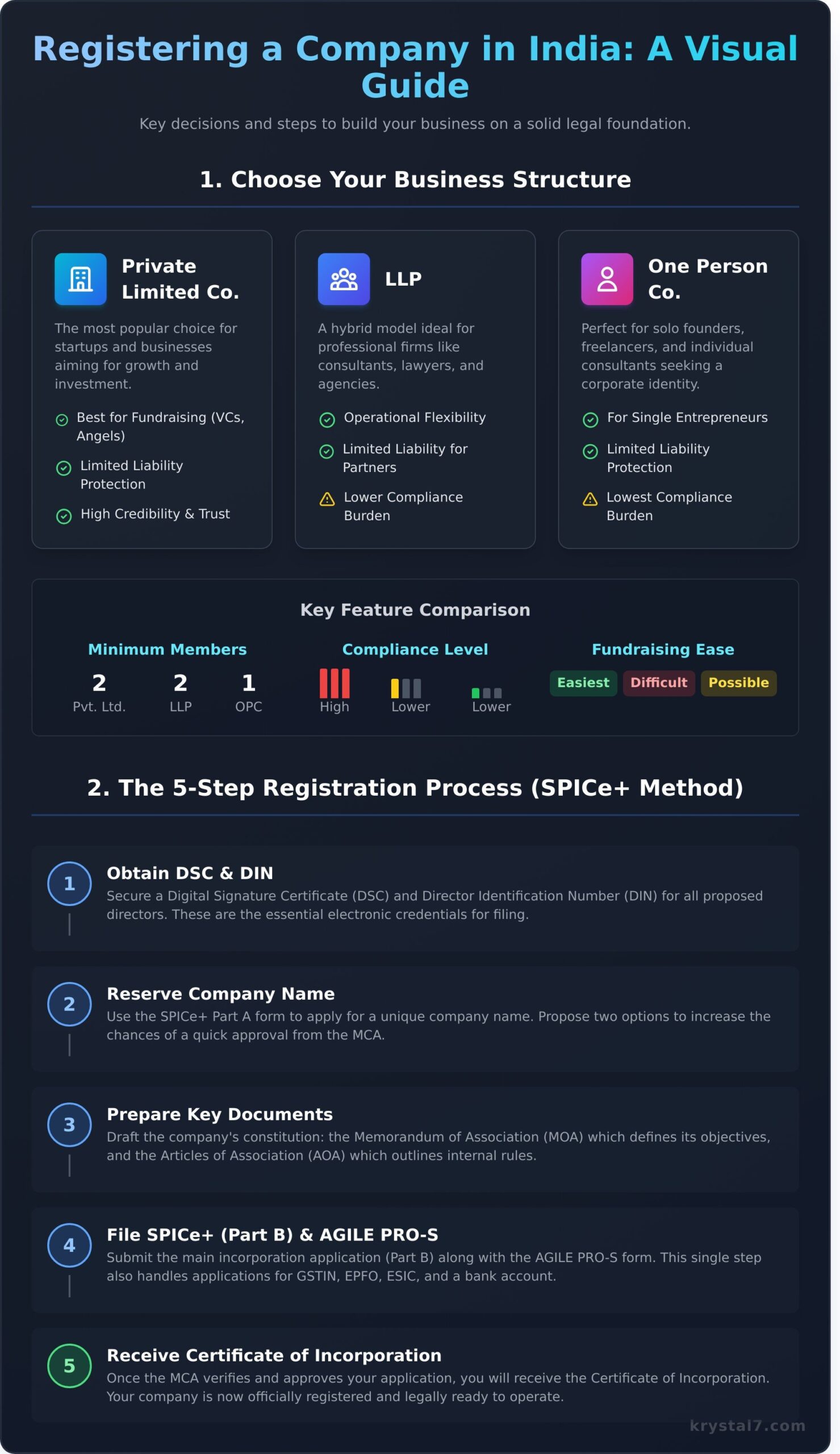
Before you dive into any paperwork, your first and most critical decision is selecting the right legal structure for your business. This choice is foundational, as it directly impacts your personal liability, how you are taxed, and your ability to raise funds in the future. Understanding the key differences is essential to aligning your company’s structure with its long-term goals. We make these differences crystal clear so you can make an informed decision.
Private Limited Company (Pvt. Ltd.)
- A Private Limited Company is the most popular and recommended structure for startups and growing businesses in India.
- It offers limited liability protection, which means the personal assets of the owners (shareholders) are shielded from business debts and losses.
- This structure enhances credibility with banks, vendors, and investors, making it significantly easier to raise funds and secure loans.
Limited Liability Partnership (LLP)
- An LLP is a modern hybrid that combines the benefits of a traditional partnership with the limited liability of a company.
- It protects partners’ personal assets while offering operational flexibility and simpler compliance requirements compared to a Pvt. Ltd. company.
- This structure is ideal for professional firms, such as consultants, architects, lawyers, and creative agencies, where partners want to operate a joint business with a protective legal shield.
One Person Company (OPC)
- An OPC allows a single entrepreneur to operate a corporate entity with limited liability protection, a feature previously unavailable to sole proprietors.
- It combines the benefits of a private limited company, like a separate legal identity, with much lower compliance burdens.
- This structure is perfect for solo founders, freelancers, and individual consultants who want to formalize their business without needing a partner.
Pvt Ltd vs. LLP vs. OPC: A Quick Comparison
To help you choose the best fit for your vision, here is a simple table comparing the key aspects of each business structure.
| Feature | Private Limited Company | Limited Liability Partnership | One Person Company |
|---|---|---|---|
| Minimum Members | 2 Shareholders, 2 Directors | 2 Partners | 1 Shareholder, 1 Director (+1 Nominee) |
| Liability | Limited to share capital | Limited to agreed contribution | Limited to share capital |
| Compliance | Higher (Board meetings, statutory audits) | Lower (Audit required only above certain turnover) | Lower than Pvt. Ltd. |
| Fundraising | Easiest (Venture Capital, Angel Investors) | Difficult (No concept of equity shares) | Possible, but must convert to Pvt. Ltd. first |
The 5-Step Company Registration Process in India (SPICe+ Method)
The Ministry of Corporate Affairs (MCA) has streamlined the company registration process into a single, integrated web form called SPICe+ (Simplified Proforma for Incorporating Company Electronically Plus). This innovation has made incorporation faster and more efficient. Follow these five clear steps for a hassle-free registration.
Step 1: Obtain Digital Signature Certificate (DSC) and Director Identification Number (DIN)
- A Digital Signature Certificate (DSC) is the electronic equivalent of a physical signature. It is a secure digital key required to sign all electronic forms submitted to the MCA.
- A Director Identification Number (DIN) is a unique identification number assigned to any individual intending to be a director of a company.
- Obtaining a DSC for all proposed directors and subscribers, and applying for the DIN, are the essential first prerequisites before starting the incorporation process.
Step 2: Reserve Your Unique Company Name
- The first part of the process involves reserving a unique name for your company using Part A of the SPICe+ form.
- The proposed name must be unique and should not be identical or too similar to an existing company name or registered trademark. It must also comply with the naming guidelines set by the MCA.
- It is advisable to propose two distinct names in order of preference to increase your chances of a swift approval.
Step 3: Prepare Key Incorporation Documents
- You will need to draft the Memorandum of Association (MOA), which is a crucial document that defines the company’s objectives and the scope of its business activities.
- You also need to draft the Articles of Association (AOA), which outlines the internal rules, regulations, and management structure of the company.
- Together, these two documents form the company’s constitution and are mandatory for the registration process.
Step 4: File the SPICe+ Form (Part B) and AGILE PRO-S
- Once the name is approved, you can proceed with Part B of the SPICe+ form. This is the main application for incorporation and includes details about the company’s capital structure, directors, shareholders, and registered office address.
- This form is filed along with the linked AGILE PRO-S form, which cleverly combines applications for GSTIN, EPFO registration, ESIC registration, Professional Tax registration (for applicable states), and the opening of a company bank account.
Step 5: Receive Your Certificate of Incorporation
- After you submit the forms and all documents are verified by the Registrar of Companies (ROC), your application will be approved.
- The MCA will then issue the official Certificate of Incorporation. This certificate is conclusive proof of your company’s existence and includes your unique Corporate Identity Number (CIN).
- Congratulations, your company is now officially a legal entity, ready to start its business journey! If this process still feels daunting, remember that you don’t have to do it alone. Let us handle the entire process for you. Get started with Krystal7.
Checklist: Documents Required for Company Registration
Having all your documents organized and ready to go can save a significant amount of time and prevent delays in the registration process. We’ve created a simple checklist to guide you through gathering everything you need.
For Indian Directors & Shareholders
- PAN Card: A self-attested copy of the PAN card is mandatory for all Indian nationals.
- Identity Proof: A self-attested copy of your Aadhaar Card, Passport, Driver’s License, or Voter ID Card.
- Address Proof: The latest copy of a bank statement, electricity bill, or telephone bill in the individual’s name (not older than two months).
For the Registered Office Address
- Proof of Ownership: The latest electricity bill, property tax receipt, or sale deed if the premises are owned.
- If Rented: A copy of the rental agreement along with a No-Objection Certificate (NOC) from the property owner, granting permission to use the address as the company’s registered office.
What Happens After Registration? Your First Compliance Tasks
Successfully incorporating your company is a major milestone, but it’s just the beginning of your compliance journey. To maintain your active status and avoid penalties, there are several mandatory tasks you must complete shortly after registration. This is where our “Freedom to Focus” promise truly helps, allowing you to concentrate on your business while we manage the legalities.
File for Commencement of Business
- Within 180 days of receiving your Certificate of Incorporation, you must file Form INC-20A with the MCA.
- This form is a declaration confirming that the company has received its initial share capital from the subscribers.
- It is critical to note that you cannot lawfully commence business activities or borrow funds until this form is filed and approved.
Appoint the First Auditor
- The Board of Directors must appoint the company’s first statutory auditor within 30 days of incorporation.
- This is a mandatory requirement under the Companies Act, 2013, to ensure financial transparency and oversight from the very beginning.
Why Ongoing Compliance Matters
- Beyond these initial tasks, your company must adhere to a schedule of regular filings throughout the year, including annual returns with the ROC, GST filings, and income tax returns.
- Failure to stay compliant can lead to heavy penalties, disqualification of directors, and even the company being struck off the register. A proactive approach to compliance is key to sustainable growth.
- Managing these deadlines can be complex, which is why many businesses choose a reliable partner. Explore our Annual Compliance Packages for peace of mind.
Frequently Asked Questions
How much does it cost to register a company in India?
The cost includes government fees (stamp duty, ROC fees) and professional fees. Government fees vary by state and authorized capital. Krystal7 offers transparent packages with no hidden costs, providing a clear breakdown of all charges upfront.
How long does the company registration process take?
With all documents in order, the process can typically be completed within 7-10 working days. Delays can occur if there are issues with name approval or document verification.
Can a foreign national register a company in India?
Yes, foreign nationals can be directors and shareholders in an Indian company, subject to FDI regulations. They will need to provide notarized and apostilled copies of their passport and address proof.
What is a Corporate Identity Number (CIN)?
The CIN is a unique 21-digit alphanumeric code issued by the Registrar of Companies to every company registered in India. It is used to track all aspects of the company’s compliance and is quoted on all official documents.
Do I need a physical office to register a company?
You need to provide a valid address in India as the “registered office” for official communication. This can be a commercial space, your home address, or even a virtual office, as long as you have the required documents like a utility bill and an NOC from the owner.
Can I register a company from home online?
Yes, the entire company registration process is now online through the MCA portal. With the help of a professional firm like Krystal7, you can complete the entire process from the comfort of your home.
What is the minimum capital required to start a private limited company?
There is no longer a minimum paid-up capital requirement to start a private limited company in India. You can start with any amount of capital that suits your business needs.
Embarking on your entrepreneurial journey is a significant step, and ensuring it starts on a firm legal footing is paramount for future success. By understanding the process and choosing the right partners, you can navigate the complexities of company registration with confidence. Let us handle the paperwork so you have the freedom to focus on what you do best: building your dream business. Start your business with crystal clarity. Get your company registered today!

Article by
Nihal Srivastava
Nihal Srivastava is the Co-Founder of Krystal7 Consultants, helping Indian entrepreneurs and startups navigate company registration, compliance, trademark protection, and regulatory requirements with clarity and confidence. With 6+ years of hands-on expertise in MCA filings, GST compliance, and corporate structuring, Nihal has guided 1000+ businesses across India through their legal and compliance journeys. He believes every business dream deserves crystal clear foundations, and that no founder should be held back by paperwork or red tape.