

ROC Filing Procedure for Pvt Ltd Company: A Step-by-Step Guide for 2026
ROC Filing Procedure for Pvt Ltd Company: A Step-by-Step Guide for 2025
Does the thought of annual compliance bring a wave of anxiety? For many directors of Private Limited Companies, navigating the maze of deadlines, complex forms like AOC-4 and MGT-7, and the intimidating MCA portal can be overwhelming. The constant worry about steep penalties for late filing can easily overshadow your business vision. It’s time to replace that stress with confidence. This guide is designed to bring absolute clarity to the roc filing procedure for pvt ltd company, ensuring you approach this critical task with ease and precision.
Consider this your definitive roadmap for 2025. We will walk you through the entire process chronologically, from preparing the essential documents to successfully submitting your returns online. You will gain a crystal-clear understanding of each form’s purpose, master the key steps, and feel empowered to keep your company 100% compliant. Let’s eliminate the guesswork and streamline your filings, giving you the freedom to focus on what truly matters-driving your business forward.
What is ROC Filing and Why is it Non-Negotiable?
For every entrepreneur leading a Private Limited Company in India, understanding your compliance duties is the foundation of sustainable growth. At the heart of these duties lies ROC filing. Think of the Registrar of Companies (ROC) as the official record-keeper for all companies operating under the Ministry of Corporate Affairs. ROC filing is the mandatory annual process of submitting your company’s financial and operational documents to this authority.
This isn’t just bureaucratic red tape; it’s a non-negotiable pillar of corporate governance. Timely filing ensures your company maintains its legal validity and active status, building trust with investors, banks, and government bodies. More importantly, a clean compliance record is your shield against heavy penalties, director disqualification, and even the risk of being struck off the register. The entire roc filing procedure for pvt ltd company is built on two core submissions: your annual financial statements and your annual return.
Key Annual Filing Forms: AOC-4 and MGT-7 Explained
Navigating compliance becomes simpler when you understand the purpose of each form. These two documents provide a complete, transparent snapshot of your company’s performance and structure over the financial year.
- Form AOC-4: Your Company’s Financial Report Card. This form contains the audited financial statements of your company. It gives a clear picture of your financial health and includes the Balance Sheet, Profit & Loss Statement, Cash Flow Statement, and the Auditor’s Report.
- Form MGT-7/7A: Your Company’s Annual Health Check-up. This is the Annual Return, a comprehensive summary of your company’s non-financial information. It details the share capital structure, changes in directorship, and details of shareholders and debenture holders as of the financial year’s close.
Annual ROC Filing Due Dates for FY 2024-25
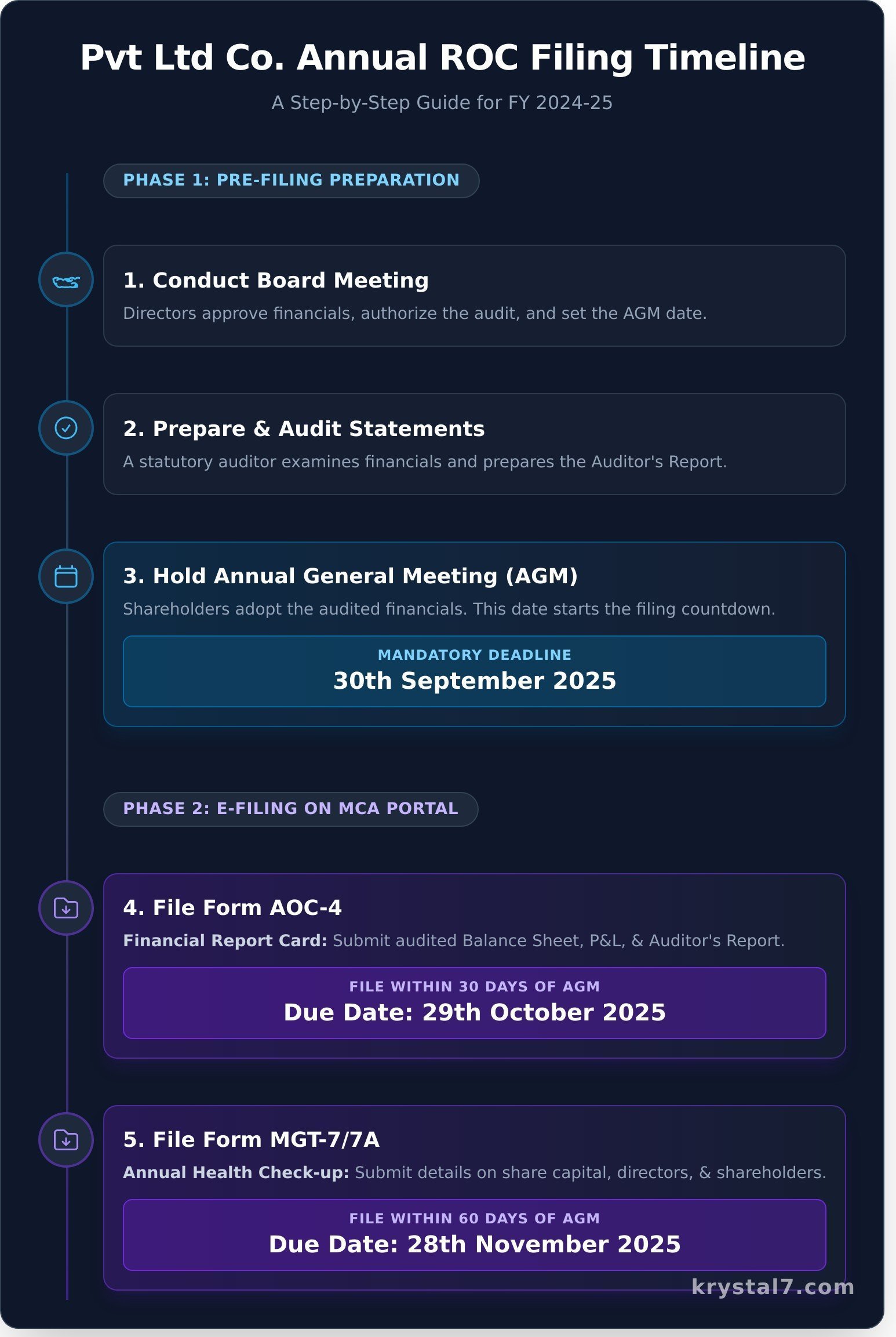
Meeting deadlines is critical to avoid late fees and compliance issues. The due dates for ROC filing are linked to the date of your company’s Annual General Meeting (AGM). For the financial year ending 31st March 2025, the AGM must be held by 30th September 2025.
Based on this AGM deadline, here are the key due dates to mark in your calendar:
- Form AOC-4 (Financials): Must be filed within 30 days of the AGM. The last date is typically 29th October 2025.
- Form MGT-7/7A (Annual Return): Must be filed within 60 days of the AGM. The last date is typically 28th November 2025.
Following this timeline is a crucial part of the roc filing procedure for pvt ltd company, giving you the clarity and peace of mind to focus on what you do best-running your business.
Phase 1: The Pre-Filing Preparation (Your Compliance Foundation)
A successful annual filing isn’t about the final click on the MCA portal; it’s about the meticulous groundwork laid weeks or even months before. This preparatory phase is the bedrock of your company’s compliance. It involves the crucial corporate actions required to prepare, review, and formally authorize the documents you will eventually submit. Think of it as building a strong foundation before constructing the building.
Skipping these steps isn’t just a procedural error-it renders your entire e-filing legally invalid, exposing your business to significant penalties. A streamlined roc filing procedure for pvt ltd company begins here, with a clear, methodical approach to your internal governance.
Step 1: Conduct Board Meetings
Before any documents are presented to shareholders, the company’s Board of Directors must convene. The primary purpose of this meeting is to review and approve the annual financial statements-namely the Balance Sheet and Profit & Loss Statement-along with the comprehensive Board’s Report. During this meeting, the directors also authorize the statutory auditor to proceed with the audit and formally fix the date, time, and agenda for the Annual General Meeting (AGM). Properly documented meeting minutes are non-negotiable, serving as the official legal record of these critical decisions.
Step 2: Prepare and Audit Financial Statements
With the Board’s approval, the financial statements are finalized. A qualified, independent Statutory Auditor then meticulously examines these documents to ensure they present a true and fair view of the company’s financial health and comply with Indian Accounting Standards. The outcome is the Auditor’s Report, a critical document that provides an unbiased opinion on your financials. This report is a mandatory attachment for Form AOC-4, one of the key official MCA e-filing forms you will submit. The Board’s Report, detailing the company’s operational and financial performance for the year, is also prepared at this stage.
Step 3: Hold the Annual General Meeting (AGM)
The AGM is the formal forum where the company’s directors present the audited financial statements to its shareholders for their approval. This is a cornerstone of corporate governance, providing transparency and accountability to the company’s owners. It is in the AGM that shareholders officially “adopt” the financials. Crucially, the date on which the AGM is held becomes the starting point for calculating your filing deadlines with the Registrar of Companies. Missing this step or getting the date wrong can directly lead to late filing fees and non-compliance.
Feeling overwhelmed by the procedural details? You’re not alone. This is where clarity and expertise make all the difference. Let our experts handle your compliance from start to finish.
Phase 2: The E-Filing Procedure on the MCA Portal
With your documents meticulously prepared, we now move to the digital stage of the roc filing procedure for pvt ltd company. The Ministry of Corporate Affairs (MCA) portal is the official gateway for all statutory submissions. While it can seem intimidating, this streamlined process brings official validation to your annual compliance. We’ll walk you through the practical steps, turning complexity into crystal clarity.
Prerequisites: Laying a Clear Foundation
Before uploading any forms, two critical elements must be in place to ensure a smooth, hassle-free submission. First, each signing director must possess a valid Digital Signature Certificate (DSC). This is your secure, electronic signature for authenticating documents online and must be registered on the MCA portal. Second, ensure all directors have completed their annual DIR-3 KYC, a mandatory verification that confirms their details are current and prevents last-minute filing rejections.
Filing Form AOC-4 (Financial Statements)
This form is the official submission of your company’s financial health for the year. The process is methodical and clear. You begin by downloading the latest e-form from the MCA website and pre-filling basic details using your Company Identification Number (CIN). The next step is to attach the core financial records.
- Audited Financial Statements (including Balance Sheet and Profit & Loss Account)
- The Board’s Report
- The Auditor’s Report
Once all information is complete and attachments are included, the form is digitally signed by a director using their DSC and certified by a Chartered Accountant or other designated professional in practice.
Filing Form MGT-7/7A (Annual Return)
The Annual Return provides a comprehensive snapshot of your company’s non-financial information as of the financial year’s end. It is vital to use the correct form: Form MGT-7A is a simplified return for Small Companies and One Person Companies (OPCs), while Form MGT-7 is required for all other private limited companies. This form captures details on your principal business activities, shareholding patterns, and changes in directorship. After attaching the list of shareholders, the form is digitally signed. For companies not classified as ‘small’, certification by a practicing Company Secretary is also mandatory.
Phase 3: Post-Filing Actions and Record Keeping
Successfully uploading your documents is a significant milestone, but the process isn’t complete once you click ‘submit’. This final phase of the roc filing procedure for pvt ltd company is about ensuring your submission is officially accepted and that your internal records are perfectly aligned. Think of it as securing your compliance foundation for the future.
Fee Payment and SRN Generation
Once your e-form is uploaded, the MCA portal automatically calculates the applicable government fees in Indian Rupees (₹), including filing fees and stamp duty. You can complete the payment securely online via net banking, credit/debit card, or NEFT. Upon successful payment, the system generates a crucial document: the Service Request Number (SRN). The SRN is your unique transaction ID and official receipt. Always save this number immediately, as it is essential for all future correspondence and status tracking related to that specific filing.
Tracking Filing Status and Handling Resubmissions
With your SRN in hand, you can monitor your filing’s progress through the ‘Track Transaction Status’ feature on the MCA portal. If the status shows ‘Pending for Approval’, it’s under review. However, if it’s marked for ‘Resubmission’, it simply means the ROC requires clarification or correction. Common reasons include:
- Incorrect or mismatched details in the form.
- Unclear or improperly scanned attachments.
- Missing professional certifications or Digital Signatures.
Addressing resubmissions promptly is key to a smooth process. Once your form is approved, you can download the final approved form and the payment challan from your MCA account’s ‘My Documents’ section. These are vital for your records.
Maintaining Statutory Registers and Records
E-filing is only the external-facing part of your corporate compliance. Internally, the Companies Act, 2013, mandates that every private limited company maintains statutory registers. These records provide a detailed history of the company’s structure and governance. Key registers include:
- Register of Members (Form MGT-1): A record of all shareholders and their holdings.
- Register of Directors and Key Managerial Personnel (KMP): Details of the company’s leadership.
- Register of Charges (Form CHG-7): A log of any loans or mortgages secured by company assets.
Maintaining these registers diligently ensures you are always prepared for an audit or inspection, demonstrating a commitment to transparent governance. This meticulous record-keeping provides the clarity you need to build your business with confidence. For expert assistance in managing this crucial final step, visit us at krystal7.com for streamlined compliance solutions.
Penalties for Non-Compliance: The High Cost of Delay
Completing the annual ROC filing is more than just a procedural task; it’s a fundamental pillar of corporate governance that safeguards your company’s legal standing and reputation. The Ministry of Corporate Affairs (MCA) enforces strict timelines, and delays can trigger a cascade of financial and operational consequences. Understanding these penalties underscores why proactive compliance is not an expense, but an essential investment in your business’s future.
Viewing the roc filing procedure for pvt ltd company as a critical deadline helps protect your venture from unnecessary risk and financial strain.
Monetary Penalties for Late Filing
The MCA has implemented a straightforward yet stringent penalty system for delayed filings of forms like AOC-4 and MGT-7. The penalty is an ad valorem fee, calculated on a per-day basis.
- Fixed Penalty: A fee of ₹100 per day, per form is levied for each day of the delay.
- No Upper Limit: Crucially, there is no maximum cap on this penalty. The amount can accumulate indefinitely until the filing is completed, potentially growing into a substantial financial burden.
Example Calculation: If a company delays filing both its AOC-4 and MGT-7 forms by 30 days, the penalty would be calculated as follows:
(₹100/day × 30 days for AOC-4) + (₹100/day × 30 days for MGT-7) = ₹3,000 + ₹3,000 = ₹6,000
Non-Monetary Consequences for the Company and Directors
Beyond the financial impact, non-compliance carries severe consequences that can jeopardise your company’s operations and the professional standing of its directors.
- Loss of ‘Active’ Status: A defaulting company may be marked as ‘ACTIVE Non-Compliant’ in the MCA database, which can hinder its ability to secure loans, participate in tenders, or engage in other significant business transactions.
- Director Disqualification: If a company fails to file its annual returns for three consecutive years, its directors can be disqualified. A disqualified director is barred from being appointed to the board of any other company for a period of five years.
- Company Strike-Off: Persistent failure to file can lead the Registrar of Companies (ROC) to assume the company is defunct. The ROC can then initiate the process of striking the company’s name from the official register, leading to its dissolution.
Navigating the complexities of statutory deadlines doesn’t have to be a source of stress. Partnering with compliance experts provides the freedom to focus on growth, secure in the knowledge that your obligations are met with precision and foresight. Avoid these penalties and ensure crystal clear compliance with our Annual Compliance Package.
Master Your Compliance, Unleash Your Growth
Navigating the annual ROC filing is not just a regulatory task; it’s a cornerstone of your company’s good standing and long-term health. As we’ve outlined, success hinges on meticulous preparation, a clear understanding of the MCA portal, and diligent record-keeping. Overlooking these steps can lead to significant penalties, turning a routine requirement into a costly burden.
While the roc filing procedure for pvt ltd company is a clear path, it demands time and precision that you should be investing in your vision. This is where Krystal7 brings absolute clarity. Our team of top-tier Chartered Accountants and Company Secretaries manages your entire compliance lifecycle, ensuring every deadline is met flawlessly. With Krystal-Clear pricing, a dedicated relationship manager, and zero hidden costs, you can finally eliminate the guesswork and anxiety from your statutory duties.
Secure your company’s future. Get a free consultation for our hassle-free Annual Compliance service.
Let us handle the complexities, giving you the freedom to focus on what truly matters: building your business legacy.
Frequently Asked Questions (FAQs)
What is the difference between mandatory ROC compliance and event-based ROC compliance?
Mandatory ROC compliance refers to the annual filings every private limited company must complete, such as Form AOC-4 (Financial Statements) and MGT-7 (Annual Return). Think of this as the regular, statutory heartbeat of your business. In contrast, event-based compliance is triggered only when specific corporate actions occur. This includes filings for changing your registered office, appointing a new director, or altering share capital, which are filed as and when these specific events happen.
Do I need a professional (CA/CS) to certify my ROC forms?
Yes, for most significant annual forms like AOC-4 and MGT-7, certification by a practising professional-a Chartered Accountant (CA), Company Secretary (CS), or Cost Accountant (CMA)-is mandatory. This step is crucial for ensuring accuracy and statutory adherence, protecting your company from potential penalties. Partnering with an expert provides the Krystal-Clear assurance that your filings are correct, giving you the freedom to focus on your business growth.
What is DIR-3 KYC and is it part of the annual ROC filing procedure?
DIR-3 KYC is a mandatory annual compliance for every individual holding a Director Identification Number (DIN). While it is an annual requirement, it is a personal compliance for the director, separate from the company’s core annual filings like AOC-4 and MGT-7. Directors must verify their personal details with the ROC by the due date to maintain an active DIN and avoid personal penalties, which can be as high as ₹5,000.
Can I revise a form after it has been filed and approved by the ROC?
Generally, once a form is approved by the Registrar of Companies (ROC), it cannot be easily revised. The Companies Act, 2013, provides a provision for revising certain filings like financial statements or annual returns, but it is a complex and formal process meant for rectifying significant errors, not minor typos. This underscores the importance of ensuring complete accuracy before submission to avoid the hassle and potential complications of post-approval revisions.
My company was inactive for the whole year. Do I still need to complete the ROC filing procedure?
Absolutely. Even if your company had zero business activity, you are still legally required to complete the annual roc filing procedure for pvt ltd company. You must file ‘Nil’ returns for Form AOC-4 and Form MGT-7 to maintain your company’s active status and avoid heavy penalties for non-compliance. Alternatively, if you anticipate long-term inactivity, you can apply to have your company declared as a ‘Dormant Company’ to reduce this compliance burden.
What is the difference between a financial year and an assessment year for filing purposes?
This is a common point of confusion, but the distinction is simple. The Financial Year (FY) is the 12-month period where your company earns income, running from April 1st to March 31st. The Assessment Year (AY) is the year immediately following the FY, during which the income earned in that FY is evaluated for tax purposes. For all ROC filings, such as your annual return, you report the data pertaining to the relevant Financial Year.

Article by
Nihal Srivastava
Nihal Srivastava is the Co-Founder of Krystal7 Consultants, helping Indian entrepreneurs and startups navigate company registration, compliance, trademark protection, and regulatory requirements with clarity and confidence. With 6+ years of hands-on expertise in MCA filings, GST compliance, and corporate structuring, Nihal has guided 1000+ businesses across India through their legal and compliance journeys. He believes every business dream deserves crystal clear foundations, and that no founder should be held back by paperwork or red tape.