

GST Registration for New Business Online: The Complete 2026 Guide
GST Registration for New Business Online: The Complete 2025 Guide
Launching your new venture is an exhilarating moment, but the path to becoming fully compliant can feel overwhelming. If the thought of navigating the official portal for gst registration for new business online fills you with anxiety, you are not alone. The confusing forms, the long list of required documents, and the fear of making a costly mistake are common hurdles that can stall your progress and dampen your entrepreneurial spirit.
This is where clarity begins. Our complete 2025 guide is designed to remove that complexity and empower you with confidence. We provide a streamlined, step-by-step walkthrough-from determining your eligibility to successfully submitting your application. You’ll get a simple document checklist and the expert insights needed to secure your GSTIN quickly and correctly, giving you the freedom to focus on what truly matters: growing your business.
Before You Begin: Is GST Registration Mandatory for Your New Business?
Embarking on a new business venture is an exciting journey, but navigating statutory compliance can feel like a complex first step. Before you begin the process of gst registration for new business online, it’s crucial to find clarity on one fundamental question: is it a legal necessity for you right now? In simple terms, the Goods and Services Tax (GST) is a unified, destination-based tax levied on the supply of goods and services across India. Proper GST compliance is non-negotiable for legal operations, enabling you to claim Input Tax Credit (ITC) on your business purchases and trade seamlessly across state lines. Let’s break down whether your business needs mandatory or can benefit from voluntary registration.
Understanding the Turnover Thresholds
For most businesses, the requirement to register for GST is linked to annual aggregate turnover. The government has set specific limits to ease the compliance burden on smaller enterprises. As of 2026, the primary thresholds are:
- ₹40 Lakh for businesses exclusively supplying goods.
- ₹20 Lakh for businesses exclusively supplying services (or a mix of goods and services).
Note: For special category states (such as those in the North-East and hilly regions), these limits are generally lower, at ₹20 Lakh for goods and ₹10 Lakh for services. Your ‘aggregate turnover’ includes the total value of all taxable supplies, exempt supplies, exports, and inter-state supplies under your PAN.
Cases Where GST Registration is Compulsory, Regardless of Turnover
Certain business models require GST registration from day one, irrespective of their turnover. This is a critical distinction that removes any guesswork. You must register for GST if you are:
- An e-commerce seller operating through platforms like Amazon or Flipkart.
- A business engaged in the inter-state supply of goods.
- A Casual Taxable Person, such as one setting up a temporary stall or kiosk in another state.
- A business required to pay tax under the Reverse Charge Mechanism (RCM).
The Pros and Cons of Voluntary GST Registration
What if you don’t meet any of the mandatory criteria? You can still choose to register voluntarily. This strategic move comes with clear benefits and responsibilities. The primary advantage is the ability to claim Input Tax Credit (ITC), reducing your tax liability. It also boosts your business’s credibility, allowing you to work with larger corporations that only deal with GST-registered vendors. However, the drawback is the commitment to regular compliance, including timely filing of returns. Deciding on a voluntary gst registration for new business online is a strategic step toward future growth, removing compliance hurdles before they appear.
Your Pre-Registration Checklist: Documents & Details to Gather
A smooth journey begins with a clear map. The key to a hassle-free gst registration for new business online is preparation. Gathering your documents beforehand transforms a potentially complex task into a streamlined process, saving you significant time and preventing common application errors. Before you even visit the official GST portal, use this comprehensive checklist to ensure you have every required detail at your fingertips, giving you the freedom to focus on your launch.
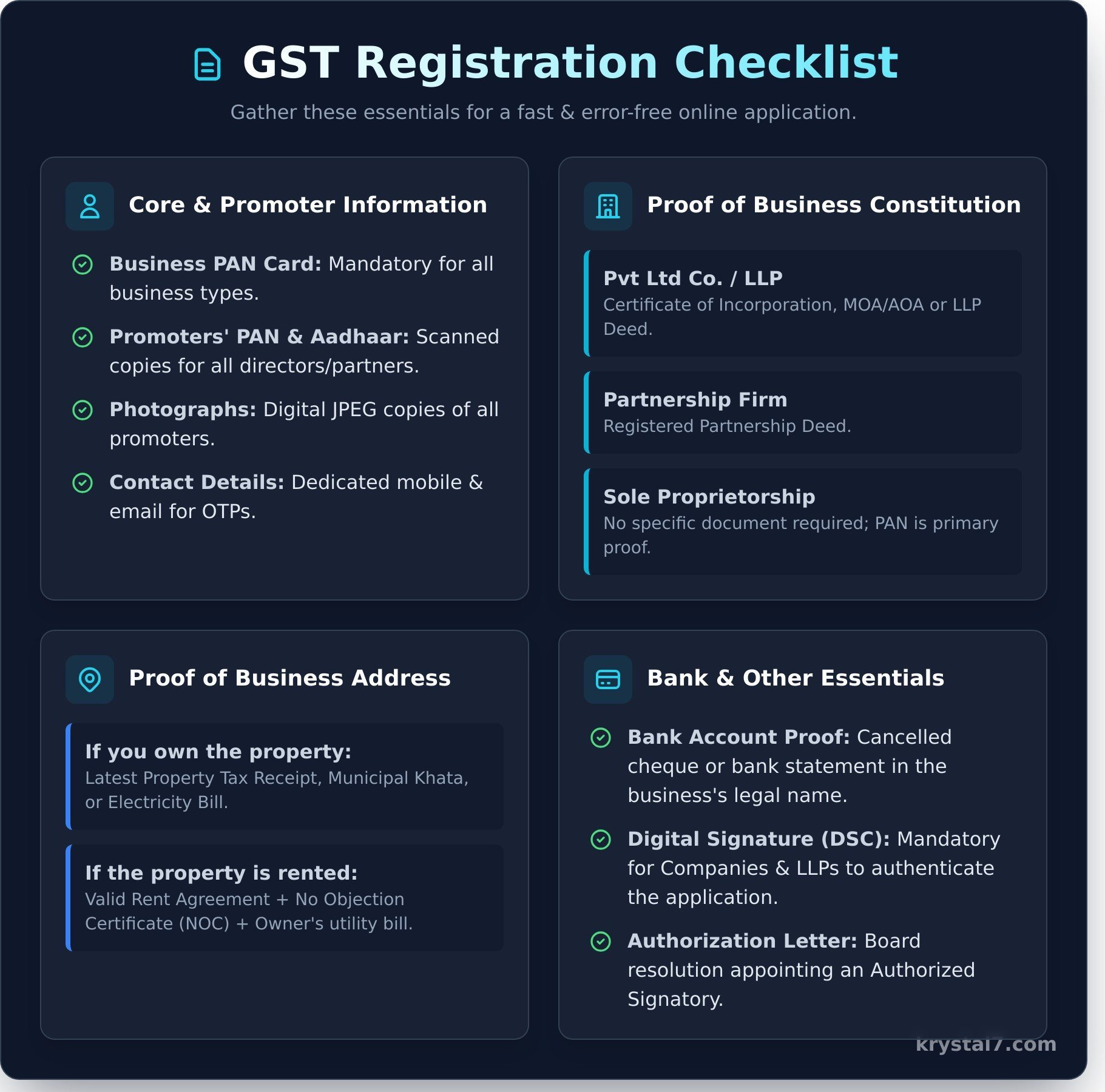
Core Business & Promoter Information
This is the foundational data that identifies your venture and its key personnel. These are non-negotiable for every application.
- Business PAN Card: This is mandatory for all business types, including proprietorships.
- Promoters/Directors’ PAN & Aadhaar Cards: Clear, scanned copies for all founders, partners, or directors.
- Passport-sized Photographs: Digital copies (preferably in JPEG format) for each promoter and authorized signatory.
- Contact Details: A dedicated mobile number and email address for the primary authorized signatory, which will be used for OTP verification and all official communication.
Proof of Business Constitution
Your business structure determines the specific legal documents required to prove its existence and legitimacy. Have the relevant document ready:
- For Private Limited Company (Pvt Ltd) or LLP: The Certificate of Incorporation issued by the Ministry of Corporate Affairs, and your Memorandum of Association (MOA) / Articles of Association (AOA) or the LLP Deed.
- For Partnership Firm: A scanned copy of the registered Partnership Deed.
- For Sole Proprietorship: No specific registration document is needed; your PAN card serves as the primary proof.
Proof of Principal Place of Business
The GST authorities need to verify your official business address. The address proof must be recent (typically within the last 2-3 months) and clearly show the business name or owner’s name.
- If you own the property: The latest Property Tax Receipt, a Municipal Khata copy, or a recent Electricity Bill.
- If the property is rented or leased: A valid Rent/Lease Agreement along with a No Objection Certificate (NOC) from the property owner, plus a copy of the owner’s property proof (like an electricity bill).
Bank Account & Other Essentials
Finally, these documents complete your financial and authorization profile, bringing Krystal-Clear transparency to your application.
- Bank Account Proof: A scanned copy of a cancelled cheque, the first page of your passbook, or a recent bank statement. Crucially, the account must be in the legal name of the business.
- Digital Signature Certificate (DSC): A Class 2 or Class 3 DSC is mandatory for Companies and LLPs for authenticating the application.
- Letter of Authorization: A formal letter or board resolution appointing an Authorized Signatory for the GST registration process.
The Online GST Registration Process: A Step-by-Step Walkthrough
Navigating the government portal for your GST registration can feel overwhelming, but we’re here to bring clarity to the process. This guide breaks down the entire journey, ensuring you can complete your gst registration for new business online with confidence and precision. The portal allows you to save your application at each stage, a feature we highly recommend using to prevent any loss of data.
Step 1: Generating Your Temporary Reference Number (TRN)
Your journey begins on the Official GST Portal. Here, you’ll initiate the process by selecting ‘New Registration’ and filling out Part A of Form GST REG-01. This section captures foundational details like your PAN, mobile number, and email address. The system validates this information by sending separate OTPs to your mobile and email. Once verified, you will receive a Temporary Reference Number (TRN). This TRN is your key to the main application and is valid for 15 days.
Step 2: Completing the Main Application (Part B)
Using your TRN, log back into the portal to access Part B of the application. This is the core of your registration, where you must meticulously provide detailed information across several tabs:
- Business Details
- Promoter/Partner Information
- Authorised Signatory
- Principal Place of Business
- Goods and Services Details
Pay close attention when entering your HSN (for goods) or SAC (for services) codes, as these directly determine your tax liability. To finalize this stage, you must digitally sign the application on the ‘Verification’ tab using a Digital Signature Certificate (DSC) or an Electronic Verification Code (EVC).
Step 3: Uploading Documents and Final Submission
The portal will now prompt you to upload scanned copies of all necessary documents, such as your PAN card, proof of business address, and photographs. Ensure each file adheres to the specified format (usually PDF or JPEG) and size limits (typically under 1MB) to avoid upload errors. This is the final hurdle before you give your application one last thorough review and click the submit button.
Step 4: Receiving the Application Reference Number (ARN)
Upon successful submission, the system instantly generates an Application Reference Number (ARN). This ARN is your official acknowledgment and is the unique code you will use to track the status of your application. Its generation signifies that your file has been successfully submitted and is now in the queue for review and approval by a designated GST officer, moving your business one step closer to full compliance.
After You Apply: What to Expect and How to Track Your Status
You’ve successfully submitted your application-congratulations on taking this crucial step. The waiting period can cause anxiety, but understanding the verification process brings Krystal-Clear peace of mind. The journey of your gst registration for new business online application doesn’t end at submission; it now enters a verification stage.
Typically, a designated GST officer will review your application and the supporting documents within 3 to 7 working days. Their role is to meticulously verify every detail to ensure compliance. This is a standard procedure designed to maintain the integrity of the GST system.
How to Track Your GST Application Status
Your key to monitoring the progress is the Application Reference Number (ARN) you received via email and SMS. You can use this ARN on the official GST portal to get real-time updates. We advise checking the status a couple of days after submission.
Simply visit the GST portal, navigate to Services > Registration > Track Application Status, and enter your ARN. Common statuses you might see include:
- Pending for Verification: Your application has been submitted and is in the queue for officer review.
- Validation Against Provisional ID: The system is cross-checking your details.
- Pending for Clarification: The officer has raised a query and is awaiting your response.
- Approved: Congratulations, your application has been accepted.
Handling Queries and Notices from the Department
It is quite common for the verifying officer to request additional information or clarification. This is not a rejection but a standard part of the due diligence process. If the officer requires more details, they will issue a notice in form GST REG-03.
You must respond to this notice within the specified timeframe, which is usually 7 working days. Your response, submitted via form GST REG-04, should include the requested clarifications or documents. A timely and accurate response is critical to ensure your application for gst registration for new business online proceeds smoothly.
Receiving Your GST Registration Certificate (GSTIN)
Once the officer is satisfied with your application and any clarifications provided, they will approve it. You will then be issued your GST Registration Certificate in form GST REG-06. This certificate contains your unique 15-digit Goods and Services Tax Identification Number (GSTIN).
Your GSTIN is a PAN-based number unique to your business. You should download the certificate from the GST portal immediately. As per GST law, you are required to display this certificate prominently at your principal place of business and any additional places of business mentioned in the registration.
Navigating departmental queries and ensuring compliance can be complex. Give your venture the advantage of professional oversight. Get expert GST registration support.
Common Mistakes New Businesses Make (And How to Avoid Them)
Navigating the GST portal is a significant step, but a few simple oversights can lead to frustrating delays or even application rejection. Based on our experience helping thousands of ventures, we’ve compiled the most common pitfalls entrepreneurs face during their gst registration for new business online. Think of this as insider advice to ensure your application is streamlined for success from the very beginning.
Mistake 1: Incorrect Jurisdictional Details
The Problem: The GST portal asks for both State and Central jurisdictional details. Many new applicants get confused and select the wrong office, which causes the application to be misrouted internally. This single error can add weeks to your processing time as your file is transferred between departments.
The Solution: Before you fill out this section, visit the official CBIC website and use their “Know Your Jurisdiction” tool. By simply entering your address, you get the precise details for your Ward, Circle, or Range, ensuring your application lands on the right desk the first time.
Mistake 2: Mismatched or Invalid Documents
The Problem: The processing officer meticulously verifies every document you upload. Any discrepancy is an immediate red flag. Common issues include:
- Blurry or unreadable scans of your PAN card or address proof.
- An expired rent agreement for your business premises.
- Slight variations in the applicant’s name between the PAN card, Aadhaar card, and bank account details.
The Solution: Treat this step with absolute precision. Ensure all scans are crystal clear. Verify that your rent agreement is current. Most importantly, confirm your name is spelled exactly the same across all official documents. Even a missing initial can cause a query.
Mistake 3: Choosing the Wrong HSN/SAC Codes
The Problem: Applicants are required to list their top five goods (HSN codes) or services (SAC codes). Choosing incorrect or overly broad codes doesn’t just look unprofessional-it can lead to incorrect tax rates being applied to your sales later, creating significant compliance issues.
The Solution: Use the HSN/SAC code finder on the official GST portal to identify the most accurate codes for your specific business activities. Be precise. If you sell “custom software,” find that specific code rather than using a generic “IT services” category. A clear and accurate list makes the verification process smoother and sets your business on a solid compliance foundation.
Avoiding these common errors will significantly improve your chances of a swift and successful gst registration for new business online. For Krystal-Clear guidance and to remove all guesswork, the experts at Krystal7 are here to manage the entire process for you.
From Complexity to Clarity: Finalizing Your GST Registration
Embarking on your business journey in India requires a solid, compliant foundation, and GST registration is a cornerstone of that structure. As this guide has detailed, success hinges on understanding if registration is mandatory for you, meticulously gathering all necessary documents, and proactively avoiding common pitfalls. A smooth gst registration for new business online isn’t just a procedural step; it’s your first major move towards transparent and scalable operations.
But you don’t have to navigate this critical compliance task alone. The potential for error can cause costly delays and unnecessary stress. This is where Krystal7 transforms complexity into confidence. Our integrated team of top-tier Chartered Accountants and legal strategists is committed to your success. We provide a dedicated advisor to handle all your compliance needs with our signature Krystal-Clear Transparency-no hidden costs, just streamlined results.
Secure your business’s future and gain the freedom to focus on your vision. Let us handle the details so you can build your legacy. Get your GST registration done right the first time. Contact our experts today!
Frequently Asked Questions
What are the government fees for online GST registration?
The Government of India does not charge any official fees for GST registration for new business online. The process on the official GST portal is completely free of cost. However, many entrepreneurs choose to engage professional services to ensure the application is accurate and submitted without errors, which can save significant time and prevent future compliance issues. This small investment ensures a smooth, hassle-free registration, giving you the freedom to focus on your business.
How long does it take to get a GST number for a new business?
Typically, after submitting your application and completing Aadhar authentication, you can expect to receive your GSTIN (GST Identification Number) within 3 to 7 working days. This timeline can extend if the GST officer raises a query or requests additional documentation. A meticulously prepared application is key to a swift approval. Our streamlined process is designed to minimize such delays, ensuring you get your GST number with clarity and speed.
What is the penalty for not getting GST registration when it’s mandatory?
Failing to register for GST when it is mandatory can lead to significant penalties. The penalty is 10% of the tax amount due or ₹10,000, whichever is higher. In addition to this monetary penalty, the tax authorities can also initiate legal proceedings, including the confiscation of goods and other assets. Ensuring timely compliance is not just a legal requirement but a crucial step in building a sustainable and trustworthy business legacy.
Can I use my personal savings bank account for GST registration?
While technically possible for a proprietorship, using a personal savings account is strongly discouraged. It complicates bookkeeping and makes it difficult to distinguish between personal and business transactions, which can lead to issues during audits. We always advise our clients to open a dedicated business current account. This provides financial clarity, establishes a professional image, and simplifies your compliance journey, aligning with best practices for a growing venture.
What should I do if my GST registration application is rejected?
If your application is rejected, the first step is to understand the specific reasons provided in the rejection notice from the GST officer. Common reasons include incorrect documents, mismatched information, or incomplete details. You must rectify these issues and then file a fresh application. Navigating this can be complex, but with expert guidance, you can address the officer’s concerns accurately and resubmit with confidence, ensuring a successful outcome.
Do I need a Digital Signature Certificate (DSC) to register for GST?
A Digital Signature Certificate (DSC) is mandatory for completing the GST registration process only if your business is a Public or Private Limited Company, a Limited Liability Partnership (LLP), or a Foreign Company. For other entities like Proprietorships and Partnerships, the application can be verified using an EVC (Electronic Verification Code), which is an OTP sent to the mobile number linked with the authorized signatory’s Aadhar card.
Can one person have multiple GSTINs?
Yes, it is possible for a single legal entity (one PAN) to have multiple GSTINs. You would need a separate GST registration for each state in which you have a place of business. Additionally, you can voluntarily opt for separate registrations for different business verticals within the same state. This helps in managing accounts and compliance for distinct business segments, providing greater operational clarity as your venture expands.

Article by
Nihal Srivastava
Nihal Srivastava is the Co-Founder of Krystal7 Consultants, helping Indian entrepreneurs and startups navigate company registration, compliance, trademark protection, and regulatory requirements with clarity and confidence. With 6+ years of hands-on expertise in MCA filings, GST compliance, and corporate structuring, Nihal has guided 1000+ businesses across India through their legal and compliance journeys. He believes every business dream deserves crystal clear foundations, and that no founder should be held back by paperwork or red tape.