

FPO Full Form in Consumer Protection: A 2026 Guide for Food Businesses
Last Tuesday, a juice manufacturer in Manesar discovered that a missing logo on his latest batch of mango pulp could lead to a ₹50,000 penalty. It’s a common nightmare for entrepreneurs who find themselves lost in the overlap of Indian food laws. Understanding the fpo full form in consumer protection is the first step to securing your business’s future and ensuring your products are legally fit for the shelf.
You’ve likely felt the pressure of balancing product quality with the strict demands of the Ministry of Food Processing Industries. It’s frustrating when you aren’t sure if your labels need an AGMARK, an FSSAI license, or the FPO mark. This guide promises to bring crystal clarity to these requirements, protecting you from the fear of non-compliance and heavy fines.
We’ll explain exactly what the Fruit Products Order stands for and which specific items must carry this seal in 2026. You’ll also get a clear roadmap for obtaining the right certifications, so you can stop worrying about documentation and find the freedom to focus on growing your food empire.
Key Takeaways
- Understand the fpo full form in consumer protection as the Fruit Products Order 1955, a mandatory quality standard for all processed fruit products in India.
- Learn how this certification acts as a legal shield under the Consumer Protection Act 2019 to safeguard buyers against food adulteration and substandard quality.
- Identify the specific list of mandatory products that must carry this mark and how it currently integrates with FSSAI compliance standards.
- Get a clear, step-by-step roadmap for the application process, including the essential PAN, GST, and MOA documentation needed for a successful filing.
- Discover how to streamline your licensing and gain the “Freedom to Focus” on your business growth while experts manage the complex regulatory red tape.
What is the FPO Full Form in Consumer Protection?
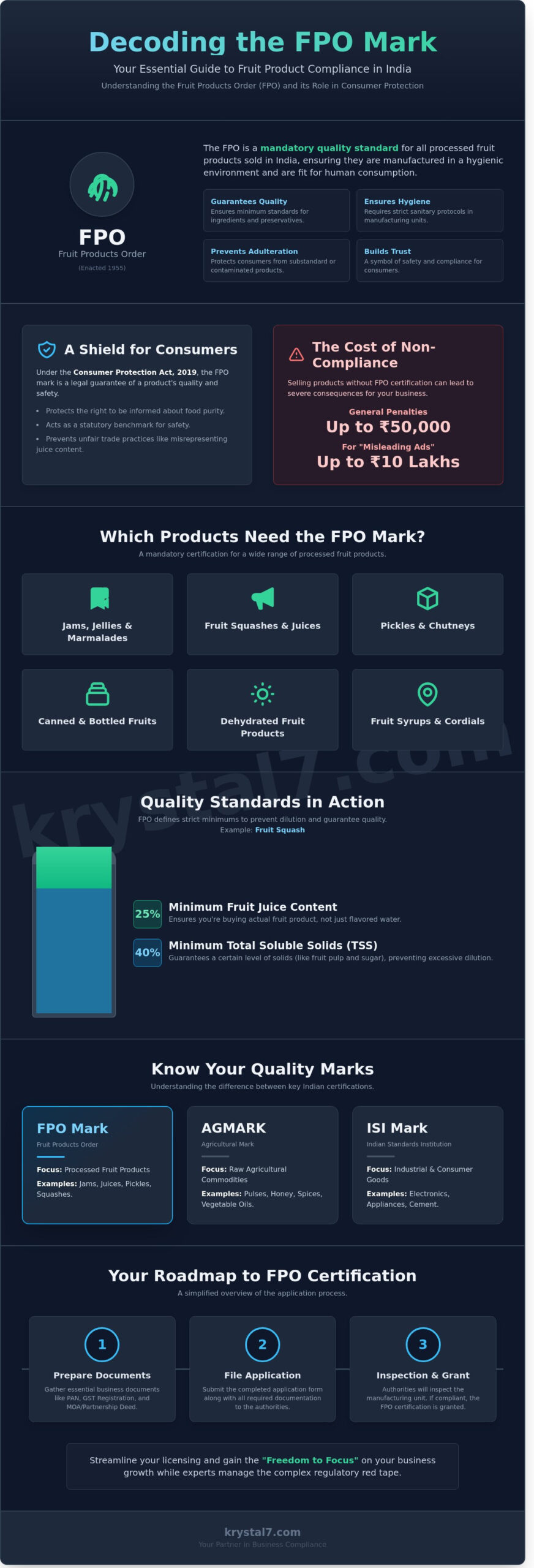
The fpo full form in consumer protection refers to the Fruit Products Order. This regulatory framework was enacted in 1955 under the Essential Commodities Act to monitor the fruit processing sector. It serves as a mandatory certification mark for all processed fruit products sold in India, ensuring they’re fit for human consumption.
For entrepreneurs in the food space, this mark is a non-negotiable symbol of hygiene and quality. It guarantees that the product was manufactured in a facility that follows strict sanitary protocols. The Ministry of Food Processing Industries (MoFPI) originally governed this order to protect consumers from adulteration and poor manufacturing practices.
- Mandatory for items like jams, squashes, and pickles.
- Ensures minimum quality standards for ingredients and preservatives.
- Requires regular inspection of manufacturing units by government authorities.
- Prevents the sale of substandard or contaminated fruit products.
Compliance with these standards isn’t just a legal hurdle. It’s a way to build trust with your customers. When a consumer sees the FPO mark, they feel secure knowing the product meets national safety benchmarks.
The Origins of the Fruit Products Order (1955)
Post-independence India faced significant challenges regarding food safety and standardization. The government introduced the Fruit Products Order in 1955 to create a uniform quality landscape for a growing industry. The primary objective was to ensure that every fruit product reached the consumer only after being processed in a clean, sanitary environment. FPO serves as the benchmark for processed fruit safety in India since 1955.
The FPO Mark vs. Other Quality Standards
Understanding the difference between various certification marks provides much-needed clarity for business owners. While the fpo full form in consumer protection is specific to processed fruits, AGMARK is used for raw agricultural commodities like pulses, honey, and vegetable oils. The ISI mark, managed by the Bureau of Indian Standards (BIS), typically applies to industrial items, electrical appliances, and some food items like condensed milk.
The FPO mark is easily identifiable on packaging as a distinct logo. You’ll find it on labels of fruit juices, canned fruits, and dehydrated fruit products. While some certifications in India are voluntary, the FPO standards were strictly mandatory for all fruit processors to ensure public health safety. Today, these standards are integrated into the FSSAI framework, yet the FPO legacy remains the foundation of fruit quality control in the Indian market.
Distinguishing between these marks helps you choose the right compliance path for your specific venture. If your business dreams involve fruit processing, the FPO standards are your first step toward market entry. We handle the complexity of these registrations so you can enjoy the freedom to focus on your brand’s growth.
FPO and the Consumer Protection Act: Safeguarding the Indian Buyer
The fpo full form in consumer protection refers to the Fruit Products Order, a regulatory framework that serves as a vital shield for Indian buyers. Under the Consumer Protection Act, 2019, every citizen has the right to be informed about the quality and purity of food products. The FPO mark acts as a statutory guarantee that a processed fruit product meets specific safety benchmarks before reaching the kitchen shelf.
Selling fruit-based products without the mandatory certification or misrepresenting juice content constitutes an unfair trade practice under Section 2(47) of the 2019 Act. The Central Consumer Protection Authority (CCPA) monitors these violations closely to prevent consumer exploitation. For entrepreneurs, complying with these standards isn’t just about law; it’s about building a legacy of trust that protects the business from heavy penalties.
Adhering to these rules helps you avoid the “misleading advertisement” trap which can result in fines up to INR 10 lakhs for first-time offenders. When you display the FPO mark, you’re telling your customers that your product is safe, standardized, and legally compliant. This transparency is essential for any modern brand looking to scale in the competitive Indian market.
Quality Standards Guaranteed by FPO
FPO standards define strict limits to ensure you aren’t selling flavored water as juice. For example, fruit squashes must maintain a minimum fruit juice content of 25% and Total Soluble Solids (TSS) of at least 40%. These specific numbers prevent manufacturers from diluting products with excessive sugar or water.
The order strictly prohibits harmful synthetic colors and limits preservatives like Sulphur Dioxide to specific parts per million (ppm) levels. Processing units must also follow Schedule II hygiene requirements. This includes maintaining stainless steel equipment and ensuring the water used in processing meets potable standards set by the Bureau of Indian Standards (BIS).
Redressal and Consumer Rights
If a product bearing the FPO mark fails independent laboratory tests, consumers have the right to seek redressal through District, State, or National Consumer Commissions. The CCPA has the power to recall dangerous goods and order the reimbursement of the purchase price to consumers. This legal heat can destroy a startup before it even begins to grow.
This is why private limited company india founders must prioritize these marks to avoid litigation. A single quality failure can lead to a class-action suit under the 2019 Act. If you’re unsure about how these standards apply to your specific product line, you can consult with our compliance experts to ensure your labels and processes are bulletproof.
Understanding the fpo full form in consumer protection is the first step toward building a compliant food business. By meeting these statutory requirements, you protect your customers from adulteration and your business from the CCPA’s scrutiny. It’s a win-win strategy that fosters long-term brand loyalty and operational peace of mind.
Mandatory Products and Legal Compliance Requirements
Compliance defines the boundary between a side project and a professional brand. When entrepreneurs ask about the fpo full form in consumer protection, they’re looking for the Fruit Products Order standards that safeguard the Indian public. These rules ensure that processed fruit items aren’t just tasty, but safe for consumption. It’s the baseline for quality that every food startup must achieve to survive in the competitive Indian market.
Which Products Require the FPO Mark?
The FPO mark is mandatory for specific processed food categories. If your business manufactures or packs these, you must comply with the standards originally set in 1955. This certification proves your facility maintains hygienic conditions and uses approved ingredients. The list includes:
- Fruit jams, jellies, marmalades, and fruit pulps.
- Packaged fruit beverages, squashes, crushes, and cordials.
- Pickles, tomato ketchups, and sauces.
- Dehydrated fruit products and fruit peels.
- Canned and bottled fruits and vegetables.
The FSSAI Transition: Is FPO Still Relevant?
The legal landscape changed when the Food Safety and Standards Act 2006 came into force. This act repealed the Fruit Products Order 1955 to create a unified regulatory body. Now, FPO standards live within the FSSAI’s ‘Food Product Standards and Food Additives’ regulations. You don’t apply for a separate FPO license anymore; you get an FSSAI license that incorporates these fruit-specific safety measures. The fpo full form in consumer protection remains a vital part of the safety vocabulary for manufacturers.
Staying compliant is a year-round job. For many founders, managing these filings alongside annual compliance for private limited company requirements is the biggest challenge. It’s essential to integrate these food safety checks into your broader corporate governance strategy to avoid unexpected legal hurdles.
Penalties and Critical Deadlines
Operating without a valid license or selling sub-standard products carries heavy risks. Under Section 63 of the FSSAI Act, selling food without a license can result in imprisonment for up to six months and a fine of up to ₹5 lakh. If your products don’t meet the prescribed standards, fines can reach ₹3 lakh for misbranded food and ₹5 lakh for sub-standard food. These penalties are designed to protect the consumer and ensure only quality goods reach the kitchen table.
Mark these dates in your calendar to stay safe:
- Annual Returns: Every licensed business must file Form D-1 by May 31st each year. Missing this deadline attracts a penalty of ₹100 per day.
- License Renewals: You should apply for renewal at least 30 days before your current license expires. Waiting until the last minute can lead to higher fees or a complete lapse in your operating authority.
- Half-Yearly Returns: Some specific categories may still require Form D-2 filings twice a year, depending on the scale of operations.
Managing these timelines requires a methodical approach. Krystal7 helps you streamline these dates so you never miss a filing. We provide the clarity you need to keep your production lines moving without the fear of sudden inspections or fines.
How to Obtain FPO Certification: Documents and Process
Understanding the fpo full form in consumer protection is your first step toward building a compliant food brand. The application process is now fully digitized through the FSSAI Food Safety Compliance System (FoSCoS). This platform brings crystal clarity to what used to be a complex manual system. It ensures that every food processing unit meets the statutory requirements of the Food Safety and Standards Act.
Essential Documents and the fpo full form in consumer protection
Preparation is the key to a smooth approval. You must gather specific identity and operational documents before logging into the portal. If you haven’t set up your legal entity yet, follow our guide on how to register your business first. For the FPO certification, you’ll need:
- Proof of Possession: A registered rent agreement or sale deed for the processing unit.
- Identity Proof: PAN cards and Aadhaar details of all directors or partners.
- Constitutional Documents: The Memorandum of Association (MOA) or Partnership Deed.
- Water Analysis: A report from a recognized laboratory confirming the water used in processing is potable.
- Unit Layout: A detailed blueprint of the processing unit showing the dimensions and dedicated areas for different operations.
The Application Workflow on the FoSCoS Portal
The workflow is methodical and transparent. First, register on the FoSCoS portal using a valid email and mobile number. You must then select the correct category based on your production capacity. Small scale units fall under State Licensing, while large units producing over 2 metric tonnes per day require a Central License.
After filling out Form B, you’ll pay the government fees. These typically range from INR 2,000 to INR 7,500 per year depending on your production volume. Once you submit the application, the portal generates a unique 17-digit application reference number. You can use this to track your status in real-time. This digital approach removes the old red tape and provides the freedom to focus on your product quality.
Verification and Inspection Process
A Food Safety Officer (FSO) will conduct a physical inspection of your premises. They check if the machinery list you provided matches the equipment on-site. The officer examines the hygiene standards, waste disposal systems, and storage conditions. They ensure your unit follows the safety protocols mandated by the fpo full form in consumer protection guidelines. If the inspection is successful, the authorities usually issue the license within 30 to 60 days.
Don’t let the paperwork overwhelm your vision. Our experts can streamline your FPO compliance so you can launch your brand with confidence.
Krystal7 Consultants: Streamlining Your Food Business Compliance
Navigating the food industry in 2026 requires more than just a great product. You need a partner who understands that the fpo full form in consumer protection represents a commitment to safety and quality standards. Krystal7 Consultants acts as that partner for Gurgaon entrepreneurs by cutting through the administrative red tape. We manage the heavy lifting of MCA and FSSAI filings so your team can focus on culinary innovation.
Our “Freedom to Focus” philosophy is built on the belief that founders shouldn’t be buried in paperwork. We handle everything from initial company incorporation to complex annual returns. Our team also guides you through trademark registration fees to protect your brand identity in a competitive market. These customized compliance packages are designed specifically for the budget and scale of Indian startups and SMEs.
Why Choose Gurgaon’s Leading Compliance Experts?
Our physical location provides a strategic advantage for your food business. We maintain close proximity to the MCA and regional food safety offices in Haryana. This allows for faster document processing and direct communication with regulatory bodies when issues arise. You won’t deal with a generic helpdesk; you get a dedicated relationship manager who knows the Indian food industry inside out.
We believe in upfront honesty and clarity. Our firm provides 100% transparent pricing with no hidden costs for registrations or monthly filings. This methodical approach ensures that your business remains in good standing with the law without unexpected financial shocks.
- Direct access to top-tier Chartered Accountants and Company Secretaries.
- Proactive alerts for upcoming FSSAI and GST deadlines.
- Expert handling of Private Limited and LLP statutory requirements.
Getting Started with Krystal7
We begin with a strategic consultation to map your entire compliance journey. Our experts analyze your business model to determine the exact licenses you need to operate legally in India. We provide end-to-end support for company registration, GST filing, and FSSAI licensing. Our team ensures you understand how the fpo full form in consumer protection impacts your daily operations and long-term reputation.
Experience Krystal-Clear transparency in your legal filings. Contact Krystal7 Consultants at business@krystal7.com or visit krystal7.com for expert assistance.
Secure Your Food Business Future with FPO Compliance
Compliance isn’t just a legal hurdle; it’s the foundation of your brand’s reputation in the competitive Indian market. Understanding the fpo full form in consumer protection, which refers to the Fruit Product Order, helps you navigate mandatory quality standards for processed food. Failing to meet these FSSAI standards can result in heavy penalties under the Food Safety and Standards Act. You deserve the freedom to focus on your culinary vision while experts handle the regulatory red tape.
Krystal7 Consultants provides elite expertise in FSSAI and MCA filings from our headquarters in Gurgaon. We offer transparent INR pricing tailored for Indian startups to ensure there are no surprises during your journey. Our team provides nationwide coverage to help you streamline every statutory requirement. Secure your business compliance today—contact Krystal7 Consultants at business@krystal7.com. Your dream of building a trusted food brand is within reach with the right partner by your side.
Frequently Asked Questions
What is the full form of FPO in the food industry?
The fpo full form in consumer protection is the Fruit Products Order, a benchmark for quality in the Indian food industry since 1955. It specifically regulates the manufacture and sale of processed fruit and vegetable products to ensure they’re safe for public consumption. While the FSSAI now oversees these regulations, the FPO mark remains a powerful symbol of trust for your customers. It gives you the freedom to focus on your craft while maintaining high standards.
Is the FPO mark mandatory for all food products in India?
No, the FPO mark isn’t mandatory for every food item; it applies specifically to processed fruit and vegetable products like jams, squashes, and pickles. Since the Food Safety and Standards Act of 2006, the FSSAI logo has become the primary mandatory requirement for all food businesses. However, many manufacturers still use the FPO mark to signify compliance with historical quality standards that consumers trust. It provides an extra layer of assurance for your brand.
What is the difference between FPO and FSSAI marks?
The main difference is their scope and regulatory timeline. The FPO mark focuses exclusively on fruit and vegetable processing standards established in 1955. In contrast, the FSSAI mark is the modern, overarching certification required for all food business operators in India under the 2006 Act. While FPO deals with specific product quality, FSSAI covers the entire food safety ecosystem from manufacturing to retail. Most businesses now transition to FSSAI for a more streamlined compliance experience.
Can I sell homemade pickles without an FPO or FSSAI license?
You can’t legally sell homemade pickles without at least an FSSAI registration. Even if you’re a small startup with an annual turnover below INR 12 lakhs, you must obtain a basic FSSAI registration to comply with Indian law. Selling food without these credentials can lead to heavy fines and the immediate closure of your business. Getting registered early ensures your venture starts on a transparent and legal foundation, protecting your entrepreneurial dream.
What are the penalties for misusing the FPO mark on packaging?
Misusing the FPO mark or providing false information on packaging carries severe penalties under Section 63 of the FSS Act, 2006. Business owners may face fines up to INR 5 lakhs and imprisonment for up to 6 months. These strict measures protect consumers from deceptive marketing practices. It’s vital to ensure your labels are accurate to avoid these costly legal setbacks and maintain your brand’s reputation. Transparency isn’t just a word; it’s how successful businesses grow.
How long is an FPO/FSSAI license valid for a startup?
An FSSAI license, which now encompasses FPO standards, is valid for a period ranging from 1 to 5 years. You can choose the duration during the application process on the FoSCoS portal based on your business plan. It’s essential to apply for renewal at least 30 days before the expiry date. Missing this deadline results in a penalty of INR 100 per day, which can quickly drain your startup’s resources. Staying ahead of these dates ensures your business thrives without interruptions.
What is the full form of FPO in consumer protection specifically?
The fpo full form in consumer protection is the Fruit Products Order, which acts as a legal shield for consumers against substandard processed foods. It mandates that manufacturers follow specific recipes and sanitary conditions during production. Understanding this regulation is a key step for any food entrepreneur aiming for long term growth. It provides the crystal clarity needed to navigate India’s complex food safety laws without any guesswork. Compliance is your bridge to consumer loyalty.
Does a fruit juice shop need an FPO mark for fresh juice?
A fruit juice shop selling fresh, made to order juice doesn’t require an FPO mark. The FPO standards apply specifically to processed and packaged fruit products with a long shelf life. However, your shop must still obtain an FSSAI license or registration to operate legally in India. This ensures your premises meet the basic hygiene requirements defined by the Food Safety and Standards Authority of India. We help you handle the red tape so you can focus on serving your customers.
For expert assistance with your food business compliance and registrations, contact Krystal7 Consultants at business@krystal7.com or visit krystal7.com.

Article by
Nihal Srivastava
Nihal Srivastava is the Co-Founder of Krystal7 Consultants, helping Indian entrepreneurs and startups navigate company registration, compliance, trademark protection, and regulatory requirements with clarity and confidence. With 6+ years of hands-on expertise in MCA filings, GST compliance, and corporate structuring, Nihal has guided 1000+ businesses across India through their legal and compliance journeys. He believes every business dream deserves crystal clear foundations, and that no founder should be held back by paperwork or red tape.