

Startup Legal Compliance Checklist India: The Ultimate 2026 Guide for Founders
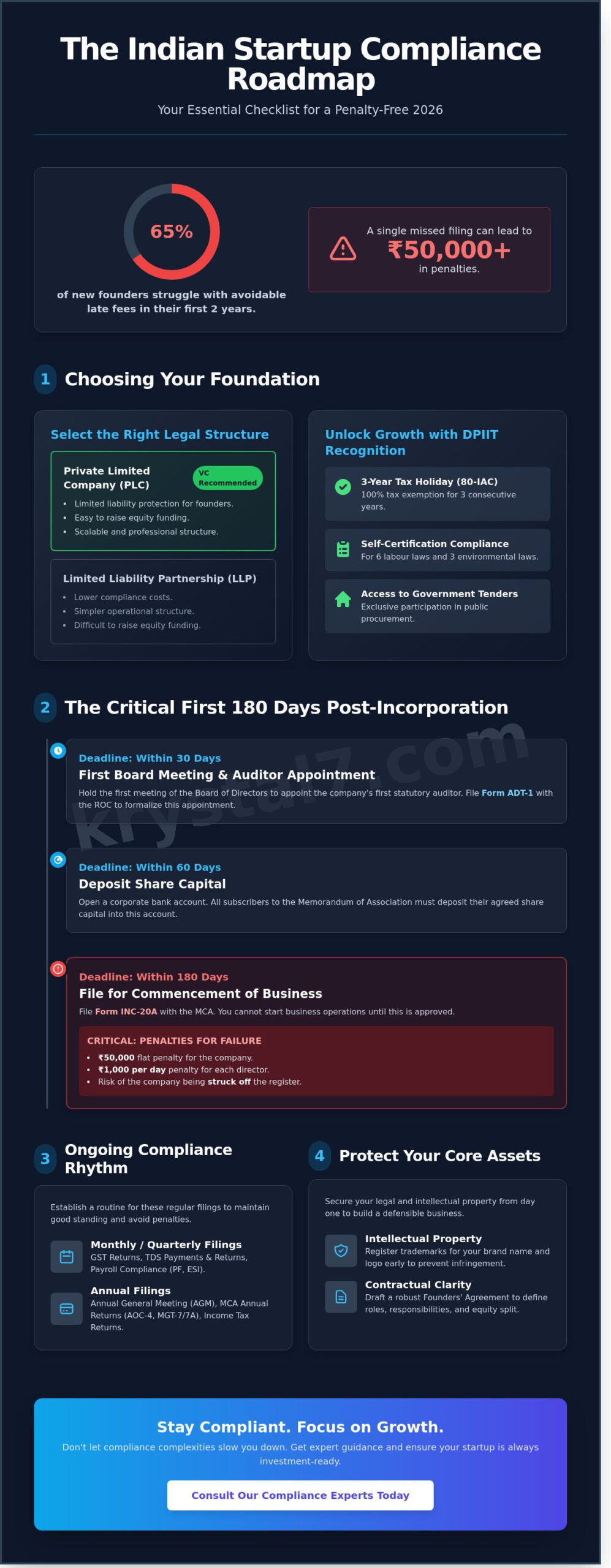
Did you know that a single missed filing on the MCA portal can snowball into penalties exceeding ₹50,000 before you even realize you’re late? Data from recent compliance audits suggests that nearly 65% of new Indian founders struggle with avoidable late fees during their first 24 months of operation. You’ve worked tirelessly to build your vision, yet the constant anxiety over GST deadlines or TRACES portal errors shouldn’t be your daily reality. We understand that you want to spend your time innovating, not deciphering complex sections of the Companies Act, which is why having a reliable startup legal compliance checklist india is essential for your 2026 strategy.
Key Takeaways
- Learn how to choose the ideal legal structure and obtain DPIIT recognition to unlock essential tax benefits and investor interest.
- Master the critical first 180 days by meeting urgent deadlines for auditor appointments and share certificate issuance to avoid early-stage penalties.
- Gain the freedom to focus on growth by understanding the monthly and quarterly rhythms of GST, TDS, and payroll compliance.
- Protect your brand and intellectual property early with a strategic approach to trademark registration and robust founders’ agreements.
- Follow this comprehensive startup legal compliance checklist india to navigate annual MCA filings and AGM requirements with crystal-clear confidence.
Choosing the Right Foundation: Entity Selection and DPIIT Recognition
Starting a business in India requires more than just a great idea. It demands a robust legal structure. A Private Limited Company remains the gold standard for founders. This structure offers limited liability protection and makes it easier to raise venture capital. Most investors won’t look at your pitch deck if you aren’t registered as a Private Limited entity. It’s the most professional way to build a legacy.
The Ministry of Corporate Affairs (MCA) oversees the entire registration process through the SPICe+ portal. While a Limited Liability Partnership (LLP) offers lower compliance costs, it lacks the scalability needed for equity funding. Investors prefer the clear shareholding patterns of a company over the partner-based structure of an LLP. Choosing the right entity is the first item on your startup legal compliance checklist india.
DPIIT recognition serves as the essential gateway for startups to access three-year tax holidays and exclusive participation in government tenders.
The Startup India Hub and DPIIT Benefits
Digital Signature Certificates (DSC) and DIN
Every director needs a Digital Signature Certificate (DSC) before filing any documents. This serves as your electronic identity for all MCA submissions. After obtaining the DSC, you must apply for a Director Identification Number (DIN). Precision here is vital. Common mistakes in SPICe+ form filings, such as address mismatches on identity proofs, often cause unnecessary delays. Ensuring these details are accurate from day one keeps your startup legal compliance checklist india on track. Krystal7 provides the crystal clarity you need to handle these filings without the guesswork.
Post-Incorporation Checklist: The First 180 Days
The adrenaline of receiving your Certificate of Incorporation is unmatched. However, the clock starts ticking immediately for several statutory requirements. Your startup legal compliance checklist india transitions from registration to operational governance during these first six months. Missing these deadlines isn’t just a clerical error; it can lead to the permanent closure of your new venture. You must act fast to protect your company’s legal standing.
Auditor Appointment and Board Meetings
You must hold your first Board Meeting within 30 days of incorporation. Under Section 139 of the Companies Act 2013, the Board must appoint the first statutory auditor during this session. This auditor holds office until the conclusion of the first Annual General Meeting (AGM). You’re required to file Form ADT-1 with the Registrar of Companies (ROC) to formalize this appointment. Drafting precise board minutes is essential to establish statutory clarity from day one. If you’re feeling overwhelmed by these timelines, you can consult our compliance experts to streamline your documentation.
Commencement of Business (Form INC-20A)
Opening a corporate bank account is your next priority. You’ll need your PAN and TAN combination, which usually arrives with your incorporation kit. Every subscriber must deposit their agreed share capital into this account within the first 60 days. Once the capital is in, you must file Form INC-20A, the Declaration of Commencement of Business. You cannot borrow money or start any business operations until the MCA approves this filing. This certificate is the final green light for your commercial activities.
The law mandates a strict 180-day deadline for this declaration. Failing to meet this results in a flat penalty of INR 50,000 for the company. Directors face an additional penalty of INR 1,000 for every day the default continues. In extreme cases, the ROC may strike off the company name entirely. For founders looking for regulatory relief, the Official Startup India Scheme offers benefits like self-certification for certain labor and environmental laws, but these post-incorporation basics remain non-negotiable for every Private Limited company.
Beyond the filings, ensure you issue physical share certificates to all subscribers within 60 days of incorporation. You must also pay the applicable stamp duty on these certificates based on your state’s regulations. This step confirms legal ownership and is a prerequisite for any future funding rounds. Keeping these records updated ensures your startup legal compliance checklist india stays on track, making your business “investor-ready” for the long haul.
Ongoing Statutory Compliance: GST, TDS, and Payroll
GSTR-1 records your outward supplies and is usually due by the 11th of the following month. GSTR-3B is your summary return for tax payment, due by the 20th. Missing these dates leads to late fees of INR 50 per day. If you file a nil return, the late fee is reduced to INR 20 per day.
GST Compliance and ITC Management
Input Tax Credit (ITC) acts as a powerful tool to preserve your startup’s cash flow. You can use GST paid on business purchases to offset the tax you owe on sales. You must reconcile your purchase invoices with GSTR-2B every month to ensure your suppliers have filed their returns. The Startup India Programme Details highlight how government support helps ventures manage these regulatory burdens effectively. Failure to file GST returns for six consecutive months can lead to your GSTIN being cancelled.
TDS Returns and TRACES Portal
Your startup must deduct Tax Deducted at Source (TDS) before paying vendors or employees. Common rates include 10% for professional fees and 10% for rent if annual payments exceed INR 2.4 Lakhs. You must deposit this tax by the 7th of the following month. Quarterly returns like Form 24Q for salaries and Form 26Q for other payments are mandatory. These are due by the 31st of the month following the quarter.
Protecting Intellectual Property and Contractual Clarity
Your brand identity and internal relationships form the core of your venture. Neglecting these early steps often leads to expensive legal battles that derail growth. Including IP protection in your startup legal compliance checklist india ensures you own what you create from day one. You should register your trademark at the same time you finalize your company name to avoid rebranding later. This proactive approach provides the crystal clarity needed to build a lasting legacy.
Founders’ Agreements: The Startup Prenup
Think of this agreement as a roadmap for the “what-ifs.” It defines equity vesting schedules; typically, these span four years with a one-year cliff. This structure prevents a co-founder from leaving early with a large chunk of the company’s equity. You must include the Right of First Refusal (ROFR) to control who joins your cap table if a founder decides to sell their shares. Clear roles and dispute resolution mechanisms aren’t just for internal peace. They’re vital for Series A due diligence. Venture capitalists scrutinize these documents to confirm the startup won’t collapse due to internal friction or ownership disputes.
Trademark and Copyright Protection
Register your brand name and logo under the Trade Marks Act, 1999 immediately. Don’t wait until your brand gains traction. Searching for “deceptively similar” names on the IP India portal prevents future infringement notices and costly litigation. Startups recognized by the DPIIT can opt for expedited examination. This reduces the processing time for the first examination report from over 12 months to just a few weeks. You should account for the trademark registration fees in India as a non-negotiable item in your initial setup budget. Protecting your intellectual property early gives you the freedom to focus on scaling your vision without fear of copycats.
Ready to secure your brand and formalize your partnerships? Get expert legal strategy from Krystal7 today.
Annual Compliance Cycle and The Cost of Non-Compliance
The core of your annual obligations revolves around the Annual General Meeting (AGM). You must hold this meeting within six months of the financial year closing, which usually falls on or before September 30th. Once the AGM is concluded, two critical forms must be filed with the Registrar of Companies (ROC). Form AOC-4, containing your audited financial statements, is due within 30 days. Form MGT-7, which captures your annual return details, must be filed within 60 days of the AGM. For a detailed roadmap of these dates, refer to our guide on annual compliance for private limited company.
The ROC Filing Calendar
Staying ahead of the ROC calendar prevents the last-minute scramble that leads to errors. Every director holding a Director Identification Number (DIN) must complete the DIR-3 KYC process by September 30th annually. Failure to do so results in the DIN being deactivated, which halts your ability to sign official documents. You also need to track half-yearly filings like MSME-1 for outstanding payments to small businesses and Form DPT-3 to report any outstanding loans or deposits. These filings ensure your startup remains transparent and trustworthy in the eyes of regulators.
Penalties and Your Startup Legal Compliance Checklist India
The cost of “forgetting” a deadline is steep and can drain your startup’s precious capital. The MCA imposes a flat additional fee of INR 100 per day for every day a filing is delayed. This penalty applies to each form individually, meaning multiple missed deadlines can quickly lead to thousands of rupees in fines. Beyond the financial hit, the legal risks are severe. If a company fails to file its annual returns or financial statements for three consecutive years, the directors are disqualified for a period of five years. This disqualification prevents them from being appointed to any other company, effectively stalling their entrepreneurial career.
Secure Your Venture’s Future with Crystal-Clear Compliance
Building a sustainable business in India requires more than a great idea. It demands a disciplined approach to the startup legal compliance checklist india. From securing your DPIIT recognition to managing monthly GST returns and TDS filings on the TRACES portal, every step protects your vision. Neglecting these statutory requirements often results in heavy fines or even striking off by the Registrar of Companies.
While mastering legal compliance is essential, operational efficiency is what truly enables scaling; for instance, trade-based businesses can discover Patio Link to see how specialized management software streamlines niche industry workflows.
Don’t let red tape stall your vision. Contact Krystal7 Consultants at business@krystal7.com or visit krystal7.com to get your crystal-clear compliance roadmap today. We handle the complexity so you have the freedom to focus on growth.
Frequently Asked Questions
What are the basic legal requirements for a startup in India?
The basic legal requirements for an Indian startup include choosing a business structure like a Private Limited Company or LLP and obtaining a PAN and TAN from the Income Tax Department. You also need to open a corporate bank account and register under the Startup India scheme to access tax benefits. These steps form the foundation of your startup legal compliance checklist india, ensuring you’re ready to operate legally from day one.
Is GST registration mandatory for all new startups?
GST registration isn’t mandatory for every startup immediately unless your annual turnover exceeds INR 40 lakhs for goods or INR 20 lakhs for services. However, you must register regardless of turnover if you sell goods through e-commerce platforms or conduct interstate business. Many founders opt for voluntary registration to claim Input Tax Credit on business expenses like laptops or office rent, providing clarity for their financial planning.
What happens if I miss the INC-20A filing deadline?
Missing the 180 day deadline for filing the Declaration of Commencement of Business (Form INC-20A) leads to a penalty of INR 50,000 for the company. Directors face a daily fine of INR 1,000, which can reach a maximum of INR 1 lakh. If you don’t file this within the timeframe, the Registrar of Companies has the power to strike off your company’s name from the register entirely.
Do I need a full-time Company Secretary for my startup?
Can a founder be a director and an employee at the same time?
Yes, a founder can simultaneously serve as a director on the board and as a salaried employee of the company. In this scenario, you’re usually designated as an Executive Director or Managing Director under the Companies Act 2013. You’ll receive a salary subject to TDS and must ensure your employment contract clearly defines your roles to maintain clarity for investors and tax authorities during audits.
What is the penalty for not holding an AGM in India?
Under Section 99 of the Companies Act 2013, the penalty for failing to hold an Annual General Meeting (AGM) can reach INR 1 lakh for the company and every officer in default. If the delay continues, an additional daily fine of INR 5,000 is charged. Holding your AGM within six months of the financial year’s end is a critical part of your startup legal compliance checklist india to avoid these heavy costs.
How much does annual compliance cost for a Private Limited company?
The annual compliance cost for a Private Limited company depends on your volume of transactions and the complexity of your accounts. You’ll need to budget for statutory audit fees, MCA filing fees for forms like AOC-4 and MGT-7, and professional charges for tax returns. While costs vary based on government fee slabs, investing in professional compliance ensures you avoid penalties that often exceed the service fees themselves.
Can I register my startup at a home address in Gurgaon?

Article by
Nihal Srivastava
Nihal Srivastava is the Co-Founder of Krystal7 Consultants, helping Indian entrepreneurs and startups navigate company registration, compliance, trademark protection, and regulatory requirements with clarity and confidence. With 6+ years of hands-on expertise in MCA filings, GST compliance, and corporate structuring, Nihal has guided 1000+ businesses across India through their legal and compliance journeys. He believes every business dream deserves crystal clear foundations, and that no founder should be held back by paperwork or red tape.