

Annual Compliance for Private Limited Company: Your Ultimate Checklist for 2026
As the financial year draws to a close, does the thought of statutory deadlines, complex forms like AOC-4 and MGT-7, and the risk of heavy penalties create a sense of dread? For ambitious entrepreneurs, navigating the intricate web of legal requirements can feel like a major distraction from the real work of growing a business. The challenge of mastering the **annual compliance for private limited company 2026** is significant, but it doesn’t have to be a source of stress or uncertainty.
This is where clarity meets confidence. We have developed your ultimate checklist to guide you through every mandatory ROC and income tax filing for the 2025-26 financial year. This comprehensive guide is designed to eliminate the guesswork, ensuring you meet every deadline with precision and ease. Consider this your roadmap to a fully compliant and legally secure company, giving you the peace of mind and the freedom to focus on what truly matters: your vision.
Why Annual Compliance in 2026 is Non-Negotiable for Your Business
For any ambitious entrepreneur, navigating the world of business regulations can feel like a complex maze. However, understanding and fulfilling your company’s legal duties is the very foundation of sustainable growth. At its core, annual compliance is the set of mandatory legal and financial filings your business must complete each year, as dictated by key authorities like the Ministry of Corporate Affairs (MCA) and the Income Tax Department. This isn’t just bureaucratic red tape; it’s a critical process that validates your company’s existence and operational integrity. As we look towards the deadlines in 2026 for the Financial Year 2025-26, mastering the annual compliance for private limited company 2026 is not just a requirement-it’s a strategic imperative.
The Cost of Non-Compliance: Penalties and Risks
Ignoring statutory duties can quickly turn from a minor oversight into a major business crisis. The consequences are designed to be severe, creating significant financial and reputational damage that can halt your company’s progress in its tracks.
- Heavy Financial Penalties: Late filings with the Registrar of Companies (ROC) attract a penalty of ₹100 per day, per form, with no upper limit. This can accumulate into thousands, or even lakhs, of rupees.
- Company Strike-Off: Prolonged non-compliance can lead the ROC to mark your company as ‘dormant’ and eventually ‘Strike Off’ its name from the register, effectively dissolving your legal entity.
- Director Disqualification: Directors of a non-compliant company can be disqualified for up to five years, barring them from holding a directorship in any other company.
- Blocked Opportunities: An out-of-date compliance record is a major red flag for investors, banks, and potential partners, effectively blocking access to loans and fundraising.
The Strategic Advantage of Being Compliant
Viewing compliance as a strategic asset rather than a burden unlocks incredible value for your business. It provides the clarity and credibility needed to thrive in a competitive market. A flawless compliance record is a testament to your professionalism and vision.
- Enhanced Credibility: It builds immense trust with investors, lenders, customers, and suppliers, showcasing your company as a reliable and well-managed entity.
- Active Status & Good Standing: Regular filings maintain your company’s ‘Active’ status and contribute to a positive credit rating, simplifying future financial transactions.
- Investment Readiness: A compliant business is always ready for due diligence, ensuring you can seize investment or acquisition opportunities without delay.
- Clear Financial Insights: Properly maintained records offer crystal-clear financial data, empowering you to make smarter, data-driven decisions for future growth.
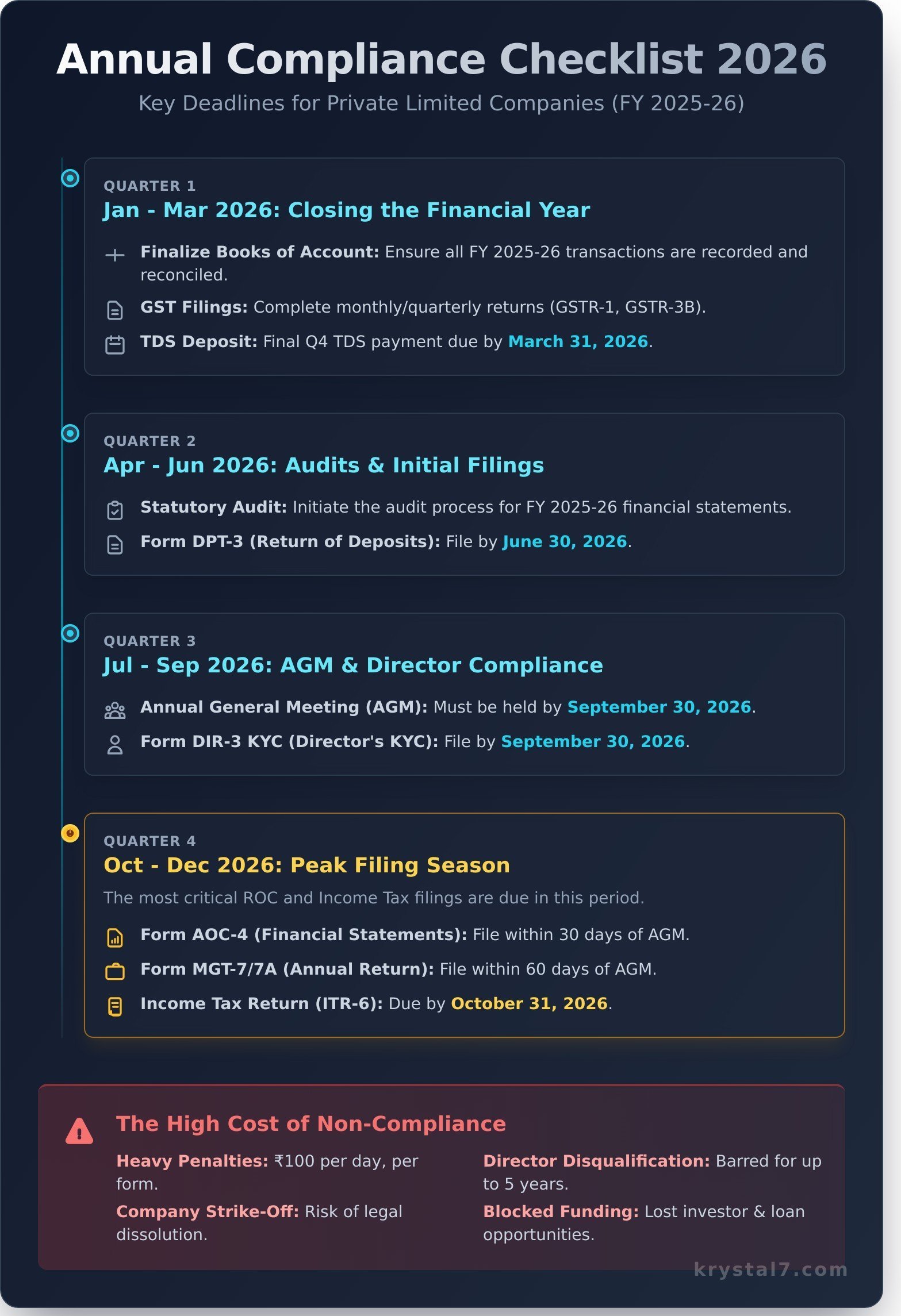
Your 2026 Compliance Calendar: Key Deadlines for FY 2025-26
Navigating the statutory landscape doesn’t have to be a source of stress. This well-structured calendar is your most powerful tool for managing the complete annual compliance for private limited company 2026. Our quarter-by-quarter roadmap integrates both Registrar of Companies (ROC) and Income Tax deadlines, providing the clarity you need to stay ahead and avoid penalties. Think of this as your high-level guide to a hassle-free financial year.
Quarter 1 (Jan – Mar 2026): Closing the Financial Year
The first quarter is dedicated to meticulously closing the books for the financial year 2025-26. This foundational work ensures all subsequent filings are accurate and smooth. It’s also a crucial time to clear any pending tasks from the previous year.
- Finalize Books of Account: Ensure all transactions for FY 2025-26 are recorded and reconciled.
- GST Filings: Timely filing of monthly or quarterly GST returns (GSTR-1, GSTR-3B).
- TDS Deposit: Deposit the final TDS payment for Q4 of FY 2025-26 by March 31, 2026.
Quarter 2 (Apr – Jun 2026): Audits and Initial Filings
As the new financial year begins, the focus shifts to auditing and the first set of annual filings. This period sets the stage for major compliance events later in the year.
- Statutory Audit: Initiate the process of a statutory audit of financial statements for FY 2025-26.
- Form DPT-3 Filing: File the Return of Deposits, detailing any loans or money not considered deposits, by June 30, 2026.
- Issue TDS Certificates: Distribute TDS certificates (like Form 16/16A) for the previous financial year.
Quarter 3 (Jul – Sep 2026): AGM and Financial Reporting
This quarter is pivotal for corporate governance and director-level compliance. The Annual General Meeting (AGM) is the cornerstone event where key financial decisions are formally approved by the shareholders.
- Conduct Annual General Meeting (AGM): The AGM must be held on or before September 30, 2026.
- Approve Financials: The audited financial statements and Director’s Report must be approved at the AGM.
- Form DIR-3 KYC: All directors must complete their annual KYC verification by filing Form DIR-3 KYC by September 30, 2026.
Quarter 4 (Oct – Dec 2026): Major ROC and Tax Filings
The final quarter is the peak season, culminating the entire process for your annual compliance for private limited company 2026. Your company’s most critical documents must be filed with both the ROC and the Income Tax Department, and meeting these deadlines is non-negotiable. Just as other global standards like the UK Government Filing Requirements mandate strict reporting, India’s Companies Act requires the following:
- Form AOC-4: File financial statements with the ROC within 30 days of the AGM.
- Form MGT-7/7A: File the company’s Annual Return with the ROC within 60 days of the AGM.
- Income Tax Return (ITR-6): The due date for filing the company’s ITR is typically October 31, 2026 (subject to official notifications).
Feeling overwhelmed? Let our experts manage your compliance calendar.
Mandatory ROC Filings in 2026: A Detailed Breakdown
Navigating the landscape of statutory filings can feel overwhelming, but it doesn’t have to be. For every private limited company in India, the Ministry of Corporate Affairs (MCA) portal is the official gateway for submitting all mandatory annual compliance documents. Staying on top of these filings is not just a legal requirement; it’s a fundamental part of maintaining your company’s good standing and avoiding significant penalties. This streamlined process ensures transparency and corporate governance, a principle echoed globally-for instance, authorities in the United States uphold similar SEC Annual Reporting Rules to protect stakeholders and ensure market integrity.
Let’s bring crystal clarity to the essential forms that are central to the annual compliance for a private limited company in 2026.
Forms AOC-4 & MGT-7/7A: The Two Pillars of Annual Filing
Think of these two forms as your company’s annual report card to the Registrar of Companies (ROC). They provide a comprehensive snapshot of your financial health and operational structure from the previous financial year.
- Form AOC-4 (Financial Statements): This form contains your company’s audited financial statements, including the Balance Sheet, Profit & Loss Account, and the Auditor’s Report. Its purpose is to declare your financial performance publicly.
Due Date: Within 30 days of your Annual General Meeting (AGM). - Form MGT-7/7A (Annual Return): This form details your company’s corporate structure. It includes information about directors, shareholders, share capital, and board meetings held during the year.
Note: Form MGT-7A is a simplified version for Small Companies and One Person Companies (OPCs), while MGT-7 is for all other private limited companies.
Due Date: Within 60 days of your AGM.
Form DPT-3: Declaration of Deposits
This is a crucial declaration regarding all funds your company has received. Every company (except government companies) must file Form DPT-3 to report both deposits and money received that is exempt from being classified as a deposit. This includes common transactions like loans from directors, other companies, or financial institutions. The goal is complete transparency in your company’s borrowings.
Due Date: On or before June 30, 2026.
Form DIR-3 KYC: Director’s KYC
To ensure the director database is accurate and up-to-date, every individual who holds a Director Identification Number (DIN) must complete an annual KYC verification. This is a simple but non-negotiable step. Failure to file this form on time results in the deactivation of the DIN and a penalty of ₹5,000 once the deadline passes. It’s a straightforward task that prevents significant future hassle.
Due Date: On or before September 30, 2026.
Income Tax & Other Statutory Compliances for 2026
While ROC filings are a cornerstone of corporate governance, they are only one part of the compliance puzzle. A company’s financial health and legal standing depend equally on meticulous tax and statutory adherence. Neglecting these areas can lead to significant penalties and legal challenges, disrupting your business vision. A truly comprehensive plan for annual compliance for a private limited company in 2026 must integrate these critical financial duties for a streamlined, hassle-free year.
Corporate Income Tax Return (Form ITR-6)
Filing your corporate income tax return is a non-negotiable annual requirement. This return, Form ITR-6, is mandatory for all companies other than those claiming exemption under Section 11 of the Income Tax Act. To ensure a smooth filing process, you will need your audited financial statements and, if applicable, the tax audit report. The typical deadline for companies requiring an audit is October 31, 2026. Remember, timely payment of Advance Tax in quarterly installments throughout the year is crucial to avoid interest penalties.
TDS/TCS Filings and GST Returns
Beyond the annual ITR, ongoing tax duties demand constant attention. Your business must diligently manage:
- TDS/TCS Returns: If you deduct or collect tax at source, you must deposit it with the government and file quarterly returns (like Forms 24Q, 26Q, 27EQ).
- GST Returns: Based on your turnover, you must file monthly or quarterly Goods and Services Tax (GST) returns, such as GSTR-1 (for outward supplies) and GSTR-3B (a summary return).
These are not year-end tasks but a continuous cycle that requires immaculate bookkeeping for accuracy and timeliness.
Maintaining Statutory Registers and Records
True compliance goes beyond just submitting forms online; it involves maintaining proper internal records as mandated by the Companies Act, 2013. This proactive record-keeping provides a strong foundation for corporate governance and is essential during any scrutiny or audit. Key registers include:
- Register of Members (Form MGT-1)
- Register of Directors and Key Managerial Personnel (KMP)
- Register of Charges (Form CHG-7)
- Minutes of Board, Committee, and General Meetings
Navigating the full spectrum of the annual compliance for a private limited company in 2026 can feel overwhelming. Let our experts bring Krystal-Clear clarity to your obligations, giving you the freedom to focus on what you do best-growing your business.
Simplifying Your 2026 Compliance: DIY vs. Professional Help
As a business owner, one of the most common questions you’ll face is: “Can I handle the annual compliance myself?” While the desire to manage costs is understandable, it’s crucial to weigh the initial savings against the potential long-term risks and hidden costs. The path you choose will directly impact your time, your company’s financial health, and your own peace of mind.
The DIY Approach: Pros and Potential Pitfalls
Attempting to manage your company’s compliance on your own may seem like a cost-effective solution at first glance. However, this path is fraught with challenges that can quickly outweigh the perceived benefits.
- Significant Time Investment: Navigating the complexities of the Companies Act, 2013, Income Tax Act, and the MCA portal requires dozens of hours of research and execution-time that could be spent growing your business.
- High Risk of Errors: A minor mistake in filing forms like AOC-4 or MGT-7 can lead to rejection, resubmission hassles, and severe penalties. Late filing fees can accumulate at ₹100 per day for each form, turning a small oversight into a significant financial burden.
- Lack of Strategic Guidance: Compliance isn’t just about filing forms. Without professional advice, you miss out on strategic tax planning and corporate governance insights that can save your company money and support its long-term vision.
The Krystal7 Advantage: Clarity and Freedom to Focus
Partnering with a professional firm transforms compliance from a burden into a streamlined, background process. It’s an investment in your business’s stability and your freedom to lead. Choosing Krystal7 for your annual compliance for a private limited company in 2026 offers Krystal-Clear benefits:
- Complete Peace of Mind: Our team of Chartered Accountants and Company Secretaries ensures every filing is accurate and submitted on time, eliminating the risk of penalties and legal complications.
- Reclaim Your Time: We handle the complex paperwork and procedural red tape, giving you back countless hours to focus on what you do best-innovation, strategy, and growth.
- Proactive & Expert Advice: The regulatory landscape is always changing. We keep you ahead of the curve with proactive updates and expert advisory, ensuring you remain 100% compliant.
- A Dedicated Partner: You get a dedicated relationship manager who understands your business and is always just a call away to provide clarity on any query.
Don’t let compliance become a source of stress. Secure your business and empower your vision with an expert partner. View our All-in-One Annual Compliance Packages today.
Achieve Krystal-Clear Compliance and Freedom in 2026
As we’ve detailed, navigating mandatory filings and key deadlines is non-negotiable for your business’s health and reputation. From critical ROC submissions to timely income tax returns, each step on your checklist is a building block for sustainable growth. Ultimately, mastering the annual compliance for private limited company 2026 is not about ticking boxes; it’s about securing your vision and gaining the freedom to focus on what truly matters.
Why navigate this complex landscape alone? At Krystal7, we replace compliance anxiety with absolute clarity. Our team of expert Chartered Accountants and Company Secretaries provides all-in-one, fixed-price compliance packages, supported by a dedicated relationship manager who understands your business. Leave the regulatory burdens to us.
Get Krystal-Clear Compliance. Secure your business for 2026.
Step into the new financial year with confidence, knowing your business is protected and poised for success.
Frequently Asked Questions
What happens if I miss an annual compliance deadline in 2026?
Missing a deadline invites significant penalties from the Ministry of Corporate Affairs (MCA). A daily penalty of ₹100 per form is levied until the filing is complete, and this amount has no upper limit. Beyond financial costs, non-compliance can lead to the company and its directors being marked as defaulters, severely impacting your business’s credibility, loan eligibility, and ability to raise funds. It’s a risk that is simply not worth taking.
Is annual compliance mandatory for a dormant or zero-revenue company?
Yes, absolutely. Statutory compliance is mandatory for every registered private limited company, regardless of its revenue or operational status. Even if your company had zero transactions, you are still legally required to file ‘Nil’ returns with both the Registrar of Companies (ROC) and the Income Tax Department. This ensures your company remains active and avoids the same heavy penalties imposed on non-compliant, operational businesses.
How can I check the compliance status of my private limited company online?
You can gain instant clarity on your company’s status via the official MCA portal. Simply use your Company Identification Number (CIN) to access the ‘View Public Documents’ feature, which shows your filing history for key forms. For a quick overview, the ‘Company Master Data’ service on the portal will display your status as “Active Compliant” or “Active Non-compliant,” giving you a clear snapshot of your standing with the ROC.
What is the difference between Form AOC-4 and Form MGT-7?
Think of them as two distinct but essential parts of your company’s annual report card. Form AOC-4 is purely financial; it contains your company’s audited financial statements, including the Balance Sheet and Profit & Loss Account. In contrast, Form MGT-7 is the Annual Return, which details corporate governance information like shareholding structure, board composition, and changes in directorship throughout the year. Both are mandatory for complete compliance.
How much does professional annual compliance service cost in India?
The cost for professional annual compliance services in India typically ranges from ₹15,000 to ₹35,000 per year. This fee varies based on transaction volume, company turnover, and the scope of services required. A standard package usually includes ROC filings, income tax return filing, and expert advisory. We provide Krystal-Clear pricing upfront, ensuring you receive comprehensive, hassle-free service with no hidden costs, giving you the freedom to focus on growth.
Do I need a separate audit report for ROC and Income Tax filings?
No, a separate audit is not required. The statutory audit conducted as per the Companies Act, 2013, is comprehensive and serves both purposes. The same set of audited financial statements and the accompanying audit report are used for your annual filings with the Registrar of Companies (e.g., Form AOC-4) and for your Income Tax Return. This streamlined process ensures consistency and prevents redundant work, saving you both time and resources.
What are the first compliance steps for a newly incorporated company in 2026?
For a newly formed company, the first few steps are critical. You must appoint the first statutory auditor within 30 days of incorporation. Subsequently, you need to open a corporate bank account and deposit the share subscription money. Finally, a declaration of business commencement must be filed in Form INC-20A within 180 days. Completing these foundational tasks is vital for your ongoing **annual compliance for private limited company 2026** journey.

Article by
Nihal Srivastava
Nihal Srivastava is the Co-Founder of Krystal7 Consultants, helping Indian entrepreneurs and startups navigate company registration, compliance, trademark protection, and regulatory requirements with clarity and confidence. With 6+ years of hands-on expertise in MCA filings, GST compliance, and corporate structuring, Nihal has guided 1000+ businesses across India through their legal and compliance journeys. He believes every business dream deserves crystal clear foundations, and that no founder should be held back by paperwork or red tape.