

How to Create a GST Compliant Invoice in 2026: A Guide for Indian Entrepreneurs
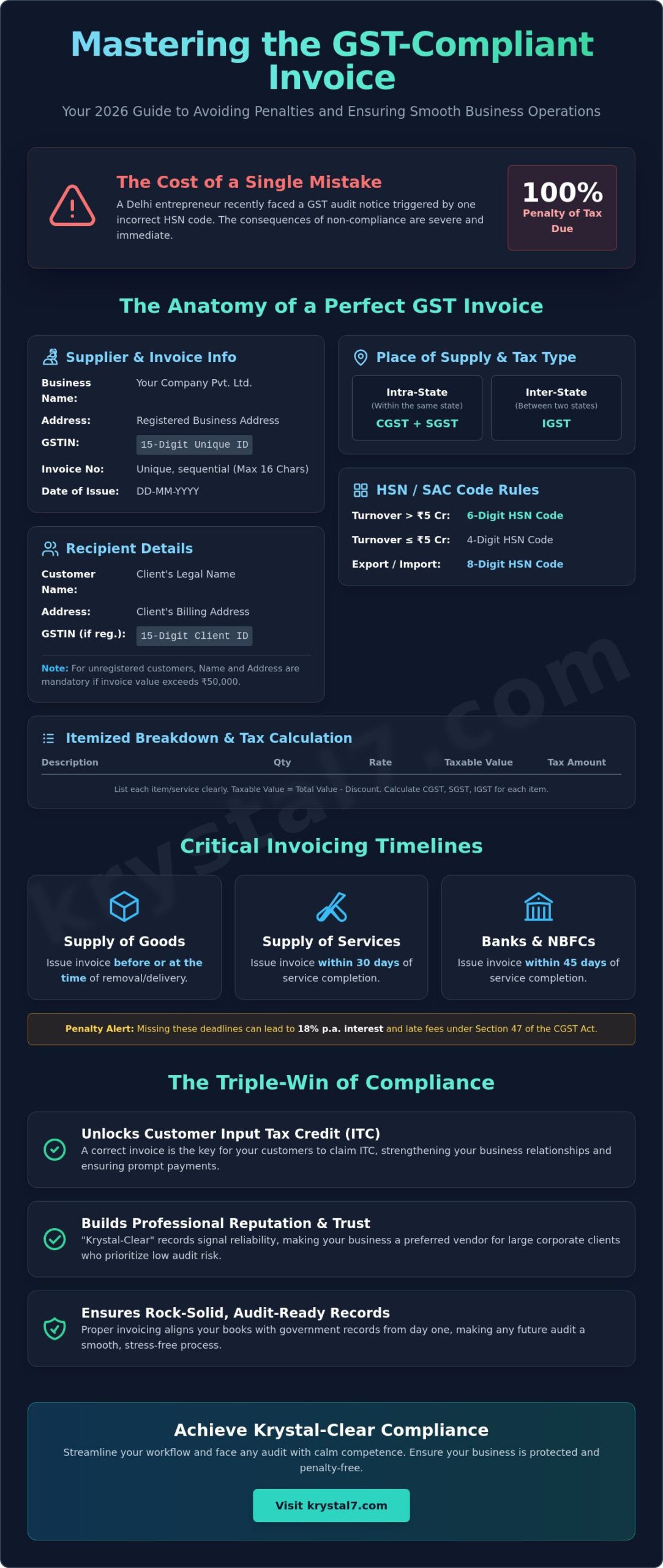
Last Tuesday, a Delhi based entrepreneur discovered that a single incorrect HSN code on a 2024 invoice triggered a GST audit notice involving penalties of up to 100% of the tax due. It’s a nightmare scenario that keeps many founders awake at night. Learning how to create a gst compliant invoice isn’t just about getting paid; it’s about protecting the business you’ve built from avoidable legal friction.
We understand that the constant updates to the GST portal can feel overwhelming, especially when you’re trying to scale your venture. You deserve the freedom to focus on your vision without worrying about whether you’ve calculated CGST and SGST correctly. This guide will help you master the art of GST invoicing to ensure your business remains compliant and penalty-free throughout 2026.
We’ve included a clear checklist for your billing department and a breakdown of how to handle HSN and SAC codes with total confidence. This comprehensive guide provides the clarity you need to streamline your workflow. You’ll soon face any future audit with calm competence.
Key Takeaways
- Understand the legal requirements under Section 31 of the CGST Act to ensure your business documentation remains rock-solid and audit-ready.
- Master how to create a gst compliant invoice by correctly identifying mandatory elements like the 15-digit GSTIN and unique 16-character serial numbers.
- Discover how a precise tax invoice protects your customers’ ability to claim Input Tax Credit (ITC) and strengthens your professional reputation.
- Identify when to issue a Bill of Supply instead of a Tax Invoice and how to correctly handle Reverse Charge Mechanism (RCM) transactions.
- Follow a step-by-step workflow to verify recipient details on the GST portal and determine accurate HSN/SAC codes to eliminate the risk of costly penalties.
Understanding the GST Invoice: Why Compliance is Your Business Foundation
A GST invoice is more than a simple request for payment. Under Section 31 of the CGST Act, 2017, it serves as the primary legal evidence for the supply of goods or services. For a comprehensive overview of GST in India, you must recognize that this document is the backbone of the entire tax chain. It’s the mechanism that allows tax to flow from the supplier to the government while allowing the buyer to claim credit.
Your customers rely on these documents to claim Input Tax Credit (ITC). If your invoice contains errors, their tax credit gets blocked on the GST portal. By 2026, the GSTN has implemented strict automated matching between GSTR-1 and GSTR-2B. This means even a small typo in a GSTIN can lead to financial friction with your clients.
Mastering how to create a gst compliant invoice protects your professional reputation. Large corporate clients specifically look for vendors who maintain “Krystal-Clear” records. It reduces their audit risks and ensures a smooth fund flow. Professional invoicing builds a bridge of trust that helps your business grow into a respected brand.
The Legal Necessity of Proper Invoicing
An incorrect invoice leads to the immediate denial of ITC for your buyer. The GST department has intensified crackdowns on “fake invoicing” using advanced data analytics. Proper invoicing is the very first step in managing annual compliance for private limited company entities. It ensures your books match the government’s records from day one.
Invoicing Deadlines You Must Know
Timing is vital for staying compliant and avoiding penalties. For the supply of goods, you must issue the invoice before or at the time of removal. This ensures the e-way bill and the tax invoice align perfectly during transit.
Service providers have more flexibility but must stay within a 30 day window from the date of service completion. Banks and NBFCs have a slightly longer 45 day period to finalize their documentation. If you miss these deadlines, you may face interest charges of 18% per annum and late fees under Section 47 of the CGST Act. Understanding how to create a gst compliant invoice within these timelines keeps your cash flow healthy and your business safe from litigation.
Mandatory Elements: The Anatomy of a Perfect GST Invoice
Understanding how to create a gst compliant invoice starts with getting the basics right. Every invoice you issue acts as a legal document that ensures your business stays on the right side of the law. You must include your business name, registered address, and your unique 15-digit GSTIN at the top of every document to establish your identity as a taxpayer.
Your invoice identification must follow a specific pattern. It should be a unique, consecutive serial number that doesn’t exceed 16 characters. This number can include alphabets, numerals, or special characters like hyphens and slashes. Proper sequencing helps you track your sales and makes your annual audit much smoother for your accounting team.
Recipient details are equally vital for transparency. If your customer is registered, you need their name, address, and GSTIN. For unregistered customers, you must record their name and address if the transaction value exceeds INR 50,000. Identifying the Place of Supply is the final step in this foundation. This location determines whether you charge IGST for inter-state sales or a combination of CGST and SGST for intra-state transactions.
HSN and SAC Codes Explained
HSN is a globally standardized nomenclature for taxing goods. While HSN codes identify physical products, SAC codes apply to services. By 2026, the government requires businesses with a turnover above INR 5 crores to use 6-digit HSN codes on all B2B and B2C invoices. Smaller ventures can often stick to 4 digits, but 8 digits are mandatory for export and import activities to maintain international standards.
Itemized Breakdown and Tax Calculation
Learning how to create a gst compliant invoice requires careful attention to the difference between total and taxable values. You must list the description of goods, their quantity, and the unit of measure clearly. The taxable value is the amount left after subtracting any discounts from the total value. You can find the specific requirements for these fields in the Official CGST Invoice Rules. Once you have the taxable value, apply the correct GST rate based on the Place of Supply rules to calculate the final tax amount.
The Importance of Digital Signatures
In 2026, the shift toward paperless compliance is almost complete. While physical signatures are still accepted, digital signatures offer more security and faster processing. E-invoicing is now mandatory for businesses with an annual turnover exceeding INR 5 crores. If you fall into this category, your invoice must feature a visible QR code generated from the IRP portal. This code allows authorities to verify your transaction instantly. If you feel overwhelmed by these technical requirements, you can always consult with our experts to streamline your billing process.
Beyond the Standard Invoice: Bill of Supply and Special Cases
Understanding how to create a gst compliant invoice involves more than just listing products and tax rates. Certain business models and transaction types require specific documentation to stay within the legal framework of the GST Act. These variations ensure that the tax department tracks every rupee accurately, whether you’re a small retailer or a global exporter.
Bill of Supply for Composition Dealers
If you’ve opted for the Composition Scheme under Section 10, you cannot charge GST to your customers. Instead of a tax invoice, you must issue a Bill of Supply. This document lacks tax components like CGST or SGST because you pay tax at a fixed rate on your turnover. You’re legally required to mention the heading “Composition taxable person, not eligible to collect tax on supplies” at the top of every bill. Many small retailers forget this when switching from the regular scheme, which can lead to unnecessary scrutiny during audits. It’s a simple step that ensures your business remains transparent and compliant.
Reverse Charge Mechanism (RCM) and Exports
When you receive goods or services from unregistered dealers or specific categories like Goods Transport Agency (GTA) services, RCM applies. Your invoice must clearly state “Tax payable on reverse charge: Yes” to signal that the recipient is responsible for the tax. For entrepreneurs looking at global markets, export invoicing requires extra care. You must include your 16-digit Letter of Undertaking (LUT) number if you’re exporting without paying IGST. Always use the exchange rates notified by the CBIC for currency conversion to avoid discrepancies on the GST portal. This precision provides the crystal clarity needed to manage international trade without legal hiccups.
Debit and Credit Notes: Correcting Errors
Errors happen, but Section 34 of the GST Act provides a structured way to fix them. You’ll use a Credit Note for sales returns or if the invoice value decreases. Conversely, a Debit Note is issued if the taxable value or tax charged was lower than the actual amount. Managing these adjustments effectively gives you the freedom to focus on growth without worrying about future litigation. Key requirements include:
- Time Limit: You must report these notes by November 30th following the end of the financial year or the date of filing the annual return.
- Audit Trail: Every note must link back to the original invoice number to maintain a clear history for tax officers.
- Portal Filing: These must be uploaded in your GSTR-1 return to adjust your tax liability correctly.
Learning how to create a gst compliant invoice for these special cases protects your business from penalties. Whether you’re dealing with RCM or issuing credit notes, keeping your documentation methodical is the best way to thrive in India’s regulatory environment.
Step-by-Step: Creating Your Invoice and Avoiding Costly Penalties
Learning how to create a gst compliant invoice is a vital skill for every Indian founder. It isn’t just about getting paid; it’s about building a transparent paper trail that protects your business from the tax authorities. Follow these five steps to ensure your documentation provides the crystal clarity your business deserves.
- Step 1: Verify the GSTIN: Always check your recipient’s GSTIN on the official GST portal. An inactive or suspended GSTIN means you cannot claim Input Tax Credit (ITC), and your invoice will be flagged during reconciliation.
- Step 2: Assign HSN or SAC Codes: Determine the correct Harmonized System of Nomenclature (HSN) for goods or Service Accounting Code (SAC) for services. Apply the specific tax rate of 5%, 12%, 18%, or 28% as per the current GST schedules.
- Step 3: Generate with Precision: Use compliant accounting software or a strictly formatted manual template. When you understand how to create a gst compliant invoice, you realize that details like your unique invoice serial number and the date of issue are non-negotiable.
- Step 4: Confirm Place of Supply: This determines if you charge IGST for inter-state sales or CGST and SGST for intra-state sales. Mistaking the state of the recipient can lead to wrong tax payments that are difficult to refund.
- Step 5: Secure Digital Delivery: Issue the invoice immediately upon supply. Share it through encrypted digital channels to maintain a reliable audit trail for your annual filings.
Common Invoicing Mistakes to Avoid
Even seasoned entrepreneurs make errors that trigger scrutiny. Using incorrect HSN codes is a frequent slip-up that results in paying the wrong tax amount. Many founders also forget to tick the “Tax Payable on Reverse Charge” box when applicable. Always include the destination state name and its two-digit code for every inter-state transaction to prevent your GSTR-1 from being rejected.
Penalties for Non-Compliance
The cost of negligence is high under the GST Act. According to Section 122, issuing an incorrect or false invoice can attract a penalty of INR 10,000 or the amount of tax evaded, whichever is higher. These errors don’t just cost money; they disrupt your GSTR-1 and GSTR-3B filing accuracy, leading to blocked credits for your clients. Utilizing professional accounting and bookkeeping services ensures these technicalities are handled with elite expertise, giving you the freedom to focus on your vision.
Don’t let compliance hurdles slow down your growth. Connect with Krystal7 Consultants for seamless GST management and ensure your business remains audit-ready at all times.
Achieving Krystal-Clear Compliance: How Krystal7 Streamlines Your Workflow
Krystal7 moves beyond the traditional mindset of just filing forms. We believe compliance is a strategic asset, not a monthly hurdle. Our team of legal strategists and top-tier Chartered Accountants ensures your business stays ahead of regulatory shifts. We provide a dedicated relationship manager who knows your business inside out. This expert acts as your single point of contact, ensuring your invoicing process is audit-ready from day one. You won’t have to worry about how to create a gst compliant invoice every time a new rule is announced.
Your dedicated relationship manager acts as a bridge between your operations and the complex world of Indian tax laws. They monitor your sales data and ensure every transaction aligns with current GST rules. We synchronize your invoicing data with TDS return filings on the TRACES portal and payroll processing. This holistic approach prevents data mismatches that often trigger scrutiny from the Ministry of Corporate Affairs (MCA). By unifying these functions, we reduce your administrative burden significantly. This is our “Freedom to Focus” promise. We manage the complexities of the GST portal and statutory deadlines while you build your legacy.
Our GST Advisory Services
Errors in the sales register lead to approximately 85% of GST notices in India. We conduct regular audits of your registers to catch discrepancies before the department does. For exporters and SEZ units, we handle the entire LUT filing process to ensure zero-rated supplies remain hassle-free. If your business receives a departmental inquiry or notice, our experts represent you directly. We provide the technical defense needed to protect your interests and maintain your reputation.
Clarity You Can Build On
Krystal-clear transparency means you always know what you’re paying for. Our annual compliance packages are designed for predictable budgeting with no hidden costs. Whether you are scaling a private limited company india or managing a growing LLP, our legal strategists provide the stability you need. We aren’t just a service provider; we’re a genuine partner in your growth. Understanding how to create a gst compliant invoice is just the first step in our journey together.
Ready to experience compliance without the stress? Reach out to Krystal7 Consultants today. Contact us at business@krystal7.com or visit krystal7.com to schedule a consultation with our experts.
Future-Proof Your Business With Compliant Billing
Mastering the details of your billing process is the first step toward long term stability. You now understand the mandatory fields required by the CGST Act and why accurate HSN codes are vital for your tax filings. Learning how to create a gst compliant invoice ensures you avoid the 18% interest on late payments and the steep penalties outlined in Section 122.
Don’t let the complexity of tax laws hinder your vision for your startup or SME. Krystal7 brings the elite expertise of Chartered Accountants and Company Secretaries to your doorstep in Gurgaon. We provide Krystal-clear transparency with no hidden costs; a promise trusted by hundreds of businesses across India.
You deserve the freedom to focus on your passion while we handle the statutory red tape. Our team streamlines your workflow and ensures every invoice meets the latest 2026 standards. Don’t let compliance slow down your growth. Contact Krystal7 Consultants today for expert GST advisory and streamlined invoicing solutions. Your business dream deserves the clarity of professional support.
Frequently Asked Questions
Can I issue a handwritten invoice under GST in 2026?
You can issue a handwritten invoice if your annual aggregate turnover stays below the e-invoicing threshold of INR 5 Crores. However, most growing businesses prefer digital formats to ensure they know how to create a gst compliant invoice without manual errors. If you’re required to generate an Invoice Reference Number on the IRP portal, a purely manual invoice won’t meet the legal requirements for 2026.
What is the difference between a Tax Invoice and a Bill of Supply?
You must issue a Tax Invoice when you’re a registered taxpayer selling taxable goods or services to collect tax and pass on Input Tax Credit. Conversely, you’ll use a Bill of Supply if you’re registered under the Composition Scheme or selling GST-exempt items. Since you can’t collect tax on a Bill of Supply, it doesn’t require a detailed tax breakdown, unlike a standard tax invoice.
Is it mandatory to mention the HSN code for all businesses?
HSN codes are mandatory for all B2B and B2C invoices, but the level of detail depends on your previous year’s turnover. If your turnover is up to INR 5 Crores, you must mention a 4-digit HSN code for all B2B transactions. Businesses with turnover exceeding INR 5 Crores must provide a 6-digit HSN code on every invoice to stay compliant with GST Department guidelines.
What happens if I calculate the wrong GST rate on an invoice?
You must issue a Credit Note or Debit Note to rectify any tax rate errors on an invoice already uploaded to the GST portal. If you charged a lower rate, a Debit Note covers the tax gap. If you overcharged, a Credit Note adjusts the liability. Failing to correct these errors can lead to penalties under Section 122 of the CGST Act, including fines of INR 10,000.
Can I revise a GST invoice once it’s been issued and shared?
You can’t technically edit a GST invoice once it’s issued and reported in your GSTR-1 filing. Instead, you must use the amendment facility in the next month’s return or issue a supplementary invoice. Learning how to create a gst compliant invoice correctly the first time saves you from the administrative hassle of managing secondary documents and keeps your business records crystal clear.
How long do I need to keep copies of my GST invoices for audit purposes?
You’re required to maintain all GST records and invoices for 72 months from the due date of filing the relevant Annual Return. For the 2025-26 financial year, this retention period effectively starts from December 31, 2026. Keep these documents at your principal place of business as defined in your GST registration certificate to ensure you’re prepared for any departmental audits or scrutiny.
Do I need a separate series for export invoices and domestic invoices?
While the GST law doesn’t strictly mandate a separate series, maintaining one for export invoices helps in streamlined tracking of refund claims. Each invoice number must be unique, consecutive, and contain only alphanumeric characters or special characters like hyphens. A dedicated series for exports makes it easier to manage shipping bills and Foreign Inward Remittance Certificates during your annual compliance reviews.
Is a signature always required on a GST invoice if it’s digitally generated?
A physical signature isn’t required if the invoice is digitally signed using a Digital Signature Certificate or an Electronic Verification Code. Rule 46 of the CGST Rules allows for these digital alternatives on computer-generated documents. This feature provides the clarity you need to automate your billing process while ensuring every document remains legally valid for your customers and the GST authorities.

Article by
Nihal Srivastava
Nihal Srivastava is the Co-Founder of Krystal7 Consultants, helping Indian entrepreneurs and startups navigate company registration, compliance, trademark protection, and regulatory requirements with clarity and confidence. With 6+ years of hands-on expertise in MCA filings, GST compliance, and corporate structuring, Nihal has guided 1000+ businesses across India through their legal and compliance journeys. He believes every business dream deserves crystal clear foundations, and that no founder should be held back by paperwork or red tape.