

Understanding HSN Codes for Services: A Guide to SAC and GST Compliance in 2026
What if a minor digit error on your invoice triggered an automated GST scrutiny notice? For many Indian founders, the line between an HSN and a SAC code feels like a legal maze that risks their hard-earned Input Tax Credit. Understanding hsn codes for services isn’t just a technicality; it’s a critical step to protect your business from the 18% interest penalties associated with incorrect tax filings.
You’ve worked hard to build your venture, and you shouldn’t have to lose sleep over technical terminology or shifting 2026 compliance mandates. We promise to give you the crystal clarity needed to classify your service offerings accurately and claim every rupee of ITC you’re entitled to. This ensures your invoicing remains seamless and your relationship with the GST department stays positive.
This guide provides a clear roadmap for mastering service classification under the latest GST portal updates. You’ll learn the exact differences between HSN and SAC, see practical examples for Indian LLPs and Private Limited companies, and discover how to automate your compliance workflow for total peace of mind. We’ll handle the complexity so you can enjoy the freedom to focus on your growth.
Key Takeaways
- Learn how to differentiate between global HSN standards and India’s specific Service Accounting Codes (SAC) to ensure your business remains compliant with the latest GST norms.
- Gain clarity on the 6-digit SAC structure and how correctly identifying the “99” prefix is the first step toward understanding hsn codes for services for accurate tax calculation.
- Prepare for 2026 mandatory disclosure rules by identifying whether your annual turnover requires 4-digit or 6-digit SAC codes on every tax invoice.
- Protect your cash flow by mastering service classification to prevent rejected Input Tax Credit (ITC) claims and avoid costly penalties from the GST department.
- Discover how a dedicated relationship with Krystal7 Consultants replaces compliance guesswork with expert-led precision, giving you the freedom to focus on your business growth.
Introduction to Understanding HSN Codes for Services in India
Every business dream starts with a vision, but the clarity of your compliance keeps that vision alive. When you launch a venture in India, you’ll immediately encounter the term HSN. The Harmonized System of Nomenclature (HSN) acts as a global language for classifying goods. It allows tax authorities and customs officials to identify products through a standardized numerical string. However, if your business provides expertise or digital solutions rather than physical products, the terminology shifts slightly.
Understanding hsn codes for services is a vital step for any modern entrepreneur. Technically, India uses the Services Accounting Code (SAC) to classify services under the GST regime. Even though SAC is the formal label, many professionals and government portals use “HSN for services” as a catch-all phrase. The GST Council and the Central Board of Indirect Taxes and Customs (CBIC) maintain these classifications to ensure every transaction is taxed fairly. They update these codes regularly to keep pace with the evolving economy of 2026.
SAC vs HSN: Clearing the Confusion
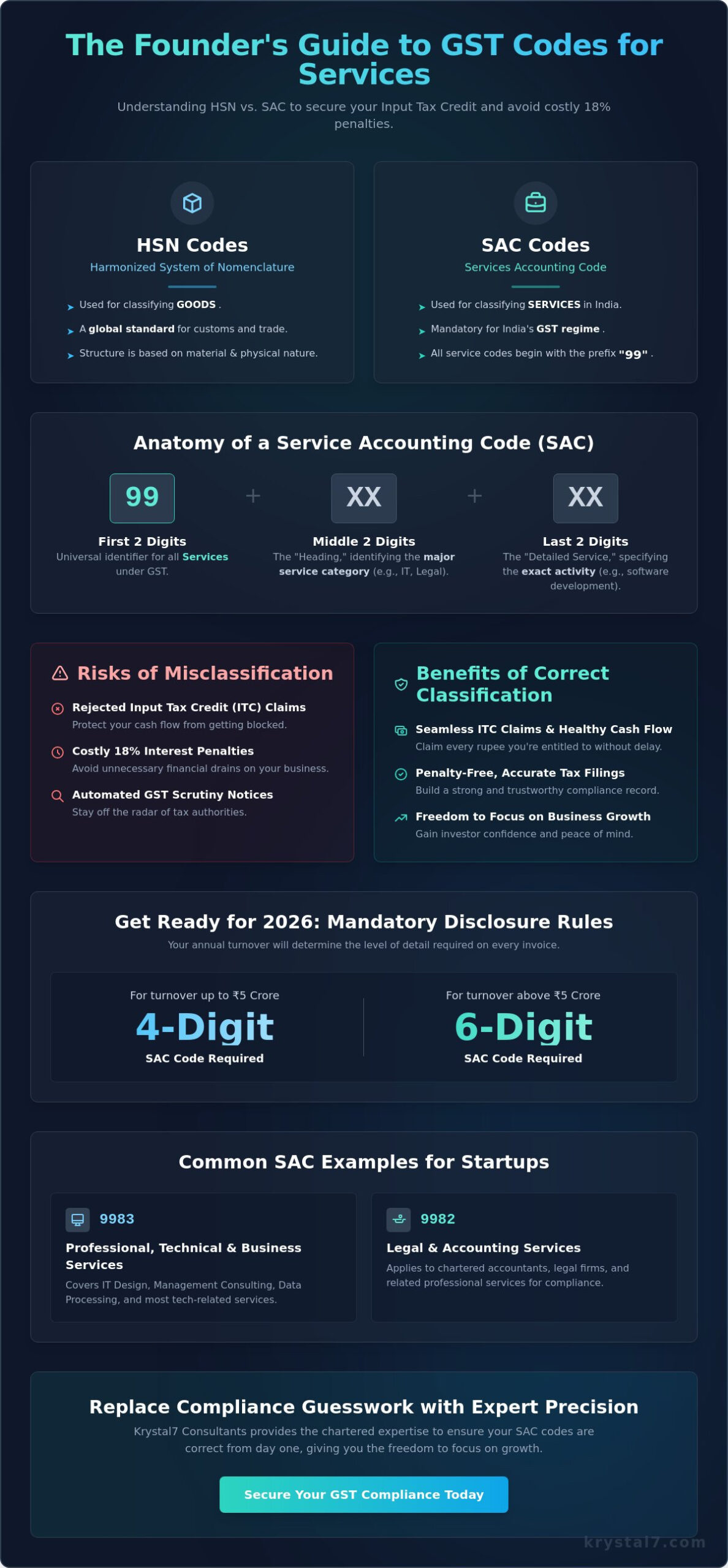
The distinction between goods and services is clear once you look at the numbers. All service codes in India strictly start with the digit 99. This prefix tells the GST portal that you’re billing for a service rather than a physical item. In contrast, HSN codes for goods are based on material composition and physical nature. While you might hear colleagues use the terms interchangeably, your invoices must strictly follow the SAC framework. Using the 99-series prefix ensures your tax filings remain accurate and your business stays clear of red tape.
Why Proper Classification Matters for New Founders
Your journey toward compliance starts earlier than you might think. Proper classification often begins during company registration in India. Selecting the right code at the start prevents massive headaches later. If you misclassify your service, you might apply the wrong GST rate. Most services fall into the 18% bracket, but others might attract 5%, 12%, or 28% depending on their nature.
Accuracy isn’t just about avoiding penalties; it’s about building a trustworthy brand legacy. When your tax structures are transparent, you gain the freedom to focus on your core passion. Investors and partners look for this level of meticulous detail when evaluating a startup. Krystal7 provides the chartered expertise you need to ensure your SAC codes are correct from your very first invoice. We handle the complexity so you can thrive without guesswork.
If you need expert guidance on classifying your business activities or managing your GST filings, contact Krystal7 Consultants at business@krystal7.com or visit krystal7.com for professional assistance.
The Anatomy of a Service Accounting Code (SAC)
Mastering the structure of a Service Accounting Code (SAC) is the foundation of GST compliance. While goods use HSN, services follow this specific 6-digit system. Understanding hsn codes for services requires a clear breakdown of how the Indian government categorizes every professional activity. This numerical logic ensures that your tax invoices are transparent and legally sound.
Every SAC follows a predictable 6-digit pattern. The first two digits are always 99. This prefix acts as a universal identifier for “Services” under the GST regime, distinguishing them from physical goods. You’ll never see a service code starting with any other number. This consistency brings crystal clarity to your accounting records from the very first digit.
The middle two digits represent the “Heading.” This part of the code identifies the broad service group or industry sector your business belongs to. For instance, it might signal that you operate in the IT sector or the hospitality industry. The final two digits provide the “Detailed Service” description. These digits narrow down your specific activity, such as software development or room rentals, ensuring the correct GST rate is applied to your turnover.
Common SAC Examples for Indian Startups
- SAC 9983: This code covers Professional, Technical, and Business services. It’s the go-to for startups offering management consulting, IT design, or data processing.
- SAC 9982: This identifier is for Legal and Accounting services. It applies to firms providing statutory audits, bookkeeping, or legal representation in Indian courts.
- SAC 9987: This group includes Maintenance, Repair, and Installation services. It’s essential for hardware startups or businesses managing office infrastructure.
How to Read the GST Tariff for Services
The Central Board of Indirect Taxes and Customs (CBIC) provides the definitive tariff for these classifications. You can access the official GST portal to search for the most current codes. Don’t pick “Miscellaneous” or “Other” codes just because they seem convenient. This often triggers scrutiny from tax officers during departmental audits. By understanding hsn codes for services, you avoid the common trap of misclassification.
Always align your SAC with the specific scope of work defined in your business contracts. If your contract says “Strategic Advisory” but you use a code for “Data Entry,” you risk a compliance mismatch. Precision here gives you the freedom to focus on growth without worrying about future tax demands. If you’re unsure about your specific classification, getting expert GST advice ensures your setup is right from day one. Accuracy is your best defense against the red tape of tax litigation.
Practical Application: Invoicing and GST Returns
Accurate invoicing is the heartbeat of your business compliance. Every tax invoice you issue must clearly mention the Service Accounting Code (SAC) to remain valid under Indian law. Understanding hsn codes for services ensures you don’t just list a service description but provide the specific numerical identity recognized by the GST portal. This transparency protects you during audits and builds trust with your corporate clients.
The SAC directly dictates how you calculate taxes. Once you identify the correct code, the GST rate, whether it’s 5%, 12%, 18%, or 28%, becomes fixed. If you provide services within your state, the SAC helps you split the tax into CGST and SGST. For interstate transactions, it defines the IGST liability. Mistyping a code or choosing a similar but incorrect one can lead to applying the wrong tax percentage, creating a financial liability you didn’t plan for.
When it’s time to file your GSTR-1, the GST portal requires an HSN/SAC summary. You must enter the total taxable value and the total tax collected for each SAC used during the month. This filing must happen by the 11th of the following month for monthly filers. Consistency is vital here. If the SAC on your physical invoice differs from what you enter in your GSTR-1, the system may flag your return for scrutiny. Keeping these records synchronized gives you the freedom to focus on growing your venture rather than fixing clerical errors.
The Financial Risk of Wrong Classification
Selecting the wrong SAC creates a ripple effect of compliance hurdles. If you accidentally use a code with a 12% rate when your service actually falls under an 18% bracket, the GST department views this as a “short payment” of tax. Under Section 122 of the CGST Act, 2017, issuing an incorrect invoice can attract a penalty of INR 10,000 or the amount of tax evaded, whichever is higher. These notices often arrive months later with added interest, putting a strain on your cash flow.
Input Tax Credit (ITC) and SAC Codes
Your SAC choice affects your client’s bottom line as much as yours. If your classification is incorrect, your B2B clients might find that the tax they paid to you doesn’t appear correctly in their GSTR-2B statement. This prevents them from claiming Input Tax Credit. For instance, on a professional service invoice of INR 1,00,000, the 18% GST amounts to INR 18,000. If the client cannot claim this INR 18,000 because of your SAC error, it becomes a direct cost to them. Regular reconciliation and understanding hsn codes for services ensure these credits remain Krystal-Clear for everyone involved. We recommend verifying your codes every quarter to stay aligned with any updated government notifications.
Mandatory Disclosure Rules and Turnover Limits in 2026
The GST department has tightened the rules for reporting service codes to ensure better tax tracking. Your reporting obligations for 2026 depend strictly on your aggregate turnover from the previous financial year. If your turnover is up to INR 5 crores, you must mention at least a 4-digit SAC on all tax invoices. This requirement ensures that small and medium enterprises provide a baseline level of classification for their service offerings.
For businesses with an aggregate turnover exceeding INR 5 crores, the stakes are higher. You’re required to use 6-digit codes for every service transaction. This added detail helps the government monitor high-value service sectors with precision. Understanding hsn codes for services is no longer optional; it’s a vital part of your monthly filing routine that prevents mismatches during department audits.
Specific rules apply to international trade regardless of your domestic turnover. Any export or import of services requires a full 8-digit code. This level of granularity is necessary for global trade alignment and ensures your shipping bills or service contracts meet international standards. Accuracy here is critical for claiming GST refunds on exports or managing Reverse Charge Mechanism (RCM) liabilities on imports.
Ignoring these disclosure rules leads to financial setbacks. Under Section 125 of the CGST Act, the government can impose a general penalty of up to INR 25,000 for incorrect invoicing. Since this penalty can apply to each instance of non-compliance, a recurring error in your SAC reporting can lead to substantial accumulated fines. Most entrepreneurs find that professional oversight is the best way to maintain the freedom to focus on growth while staying compliant.
Calculating Aggregate Turnover for Compliance
Aggregate turnover isn’t just your taxable sales. It includes the total value of all taxable supplies, exempt supplies, and exports made under a single PAN across India. You can easily verify your previous financial year’s turnover by logging into the GST portal and checking the “Taxpayer Dashboard.” We recommend that your annual compliance for private limited companies includes a formal turnover verification step to avoid using the wrong digit count in your invoices.
Specific Rules for B2C vs B2B Invoicing
B2B invoices require absolute precision because they facilitate the flow of Input Tax Credit (ITC). If you provide an incorrect SAC, your client’s ITC may be blocked or flagged in their GSTR-2B, damaging your business relationships. For B2C transactions, while the rules allow for some flexibility for very small taxpayers, 2026 e-invoicing mandates now trigger automatic code validation. If your turnover exceeds INR 5 crores, the IRP portal will reject invoices that contain invalid or non-existent service codes.
Need help identifying the right SAC for your business model? Speak with our GST experts at Krystal7 to streamline your compliance today.
Navigating GST Compliance with Krystal7 Consultants
Managing tax compliance shouldn’t feel like a second job for an entrepreneur. At Krystal7, we remove the guesswork from your daily operations by providing crystal clarity on SAC and GST requirements. Understanding hsn codes for services is often the first major hurdle for new startups and LLPs. Our team ensures you don’t misclassify a consulting fee as a management service, which could lead to audit flags or tax demand notices in 2026. We use a Dedicated Relationship model where your assigned advisor learns your business DNA from day one. You get a partner who understands your specific industry nuances rather than a generic helpdesk response.
We believe in the “Freedom to Focus” promise. This means we handle the administrative burden while you pursue your passion and grow your venture. Whether it’s your initial GST registration or responding to a complex inquiry from the tax department, our legal strategists and Chartered Accountants are always just a call away. We bridge the gap between complex statutory requirements and your business goals.
Our Methodical Approach to GST Advisory
We follow a rigorous three-step process to secure your compliance status. First, we perform a deep analysis of your service contracts to identify the most accurate SAC. This prevents the risk of applying the wrong tax rate. Second, we configure your accounting software for seamless invoicing. This step ensures every invoice you issue is legally sound and reflects the correct GST data. Third, we maintain 100% accuracy in your monthly GSTR-1 and GSTR-3B filings. We monitor the GST portal daily to catch and resolve discrepancies before they escalate into formal notices.
Why Professional Guidance Beats the DIY Approach
The cost of a single filing error often far exceeds the investment in professional CA expertise. Under Section 122 of the CGST Act, the penalty for incorrect invoicing can reach 10,000 INR or the amount of tax involved, whichever is higher. Understanding hsn codes for services requires constant monitoring of government notifications that change frequently. Krystal7 operates with a strict “No Hidden Costs” policy, providing you with upfront pricing and total transparency. By choosing professional advisory, you trade the anxiety of “red tape” for the security of elite expertise.
Don’t let compliance hold your business back. Contact our team at business@krystal7.com or visit krystal7.com to secure your compliance and reclaim your time today.
Secure Your Business Growth with Error-Free SAC Mapping
Navigating the evolving GST landscape requires more than just basic filing. It’s about precision. As we move into 2026, the mandatory disclosure of 6-digit codes for businesses with turnover exceeding INR 5 crores makes accuracy non-negotiable. Understanding hsn codes for services ensures your invoices are legally sound and your input tax credit remains protected. Misclassification often leads to unwanted scrutiny from the GST department. Getting your Service Accounting Codes right from the start is essential for long-term stability and avoiding heavy penalties.
Krystal7 Consultants provides the clarity you need to stay ahead of these regulatory shifts. Our elite team of CAs and Legal Strategists works alongside you to eliminate guesswork and streamline your filing process. We believe in total transparency with no hidden costs; you’ll always know exactly what you’re paying for. Every client receives a Dedicated Relationship Manager who understands your specific business vision and operational needs inside out.
Ready to bring clarity to your compliance? Contact Krystal7 Consultants for expert GST advisory
Your business deserves the freedom to grow without the weight of administrative doubt. We’re here to turn your compliance hurdles into a foundation for future success.
Frequently Asked Questions
What is the difference between HSN and SAC codes for services?
HSN stands for Harmonized System of Nomenclature and applies to goods, while SAC refers to Services Accounting Code used specifically for identifying services. Both systems are managed by the CBIC to ensure uniform taxation across India. Understanding hsn codes for services involves identifying the correct 6 digit SAC from the official GST classification list to ensure your business stays compliant.
Is it mandatory to mention the HSN/SAC code on a GST invoice in 2026?
Yes, mentioning the code is compulsory for all taxpayers as per Notification No. 78/2020 Central Tax. For the 2026 fiscal year, businesses with an aggregate turnover above INR 5 crores must use 6 digit codes on all invoices. Businesses with turnover up to INR 5 crores are required to mention at least 4 digit codes for all B2B transactions.
How many digits of SAC code are required for a business with 2 crore turnover?
A business with an annual turnover of INR 2 crores must provide a minimum of 4 digits for its SAC codes on B2B invoices. While the 4 digit limit is the legal minimum for this turnover bracket, you can choose to use 6 digits for better clarity. This practice helps your clients claim Input Tax Credit without facing technical queries from the GST portal.
Can I change the SAC code once I have started filing GST returns?
You can’t change a code on a return that’s already been filed, but you can adopt the correct code for all future invoices and filings. If you discover an error in a previous filing, it’s best to issue a credit note or debit note to rectify the specific invoice. Consistently using the correct classification is essential for maintaining a clean compliance record with the tax department.
What happens if I use the wrong SAC code on my invoice?
Using an incorrect code can attract a general penalty of up to INR 25,000 under Section 125 of the CGST Act. Inaccurate codes also cause mismatches in the GSTR 2B of your clients, which prevents them from claiming their rightful Input Tax Credit. Such errors often lead to automated scrutiny notices from the GST department’s risk management system.
Where can I find the latest list of SAC codes for 2026?
The most reliable source for the latest SAC codes is the official GST Council portal or the CBIC website. You should refer to the Scheme of Classification of Services which is updated periodically through government notifications. For 2026 compliance, always verify your codes against the latest version of Notification No. 11/2017 Central Tax (Rate) to account for any recent amendments.
Do freelancers in India need to use SAC codes?
Freelancers registered under GST must use SAC codes on their invoices to categorize their professional services. Even if your annual revenue is below the INR 5 crore threshold, providing a 4 digit code is necessary for your corporate clients to process payments and claim tax credits. Understanding hsn codes for services allows freelancers to professionally document their work for audit purposes.
Are SAC codes different for export of services?
The SAC codes remain identical for both domestic and export services, though the tax treatment differs under the IGST Act. When you export services, you must use the 6 digit SAC on your invoice to qualify for “Zero Rated Supply” benefits. This accuracy is vital when you apply for GST refunds or file a Letter of Undertaking through the GST portal.
For expert guidance on GST compliance and classification, contact Krystal7 Consultants at business@krystal7.com or visit krystal7.com to speak with our advisory team.

Article by
Nihal Srivastava
Nihal Srivastava is the Co-Founder of Krystal7 Consultants, helping Indian entrepreneurs and startups navigate company registration, compliance, trademark protection, and regulatory requirements with clarity and confidence. With 6+ years of hands-on expertise in MCA filings, GST compliance, and corporate structuring, Nihal has guided 1000+ businesses across India through their legal and compliance journeys. He believes every business dream deserves crystal clear foundations, and that no founder should be held back by paperwork or red tape.