

Filing Form MGT-7 Annual Return: A Complete Guide for Indian Business Owners (2026)
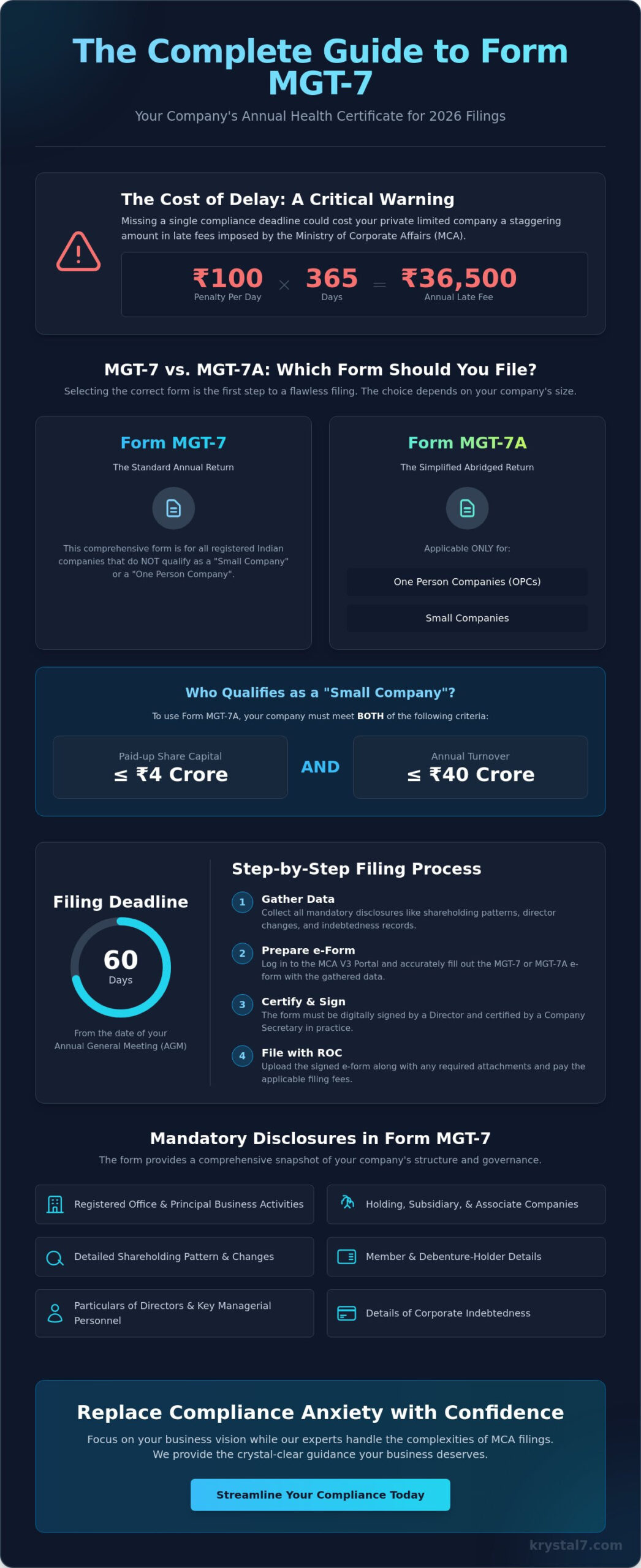
Did you know that missing a single compliance deadline could cost your private limited company ₹36,500 in late fees over just one year? The Ministry of Corporate Affairs (MCA) imposes a strict penalty of ₹100 per day for delays, making filing form mgt-7 annual return a high-stakes task for every Indian director.
We understand that the weeks following your Annual General Meeting (AGM) often feel more like a race against red tape than a celebration of your business milestones. It’s common to feel confused by the complex requirements of the Companies Act, but you don’t have to tackle the MCA portal alone. Our krystal-clear guide is designed to replace your compliance anxiety with the confidence of an expert.
You’ll master the entire process, from gathering shareholding data to meeting the 60-day deadline with ease. We’ll also clarify the important distinctions between MGT-7 and the simplified MGT-7A for small companies to ensure your 2026 filing is flawless.
Key Takeaways
- Understand why Form MGT-7 serves as your company’s essential annual health certificate under the Companies Act, 2013.
- Navigate the legal requirements of Section 92 to ensure your business profile is reported accurately to the Registrar of Companies.
- Learn the exact step-by-step process for filing form mgt-7 annual return using the latest e-forms on the MCA V3 portal.
- Stay ahead of strict 2026 deadlines and avoid costly penalties by mastering the 60-day filing window following your Annual General Meeting.
- Discover how professional compliance management provides the clarity and freedom to focus on scaling your business vision.
Understanding Form MGT-7: The Annual Health Certificate for Indian Companies
Every registered company in India carries a legal obligation to provide a snapshot of its operations to the government. Form MGT-7 serves as this essential electronic document. It’s often called the “Annual Health Certificate” because it summarizes your company’s legal and structural status at the close of the financial year. Under the Companies Act, 2013, this filing isn’t optional. It’s a mandatory step for maintaining your company’s active status on the Ministry of Corporate Affairs (MCA) portal.
When you’re filing form mgt-7 annual return, you’re providing the Registrar of Companies (ROC) with a transparent view of your business. This data becomes part of the public record. It ensures that stakeholders, from vendors to potential investors, can verify that your company is compliant and legitimate. Timely filing form mgt-7 annual return is a non-negotiable statutory requirement for every registered Indian company, regardless of turnover or activity level.
The Purpose and Objective of the Annual Return
While financial statements focus on profits and losses, the annual return tracks the DNA of your organization. It records changes in shareholding patterns, shifts in management, and details of corporate indebtedness. Don’t confuse this with Form AOC-4. While AOC-4 deals with your balance sheet and financial health, MGT-7 focuses strictly on compliance and governance. Maintaining a clean filing history builds immense trust with banks and financial institutions. It gives them the clarity they need to approve your credit lines or business loans.
MGT-7 vs. MGT-7A: Which One Should You File?
The 2021 amendment introduced Form MGT-7A to simplify life for smaller entities. This abridged version is specifically for One Person Companies (OPCs) and Small Companies. To qualify as a “Small Company” under the latest Indian regulations, your paid-up capital must not exceed INR 4 crore and your annual turnover must stay below INR 40 crore. Both conditions must be met to use the simplified form. Selecting the wrong form on the MCA portal leads to immediate filing rejection. This guesswork often results in late fees and compliance red tape that we help our clients avoid.
At Krystal7, we believe in giving you the freedom to focus on your vision while we handle the complexity of the ROC. Our experts ensure your data is meticulously organized, providing the crystal-clear transparency your business deserves. If you’re unsure which category your business falls into, our legal strategists are ready to guide you through the process.
The Legal Framework: Section 92 of the Companies Act, 2013
Section 92 of the Companies Act, 2013, serves as the primary legislative pillar for corporate transparency in India. It mandates that every company must prepare an annual return containing the particulars as they stood on the close of the financial year. This document isn’t merely a formality; it’s a comprehensive snapshot of your company’s operational and financial structure provided to the Ministry of Corporate Affairs.
The law requires every registered entity to file this return in the prescribed format. For most companies, this means filing form mgt-7 annual return within 60 days of holding the Annual General Meeting (AGM). This statutory requirement ensures that the government and stakeholders have access to updated information regarding the company’s management and ownership.
Compliance under Section 92 is rigorous. The Company Secretary (CS) plays a vital role here, acting as the bridge between the company and the regulator. They ensure that every data point, from shareholding shifts to directorship changes, is recorded with precision. This meticulous approach helps business owners maintain a clean compliance record and avoid heavy penalties.
Mandatory Disclosures in Form MGT-7
Form MGT-7 requires a deep dive into your company’s records. You must disclose your registered office address, principal business activities, and particulars of any holding, subsidiary, or associate companies. This transparency helps the MCA track corporate structures across the Indian economy.
The form also demands a detailed shareholding pattern. You must list details of members and debenture-holders, along with any transfers or changes that occurred since the last financial year. These disclosures are part of the broader Annual Compliance for Private Limited Company framework that keeps your business in good standing.
If you find these requirements overwhelming, our team at Krystal7 can provide the crystal-clear guidance needed to streamline your filing process.
Certification and Signing Authority
Signing authority for the annual return is strictly regulated. Generally, a Director and the Company Secretary must sign the form. If the company doesn’t have a whole-time CS, a practicing Company Secretary must sign it to verify the details.
Specific thresholds trigger additional layers of scrutiny. For instance, companies with a paid-up share capital of INR 10 Crore or more, or a turnover of INR 50 Crore or more, require a practicing CS to certify the return in Form MGT-8. Certification is the professional verification of the form’s contents against company records to ensure absolute accuracy.
Properly filing form mgt-7 annual return involves confirming that the company has disclosed all necessary facts. This professional oversight protects directors from liability and ensures the business remains empowered to focus on its long-term vision. Our experts handle these complexities so you can stay dedicated to your business growth.
Step-by-Step Guide to Filing Form MGT-7 Annual Return
Completing your annual compliance doesn’t have to be a stressful experience for your leadership team. The Ministry of Corporate Affairs (MCA) has streamlined the process through its V3 portal to ensure better data accuracy. Successfully filing form mgt-7 annual return requires precision and a methodical approach to avoid heavy late fees that accrue daily.
First, you must download the latest e-form directly from the MCA V3 portal. Don’t use old versions saved on your computer; the portal frequently updates these forms to reflect new legislative changes. Enter your 21-digit Corporate Identification Number (CIN) and click the ‘Pre-fill’ button. This action automatically pulls your company’s basic details from the MCA database, which saves you time and reduces manual entry errors.
You’ll need to enter detailed information regarding board meetings, the remuneration paid to directors, and any shareholding changes that occurred during the financial year. The form requires specific data on the number of meetings held and the attendance of each director. Accuracy here is vital because this data must match your secretarial records and board minutes.
Checklist of Documents and Information Required
- A comprehensive list of shareholders and debenture holders as of the financial year end.
- Specific details of the Annual General Meeting (AGM) date and official attendance records.
- A copy of Form MGT-8, which is a certification required for listed companies or those with a paid-up capital of INR 10 Crores or more.
- Detailed breakdown of the company’s indebtedness and any transfers of shares.
If you’re unsure where to find your CIN or need to verify your company’s official structure before you begin, refer to our Company Registration guide for foundational details. Having these details ready prevents session timeouts on the portal.
Navigating the MCA V3 Portal and Digital Signatures
Every director signing the form must possess a valid Class 3 Digital Signature Certificate (DSC). The MCA V3 portal requires the DSC to be registered against the director’s DIN (Director Identification Number) on the portal before you attempt the upload. Without this registration, the system will reject the signature and the filing will fail.
Before you submit, you must perform a ‘Pre-scrutiny’ check within the form itself. This automated tool identifies missing fields or inconsistent data patterns. If you encounter common errors like “Date of AGM cannot be before the end of the financial year,” double-check your board meeting minutes for accuracy. Once the form passes pre-scrutiny, you can upload it and proceed to the payment gateway. The portal accepts credit cards, net banking, and UPI for paying the statutory filing fees. By following these steps, filing form mgt-7 annual return becomes a routine part of your business growth rather than a compliance hurdle.
Deadlines, Filing Fees, and Penalties for 2026
Missing a compliance deadline can turn a routine administrative task into a significant legal headache. For the 2026 filing cycle, your primary window for filing form mgt-7 annual return is within 60 days from the date of your Annual General Meeting (AGM). Since most Indian companies must hold their AGM by 30th September following the end of the financial year, your compliance calendar usually peaks during October and November.
The Ministry of Corporate Affairs (MCA) sets filing fees based on your company’s nominal share capital. These rates are statutory and must be paid through the MCA V3 portal at the time of submission. Staying aware of these costs helps you manage your compliance budget with crystal clarity.
| Nominal Share Capital (INR) | Normal Filing Fee (INR) |
|---|---|
| Less than 1,00,000 | 200 |
| 1,00,000 to 4,99,999 | 300 |
| 5,00,000 to 24,99,999 | 400 |
| 25,00,000 to 99,99,999 | 500 |
| 1,00,00,000 or more | 600 |
Calculating Your Specific Due Date
Don’t wait until the final week to gather your data. If you hold your AGM on 30th September 2026, your deadline for filing form mgt-7 annual return is 29th November 2026. Many founders fall into the “One-Day Delay” trap by counting two calendar months instead of exactly 60 days. The MCA portal often experiences high traffic during the peak season; filing early ensures you avoid technical glitches that could lead to accidental late fees. Extensions are exceptionally rare and only granted by the government in extreme circumstances.
The High Cost of Non-Compliance
The financial impact of a delay is immediate and compounding. Under the Companies Act, the late fee is a fixed INR 100 per day of delay. This penalty has no upper cap for standard annual filings, meaning a few months of oversight can cost your company thousands. Legal consequences also extend to the company’s leadership. Directors risk disqualification from the board or personal fines if the company fails to file returns for three consecutive years.
A “Defaulting” status on the MCA portal cripples your business growth. You won’t be able to change your registered office, increase share capital, or register new trademarks. Banks and financial institutions check compliance history before approving credit lines, so a single late filing can damage your financial credibility. Our team provides the expertise needed to stay ahead of these dates, giving you the freedom to focus on your business goals.
Ensure your business remains compliant and active. Get expert help with your 2026 annual filings from our legal strategists.
Streamlining Your Compliance with Krystal7 Consultants
Managing statutory requirements doesn’t have to be a source of stress for your leadership team. At Krystal7, we act as your dedicated partner for Krystal-Clear compliance management, ensuring every detail of your company’s legal standing is accurate. When you’re filing form mgt-7 annual return for the 2026 financial year, our experts handle the heavy lifting so you can enjoy the Freedom to Focus on scaling your operations.
Our team consists of seasoned Chartered Accountants and Company Secretaries who bring a meticulous approach to every MCA submission. We ensure your shareholding patterns, director details, and transfer records align perfectly with the Companies Act, 2013. This specialized oversight is a core component of our Annual Compliance Package, which provides a 360-degree safety net for your Private Limited Company or LLP.
Why Founders Choose Krystal7 for MCA Filings
Transparency is the foundation of our relationship with Indian entrepreneurs. We maintain a strict No Hidden Costs policy, providing upfront pricing for all compliance services before any work begins. You’ll never be surprised by unexpected administrative charges or hidden consultation fees halfway through the process.
Every client is paired with a dedicated relationship manager who knows your business inside out. They aren’t just filing papers; they’re understanding your growth trajectory to provide better advisory. We also utilize a proactive alert system to notify you of upcoming deadlines weeks in advance. This ensures your business never pays a late fee to the Ministry of Corporate Affairs again.
Getting Started with Your 2026 Filing Form MGT-7 Annual Return
Our onboarding process is designed to be swift and logical. We begin with a brief consultation to assess your company’s current compliance status and historical filings. After this, we move to document collection and expert review to ensure no data point is missed.
We promise absolute clarity in every legal formality we handle. You’ll receive clear updates at every stage of the filing process. There’s no guesswork involved, just professional execution that protects your company’s reputation. Filing form mgt-7 annual return is the final step in securing your company’s legacy for the year, and we’re here to ensure it’s done right.
Contact Krystal7 Consultants today at business@krystal7.com or visit krystal7.com to secure your business’s future.
Secure Your Company’s Compliance for 2026 and Beyond
Staying compliant with Section 92 of the Companies Act, 2013 isn’t just a legal formality; it’s a vital health check for your business. Missing the 60-day window after your Annual General Meeting leads to mandatory penalties of INR 100 per day. These costs add up quickly and can tarnish your company’s standing on the MCA portal. Proper documentation ensures your business remains attractive to investors and lenders alike.
Filing form mgt-7 annual return requires absolute precision to reflect your shareholding and directorship changes accurately. Our expert team of Chartered Accountants and Company Secretaries at Krystal7 Consultants maintains a zero-penalty track record for our regular compliance clients. We provide transparent, upfront pricing with no hidden charges. This approach gives you the clarity you need to manage your budget effectively while meeting every statutory requirement.
You’ve worked hard to build your vision. Let us handle the complex red tape so you can focus on growing your business with total peace of mind.
Frequently Asked Questions
Is filing form MGT-7 annual return mandatory for a dormant company?
Yes, filing form mgt-7 annual return is mandatory for a dormant company under Section 455 of the Companies Act 2013. You must submit this return to maintain your legal status and keep MCA records updated. This process provides the clarity you need to keep your entity active while you pause operations and plan your next venture.
What is the difference between MGT-7 and MGT-8?
MGT-7 is the annual return filed by all companies, but MGT-8 is a specialized certification report. Companies with a paid-up share capital of INR 10 crore or more, or a turnover of INR 50 crore or more, must obtain MGT-8 from a practicing Company Secretary. This dual requirement ensures higher transparency for larger corporate structures in India.
Can I file MGT-7 without holding an Annual General Meeting (AGM)?
You cannot file the return without providing specific details about your Annual General Meeting (AGM). The form requires you to enter the actual date the meeting occurred or a valid reason for any delay. If you fail to hold an AGM, you’ll face penalties under Section 99 of the Companies Act including fines reaching INR 1,00,000 for the company.
What happens if I make a mistake in the MGT-7 form after filing?
You must file a revised MGT-7 form if you discover a mistake after the initial submission. The MCA portal allows you to upload a fresh version to replace the incorrect data, though you’ll pay the filing fees again. Correcting these errors quickly helps you avoid future compliance red tape and legal disputes.
Who is authorized to sign the MGT-7 form for a Private Limited Company?
A director and a Company Secretary must sign the MGT-7 form for most Private Limited Companies. If your business qualifies as a Small Company under Section 2(85), then a director’s signature alone is sufficient. Our experts help you identify your company’s specific category to ensure your documents meet all legal standards.
How much is the late fee for MGT-7 filing in 2026?
The late fee for filing form mgt-7 annual return in 2026 is INR 100 per day of delay. This penalty starts immediately after the 60-day window from your AGM date expires. There’s no maximum cap on these daily fines, making timely submission vital for your company’s financial health.
Do I need to attach a list of shareholders if there were no changes during the year?
You must attach a complete list of shareholders every year, regardless of whether your ownership structure changed. The MCA uses this attachment to verify your current shareholding pattern and maintain transparency. Providing this documentation ensures your filing process remains streamlined and free from technical rejections that cause unnecessary stress.
Is MGT-7 filing required for a Foreign Subsidiary registered in India?
Every foreign subsidiary registered as an Indian company must file its annual returns just like any domestic firm. The location of your parent company doesn’t excuse you from the statutory requirements of the Companies Act 2013. We provide the elite expertise needed to manage these complex cross-border compliances so you have the freedom to focus on your vision.

Article by
Nihal Srivastava
Nihal Srivastava is the Co-Founder of Krystal7 Consultants, helping Indian entrepreneurs and startups navigate company registration, compliance, trademark protection, and regulatory requirements with clarity and confidence. With 6+ years of hands-on expertise in MCA filings, GST compliance, and corporate structuring, Nihal has guided 1000+ businesses across India through their legal and compliance journeys. He believes every business dream deserves crystal clear foundations, and that no founder should be held back by paperwork or red tape.