

What Happens if I Don’t Do Annual Compliance? Risks, Penalties, and Strike-offs in India
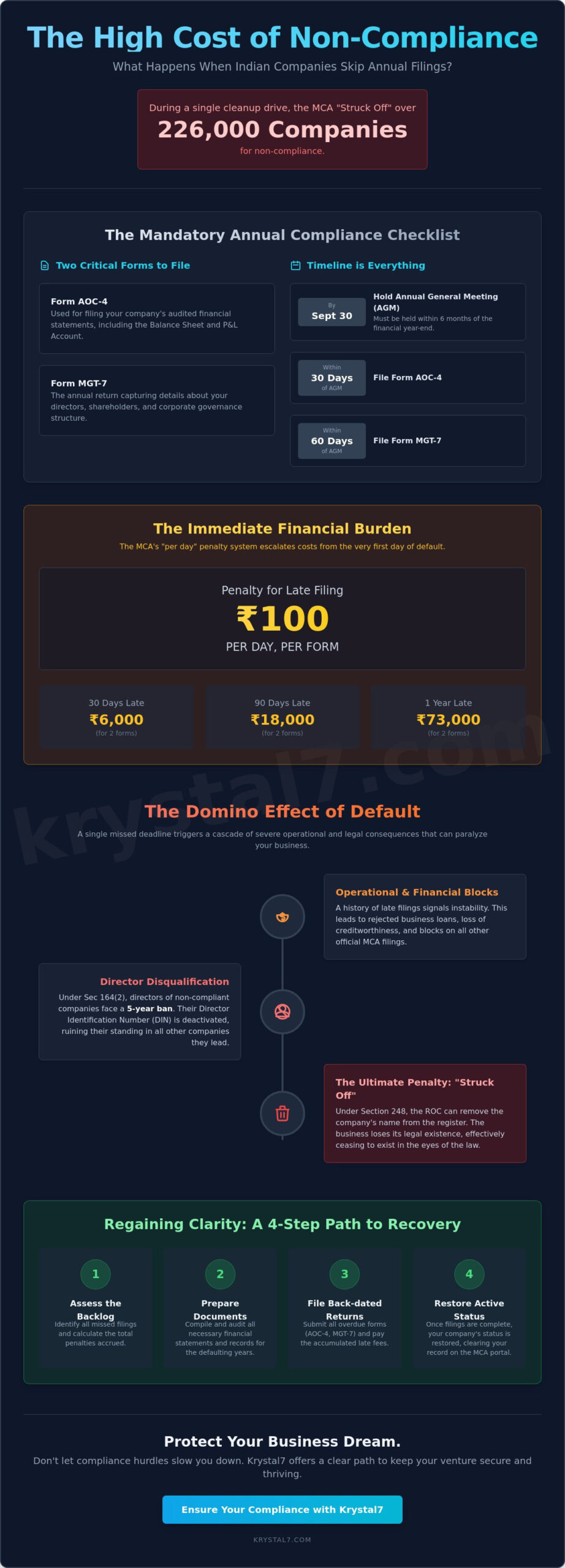
Imagine waking up to a notice from the Ministry of Corporate Affairs stating your company status is “Struck Off” and your Director Identification Number is deactivated. This became a harsh reality for over 226,000 companies during a single cleanup drive by the Registrar of Companies under Section 248. You might be wondering what happens if i don’t do annual compliance while you’re busy scaling your startup. It’s easy to push aside forms like AOC-4 and MGT-7 when you’re focused on growth, but the Ministry of Corporate Affairs doesn’t pause its clock.
We understand that navigating the Companies Act feels like a heavy burden when you just want the freedom to focus on your passion. You’ve invested immense time and capital into your venture, and the last thing you need is a 100 INR per day penalty or a five year ban on your directorship. It’s frustrating to face legal hurdles that feel like they’re designed to slow you down and create unnecessary guesswork.
This article promises to clear the fog by detailing the exact financial and legal consequences of skipping your statutory filings. You’ll discover how to protect your business and find a streamlined path to restore your compliance status. We’ll walk through the specific INR penalties, the risk of strike-offs, and the expert steps to keep your business dream alive and thriving.
Key Takeaways
- Understand the high cost of delay, including the MCA’s “per day” penalty system that causes costs to escalate rapidly from the very first day of default.
- Learn exactly what happens if i don’t do annual compliance, ranging from the deactivation of Director Identification Numbers (DIN) to your company being officially “struck off” the register.
- Discover how Section 164(2) of the Companies Act can trigger a five-year disqualification for directors, creating a “domino effect” that ruins your standing in every other company you lead.
- Protect your business’s reputation and creditworthiness by understanding how non-compliance blocks your access to essential business loans and halts all official filings.
- Find a clear, methodical path to recovery with a step-by-step approach to catching up on back-dated filings and restoring your business to crystal-clear standing.
Understanding Annual Compliance for Indian Companies
Annual compliance is a mandatory statutory requirement for every registered entity in India. It serves as an official health check for your business, ensuring the Ministry of Corporate Affairs (MCA) has an updated record of your operations. Many founders ask what happens if i don’t do annual compliance when their business is in a pre-revenue stage. The law is strict; even “dormant” or “inactive” companies must file their returns to maintain their active status on the MCA portal.
The Registrar of Companies (ROC) acts as the primary regulator under the MCA. They track your company’s life cycle from incorporation to dissolution. Filing your returns is not just a formality; it’s a declaration of transparency to your shareholders and the government. Failure to report your financial status can lead to the “Strike-off” of your company name from the official register.
You’ll primarily deal with two critical forms each year. Form AOC-4 is used for filing your audited financial statements, including the balance sheet and profit and loss account. Form MGT-7 is the annual return that captures details about your directors and shareholders. These forms provide the government with crystal-clear visibility into your corporate governance and financial stability.
The Legal Framework: Companies Act 2013
The Companies Act, 2013 provides the statutory basis for all corporate filings in India. Section 92 governs the filing of annual returns, while Section 137 mandates the submission of financial statements. The law views these requirements as essential for maintaining a trustworthy business environment.
It’s vital to distinguish between tax compliance and statutory compliance. While Income Tax and GST filings deal with your revenue and tax liabilities, ROC compliance focuses on your legal existence. You might have zero tax liability in a year, but you’re still legally obligated to complete your ROC filings. Krystal7 helps you navigate these distinct layers of law, providing the freedom to focus on your core business growth.
Key Deadlines and What Happens if I Don’t Do Annual Compliance
Timing is the most critical factor in avoiding heavy penalties. You must hold an Annual General Meeting (AGM) within six months of the financial year-end, which is usually September 30. This meeting is where shareholders approve the financial results for the year ending March 31. Missing this window triggers immediate financial consequences and legal risks.
- AOC-4 Filing: This must be completed within 30 days of your AGM.
- MGT-7 Filing: This must be submitted within 60 days of your AGM.
- Late Fees: Missing these windows results in a penalty of INR 100 per day per form.
These “Krystal-clear” penalties accumulate quickly and can reach significant amounts if ignored. Beyond the money, late filings tarnish your company’s reputation and make it difficult to secure bank loans or investor funding. Krystal7’s meticulous approach ensures your filings are accurate and submitted well before the deadline, keeping your business dream secure and compliant.
The Financial Burden: Late Fees and Monetary Penalties
Missing a deadline might feel like a minor oversight, but the Ministry of Corporate Affairs (MCA) views it differently. When you ask what happens if i don’t do annual compliance, the first answer is an immediate and compounding financial drain. Unlike private contracts where grace periods are common, Indian statutory bodies use a strict “per day” penalty system that triggers the moment the clock strikes midnight on the due date.
The current statutory late fee for filing forms with the Registrar of Companies (ROC) is ₹100 per day for each individual form. This cost escalates from the very first day of default, leaving no room for error. Over several months, these small daily charges transform into a massive liability that can drain a startup’s working capital.
This financial burden extends beyond the immediate cash outflow. Banks and financial institutions regularly check the MCA portal before approving credit lines. A history of late filings signals operational instability, which often leads to rejected business loan applications or significantly lower credit ratings. Maintaining krystal-clear transparency in your filings is the only way to protect your company’s borrowing power.
Hiring experts for professional compliance management typically costs a fraction of the penalties accrued from a three-month delay. While professional fees are a predictable investment in your company’s growth, government penalties are sunk costs that offer no return. It’s always more cost-effective to pay for expertise than to pay for neglect.
ROC Filing Penalties (AOC-4 and MGT-7)
The two most critical forms for any Private Limited Company are AOC-4 (Financial Statements) and MGT-7 (Annual Return). Under the official text of the Companies Act, 2013, failing to file these results in a ₹100 per day penalty per form. This means a simple delay of one year results in a ₹36,500 penalty for each form, or ₹73,000 total.
For prolonged defaults, the ROC can levy additional ad-hoc penalties. These fines are often directed at both the company and its directors personally. The financial impact of what happens if i don’t do annual compliance can quickly exceed the company’s initial share capital if left unaddressed.
GST and Income Tax Non-Compliance Costs
Non-compliance also severely impacts your tax standing and cash flow. For GST, late filing of GSTR-3B or GSTR-1 attracts daily late fees and interest on the unpaid tax liability. These defaults can lead to the suspension of your GSTIN or the blocking of your Input Tax Credit (ITC), which hurts your buyers and disrupts your entire supply chain.
Income Tax Return (ITR) defaults are equally expensive under the current tax regime. Under Section 234F of the Income Tax Act, late filing fees can reach up to ₹5,000 depending on your total income levels. You can review our annual compliance for private limited company guide for a complete checklist of these specific tax requirements.
Operational Risks: DIN Deactivation and “Strike-Off” Status
Ignoring your statutory obligations leads to more than just financial penalties. It triggers a chain reaction that can paralyze your operations. When you ask what happens if i don’t do annual compliance, the most immediate operational threat is the loss of your legal standing. The Ministry of Corporate Affairs (MCA) monitors every filing. If your company fails to file its financial statements or annual returns for two consecutive years, the Registrar of Companies (ROC) can initiate a “Strike-Off” process.
Deactivation of Director Identification Number (DIN)
Your Director Identification Number is your identity in the corporate world. If you don’t file the DIR-3 KYC form every year by September 30, the MCA will mark your DIN as “Deactivated due to non-filing of KYC.” This status freezes your authority. You won’t be able to sign any digital forms or authorize corporate actions for any company where you hold a directorship. Reactivating a DIN requires a flat government fee of ₹5,000 per director. This creates an unnecessary bottleneck for your entire leadership team and halts your growth momentum.
The Threat of Administrative Dissolution (Strike-Off)
Under Section 248 of the Companies Act, the ROC has the authority to remove companies from the official register if they aren’t carrying out business. A “Strike-Off” is essentially a corporate death sentence. It is the ultimate answer to what happens if i don’t do annual compliance for an extended period. Your company’s bank accounts are frozen by the bank upon receiving notice from the MCA. You lose the right to enter into contracts or defend your business in legal disputes. Maintaining annual compliance for private limited company is the only way to shield your vision from this dissolution.
The damage extends to your brand identity. Once a company is struck off, its name becomes available in the public domain. Another entrepreneur can register your hard-earned brand name immediately. You could lose years of goodwill and market presence in an instant.
Reversing this through the National Company Law Tribunal (NCLT) is a grueling process. It involves heavy legal expenses, multiple hearings, and the payment of all pending penalties and compounded interests. Reinstatement isn’t guaranteed and can take several months or even years. It’s far more efficient to stay compliant than to fight a multi-year battle to bring your company back to life. Krystal7 ensures your filings are precise and timely, giving you the freedom to focus on your business goals without fear of administrative closure.
Impact on Directors: Disqualification and Personal Liability
Compliance isn’t just a corporate obligation; it’s a personal safeguard for you as a leader. When you ask what happens if i don’t do annual compliance, the answer moves beyond company fines to your own legal standing. Under the Companies Act, 2013, the Ministry of Corporate Affairs (MCA) holds directors directly accountable for the company’s transparency and statutory health.
Section 164(2) Explained
The law is strict about consistency. If your company fails to file financial statements or annual returns for three consecutive financial years, you face automatic disqualification under Section 164(2). This isn’t a mere warning. You’re banned from being appointed or re-appointed as a director in any Indian company for five years from the date of default.
- Immediate Vacation: You must immediately step down from all other directorships you hold in other active companies.
- The Five-Year Block: You cannot start a new venture or join a board until the disqualification period ends.
- No Escape: Resigning from a defaulting company won’t shield you from the disqualification triggered by past lapses.
This “Domino Effect” can paralyze your entire professional portfolio. One dormant company you forgot to close can ruin your standing in your primary, successful business. It’s a high price to pay for a simple administrative oversight.
Public Record and Reputation Risk
The MCA maintains a public list of disqualified directors on its official portal. This “blacklisting” creates a permanent mark on your professional legacy. It often leads to rejected bank loan applications, difficulty in opening personal accounts, and even challenges with high-stakes visa applications for business travel. Your “Freedom to Focus” on new dreams disappears when your name is tied to statutory defaults.
Don’t let compliance gaps jeopardize your career. If you’re unsure about your current filing status, our team provides the clarity you need to stay protected. Secure your directorship with Krystal7 compliance advisory.
Beyond the ban, you may face personal liability for the company’s debts. While a Private Limited company usually offers limited liability, the courts can “lift the corporate veil” if they find gross negligence in compliance. This means your personal assets could be used to settle company debts or penalties. It’s a heavy price for avoidable paperwork.
The “Krystal-clear” reality is that your responsibility doesn’t end when you leave a company. You remain liable for any non-compliance that occurred during your tenure. Understanding what happens if i don’t do annual compliance early helps you build a business on a foundation of integrity. We handle the complexity so you can lead with confidence.
Regaining Clarity: How to Restore Compliance and Move Forward
Falling behind on statutory filings creates a heavy cloud of uncertainty for any founder. You might feel overwhelmed by the mounting penalties or the fear of a strike-off notice. However, the path to regularizing your company is structured and manageable. Understanding what happens if i don’t do annual compliance is the first step toward fixing it. Once you recognize the risks, you can take decisive action to restore your company’s standing and reclaim your peace of mind.
The Compliance Restoration Process
Restoring your company status requires a methodical approach to clear the backlog. It’s not just about paying fines; it’s about ensuring every record is accurate and transparent. Follow these steps to regularize your entity:
- Master Data Verification: We begin by conducting a deep dive into your company’s Master Data on the MCA portal. This identifies exactly which years are marked as “defaulting” and which forms, such as AOC-4 or MGT-7, are missing.
- Financial Reconstruction: Our team helps you prepare pending financial statements for all missed years. These documents must undergo a mandatory audit by a Chartered Accountant to ensure they meet the standards of the Companies Act, 2013.
- Filing and Regularization: After the audit, we file the “Krystal-clear” returns on the MCA portal. This process includes paying the statutory late fees, which currently stand at ₹100 per day for each day of delay.
Why Partner with Krystal7 Consultants?
Navigating the MCA portal and government red tape shouldn’t be your full-time job. Our expert team of Company Secretaries and Chartered Accountants provides the technical expertise to handle complex back-dated filings. We move you from a state of compliance anxiety to a state of “Freedom to Focus” on your business growth. We don’t just fix the past; we protect your future with proactive deadline alerts so you never face those ₹100 per day penalties again.
Whether you are running a startup or a growing enterprise, having a solid foundation is vital. You can explore our guide on private limited company india to learn more about long-term growth strategies and maintaining a healthy corporate structure. We believe that every business dream deserves crystal clarity, and we’re here to provide the roadmap.
Don’t let the question of what happens if i don’t do annual compliance keep you up at night. Take the first step toward total transparency and professional security today. Contact Krystal7 Consultants at business@krystal7.com or visit krystal7.com to schedule your compliance audit and restore your business to full health.
Protect Your Business Vision from Compliance Risks
Neglecting MCA filings leads to more than just administrative paperwork. You face daily penalties of INR 100 per form and the severe risk of director disqualification for five years under the Companies Act. Understanding what happens if i don’t do annual compliance is the first step toward safeguarding your entrepreneurial journey.
A strike-off by the Registrar of Companies can freeze your bank accounts and halt operations without warning. Our team of top-tier Chartered Accountants and Company Secretaries has assisted over 500 startups with seamless MCA and ROC filings. We offer transparent, upfront pricing with no hidden costs, giving you the clarity needed to scale.
Taking proactive steps today prevents the heavy financial and legal burden of restoration later. You’ve worked hard to build your brand. Don’t let avoidable red tape jeopardize your progress.
Don’t let compliance hurdles block your vision. Contact Krystal7 Consultants for a Krystal-Clear compliance audit today.
Frequently Asked Questions
Is annual compliance mandatory even if my company has no turnover?
Yes, annual compliance is mandatory for every registered Indian company regardless of its turnover or business activity. Even if your business didn’t trade during the year, you must file “NIL” returns for forms AOC-4 and MGT-7 with the Registrar of Companies. Failing to meet these statutory requirements can lead to heavy penalties and the eventual closure of your company by the MCA.
What is the penalty for late filing of AOC-4 and MGT-7 in 2026?
The penalty for late filing of AOC-4 and MGT-7 is currently INR 100 per day for each form. This fine accumulates daily from the date the deadline passes until the filing is successfully completed. For a single month of delay, a company can face a total penalty of INR 6,000 across both forms, making timely filing essential for your financial health.
Can a director be arrested for non-compliance of company law in India?
Directors can face imprisonment under Section 448 and 447 of the Companies Act if they are found guilty of providing false information or committing fraud. While simple delays in filing usually result in monetary fines, deliberate non-compliance or misrepresentation in statutory documents carries serious legal risks. Maintaining crystal-clear transparency in your filings is the best way to protect your personal reputation and freedom.
How long does it take for a company to be “Struck Off” by the ROC?
The Registrar of Companies (ROC) can initiate the “Struck Off” process if a company fails to file its annual returns for two consecutive financial years. Under Section 248 of the Companies Act, the ROC will issue a notice and provide a 30 day window for the company to respond. If no valid explanation is provided within this period, the company name is removed from the official register.
What happens to the company bank account if the company is struck off?
The company bank account is immediately frozen by the bank once the MCA updates the company status to “Struck Off.” Banks monitor the MCA portal regularly and are legally obligated to stop all transactions for entities that lose their active status. You won’t be able to withdraw funds, pay employees, or settle vendor bills until you obtain a restoration order from the National Company Law Tribunal.
Can I reactivate a disqualified DIN?
You cannot reactivate a disqualified Director Identification Number (DIN) through a simple payment or application. A director remains disqualified for a period of five years under Section 164(2) of the Companies Act unless the disqualification is challenged and stayed by a High Court. This situation perfectly illustrates what happens if i don’t do annual compliance, as it prevents you from being appointed to any other company board during that period.
Is an annual report the same as an Income Tax Return (ITR)?
No, an annual report filed with the MCA is entirely different from an Income Tax Return (ITR) filed with the Income Tax Department. The MCA filings focus on corporate governance and financial transparency, while the ITR (Form ITR-6 for companies) is used to calculate and pay taxes on income. You must complete both sets of filings annually to ensure full compliance with Indian law.
How can I check my company’s current compliance status on the MCA portal?
You can check your status by using the “View Company/LLP Master Data” tool on the official MCA portal. By entering your Corporate Identification Number (CIN), you can instantly see if your company status is “Active,” “Dormant,” or “Struck Off.” Regularly verifying this data gives you the clarity to focus on your business growth without worrying about hidden compliance issues.

Article by
Nihal Srivastava
Nihal Srivastava is the Co-Founder of Krystal7 Consultants, helping Indian entrepreneurs and startups navigate company registration, compliance, trademark protection, and regulatory requirements with clarity and confidence. With 6+ years of hands-on expertise in MCA filings, GST compliance, and corporate structuring, Nihal has guided 1000+ businesses across India through their legal and compliance journeys. He believes every business dream deserves crystal clear foundations, and that no founder should be held back by paperwork or red tape.