

How to Issue Shares in a Private Limited Company: A Krystal-Clear Guide (2026)
What if the simple act of raising capital triggered a mandatory penalty of ₹1,000 per day under Section 42 of the Companies Act 2013? Many Indian founders delay their growth because the distinction between authorized and paid-up capital feels like a riddle. Understanding how to issue shares in a private limited company is the first step to scaling your vision without the shadow of legal risks.
You’ve likely felt the weight of compliance anxiety when facing the complex MCA portal for the first time. This guide provides the crystal-clear roadmap you need to handle every statutory requirement with professional confidence. We’ll ensure you move through the allotment process with the precision of a seasoned Company Secretary.
You’re about to learn the exact steps for Rights Issues and Private Placements, including the critical timelines for filing Form PAS-3 and Form MGT-14. We’ll transform this complex regulatory burden into a streamlined process that gives you the freedom to focus on your business goals.
Key Takeaways
- Understand the critical distinctions between Authorized and Paid-up Share Capital to ensure your MoA and AoA align with your company’s expansion plans.
- Identify whether a Rights Issue under Section 62 or a Private Placement under Section 42 is the most strategic and compliant path for your next funding round.
- Master the exact statutory procedure on how to issue shares in a private limited company, including the mandatory steps for convening Board Meetings and Extraordinary General Meetings.
- Navigate MCA compliance with confidence by learning how to file Form PAS-3 and MGT-14 accurately within the strict 30-day deadline to avoid heavy penalties.
- Discover how to eliminate the stress of administrative red tape by leveraging Krystal7’s expert Company Secretaries to manage your end-to-end share allotment paperwork.
The Fundamentals of Share Issuance in India
Every growth phase in a business requires a clear roadmap for capital. Understanding how to issue shares in a private limited company begins with the Companies Act, 2013. This legislation governs every allotment to ensure transparency and legal compliance for Indian founders and visionaries.
Your company’s foundation rests on the Memorandum of Association (MoA) and the Articles of Association (AoA). These documents define the internal rules and the external boundaries of your corporate structure. A private company limited by shares must strictly follow these documents to maintain its legal standing while bringing in new equity. The AoA specifically outlines the procedure for the transfer and transmission of shares, ensuring directors maintain control over the cap table.
Businesses typically issue shares for three primary reasons:
- Raising capital to fund operational expansion or R&D.
- Implementing Employee Stock Option Plans (ESOPs) under Section 62(1)(b) to retain top talent.
- Bringing in strategic partners who provide industry expertise alongside investment.
Authorized vs. Paid-up Capital: Knowing Your Limits
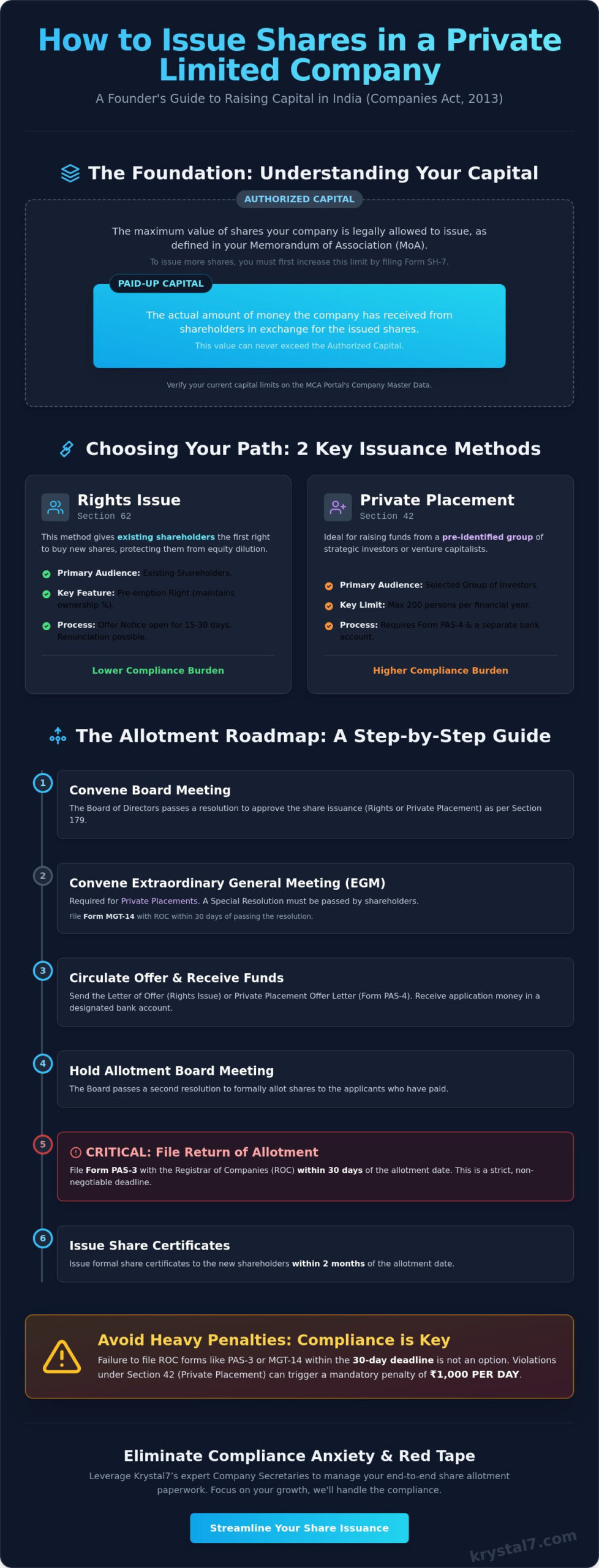
Authorized Capital is the maximum ceiling of share capital your company can issue, as defined in your MoA. If your company was incorporated with an initial capital of INR 1,00,000, you cannot issue shares worth INR 5,00,000 without first filing Form SH-7 to increase this limit. Paid-up Capital is the actual amount of money the company receives from shareholders in exchange for shares.
You can verify your current capital limits by checking the Company Master Data on the MCA portal.
The Role of the Board of Directors in how to issue shares in a private limited company
The Board of Directors acts as the primary authority for initiating any share allotment process. Under Section 179 of the Companies Act, directors must approve the issuance through a formal Board Resolution. This document serves as the first legal step in the allotment journey, and without it, any subsequent filing with the MCA remains invalid.
Directors carry a fiduciary duty to protect existing shareholders from unnecessary equity dilution. They must ensure that the share valuation is fair and that the new issuance aligns with the company’s long-term vision. This methodical approach provides the clarity needed to build a sustainable corporate legacy while giving you the freedom to focus on your core business goals.
Methods of Issuing New Shares: Rights Issue vs. Private Placement
Deciding how to issue shares in a private limited company depends on your funding goals and existing shareholder agreements. The Companies Act, 2013 offers distinct pathways, each with specific compliance milestones. Choosing the wrong method can lead to procedural delays or heavy penalties from the Ministry of Corporate Affairs (MCA).
Understanding Section 62: Rights Issue
Section 62 of the Companies Act governs the Rights Issue. This method respects the “Pre-emption Right” of your current shareholders. It ensures they get the first opportunity to purchase new shares to maintain their current ownership percentage. It’s a fair way to raise capital without diluting the control of founding members unless they choose to opt out.
You must send a formal offer notice to all existing shareholders. This notice must stay open for at least 15 days, though it shouldn’t exceed 30 days. If you need to move faster, you can reduce this period if 90% of the shareholders provide written consent. Shareholders also have the power of renunciation. This allows them to transfer their right to buy the shares to another person, unless your Articles of Association (AoA) prohibit it.
Section 42: The Private Placement Route
Section 42 is the preferred route when you have a specific group of investors ready to fund your vision. Unlike a public offer, a private placement targets a “Selected Group” identified by the Board of Directors. You’re limited to offering shares to a maximum of 200 persons in a single financial year. This limit excludes Qualified Institutional Buyers (QIBs) and employees receiving shares under an ESOP scheme.
The compliance burden for a private placement is higher than a rights issue. You must prepare a Private Placement Offer Letter using Form PAS-4. This document details the company’s financial health and the purpose of the raise. Additionally, you must receive all subscription money through a separate bank account opened specifically for this issue. You cannot use this money until you file the return of allotment with the ROC.
Preferential Allotment: The Hybrid Choice
Preferential Allotment falls under Section 62(1)(c) and is often used to issue shares to specific individuals, such as consultants or strategic partners. This method requires a Special Resolution, meaning at least 75% of your shareholders must approve the move. You must also obtain a valuation report from a Registered Valuer to justify the share price. This ensures transparency and protects the company’s valuation from arbitrary pricing.
Compliance doesn’t end with the allotment of paper certificates. The MCA now emphasizes the dematerialization of shares to increase transparency across the corporate sector. While this was initially for unlisted public companies, private companies are increasingly moving toward digital shareholding to simplify future transfers and audits.
Comparing Timelines and Compliance
Rights issues are generally faster and more cost-effective because they don’t require a valuation report or a separate bank account. Private placements and preferential allotments involve more paperwork, including filing Form PAS-3 within 15 days of the allotment. If you miss this deadline, the company faces a penalty of INR 1,000 for each day the default continues. If you’re unsure which path fits your current growth stage, you can consult our compliance experts to ensure your capital raise stays on the right side of the law. Understanding how to issue shares in a private limited company is the first step toward building a scalable, legally sound business legacy.
Step-by-Step Procedure to Allot Shares in India
Issuing new equity is a transformative milestone for any growing business. To maintain your company’s “Good Standing” status with the Ministry of Corporate Affairs (MCA), you must follow a rigid statutory timeline. Knowing how to issue shares in a private limited company requires a blend of board-level strategy and secretarial precision.
The Pre-Allotment Phase
Your journey begins with a Board Meeting to approve the share issuance proposal. Directors must draft a formal notice for an Extraordinary General Meeting (EGM) that includes a detailed explanatory statement. Under the Companies Act, 2013, you must obtain a valuation report from a Registered Valuer to justify the share price and any premium. Shareholders then meet to pass a Special Resolution, which you must file with the ROC in Form MGT-14 within 30 days of the meeting.
Execution and Fund Management
Transparency is vital during the fund collection stage. You’re required to open a separate bank account specifically for share application money. Indian law strictly prohibits receiving these funds in cash. All transactions must occur through standard banking channels like NEFT, RTGS, or cheques. This ensures a clear audit trail for the authorities and protects your company’s integrity.
Timing is the most critical factor in this phase. Your company must complete the formal allotment of shares within 60 days of receiving the subscription money. If you miss this 60-day window, you must refund the entire amount to the subscribers within 15 days. Failure to refund on time triggers a heavy interest penalty of 12% per annum starting from the expiry of the 60th day.
- Board Resolution: Once funds are cleared, convene a second Board Meeting to pass the formal Allotment Resolution.
- Filing Form PAS-3: File the Return of Allotment with the ROC within 30 days of passing the allotment resolution.
- Share Certificates: Issue physical or demat certificates to shareholders within two months from the date of allotment.
- Stamp Duty: Pay the applicable stamp duty based on your state’s specific rates, typically within 30 days of issuing certificates.
Following these steps ensures you understand how to issue shares in a private limited company without risking litigation or expensive fines. Krystal7’s legal strategists can manage this entire workflow, giving you the freedom to focus on your vision while we handle the red tape. It’s our job to bring clarity to these complex statutory requirements.
Mandatory ROC Filings and Post-Allotment Compliance
Once your board approves the allotment, the focus shifts to statutory reporting. Missing a deadline here isn’t just a minor oversight. It can lead to significant financial penalties and legal hurdles. Understanding how to issue shares in a private limited company requires a firm grasp of these post-allotment steps to ensure your venture remains compliant and transparent.
If your company passed a Special Resolution for a preferential allotment, you must first file Form MGT-14. This must reach the Registrar of Companies (ROC) within 30 days of the shareholders’ meeting. Only after this filing is recorded can you proceed with the actual allotment and subsequent returns. Keeping this sequence in mind prevents the MCA portal from flagging your filings as out of order.
Mastering Form PAS-3 and Deadlines
Form PAS-3 acts as the official Return of Allotment filed with the ROC. You must submit this form via the MCA portal within 30 days of your board meeting. The document requires specific attachments to be valid. You’ll need to include a certified copy of the board resolution and a detailed list of allottees containing their names, addresses, and occupations. For shares issued for cash, the bank statement showing receipt of funds is often required as proof. Filing fees are calculated based on your company’s nominal share capital. Don’t delay this filing. Section 42 of the Companies Act, 2013, mandates a heavy penalty of INR 1,000 per day for late submissions, which can quickly drain a startup’s resources.
Share Certificates and Register of Members
Issuing the shares is only half the battle. You must provide share certificates to your shareholders using Form SH-1 within two months of the allotment date. Each certificate should bear the company seal and signatures of two directors or a director and the Company Secretary. Simultaneously, you must update your Register of Members in Form MGT-1 at your registered office. This register is a permanent statutory record that reflects the current ownership structure of your business. It’s the primary evidence of who owns what in your company.
Paying stamp duty is the final, non-negotiable step. Under the Indian Stamp Act, you’re required to pay duty on the total value of shares issued, usually within 30 days of issuing the certificates. Most states now facilitate this through online portals like Stock Holding Corporation of India Limited (SHCIL) or state-specific revenue departments. Rates vary by state. For instance, Delhi and Maharashtra have specific schedules you must follow. Failure to pay stamp duty can make your share certificates legally inadmissible in court. If you’re feeling overwhelmed by these timelines, our team can help you manage your ROC compliance with crystal-clear precision.
Streamlining Your Share Issuance with Krystal7 Consultants
Learning how to issue shares in a private limited company is a vital skill for any founder, but the execution requires surgical precision. Krystal7 Consultants manages the entire share allotment lifecycle, from drafting board resolutions to submitting filings on the MCA V3 portal. Our team of Chartered Accountants and Company Secretaries ensures every PAS-3 form is filed within the mandatory 30 day window to avoid heavy per day penalties.
We understand that a messy cap table can derail your Series A or Series B funding rounds. Our experts maintain meticulous records of your share certificates and SH-2 registers to ensure your equity structure is always investor ready. By removing the compliance burden, we give you the “Freedom to Focus” on your core business operations while we handle the regulatory heavy lifting.
Our approach eliminates the guesswork often associated with corporate law. We verify every detail against the Companies Act, 2013, ensuring your private placement or rights issue is legally sound. This methodical oversight protects your company from future litigation and ensures a smooth path for your business journey.
Elite Expertise for Indian Startups
Our “Krystal-Clear” approach to statutory compliance means you never have to worry about missing a deadline. We provide strategic advisory that integrates your share issuance with your broader Annual Compliance for Private Limited Company requirements. This holistic view ensures that your internal records always match the official filings on the Ministry of Corporate Affairs portal.
Managing a Private Limited Company in India involves navigating a complex web of rules and notifications. Krystal7 acts as a dependable partner, offering the technical clarity you need to make informed decisions. We help you stay ahead of regulatory changes so your startup remains compliant as it scales.
Your Partner in Every Business Dream
Transparency is our core promise at Krystal7. We offer upfront pricing with no hidden costs, allowing you to plan your expansion budget with total confidence. Whether you are issuing shares to employees or bringing in new directors, our process is designed to be efficient and cost effective.
Our dedicated relationship managers are always just a call away to provide tailored support for your next milestone. We treat your business dreams with the same passion you do, providing the legal and financial security required to build a lasting legacy. Let our experts simplify how to issue shares in a private limited company so you can focus on reaching your goals.
Contact us at business@krystal7.com or visit krystal7.com for expert assistance with your company’s compliance and share issuance needs.
Secure Your Company’s Future Through Strategic Share Issuance
Mastering how to issue shares in a private limited company is a vital milestone for any growing Indian startup. You’ve now seen that the process involves more than just a simple bank transfer. It requires strict adherence to the Companies Act, 2013, including timely board meetings and precise PAS-3 filings on the MCA portal within 30 days of allotment. Missing these statutory deadlines leads to heavy financial penalties that can stall your business momentum.
Whether you opt for a rights issue to reward existing stakeholders or a private placement to bring in new investors, clarity is your best asset. You don’t have to navigate these complex regulatory waters alone. Krystal7 Consultants provides elite expertise through our team of top-tier Chartered Accountants and Company Secretaries. We specialize in foreign subsidiary and startup compliance with Krystal-Clear transparency and no hidden costs.
Ready to raise capital? Contact Krystal7 Consultants for expert assistance with your share issuance
Your vision deserves a solid legal foundation. We’re here to handle the red tape so you can stay focused on scaling your business to new heights.
Frequently Asked Questions
Can a private limited company issue shares to the general public?
No, a private limited company cannot issue shares to the general public. Under Section 2(68) of the Companies Act, 2013, these companies must restrict the right to transfer shares and limit the total number of members to 200. You can only raise capital through private placement or rights issues to specific individuals or existing shareholders.
What is the penalty for late filing of Form PAS-3 with the ROC?
If you fail to file Form PAS-3 within 30 days of allotment, the Registrar of Companies (ROC) imposes a daily penalty. For delays up to 30 days, the fee is twice the normal filing fee, and it scales up to 12 times for delays beyond 180 days. Section 42 of the Companies Act also mandates a penalty of INR 1,000 per day for continuing defaults, capped at INR 25 lakhs.
Is a valuation report mandatory for every share issuance in India?
A valuation report is mandatory for all share issuances involving private placement or preferential allotment under Section 62(1)(c). This report must be obtained from a Registered Valuer to determine the fair price of the shares. However, a rights issue to existing shareholders at face value doesn’t strictly require a valuation report under Rule 13 of the Companies (Share Capital and Debentures) Rules, 2014.
How long does the entire process of issuing shares typically take?
The entire process of how to issue shares in a private limited company typically takes 15 to 30 days. This timeline includes sending board meeting notices seven days in advance, passing necessary resolutions, and filing the Return of Allotment in Form PAS-3. Your specific timeline might vary based on how quickly you finalize the valuation report and receive the application money in the bank.
What happens to the share application money if shares are not allotted?
If the company doesn’t allot shares within 60 days of receiving the application money, it must refund the full amount to the subscribers. You have 15 days from the end of that 60-day period to complete the refund process. Failure to do so attracts an interest rate of 12 percent per annum from the 60th day onwards, making timely compliance essential for your cash flow.
Can shares be issued for consideration other than cash?
Yes, your company can issue shares for consideration other than cash, such as for acquiring assets, intellectual property, or technical know-how. You must still follow the valuation rules and disclose the non-cash consideration details clearly in Form PAS-3. This is a common strategy for startups to compensate founders or consultants through sweat equity under Section 54 of the Companies Act.
Do I need to increase Authorized Capital before issuing new shares?
You must increase your Authorized Capital if the proposed share issuance exceeds the current limit mentioned in your Memorandum of Association (MoA). This requires passing an ordinary resolution at an Extraordinary General Meeting (EGM) and filing Form SH-7 with the MCA portal. Understanding how to issue shares in a private limited company starts with ensuring your capital ceiling allows for the new growth.
What is the role of a Registered Valuer in the share allotment process?
A Registered Valuer provides an independent assessment to determine the fair market value of your company’s shares. This ensures that shares aren’t issued at an undervalued price, which protects existing shareholders and maintains compliance with Section 247 of the Companies Act. Their report is a critical attachment for the PAS-3 filing and helps justify any share premium to the Income Tax authorities.
For expert assistance with your company’s share issuance and compliance needs, contact Krystal7 Consultants at business@krystal7.com or visit krystal7.com to schedule a consultation with our legal strategists.

Article by
Nihal Srivastava
Nihal Srivastava is the Co-Founder of Krystal7 Consultants, helping Indian entrepreneurs and startups navigate company registration, compliance, trademark protection, and regulatory requirements with clarity and confidence. With 6+ years of hands-on expertise in MCA filings, GST compliance, and corporate structuring, Nihal has guided 1000+ businesses across India through their legal and compliance journeys. He believes every business dream deserves crystal clear foundations, and that no founder should be held back by paperwork or red tape.



![PMFME Loan Scheme: A Complete Guide for Food Entrepreneurs [2026]](https://blogs.krystal7.com/wp-content/uploads/2026/04/PMFME-Loan-Scheme-A-Complete-Guide-for-Food-Entrepreneurs-2026-Hero-Image-768x439.jpg)