

How to Close a Private Limited Company in India: A Krystal-Clear 2026 Guide
In early 2024, a Mumbai based founder discovered that leaving a dormant business unattended led to a compounding ROC penalty of 100 INR per day for every director. Many entrepreneurs assume that stopping operations is the same as legal closure, but the Ministry of Corporate Affairs sees it differently. If you’re searching for how to close a private limited company in india, you’ve likely realized that a “silent” exit is a risky gamble that can lead to frozen bank accounts or director disqualification.
We understand the anxiety that comes with untangling GST liabilities and pending tax audits. You want a clean break without the fear of future litigation or personal liability hanging over your head. This guide provides the crystal clarity you need to navigate the STK-2 process and voluntary winding up procedures with confidence. We’ll show you how to handle the paperwork so you can finally gain the freedom to focus on your next chapter.
This comprehensive walkthrough covers everything from board resolutions to obtaining No Objection Certificates from various departments. You’ll get a step by step roadmap to ensure your company is struck off the register legally and permanently. Let’s explore the path to a streamlined and compliant business exit.
Key Takeaways
- Identify the distinct legal pathways for closure, including the Fast Track Exit and Voluntary Liquidation, to select the most efficient route for your business.
- Learn the specific eligibility criteria for how to close a private limited company in india using the popular STK-2 route for inactive startups.
- Avoid common pitfalls by ensuring all pending MCA annual filings, such as Form MGT-7 and AOC-4, are completed before you begin the exit process.
- Differentiate between administrative strike-offs and full legal liquidations to protect yourself from long-term liabilities and unexpected regulatory hurdles.
- Gain the “Freedom to Focus” on your next venture by understanding how professional advisory simplifies the complex documentation required by the Registrar of Companies.
Understanding the Routes to Close a Private Limited Company in India (2026)
Closing a business is a significant decision that requires a structured legal exit. It’s not as simple as stopping operations or letting a lease expire. To officially learn how to close a private limited company in india, you must follow the statutory process to remove its name from the Registrar of Companies (ROC) records. This ensures that all legal ties are severed and directors are shielded from future compliance liabilities.
In 2026, the Ministry of Corporate Affairs (MCA) continues to offer two primary routes for dissolution. The Fast Track Exit, commonly known as Strike Off, is the most streamlined path for companies that haven’t conducted business for at least two years. Alternatively, Voluntary Liquidation is the mandatory route for active companies that possess assets and need to distribute them to shareholders before shutting down.
When Should You Consider Closing Your Company?
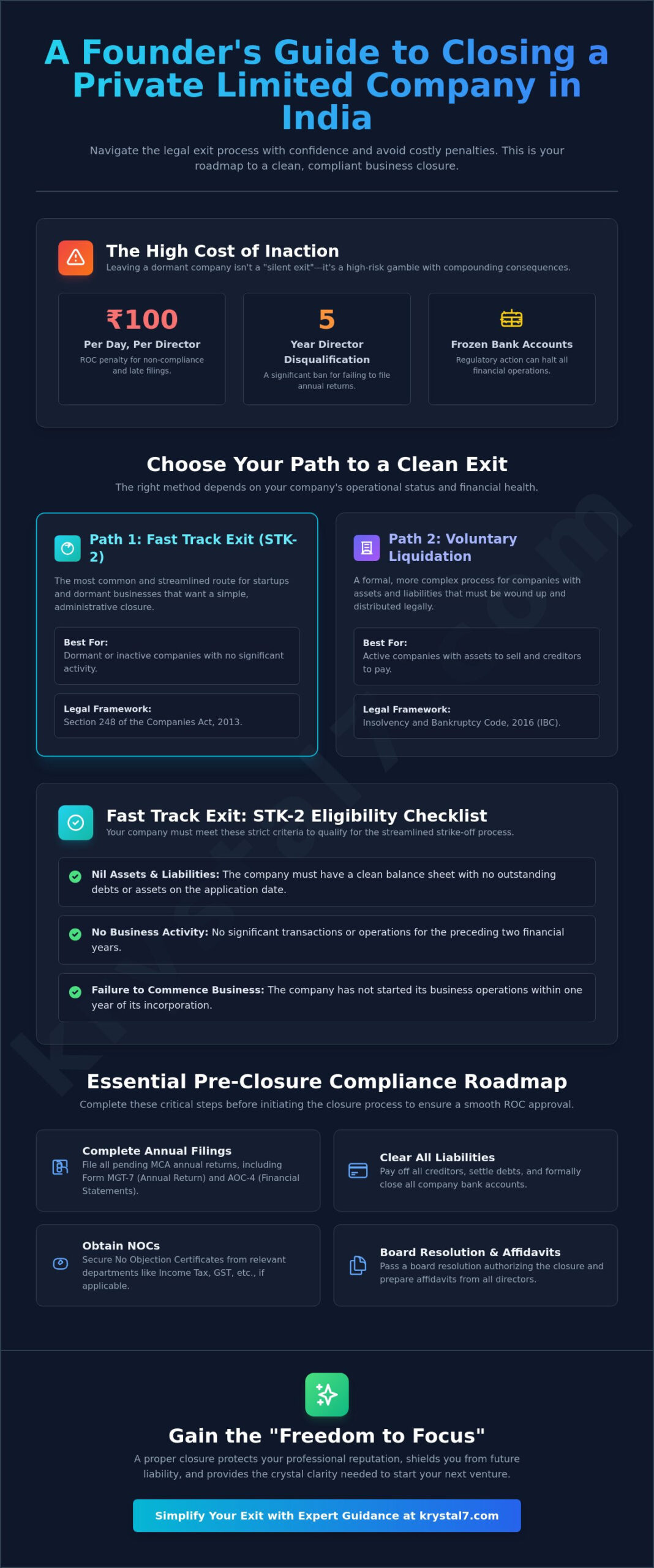
Entrepreneurs often reach a crossroads due to a business pivot, continuous financial losses, or the entity becoming dormant. If your venture has served its purpose, closing it formally provides the freedom to focus on your next big idea. Leaving a company inactive without filing annual returns is a high-risk move. The ROC can impose penalties of 100 INR per day for late filings, and directors risk disqualification for five years. A 2024 review of MCA data showed that thousands of directors faced such bans because they ignored dormant entities. For a refresher on your ongoing duties, review our guide on the Private Limited Company in India to understand what you’re stepping away from.
The Legal Framework: Companies Act 2013 and IBC
The legal basis for how to close a private limited company in india resides within two major pieces of legislation. Section 248 of the Companies Act 2013 governs the Strike Off process, allowing the ROC to remove a company’s name if it fails to commence business within one year of incorporation. For companies with complex asset structures or outstanding debts, the Insolvency and Bankruptcy Code, 2016 provides the framework for liquidation. This is a statutory requirement, not an optional step. Following these laws ensures that your exit is transparent and legally binding, protecting your professional reputation and future ventures. Taking action now prevents avoidable legal hurdles and provides the clarity you need to move forward.
The Fast Track Exit: Closing via the STK-2 Route
For most startups and small businesses, the STK-2 route is the preferred exit strategy. It provides a streamlined path for companies that haven’t commenced business within one year of incorporation or have remained inactive for a significant period. This “Fast Track” process is designed to reduce the administrative burden on founders who want to move on to their next venture. Understanding how to close a private limited company in india through this method is essential for a clean, legal break.
The entire process is managed online via the MCA portal, which makes it accessible but also demands absolute precision. There is no room for guesswork here. Krystal-clear transparency in your filings is the only way to prevent the Registrar of Companies (ROC) from rejecting your application. If the documents don’t match the statutory records perfectly, the ROC may issue a notice for clarification, which can delay the closure by several months.
Eligibility Criteria for Striking Off
To qualify for this route under Section 248 of the Companies Act, 2013, your company must meet specific financial and operational benchmarks. First, the company must have nil assets and nil liabilities on the date of the application. You can’t leave any loose ends or outstanding debts. Second, no business activity or significant financial transaction should have occurred for the preceding two financial years. This inactivity is a non-negotiable prerequisite for the strike-off process.
When founders evaluate their options, they often compare Strike off and voluntary liquidation to see which fits their situation. While liquidation is for companies with assets and debts to settle, the STK-2 route is for those that are already “dormant” in a practical sense. Special cases, such as closing a foreign subsidiary’s Indian arm, require even more care. These entities must ensure full FEMA compliance and close all pending GST or Income Tax assessments before the ROC will approve the exit.
Step-by-Step Filing Process with the MCA
The journey to a successful closure involves a methodical approach to documentation. It’s a four-step process that requires coordination between the directors and a professional advisor.
- Step 1: Convene a Board Meeting. You must pass a formal resolution to close the company and authorize a director to file the application. At least 75% of the shareholders must consent to this decision.
- Step 2: Extinguish all liabilities. Before moving forward, you must pay off every creditor and obtain a “No Objection Certificate” (NOC) where applicable. This ensures no third party can later claim the closure was fraudulent.
- Step 3: Prepare the Statement of Accounts. You need to file Form STK-8, which is a statement of assets and liabilities. This document must be certified by a practicing Chartered Accountant and should not be dated more than 30 days before the application date.
- Step 4: File Form STK-2. Submit the final application on the MCA portal along with the prescribed government fee, which is currently INR 10,000. You must also attach an indemnity bond and an affidavit signed by every director.
Learning how to close a private limited company in india doesn’t have to be an overwhelming experience. By following these steps with precision, you can secure the freedom to focus on your next big idea. If you’re feeling stuck with the paperwork, our team at Krystal7 offers the expert advisory needed to navigate these filings without the stress of red tape.
Strike Off vs. Voluntary Liquidation: Which Is Right for You?
Deciding between Strike Off and Voluntary Liquidation is the most critical choice in your exit strategy. Choosing the wrong method often leads to years of legal delays and higher costs that drain your remaining capital. When you look at how to close a private limited company in india, you must first determine if your business is simply “dormant” or if it has complex financial ties to untangle.
Strike Off is an administrative process under Section 248 of the Companies Act, 2013. It’s designed for companies that have no assets and no liabilities. Liquidation is a far more comprehensive legal and financial settling. It involves a formal closing of books, realization of assets, and distribution of proceeds to creditors and shareholders. While Strike Off is faster, usually taking 6 to 10 months, liquidation often stretches beyond a year because it requires a deeper level of statutory scrutiny.
Comparing Timelines, Costs, and Complexity
For most small and medium enterprises (SMEs), Strike Off via the STK-2 form is the preferred route. It’s generally 70% more cost-effective than a full liquidation. However, liquidation provides a “cleaner” shield. Once a liquidator finishes the process, it’s much harder for creditors to bring future claims against the directors. The table below clarifies these distinctions.
| Feature | Strike Off (STK-2) | Voluntary Liquidation (IBC) |
|---|---|---|
| Typical Timeline | 6 to 10 Months | 12 to 18+ Months |
| Cost Level | Low (Affordable for SMEs) | High (Includes Professional Fees) |
| Professional Needed | Company Secretary / CA | Insolvency Professional (IP) |
| Legal Shield | Standard | Maximum protection from creditors |
Liquidation requires the appointment of an Official Liquidator or a registered Insolvency Professional. This expert takes over the company’s management, sells off any equipment or property, and pays off debts in a specific order of priority. It’s a rigorous process that ensures every paisa is accounted for before the company’s name is removed from the MCA register.
The Role of the National Company Law Tribunal (NCLT)
The NCLT acts as the judicial overseer for company closures. While Voluntary Liquidation is initiated by shareholders, the NCLT gets involved in “Compulsory Winding Up” cases. This usually happens when a company cannot pay its debts or if it’s acted against the interests of the state. You want to avoid this at all costs. A forced closure by the government often carries heavy penalties and can disqualify directors from starting new ventures.
The Registrar of Companies (ROC) can also initiate a forced Strike Off if you fail to file your financial statements for two consecutive years. To stay on the right side of the law and maintain the option for a smooth exit, you should review our guide on Annual Compliance for Private Limited Company. Keeping your filings current is the only way to ensure you have the freedom to choose your own path when learning how to close a private limited company in india. Don’t let non-compliance turn a simple exit into a legal battle.
The Essential Pre-Closure Compliance Checklist
Closing a business isn’t just about stopping operations. It’s a formal legal exit that requires meticulous record-keeping. The Ministry of Corporate Affairs (MCA) requires your records to be up to date before they’ll even consider your application. You cannot start the process of how to close a private limited company in india if your annual filings are pending. The Registrar of Companies (ROC) will reject any STK-2 application if Form MGT-7 or AOC-4 is missing for previous financial years. Ensure your returns are filed up to the date the company ceased its business operations to avoid immediate rejection.
Financial and Asset Disposal Requirements
Before a Chartered Accountant certifies your accounts for closure, every asset must be sold or transferred. The company must have zero assets and zero liabilities on the date you file for strike-off. Directors hold a significant legal burden during this stage. You’re required to provide an indemnity bond using Form STK-3 and an affidavit through Form STK-4. This confirms that any future liabilities will be met by the directors personally. The Statement of Assets and Liabilities must be current, typically dated no more than 30 days before the application. This snapshot proves to the ROC that the company is truly ready for dissolution.
Surrendering GST, PAN, and TAN Registrations
Many founders mistakenly believe that an MCA closure automatically cancels all other tax registrations. This isn’t true. You must proactively apply for GST cancellation through the official portal. Failing to do this can lead to “Suo Moto” cancellations by the department, which often carries heavy penalties. You also need to surrender Professional Tax, EPFO, and ESIC registrations to stop the clock on compliance requirements. If your company holds intellectual property, you might need to review Trademark Registration Fees to transfer these assets to a director before the company is dissolved. Don’t forget to close all corporate bank accounts and obtain a formal Bank Closure Certificate. This document is a vital piece of evidence for how to close a private limited company in india properly, proving the entity no longer maintains a financial presence.
Taking care of these details now prevents legal headaches later. If you’re looking for a smooth exit, get expert guidance on your company closure from our team.
Navigating the Exit: How Krystal7 Ensures a Hassle-Free Closure
Closing your business shouldn’t feel like a legal battle. It’s actually a strategic step toward your next big idea. At Krystal7, we give you the “Freedom to Focus” on your future while our experts handle the bureaucratic red tape. Our team of elite Chartered Accountants and Company Secretaries ensures 100% compliance with the latest 2026 Ministry of Corporate Affairs (MCA) regulations. We bring “Crystal Clarity” to the often-confusing world of ROC filings, ensuring your exit is as smooth as your launch was.
Our approach centers on your peace of mind. We don’t just file forms; we protect your reputation. By managing the entire lifecycle of the closure, we allow you to step away from your current venture without looking back in worry. You’ve spent years building a vision, and we’re here to make sure the final chapter is written with precision and professional care.
Avoiding Penalties and ROC Objections
Errors in your final filings can lead to years of legal headaches and unexpected costs. Krystal7 performs a rigorous pre-audit of all your financial statements and board resolutions to ensure zero rejections from the Registrar of Companies. If you don’t follow the legal steps for how to close a private limited company in india, directors risk significant personal liability. Under Section 164 of the Companies Act, a failure to file statutory returns can lead to disqualification from starting or managing any new company for a period of 5 years.
Our “End-to-End Closure Package” removes this risk by covering every necessary statutory surrender. This includes:
- Cancellation of GST registration to avoid late filing fees of INR 50 per day.
- Surrendering Professional Tax and Shops and Establishment licenses.
- Filing Form STK-2 with the necessary indemnity bonds (Form STK-3) and affidavits (Form STK-4).
- Closing PF and ESI accounts to ensure no outstanding labor law liabilities remain.
Your Partner for a Strategic Exit
You won’t be talking to a different person every time you call. We assign a dedicated relationship manager who learns your business history and financial trajectory. They guide you through the specific eligibility criteria for the STK-2 form, ensuring your company meets the “nil assets and liabilities” requirement before the application is submitted. This personalized attention ensures that no small detail, like an unclosed bank account or a pending TDS refund, halts your progress.
We handle the paperwork so you can build your legacy. Don’t let compliance hurdles hold you back from your next venture or startup dream. Understanding how to close a private limited company in india is simpler when you have a partner who treats your business with the same respect you do. Reach out for a professional consultation today to assess your eligibility for a streamlined exit and start your next chapter with confidence.
Contact Krystal7 Consultants at business@krystal7.com or visit krystal7.com for expert assistance with your company closure and compliance needs.
Secure Your Professional Future with a Clean Exit
Closing your business is a significant milestone that demands precision and clarity. You’ve learned that the STK-2 fast track route offers a streamlined path for defunct entities, while voluntary liquidation remains the standard for solvent companies with assets. Success hinges on a meticulous compliance checklist, from settling all statutory liabilities to filing the final forms with the Ministry of Corporate Affairs (MCA).
Navigating how to close a private limited company in india requires more than just following steps; it requires professional foresight to avoid heavy penalties and legal hurdles. Our team of top-tier Chartered Accountants and Company Secretaries specializes in Indian compliance and MCA filings. We prioritize transparency with no hidden costs, giving you the freedom to focus on your next big vision without the weight of old red tape.
Ready for a krystal-clear exit? Contact Krystal7 Consultants at business@krystal7.com or visit krystal7.com for expert assistance with your company closure. It’s time to close this chapter with total peace of mind and step forward into your next venture.
Frequently Asked Questions on How to Close a Private Limited Company in India
What is the timeline for how to close a private limited company in India?
Knowing how to close a private limited company in India is essential, as the process typically takes between 6 to 10 months. This period starts from the date you file the STK-2 form and allows the Registrar of Companies to invite objections from the public. Our experts at Krystal7 handle the complexity of this timeline and ensure your documentation is perfect, giving you the freedom to focus on your next big venture.
Can I close my company if there are pending GST or Income Tax litigations?
You cannot close your company if there are active GST or Income Tax litigations or any outstanding tax demands. The MCA requires a clean slate and a verified indemnity bond from directors before approving a strike-off application. You must resolve all legal disputes and pay any pending dues to the tax departments. Obtaining a clear status on the GST portal is a mandatory step in this process.
What is the government fee for filing the STK-2 form in 2026?
The government fee for filing the STK-2 form in 2026 is INR 10,000 for a voluntary strike-off. You must pay this fee through the MCA V3 portal when you submit your application. It’s important to remember that this fee doesn’t include any late penalties for overdue annual filings. You should ensure all previous MGT-7 and AOC-4 forms are filed to avoid additional costs during the closure process.
Is it possible to revive a company after it has been struck off by the ROC?
You can revive a company after it’s struck off by filing an appeal with the National Company Law Tribunal under Section 252. This application must be made within 20 years of the strike-off date if you’re a creditor or shareholder. The tribunal will restore the company name if you prove it was active or it’s just to do so. This legal process requires meticulous documentation and professional representation.
Do I need to file annual returns for how to close a private limited company in India?
You must file annual returns for the financial year in which you learn how to close a private limited company in India. The ROC requires your compliance history to be updated until the date the company ceased its operations. Skipping Form AOC-4 or MGT-7 filings for the final period will lead to the rejection of your STK-2 application. Our team ensures every statutory filing is completed to provide a smooth exit.
What happens to the company assets after a successful strike-off?
Any assets that remain in the company after a successful strike-off automatically vest in the Central Government. This legal principle, known as Bona Vacantia, treats unclaimed assets as state property. You should liquidate all machinery, property, and bank balances before you submit your closure application. We help you manage this asset distribution to ensure shareholders receive their proper value before the company is officially dissolved.
Are directors personally liable for company debts after closure?
Directors stay personally liable for all company debts and legal obligations even after the company name is struck off the register. Section 248 of the Companies Act clarifies that the liability of directors and officers continues as if the company had never been dissolved. This means creditors can still pursue you for past dues. It’s vital to settle all liabilities and obtain proper clearances to protect your personal assets.
Can a company be closed if it has active employees on the payroll?
You cannot close a company if you have active employees on your payroll or unpaid salary obligations. All employment contracts must be terminated and full settlements must be paid before you initiate the strike-off process. You also need to close your registrations with the EPFO and ESIC to show the company has no pending labor liabilities. This ensures a clean break and prevents future legal hurdles from the labor department.
Closing your business doesn’t have to be a stressful experience. If you’re still unsure about how to close a private limited company in India, our experts are here to help. Contact Krystal7 Consultants at business@krystal7.com or visit krystal7.com to ensure your company closure is handled with crystal-clear transparency and compliance.

Article by
Nihal Srivastava
Nihal Srivastava is the Co-Founder of Krystal7 Consultants, helping Indian entrepreneurs and startups navigate company registration, compliance, trademark protection, and regulatory requirements with clarity and confidence. With 6+ years of hands-on expertise in MCA filings, GST compliance, and corporate structuring, Nihal has guided 1000+ businesses across India through their legal and compliance journeys. He believes every business dream deserves crystal clear foundations, and that no founder should be held back by paperwork or red tape.