

Private Limited Company in India: The Ultimate Guide for Founders
Starting a new venture is an exciting journey, but navigating the legal landscape can feel overwhelming. One of the first, most crucial decisions you’ll make is choosing the right legal structure for your business. For ambitious entrepreneurs in India, the Private Limited Company is often the gold standard. This guide is designed to give you crystal clear on what a Private Limited Company is, its powerful benefits, the requirements for setting one up, and whether it’s the right choice to turn your business dream into a reality.
What is a Private Limited Company in India?
A Private Limited Company is the most popular and credible business structure for startups and growing businesses in India. Formally registered under the Companies Act, 2013, it is recognized as a distinct legal entity separate from its owners (known as shareholders). The most significant feature is that the owners’ personal assets are protected from any business debts or liabilities, a concept known as “limited liability.” This structure provides a powerful foundation for growth, credibility, and security.
Key Characteristics Explained in Simple Terms
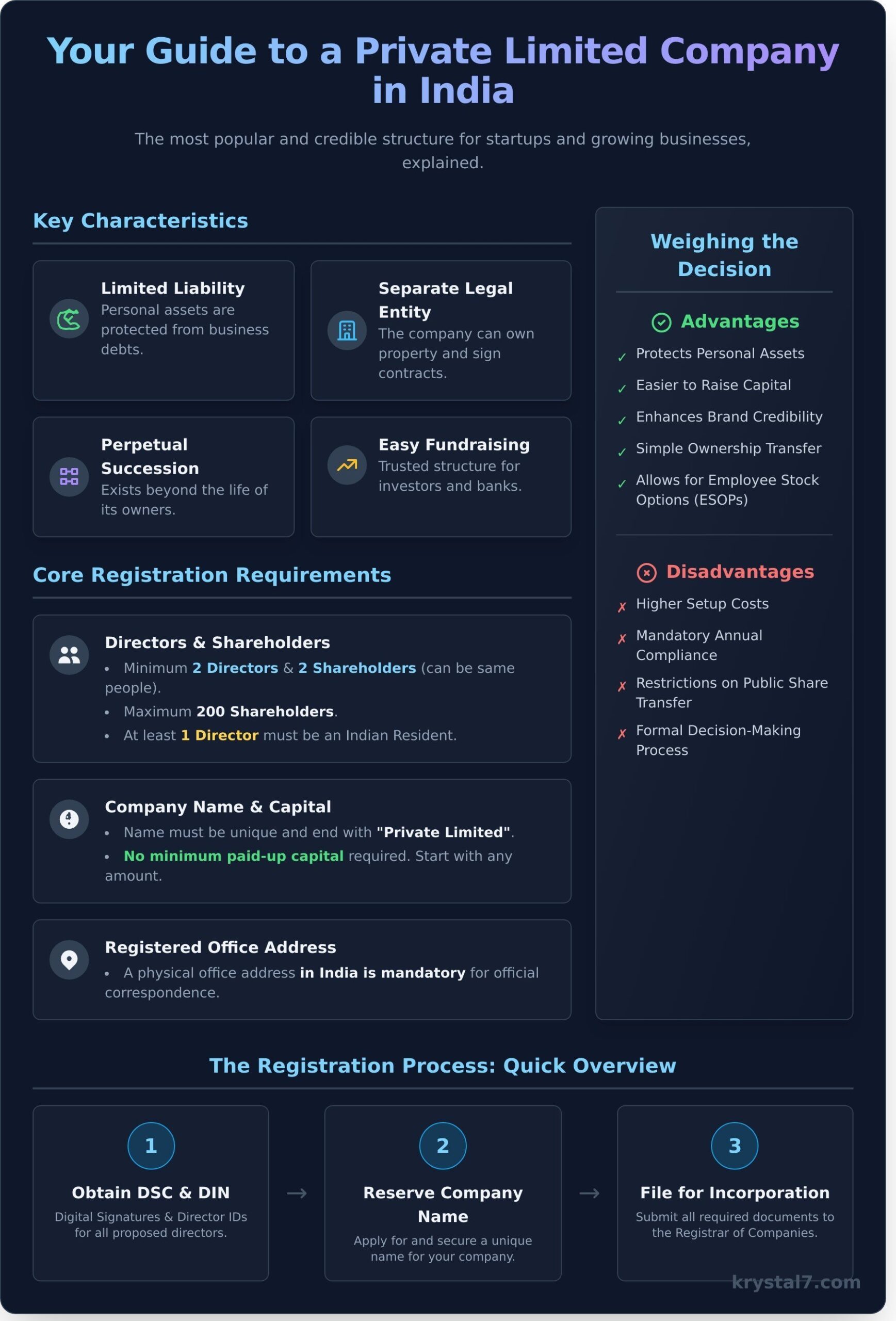
- Limited Liability: This is the core advantage. Your personal risk is strictly limited to the amount you’ve invested in the company. If the business incurs debt, your personal assets like your home or savings remain safe, giving you the confidence to take calculated risks.
- Separate Legal Entity: The company is treated as a separate “person” in the eyes of the law. This means it can own property, enter into contracts, and sue or be sued in its own name, completely independent of its owners.
- Perpetual Succession: A Private Limited Company has a continuous existence. The business continues to operate even if there’s a change in ownership or the unfortunate death of a shareholder or director. Its legacy is built to last.
- Easy Fundraising: This structure is highly trusted by investors. If you plan to seek funding from angel investors, venture capitalists, or banks, being a Private Limited Company makes the process significantly smoother and signals that your business is serious and well-structured.
Is a Private Limited Company Right for You?
While powerful, this structure isn’t for everyone. It is the ideal choice for entrepreneurs who are serious about growth and establishing a long-term, scalable venture. Consider it if you fit into one of these categories:
- You are a startup founder planning to raise funds from external investors.
- You have a vision to scale your business across cities, states, or even countries.
- You want to build strong credibility and trust when dealing with large clients, suppliers, and partners.
- You are running a family business and want a formal, professional structure that can be passed down through generations.
Advantages and Disadvantages of a Pvt Ltd Company
Making an informed decision means having complete clarity on both the benefits and the responsibilities. Weighing the pros and cons will help you determine if this structure aligns perfectly with your business goals. While it offers significant advantages for growth and protection, it also comes with certain compliance obligations.
Top 5 Advantages for Entrepreneurs
- Protects Personal Assets: As mentioned, the limited liability feature shields your personal wealth from business risks, providing essential peace of mind.
- Easier to Raise Capital: Investors prefer this structure due to its formal and transparent nature, making it easier to secure the funding needed for growth.
- Enhances Brand Credibility: Operating as a Private Limited Company signals professionalism and stability, boosting the trust of customers, vendors, and employees. Once your company is established, protecting your brand identity through trademark registration fees becomes a crucial investment to safeguard your business reputation.
- Simple to Transfer Ownership: Ownership can be easily transferred by selling shares. This flexibility is crucial for bringing on new partners or planning an exit strategy.
- Allows for Employee Stock Ownership Plans (ESOPs): You can attract and retain top talent by offering them company shares, giving them a real stake in the business’s success.
Potential Drawbacks to Consider
- Higher Setup Costs: The initial registration process is more involved and costly compared to simpler structures like a sole proprietorship or partnership.
- Mandatory Annual Compliance: A Private Limited Company must adhere to strict annual compliance for private limited company requirements set by the Registrar of Companies (ROC), including filing financial statements and annual returns.
- Restrictions on Share Transfer: While ownership transfer is simple, shares cannot be offered to the general public and their transfer is governed by the company’s internal rules (Articles of Association).
- Formal Decision-Making: Important business decisions must be passed through formal board meetings and documented as resolutions, adding a layer of administrative process.
Core Requirements for Registration in India
Meeting these foundational criteria is the first step in your registration journey. Ensuring you have everything in place beforehand will make the process smooth and efficient. Our team of experts can guide you through each requirement, providing clarity at every stage.
Directors and Shareholders
- A minimum of two directors and two shareholders are required to form the company. The directors and shareholders can be the same people.
- A maximum of 200 shareholders are allowed, which provides ample room for growth and investment.
- Crucially, at least one of the company’s directors must be a resident of India (having stayed in India for at least 182 days in the previous calendar year).
Company Name and Capital
- Your company name must be unique and not resemble any existing company or registered trademark. It must also end with the words “Private Limited”. Beyond just ensuring name uniqueness, you’ll want to protect your chosen brand name through proper trademark registration, and understanding the complete cost breakdown for trademark registration fees in India will help you budget for this essential brand protection step.
- There is no longer a minimum paid-up capital requirement. You can start your company with any amount of capital that suits your business plan.
- This flexibility allows you to launch your venture without a significant upfront capital burden.
Registered Office Address
- A physical office address located in India is mandatory. This address will be used for all official correspondence from the Ministry of Corporate Affairs (MCA) and other government bodies.
- This address will be listed on all official company documents. If you are unsure about any of these requirements, professional guidance can provide immense clarity. Talk to our experts today to ensure your foundation is solid.
The Registration Process: A Quick Overview
While the process involves several legal steps, partnering with an expert can make it a streamlined and hassle-free experience. We handle the complexity so you can focus on your business vision. Here is a brief overview of the key milestones you’ll go through from start to finish.
Step 1: Obtain Digital Signature (DSC) & Director ID (DIN)
- A Digital Signature Certificate (DSC) is the online equivalent of a physical signature. Every proposed director needs one to sign the electronic forms required for registration.
- The Director Identification Number (DIN) is a unique lifetime ID assigned to each director by the government.
Step 2: Reserve Your Unique Company Name
- The first official step is to file the SPICe+ Part A form with the Ministry of Corporate Affairs (MCA) to apply for your chosen company name.
- The name must be unique and adhere to the naming guidelines to get approved.
Step 3: File Incorporation Documents
- Once the name is approved, the main incorporation application, the SPICe+ Part B form, is filed. This comprehensive form includes all details about the company, its directors, and shareholders.
- It is submitted along with the electronic Memorandum of Association (e-MoA) and Articles of Association (e-AoA), which are the charter documents of the company.
Step 4: Receive Your Certificate of Incorporation
- After the Registrar of Companies verifies all your documents and forms, they will issue the Certificate of Incorporation.
- This certificate is conclusive proof of your company’s existence and includes your unique Company Identification Number (CIN).
- Congratulations! With this certificate, your company is officially registered and ready to do business.
Frequently Asked Questions
Here are answers to some common questions entrepreneurs have about Private Limited Companies.
What is the minimum number of directors for a private limited company in India?
You need a minimum of two directors to register a Private Limited Company.
Can an NRI or foreigner be a director in an Indian private limited company?
Yes, absolutely. However, the company must still have at least one director who is a resident of India.
Is there any minimum capital required to start a private limited company?
No, the requirement for a minimum paid-up share capital has been removed. You can start your company with any amount of capital.
How long does it take to register a private limited company in India?
With all documents in order, the process typically takes about 7-10 working days. Krystal7’s streamlined process ensures maximum efficiency.
What is the difference between a Private Limited Company and an LLP?
A Private Limited Company is governed by the Companies Act and is preferred by startups seeking equity funding. A Limited Liability Partnership (LLP) is a hybrid structure combining features of a partnership and a company, often chosen by professionals. The compliance requirements for a Pvt Ltd are generally more stringent.
What happens if I miss my annual compliance filings?
Missing statutory deadlines can lead to significant penalties and fines from the ROC. In severe cases, it can lead to the disqualification of directors and the company being struck off the register. It’s crucial to manage compliance diligently. Understanding the complete annual compliance for private limited company requirements can help you avoid these costly mistakes and maintain good legal standing.
Choosing the right structure is the bedrock of your business. A Private Limited Company offers the credibility, protection, and scalability that ambitious founders need to build a lasting legacy. While the process has its complexities, you don’t have to navigate it alone. Let us handle the paperwork and compliance, giving you the freedom to focus on what you do best: building your dream.
Start your business with clarity. Get your all-in-one incorporation package.

Article by
Nihal Srivastava
Nihal Srivastava is the Co-Founder of Krystal7 Consultants, helping Indian entrepreneurs and startups navigate company registration, compliance, trademark protection, and regulatory requirements with clarity and confidence. With 6+ years of hands-on expertise in MCA filings, GST compliance, and corporate structuring, Nihal has guided 1000+ businesses across India through their legal and compliance journeys. He believes every business dream deserves crystal clear foundations, and that no founder should be held back by paperwork or red tape.