

What Is a Limited Company? A Clear Guide for Indian Founders
Starting a new business is an exciting journey, but the legal formalities can often seem daunting. One of the first and most critical decisions you’ll make is choosing the right business structure. You’ve likely heard the term “limited company,” but what does it actually mean for you as an entrepreneur? In simple terms, it’s a formal business structure that creates a legal distinction between the business and its owners, offering a powerful layer of protection for your personal assets.
Understanding this structure is the first step toward building a secure and scalable foundation for your venture. This guide provides crystal-clear answers, helping you navigate the essentials of a limited company in India so you can make an informed decision with confidence.
What Does ‘Limited Company’ Actually Mean?
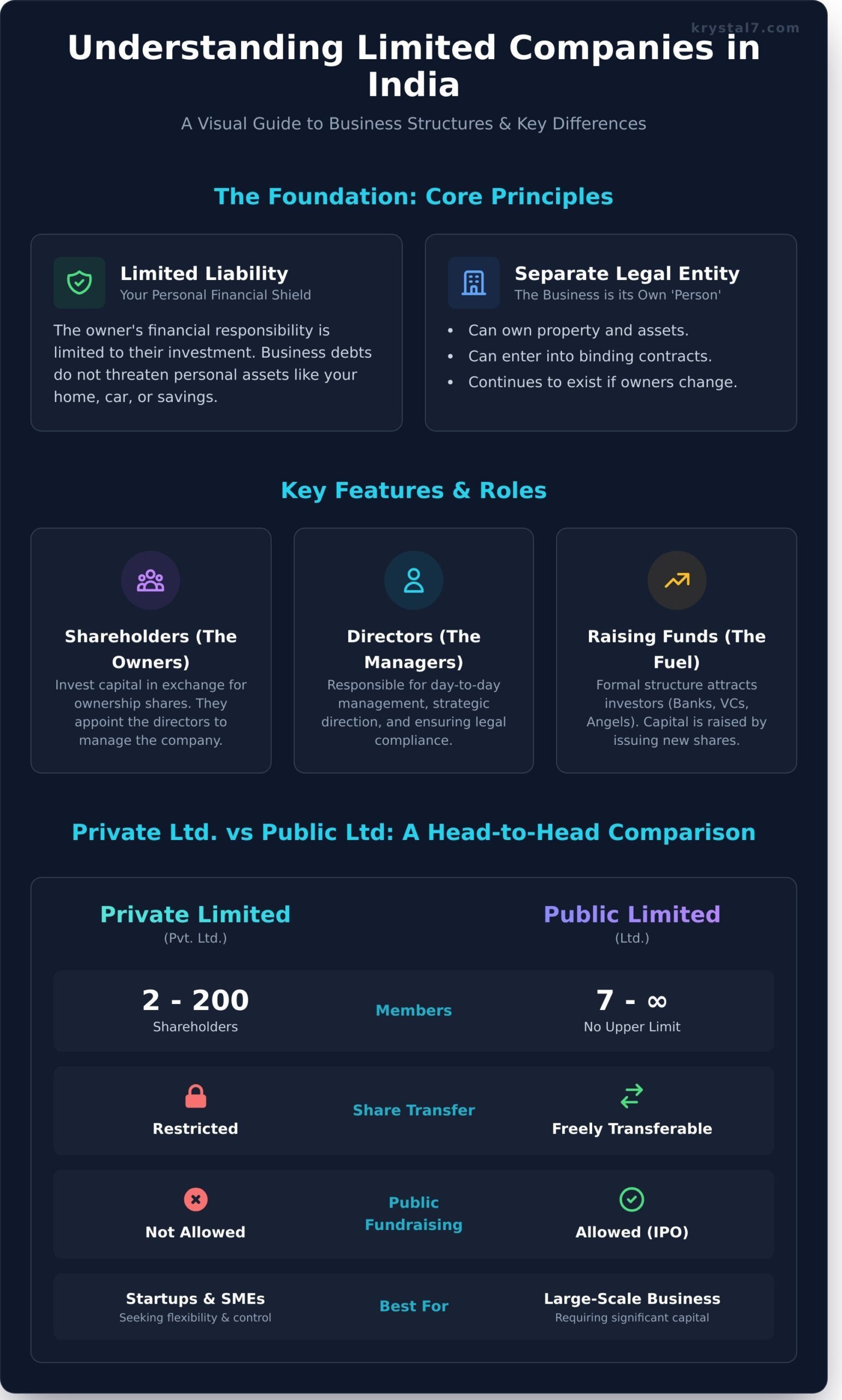
At its core, a limited company is a type of business structure that is legally separate from the people who own it. Think of it as creating a distinct ‘legal person’ that can own assets, enter into contracts, and take on debt, all in its own name. This separation is the key to its most significant benefit: protecting the personal wealth of its owners.
The Core Concept: Understanding Limited Liability
The “limited” in limited company refers directly to “limited liability.” This means that the financial responsibility of the company’s owners (the shareholders) is limited to the value of their investment in the company-the amount they paid for their shares. Imagine a financial shield between your business debts and your personal finances. If the company faces financial trouble or accrues debt, creditors can make a claim against the company’s assets, but not your personal property like your home, car, or personal savings. This protection is fundamental for entrepreneurs who want to take calculated risks without jeopardizing their personal financial security.
What is a Separate Legal Entity?
When you register a limited company, you create a separate legal entity. This principle reinforces the shield of limited liability and has several important implications. As a separate entity, the company can:
- Own property and assets in its own name.
- Enter into legally binding contracts with suppliers, clients, and employees.
- Sue or be sued in a court of law.
This structure also ensures “perpetual succession,” meaning the company continues to exist even if the original founders or shareholders leave, retire, or pass away. This stability is crucial for long-term growth, building a legacy, and attracting investors.
Key Features of a Limited Company in India
In India, limited companies are governed by the Companies Act, 2013, which outlines their structure, governance, and compliance requirements. Understanding the key components will give you a clearer picture of how these entities operate.
Shareholders: The Owners of the Company
The ownership of a limited company is divided into units called shares. The individuals or entities that hold these shares are known as shareholders. Their primary role is to invest capital into the business in exchange for ownership. While they are the ultimate owners, they typically do not manage the daily operations. Instead, their key responsibility is to appoint a Board of Directors to run the company on their behalf.
Directors: The Managers of the Company
The directors are responsible for the day-to-day management and strategic direction of the company. Appointed by the shareholders, the Board of Directors makes crucial operational decisions, ensures the company meets its legal obligations, and works to achieve its business goals. They act as the brain of the company, steering it towards growth and profitability while ensuring compliance with all applicable laws.
Raising Funds: Attracting Investment
One of the most significant advantages of a limited company is its ability to attract investment. The formal structure, clear governance, and liability protection make it a credible and trustworthy entity for banks, venture capitalists, and angel investors. A company can raise capital by issuing new shares to investors, a process known as equity financing. This ability to bring in external funding is often essential for scaling operations, developing new products, and expanding into new markets.
The Main Types of Limited Companies in India
“Limited company” is a broad category that includes two primary types of corporate structures in India. The right choice for your business will depend on your long-term vision, funding needs, and desired level of control.
Private Limited Company (Pvt. Ltd.)
A Private Limited Company in India is the most popular and preferred business structure for startups and small to medium-sized enterprises (SMEs) in India. It offers the perfect blend of liability protection and operational flexibility. Key features include:
- Shareholders: It can have a minimum of two and a maximum of 200 shareholders.
- Share Transfer: It restricts the right to transfer shares publicly, meaning shares cannot be traded on a stock exchange. This keeps ownership within a closed group.
Public Limited Company (Ltd.)
A Public Limited Company is designed for large-scale businesses that require significant capital from the general public. These companies can list their shares on a stock exchange, allowing anyone to buy and sell them. This structure is subject to stricter regulations and disclosure norms to protect public investors.
- Shareholders: It requires a minimum of seven shareholders with no upper limit.
- Public Fundraising: It can raise capital from the public by issuing shares through an Initial Public Offering (IPO).
Quick Comparison: Pvt. Ltd. vs. Public Ltd.
Here is a simple table to highlight the key differences at a glance:
| Feature | Private Limited Company (Pvt. Ltd.) | Public Limited Company (Ltd.) |
|---|---|---|
| Minimum Members | 2 | 7 |
| Maximum Members | 200 | No limit |
| Share Transferability | Restricted | Freely transferable |
| Public Fundraising | Not allowed | Allowed (can be listed on stock exchange) |
Is a Limited Company the Right Choice for You?
Now that you understand the fundamentals, it’s time to evaluate if this structure aligns with your business goals. Like any decision, it comes with a balanced set of advantages and considerations.
Key Advantages of Forming a Limited Company
- Liability Protection: Your personal assets are safe from business risks and debts.
- Enhanced Credibility: A registered company is viewed as more professional and trustworthy by customers, suppliers, and banks.
- Easier to Raise Funding: It is the preferred structure for venture capitalists and angel investors.
- Clear Ownership Structure: The division of ownership through shares makes it easy to add co-founders or investors.
- Perpetual Existence: The business continues to exist regardless of changes in ownership.
Potential Disadvantages to Consider
- Setup Complexity: The registration process is more detailed and costly compared to a sole proprietorship or partnership.
- Annual Compliance: A limited company must fulfill mandatory annual compliance requirements, such as filing reports with the Registrar of Companies (ROC).
- Public Disclosure: Key information about the company, including its financial statements and director details, is available on public record through the Ministry of Corporate Affairs (MCA).
While compliance is a necessity, it doesn’t have to be a burden. When you partner with experts, you gain the freedom to let Krystal7 handle your compliance so you can focus on growth.
Frequently Asked Questions
What is the main difference between a limited company and a sole proprietorship?
The biggest difference is legal separation. In a sole proprietorship, the owner and the business are considered one and the same, meaning the owner is personally liable for all business debts. A limited company is a separate legal entity, protecting the owner’s personal assets.
Can a single person form a limited company in India?
Yes. A single person can form a One Person Company (OPC), which is a type of private limited company. However, a standard Private Limited Company requires a minimum of two members.
What does ‘Ltd.’ and ‘Pvt. Ltd.’ at the end of a company name mean?
“Pvt. Ltd.” stands for Private Limited, indicating that the company’s shares are privately held and not available to the public. “Ltd.” stands for Limited and typically refers to a Public Limited Company, whose shares can be traded on a stock exchange.
How much does it cost to register a limited company in India?
The cost varies based on factors like the authorized share capital and professional fees for registration services. It includes government fees, stamp duty, and charges for obtaining Digital Signature Certificates (DSC) and Director Identification Numbers (DIN).
What is a Director Identification Number (DIN)?
A Director Identification Number (DIN) is a unique identification number assigned by the Ministry of Corporate Affairs to any individual intending to be a director of a company. It is a mandatory prerequisite for directorship.
Choosing the right business structure is a foundational step in your entrepreneurial journey. A limited company offers unparalleled protection, credibility, and scalability, making it the preferred choice for serious founders aiming for long-term growth. While the process involves formalities, the peace of mind and opportunities it unlocks are invaluable. With a clear understanding and the right partner, you can navigate the registration process seamlessly and set your business up for success.
Ready to start your company with Krystal-Clear guidance? Explore our Incorporation Package.

Article by
Nihal Srivastava
Nihal Srivastava is the Co-Founder of Krystal7 Consultants, helping Indian entrepreneurs and startups navigate company registration, compliance, trademark protection, and regulatory requirements with clarity and confidence. With 6+ years of hands-on expertise in MCA filings, GST compliance, and corporate structuring, Nihal has guided 1000+ businesses across India through their legal and compliance journeys. He believes every business dream deserves crystal clear foundations, and that no founder should be held back by paperwork or red tape.