

Stand Up India Loan Scheme: A Complete Guide for Entrepreneurs (2026)
Is the dream of launching your own venture being clouded by confusing jargon and bureaucratic red tape? You have the vision, but navigating government websites can feel overwhelming. The Stand-Up India initiative was created to empower entrepreneurs just like you-specifically women and individuals from SC/ST communities-but accessing its benefits shouldn’t be a struggle. If you’re feeling unsure about eligibility or daunted by the application process, you are not alone.
This guide is designed to bring you crystal clarity. We will demystify the entire stand up india loan process for 2025, giving you the freedom to focus on what truly matters: building your business. Inside, you will find a streamlined, step-by-step plan that covers everything from confirming your eligibility with confidence to preparing a complete checklist of required documents. Let’s replace uncertainty with a clear action plan and turn your entrepreneurial vision into a funded reality.
What is the Stand-Up India Loan Scheme? The Core Idea Explained
The Stand-Up India scheme is a powerful initiative by the Government of India, launched by the Department of Financial Services (Ministry of Finance), to foster entrepreneurship at the grassroots level. Its primary mission is to empower and uplift entrepreneurs from Scheduled Castes (SC), Scheduled Tribes (ST), and women by providing them with the financial foundation to bring their business visions to life. This scheme is designed to address the unique challenges these entrepreneurs face in securing capital for their ventures.
It’s crucial to understand that this is a credit facility, meaning the stand up india loan is a formal loan that must be repaid, not a subsidy or a grant. The scheme’s structure is designed to promote financial discipline and sustainable business growth. For a complete historical and structural background, the Stand-Up India Scheme Overview provides an authoritative reference. The core focus is on funding ‘greenfield’ enterprises-brand new projects-ensuring that capital is directed towards creating fresh economic activity and new opportunities.
Key Objectives of the Scheme
The scheme is built on three strategic pillars aimed at creating a more inclusive and dynamic entrepreneurial ecosystem:
- Empowering Underrepresented Entrepreneurs: To provide a clear financial pathway for women and SC/ST individuals, turning them from job seekers into job creators.
- Facilitating Bank Loans: To streamline access to bank credit between ₹10 lakh and ₹1 Crore for setting up new ventures.
- Boosting Job Creation: By funding new businesses in manufacturing, services, or trading sectors, the scheme directly contributes to employment generation at the local level.
Scheme at a Glance: Quick Facts
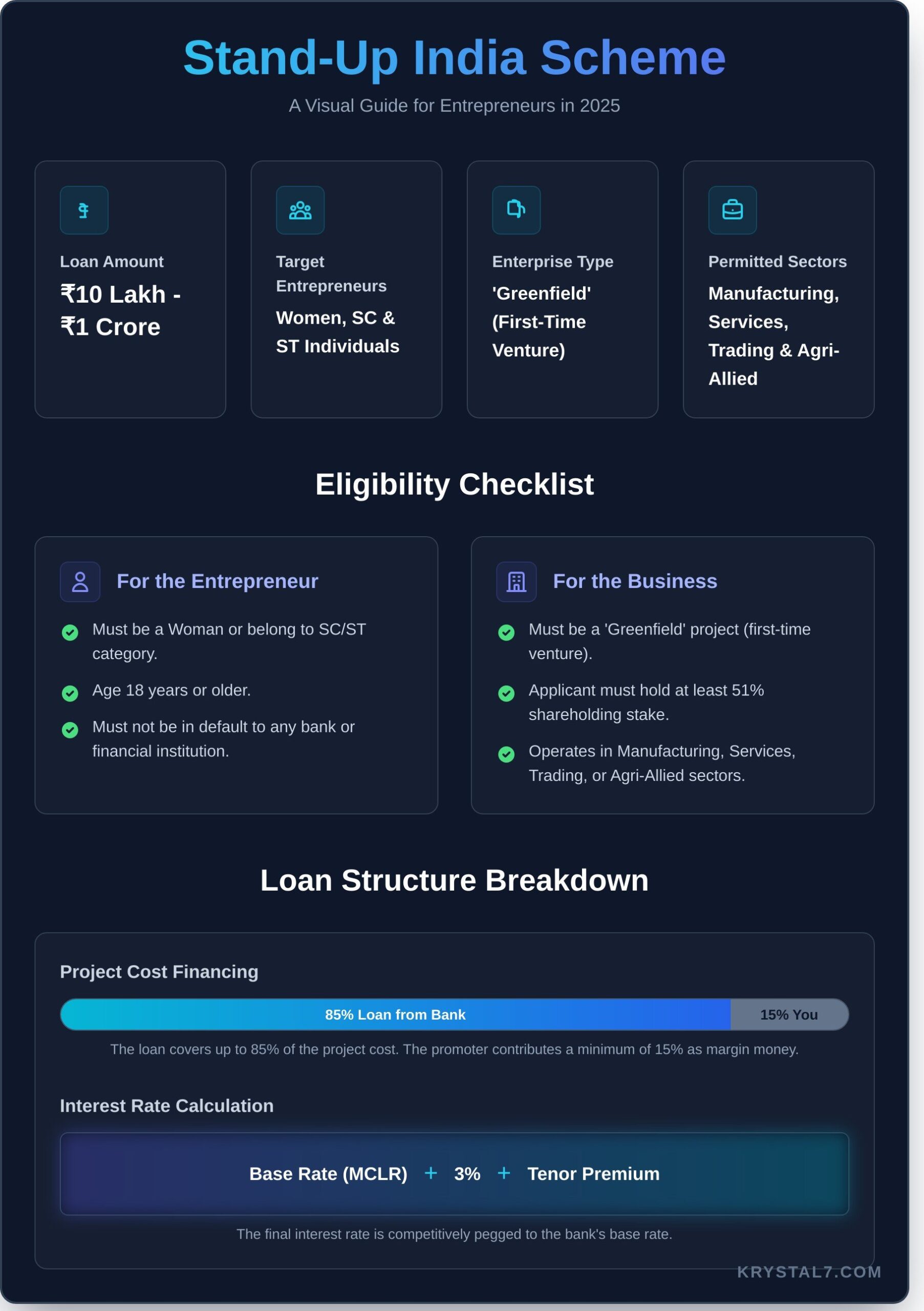
For crystal clarity, here are the essential features of the Stand-Up India loan scheme summarized:
- Loan Amount: Between ₹10 lakh and ₹1 Crore.
- Target Borrowers: Enterprises led by Scheduled Caste (SC), Scheduled Tribe (ST), or Women entrepreneurs.
- Purpose of Loan: For setting up a new enterprise in the manufacturing, services, trading, or agri-allied activities sector.
- Enterprise Type: The loan must be for a ‘greenfield’ project, which signifies the first-time venture of the beneficiary in the chosen sector.
Are You Eligible? A Detailed Checklist for Applicants
Navigating government schemes can often feel complex, but we are here to bring you clarity. Understanding the eligibility for the stand up india loan is the crucial first step toward securing the capital your vision deserves. The criteria are straightforward and designed to empower specific segments of entrepreneurs. The government has laid out clear guidelines, which you can also review on the official portal detailing the Stand-Up India Eligibility and Benefits. To simplify this for you, we have broken down the requirements into two core areas: the entrepreneur and the business itself.
Eligibility Criteria for the Entrepreneur
The scheme is designed to champion new leaders in business. As an applicant, you must personally meet the following conditions:
- Category: You must be a citizen of India and belong to either the Scheduled Caste (SC), Scheduled Tribe (ST), or be a Woman entrepreneur.
- Age: You must be 18 years of age or older.
- First-Time Venture: This loan must be for your first-time venture under the Stand-Up India Scheme. This ensures the program supports new and emerging business ideas.
- Credit History: You must not be in default to any bank or financial institution. This ‘no-defaulter’ clause simply means you have a responsible credit history and no outstanding dues that have been classified as defaults.
Eligibility Criteria for the Business
Beyond the individual, the business venture itself must align with the scheme’s objectives. Here is what your proposed enterprise needs to qualify:
- Greenfield Enterprise: Your project must be ‘Greenfield’. In simple terms, this means it must be your first-time venture in the manufacturing, services, trading, or agri-allied sector. For example, starting a new food processing unit or launching a digital marketing agency from scratch would qualify.
- Shareholding Control: For non-individual enterprises (like a Private Limited Company or a Partnership), the SC/ST or Woman entrepreneur must hold a minimum of 51% of the shareholding and controlling stake. This ensures the person the scheme is meant to benefit is in control of the business.
- Business Sector: The enterprise must operate within the manufacturing, services, trading, or agri-allied sectors.
Meeting these criteria positions you as a strong candidate for a stand up india loan, paving the way for you to turn your business dream into a thriving reality.
Loan Details: Amount, Interest Rate, and Repayment Terms
Understanding the financial structure of the Stand-Up India scheme is the first step toward leveraging it for your venture’s growth. The scheme is designed with clarity and flexibility in mind, removing the guesswork often associated with business financing. Here’s a streamlined breakdown of what you can expect.
Loan Amount and Margin Money
The scheme provides a composite loan, covering both term loan and working capital needs, ranging from ₹10 lakh to ₹1 crore. This loan is structured to finance up to 85% of the total project cost. The remaining 15% is known as ‘margin money,’ which the promoter is expected to contribute. However, to make this more accessible, the scheme allows for this margin money to be arranged through convergence with other eligible central or state government schemes, reducing the initial financial burden on the entrepreneur.
Interest Rate Calculation
The interest rate for a stand up india loan is not a fixed figure but is competitively pegged to the bank’s base rate. This ensures transparency and fairness. The applicable rate is calculated using a clear formula:
- Base Rate (MCLR) + 3% + Tenor Premium
The Marginal Cost of Funds based Lending Rate (MCLR) varies between banks, and the Tenor Premium depends on the loan’s repayment duration. We strongly advise applicants to connect with their chosen lending institution to confirm the precise interest rate applicable at the time of their application.
Repayment Period and Moratorium
To support your business in its crucial early stages, the loan offers a generous repayment period of up to 7 years. A key feature that empowers new ventures is the moratorium period of up to 18 months. This moratorium is a strategic pause on repayments, giving your business the vital breathing room it needs to stabilise operations, build a customer base, and start generating revenue before the loan instalments begin. This freedom to focus on growth is a cornerstone of the scheme’s design.
Furthermore, to address the common challenge of collateral, the loan is secured by the primary asset purchased. Additionally, it is backed by a credit guarantee through the Credit Guarantee Fund Scheme for Stand-Up India (CGSSI). For complete, official guidelines on these financial terms, the government’s portal for the Stand-Up India Scheme serves as an authoritative and invaluable resource for every aspiring entrepreneur.
How to Apply for the Stand-Up India Loan: A Step-by-Step Guide
Securing funding for your venture is a pivotal moment. The application process for the stand up india loan is designed to be accessible, but meticulous preparation is the key to a successful outcome. This guide provides a clear, actionable roadmap to navigate the process with confidence, transforming your business vision into a funded reality.
Step 1: Essential Pre-Application Preparation
Before you even approach a lender or visit the portal, laying a strong foundation is critical. This groundwork demonstrates your seriousness and significantly streamlines the approval process. Ensure you have the following in place:
- A Registered Business Entity: Your enterprise must be legally structured as a Private Limited Company, a Limited Liability Partnership (LLP), or a Partnership firm. The nature of your business will determine the best structure for you.
- A Detailed Business Plan: This is your venture’s blueprint. It must include financial projections, market analysis, and a clear operational strategy. Lenders need to see a viable, well-researched plan.
- Complete KYC Documents: Gather all personal and business Know Your Customer (KYC) documents for the promoters and the company. Having these ready avoids unnecessary delays.
The first step of forming a legal entity can often feel like the biggest hurdle. If you’re unsure about how to register your business entity, understanding the different types of business registrations in India is crucial for making the right choice for your venture.
Step 2: The Application Process
The scheme offers flexibility, allowing you to apply through one of three primary channels. You can choose the path that best suits your comfort level and resources:
- Directly at a Bank Branch: You can visit any scheduled commercial bank branch, meet with a loan officer, and submit your application in person.
- Through the Stand-Up India Mitra Portal: The official portal (www.standupmitra.in) is a user-friendly digital gateway. The process involves registering, filling out an application form with your business details, and selecting your preferred lender from a list of participating banks.
- Via your Lead District Manager (LDM): Every district has an LDM who can provide guidance and assistance with the loan application process.
Step 3: Required Documents Checklist
Having your documentation organised is non-negotiable. A complete and accurate file prevents back-and-forth communication with the bank and accelerates your application. While specific requirements may vary slightly between lenders, this checklist covers the essentials:
- Identity & Address Proof: PAN Card, Aadhaar Card, Passport, Voter’s ID, and recent utility bills for all promoters.
- Proof of Business: Certificate of Incorporation/LLP Agreement, Memorandum & Articles of Association, and proof of business address.
- Financial Documents: Last two years’ balance sheets (if applicable), and detailed asset & liability statements for promoters.
- Project Report: Your comprehensive business plan is a mandatory submission.
- Category Proof: For SC/ST applicants, a valid caste certificate is required. For women entrepreneurs, no separate certificate is needed as identity proofs suffice.
- Licenses and Permits: Any relevant licenses required to operate your business.
Navigating the paperwork for a government scheme can seem complex, but with the right preparation, it is entirely achievable. For expert advisory on your business plan and compliance needs, the team at Krystal7 is here to provide the clarity you need to thrive.
Turn Your Entrepreneurial Vision into Reality
The Stand-Up India scheme offers a powerful pathway for SC/ST and women entrepreneurs to secure vital funding. As we’ve covered, understanding the eligibility criteria and loan terms is your first step towards success. With this guide, you now have a clear roadmap to navigate the application process for your stand up india loan and transform your business idea into a thriving enterprise.
However, a successful loan application begins with a solid foundation. An improperly registered company can halt your progress before it even starts. Before you apply for a loan, ensure your business is properly structured by understanding how to register your business entity correctly. Once your Private Limited Company is established, maintaining compliance becomes equally crucial. Understanding annual compliance for private limited company requirements ensures your business remains in good legal standing throughout its growth journey. Our team of Chartered Accountants and Company Secretaries offers a streamlined, transparent company registration process, removing all guesswork. With dedicated advisors ensuring your business is compliance-ready from day one, you gain the clarity and confidence needed to secure funding and achieve your vision.
Your legacy starts now. Take the first step towards growth with a partner you can trust.
Frequently Asked Questions
What is the main difference between the Stand-Up India and Start-Up India schemes?
The core distinction lies in their purpose. Start-Up India is a comprehensive government initiative creating a supportive ecosystem with tax exemptions and simplified compliance for innovative ventures. In contrast, Stand-Up India is a dedicated financing scheme. It is specifically designed to provide bank loans from ₹10 lakh to ₹1 crore to empower entrepreneurs who are women or from Scheduled Caste (SC) or Scheduled Tribe (ST) communities for setting up a new enterprise.
Can an existing business apply for the Stand-Up India loan for expansion?
No, the Stand-Up India scheme is exclusively for establishing ‘greenfield’ enterprises. This means the loan must be used to fund the very first venture of the beneficiary in the manufacturing, services, or trading sector. Therefore, an existing business cannot secure this funding for expansion or diversification. The scheme’s primary objective is to foster new entrepreneurship among its target demographic, not to scale up established operations. Clarity on this point is crucial for a successful application.
Is collateral mandatory for securing a loan under this scheme?
Collateral is not a mandatory requirement in all cases. The loan is primarily secured by the asset purchased with the funds. To further streamline access to credit and reduce the burden on entrepreneurs, the scheme is backed by the Credit Guarantee Fund Scheme for Stand-Up India (CGFSI). While the lending institution retains the discretion to request collateral security, the scheme’s design significantly minimizes this dependency, making funding more accessible for aspiring visionaries.
What is the role of SIDBI and NABARD in the Stand-Up India scheme?
The Small Industries Development Bank of India (SIDBI) acts as the operational backbone for the scheme, managing the official Stand-Up India portal and coordinating with various lending institutions. The National Bank for Agriculture and Rural Development (NABARD) plays a vital role by providing refinance support and connecting with Regional Rural Banks and Cooperative Banks. Together, they ensure the scheme’s framework is robust, accessible, and effectively implemented across the country.
How long does the entire loan application and approval process take?
The timeline for loan approval can vary, as there is no single mandated period. The duration depends on the chosen lending institution, the complexity of your business plan, and the completeness of your documentation. A meticulously prepared application with a clear project report can streamline the process, which may take anywhere from a few weeks to several months. Proactive follow-ups and ensuring all compliance requirements are met upfront can help accelerate the sanctioning of your stand up india loan.
Can I apply for this loan if I am a man from the general category?
Eligibility for the Stand-Up India scheme is very specific and does not extend to men from the general category. The scheme is exclusively designed to promote entrepreneurship among women (of any category) or individuals belonging to Scheduled Caste (SC) or Scheduled Tribe (ST) communities. For a non-individual enterprise to qualify, at least 51% of the shareholding and controlling stake must be held by an eligible SC/ST or woman entrepreneur.
What kind of handholding support is provided after the loan is sanctioned?
The scheme provides holistic handholding support that extends far beyond just the loan sanction. This support system is designed to guide you through your entrepreneurial journey and includes assistance with preparing project reports, financial literacy training, and skill development programs. Guidance on marketing and other critical business functions is also provided through a network of agencies like SIDBI, NABARD, and District Industries Centres (DICs), ensuring you have a partner in your venture’s growth.

Article by
Nihal Srivastava
Nihal Srivastava is the Co-Founder of Krystal7 Consultants, helping Indian entrepreneurs and startups navigate company registration, compliance, trademark protection, and regulatory requirements with clarity and confidence. With 6+ years of hands-on expertise in MCA filings, GST compliance, and corporate structuring, Nihal has guided 1000+ businesses across India through their legal and compliance journeys. He believes every business dream deserves crystal clear foundations, and that no founder should be held back by paperwork or red tape.



![PMFME Loan Scheme: A Complete Guide for Food Entrepreneurs [2026]](https://blogs.krystal7.com/wp-content/uploads/2026/04/PMFME-Loan-Scheme-A-Complete-Guide-for-Food-Entrepreneurs-2026-Hero-Image-768x439.jpg)