

Business Registration: The Complete Step-by-Step Guide for Indian Entrepreneurs
You have a groundbreaking vision and the drive to build a legacy in India. But standing between your idea and your first customer is a maze of intimidating acronyms and complex government paperwork. LLP, Pvt. Ltd., OPC-the jargon alone can feel overwhelming, and the fear of a costly misstep can halt your momentum before you even begin.
Consider this your official guide to clarity. We are here to demystify the entire business registration process, transforming what seems like a mountain of red tape into a series of simple, manageable steps. This guide is your trusted partner, designed to give you the confidence to move forward without the guesswork and build a strong legal foundation for your venture.
Inside, you will find a complete step-by-step walkthrough, a clear breakdown for choosing the perfect legal structure, and a checklist of every required document. It’s time to trade confusion for confidence and gain the freedom to focus on what truly matters: building your dream business.
Why Business Registration is Your First Crucial Step
Embarking on your entrepreneurial journey in India is exhilarating. But before you can build your vision, you must lay a solid foundation. That foundation is business registration-the formal, legal process of establishing your venture as a recognized entity with the government, such as the Ministry of Corporate Affairs (MCA). This isn’t just about statutory compliance or avoiding penalties; it’s the first strategic move that unlocks credibility, protection, and the potential for real growth. Operating without it leaves your personal assets exposed and severely limits your business’s future.
Gaining Credibility and Trust
In a competitive market, trust is your most valuable asset. A registered business instantly projects professionalism and stability. Customers are more willing to pay, suppliers are more open to extending credit, and potential partners see you as a serious player. Crucially, registration is a non-negotiable prerequisite for opening a dedicated business current account, which separates your personal and professional finances and brings Krystal-Clear transparency to your operations.
Access to Funding and Legal Protection
Do you envision scaling your business with external funding? Investors, venture capitalists, and banks in India exclusively fund legally registered entities. They need the assurance that their investment is in a structured, compliant organisation. More importantly, registration provides you with the shield of limited liability. This legal principle separates your personal wealth from the business’s debts, ensuring that if the venture faces financial trouble, your personal assets remain safe. Choosing the right structure from the various business entity types available is fundamental to this protection, allowing your company to enter contracts and own assets in its own name.
Ensuring Perpetual Succession
A registered company is built to last. It benefits from ‘perpetual succession,’ a legal concept meaning the business continues to exist even if the owners or directors change, retire, or pass away. This is a stark contrast to an unregistered sole proprietorship, which is legally tied to its owner and dissolves with them. This continuity provides long-term stability, makes your business a transferable asset, and allows you to build a legacy that can thrive for generations to come.
Choosing the Right Business Structure in India
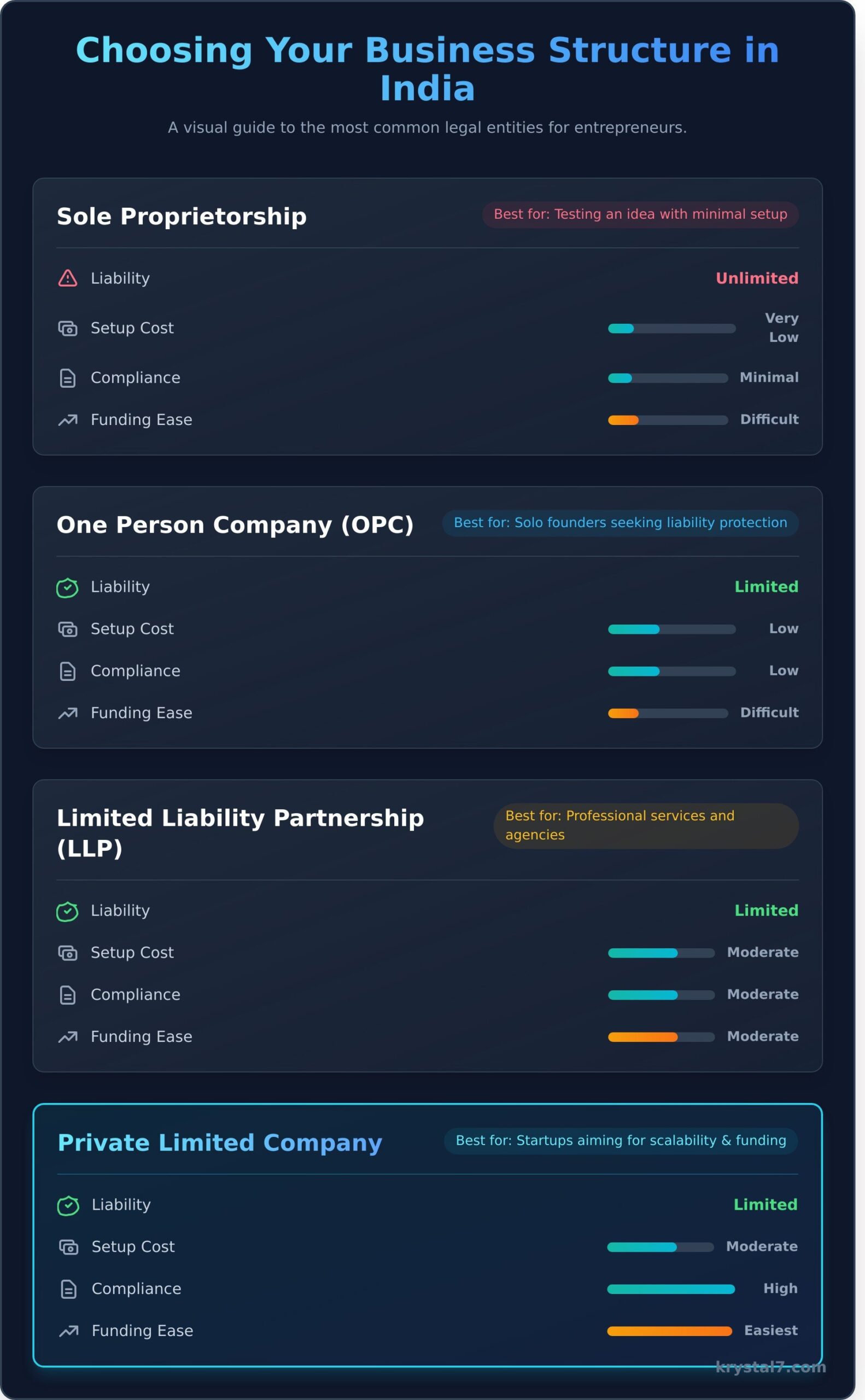
Choosing the right legal structure is the foundational step in your business registration journey in India. This decision impacts everything from your personal liability and tax obligations to your ability to raise funds for growth. The ideal choice aligns with your long-term vision, the number of owners, and your appetite for risk. Let’s bring clarity to the most common business entities to help you make an informed decision.
| Feature | Sole Proprietorship | One Person Company (OPC) | LLP | Private Limited Company |
|---|---|---|---|---|
| Liability | Unlimited | Limited | Limited | Limited |
| Setup Cost | Very Low | Low | Moderate | Moderate |
| Compliance | Minimal | Low | Moderate | High |
| Funding Ease | Difficult | Difficult | Moderate | Easiest |
Sole Proprietorship vs. One Person Company (OPC)
For the solo entrepreneur, the choice is often between these two. A Sole Proprietorship is the simplest to start with minimal paperwork, but it offers no separation between you and the business-your personal assets are at risk (unlimited liability). An OPC, however, provides the crucial benefit of limited liability, protecting your personal assets while giving your venture a separate legal identity, making it a safer choice for a single founder with growth ambitions.
Partnership Firm vs. Limited Liability Partnership (LLP)
When two or more individuals co-found a venture, they can choose a traditional Partnership Firm or an LLP. A Partnership is governed by a simple deed but exposes all partners to unlimited liability for the business’s debts. In contrast, an LLP is a modern hybrid, offering the flexibility of a partnership with the vital protection of limited liability. This makes LLPs a widely preferred structure for service-based professionals like consultants, architects, and creative agencies.
Private Limited Company (Pvt Ltd)
The Private Limited Company is the most popular and robust structure for startups aiming for scalability and external funding. It is recognized as a separate legal entity, which limits shareholder liability, enhances brand credibility, and allows for the easy transfer of ownership through shares. While it involves higher compliance, such as mandatory audits and regular filings through the official Ministry of Corporate Affairs (MCA) portal, its structure is essential for attracting angel investors and venture capitalists. Feeling overwhelmed by the options? Let our experts provide the clarity you need. Get a free consultation to choose the right structure.
The Step-by-Step Business Registration Process (for Pvt Ltd)
Navigating the path to incorporating a Private Limited Company in India involves a structured, digital-first approach through the Ministry of Corporate Affairs (MCA) portal. While the process is streamlined, every detail matters. Accuracy at each stage is crucial to prevent rejections and ensure a smooth, hassle-free launch for your venture. This guide provides Krystal-Clear clarity on the complete business registration journey.
Phase 1: Pre-Registration Essentials
This initial phase is about laying the digital groundwork for your company’s identity and its directors. It involves securing the necessary credentials to interact with the MCA system.
- Step 1: Obtain Digital Signature Certificate (DSC): A DSC is the digital equivalent of a physical signature, used to securely sign electronic documents. All proposed directors must obtain a Class 3 DSC from a certified authority.
- Step 2: Apply for Director Identification Number (DIN): The DIN is a unique lifetime identification number assigned to any individual wanting to be a director. This is now applied for directly within the main incorporation form.
- Step 3: Reserve a Unique Company Name: Using the MCA’s RUN (Reserve Unique Name) service, you can submit your proposed company names. It’s vital to choose a name that is unique, relevant, and not in violation of trademark laws to ensure approval.
Phase 2: Filing Incorporation Documents
With the prerequisites in place, you can now draft and file the core legal documents that will define your company. This is the most critical part of the process.
- Step 4: Draft the MoA and AoA: The Memorandum of Association (MoA) defines your company’s objectives and scope, while the Articles of Association (AoA) outline its internal governance rules. These are the constitutional documents of your company.
- Step 5: Fill and Submit the SPICe+ Form: The SPICe+ (INC-32) is a sophisticated, integrated web form that has revolutionized the incorporation process. It cleverly combines applications for name reservation, DIN allotment, incorporation, PAN, TAN, and even GSTIN into a single submission, eliminating redundant paperwork.
Phase 3: Receiving Your Certificate
This final phase marks the official birth of your company. After submission, your application undergoes official review, culminating in the issuance of your incorporation certificate.
- Step 6: Scrutiny by the Registrar of Companies (RoC): An official from the RoC will meticulously examine your SPICe+ form and all attached documents. If everything is in order, your application is approved.
- Step 7: Issuance of the Certificate of Incorporation (COI): Upon approval, the MCA issues the Certificate of Incorporation. This legally binding document includes your unique Corporate Identity Number (CIN) and signifies that your company is officially registered and ready to operate.
Essential Documents Required for Business Registration
Embarking on your entrepreneurial journey in India begins with a crucial step: gathering the right paperwork. A well-prepared set of documents is the key to a streamlined and hassle-free process, eliminating potential delays and rejections from regulatory bodies. Ensuring every document is clear, valid, and up-to-date is non-negotiable. Many of these documents will require self-attestation, and in some specific cases, notarization may be necessary.
Documents for Directors and Shareholders
Every individual who will serve as a director or shareholder in the company must provide a standard set of identification documents for Know Your Customer (KYC) compliance. This provides transparency and establishes the legal identity of the company’s stakeholders.
- PAN Card: A mandatory, self-attested copy for all Indian nationals. The PAN is a primary identifier for all financial and business transactions in India.
- Identity Proof: A clear, self-attested copy of an Aadhaar Card, Passport, Driver’s License, or Voter ID Card.
- Address Proof: The latest copy (not older than two months) of a telephone bill, electricity bill, or a bank account statement showing the current address.
- Photographs: Recent, clear passport-sized photographs of every proposed director and shareholder.
Documents for the Registered Office
Your company’s registered office is its official address for all formal communications. The Ministry of Corporate Affairs (MCA) requires valid proof of this address to complete the incorporation.
- Proof of Address: A recent utility bill, such as an electricity or telephone bill (not older than two months), is required as proof.
- If Rented: You must provide a copy of the valid rental agreement along with a No Objection Certificate (NOC) from the property owner, explicitly granting permission to use the premises as the company’s registered office.
- If Owned: A copy of the property deed or sale deed is required as conclusive proof of ownership.
Other Key Information Needed
Beyond the paperwork, finalising key strategic details is essential before initiating the business registration process. This information forms the core of your company’s legal identity and operational framework.
- Proposed Company Name: A unique name for your venture that is not identical or too similar to any existing company or trademark.
- Business Objectives: A detailed description of the primary business activities the company will engage in.
- Share Capital Structure: Clear details on the authorised and paid-up share capital, along with the proposed shareholding pattern among the founders.
Compiling these documents correctly provides the clarity you need for a successful incorporation. For expert guidance ensuring every document is perfectly in order, the team at Krystal7 is here to help you build your venture on a solid foundation.
Post-Registration Compliance: What Happens Next?
Congratulations on successfully incorporating your company! This is a significant milestone. However, your journey into the world of statutory requirements has just begun. Completing the business registration process is the foundational step, but maintaining compliance is what ensures your venture’s long-term health and credibility. Neglecting these post-registration duties can lead to severe penalties, fines, and even director disqualification, creating unnecessary hurdles for your growth.
Think of compliance not as a burden, but as the framework that supports your business vision. At Krystal7, we provide the clarity you need to navigate this landscape, giving you the freedom to focus on what you do best: building your business.
Immediate First Steps
Once you receive your Certificate of Incorporation, a few critical tasks must be completed immediately to make your company fully operational and compliant from day one.
- Apply for PAN and TAN: Your company’s Permanent Account Number (PAN) and Tax Deduction and Collection Account Number (TAN) are essential for all financial transactions and tax filings. This is often streamlined through the SPICe+ form during incorporation.
- Open a Business Bank Account: All transactions must be conducted through a dedicated current account in the company’s legal name.
- Deposit Share Capital: The initial subscribers to the Memorandum of Association (MOA) must deposit their share capital contribution into the company’s new bank account.
Key Business Registrations
Beyond the initial incorporation, your business may require several other licenses and registrations depending on its turnover, location, and nature of operations. These are not optional and are critical for legal operation.
- GST Registration: Mandatory if your annual turnover exceeds the prescribed threshold (₹40 lakh for goods and ₹20 lakh for services in most states).
- Professional Tax Registration: Required in most Indian states for the company as an entity and for its employees.
- Shops and Establishment Act License: A state-specific license required if you operate from a commercial or retail premise.
Ongoing Annual Compliance
Staying compliant is a continuous process. The Companies Act, 2013, mandates several annual filings and activities to ensure transparency and accountability. Failing to meet these deadlines can attract heavy penalties.
- Appoint an Auditor: The first statutory auditor must be appointed by the Board of Directors within 30 days of incorporation.
- Annual Filings with RoC: You must file your annual financial statements (Form AOC-4) and Annual Return (Form MGT-7) with the Registrar of Companies (RoC) every year.
- Conduct Meetings: Holding regular board meetings and at least one Annual General Meeting (AGM) is mandatory, with proper minutes recorded.
Navigating this complex web of statutory duties can be overwhelming. Don’t let compliance challenges hinder your vision. Let us manage your annual compliance so you can focus on growth.
Your Journey from Idea to Official Enterprise Starts Here
Embarking on your entrepreneurial journey in India begins with one foundational step: formalizing your venture. As this guide has shown, selecting the right business structure and preparing the necessary documents are not just legal formalities; they are the strategic cornerstones that protect your vision and pave the way for sustainable growth.
The business registration process, while detailed, is the official launchpad for your dream. But you should not have to navigate the complexities of compliance and paperwork alone. Your energy is best spent building your business, not getting lost in red tape.
Let Krystal7 bring Krystal-Clear clarity to your launch. Our all-in-one solution is built on Chartered Expertise & Professional Guidance, ensuring a seamless and streamlined process. With our Krystal-Clear Transparent Pricing and a Dedicated Relationship Manager for Your Business, you gain a trusted partner and the freedom to focus on what truly matters.
Ready to launch your dream venture? Explore our All-in-One Company Incorporation Package today! Take the definitive step to transform your vision into a recognized business legacy.
Frequently Asked Questions
How much does it cost to register a business in India?
The cost of business registration in India depends heavily on the type of entity you choose. A Sole Proprietorship is the most affordable, often costing under ₹2,000. For a Private Limited Company, costs can range from ₹6,000 to ₹15,000, covering government fees, stamp duty, and professional charges. We believe in Krystal-Clear pricing, ensuring you understand every expense involved, so you can plan your venture’s finances with confidence and clarity from day one.
How long does the entire business registration process take?
The timeline for registering your business varies by structure. A Sole Proprietorship can be established in as little as 2-3 days. However, incorporating a Private Limited Company or an LLP is a more detailed process, typically taking between 10 to 20 working days, subject to government processing times. Our streamlined approach is designed to navigate this efficiently, removing delays and giving you the freedom to focus on your business launch sooner.
Can I register a business in India without a physical office address?
Yes, you can. While a registered office address is a mandatory requirement for company registration, it does not need to be a commercial property. You can use your residential address, provided you have a No Objection Certificate (NOC) from the property owner. Alternatively, entrepreneurs often use virtual office services, which provide a professional address and mail-handling facilities. This flexibility helps you start your venture with lower initial overheads and greater agility.
What is the difference between a business name and a trademark?
A business name is the legal name your entity is registered under with the Ministry of Corporate Affairs (MCA), like “Innovate Solutions Pvt. Ltd.” It identifies your company legally but offers no brand protection. A trademark, on the other hand, protects your brand name, logo, or slogan from being used by competitors nationwide. Registering a trademark is a crucial step to secure your unique brand identity and build a lasting business legacy. To understand the complete cost structure for protecting your brand, refer to our comprehensive guide on trademark registration fees in India.
Do I need a lawyer or a CA to register my company?
While it’s not a strict legal mandate, engaging a Chartered Accountant (CA), Company Secretary (CS), or a lawyer is highly advisable for registering a company like a Private Limited or LLP. The process involves complex legal documentation, digital signatures, and filings with the MCA. Partnering with an expert ensures your business registration is compliant and error-free, saving you from potential hassles and penalties down the line and setting a strong foundation for your growth.
What is a Corporate Identity Number (CIN) and where do I find it?
A Corporate Identity Number (CIN) is a unique 21-digit alphanumeric code assigned by the Registrar of Companies (ROC) to every company registered in India, such as a Private Limited Company or One Person Company. It acts as a distinct identifier for all regulatory purposes. You can find your company’s CIN on its Certificate of Incorporation and by searching for your company details on the public Master Data portal of the Ministry of Corporate Affairs (MCA) website.

Article by
Nihal Srivastava
Nihal Srivastava is the Co-Founder of Krystal7 Consultants, helping Indian entrepreneurs and startups navigate company registration, compliance, trademark protection, and regulatory requirements with clarity and confidence. With 6+ years of hands-on expertise in MCA filings, GST compliance, and corporate structuring, Nihal has guided 1000+ businesses across India through their legal and compliance journeys. He believes every business dream deserves crystal clear foundations, and that no founder should be held back by paperwork or red tape.