
First Board Meeting After Incorporation: A Complete Agenda & Checklist
The journey from a business idea to a registered company in India is a monumental achievement. But with the certificate of incorporation in hand, a new wave of questions can feel overwhelming. What are the immediate legal obligations? How do you avoid the common compliance pitfalls that new ventures face? The answer lies in conducting a structured and compliant first board meeting after incorporation – a pivotal event that sets the entire foundation for your company’s governance and future growth.
This is where the guesswork ends. We’ve created this comprehensive guide to bring Krystal-Clear clarity to the process, transforming this statutory requirement from a source of anxiety into an empowering first step. Inside, you’ll find a complete agenda and a step-by-step checklist to confidently navigate every critical decision, from appointing officers to opening a corporate bank account. Let’s ensure your vision is built on a solid, compliant, and secure foundation, giving you the freedom to focus on what you do best: growing your business.
Why Your First Board Meeting is a Non-Negotiable Milestone
Congratulations on incorporating your company! This is a monumental step in transforming your vision into a tangible business legacy. While your Certificate of Incorporation gives the company a legal identity, the first board meeting after incorporation is the event that breathes life into it, turning a paper entity into an operational reality.
This inaugural meeting is far more than a procedural formality. It is a critical milestone that establishes your company’s formal governance structure from day one. It lays the essential legal and strategic groundwork, providing the clarity and authority needed to move forward with confidence and purpose. Getting this right sets the precedent for all future compliance and decision-making.
The Legal Mandate: What the Companies Act, 2013 Says
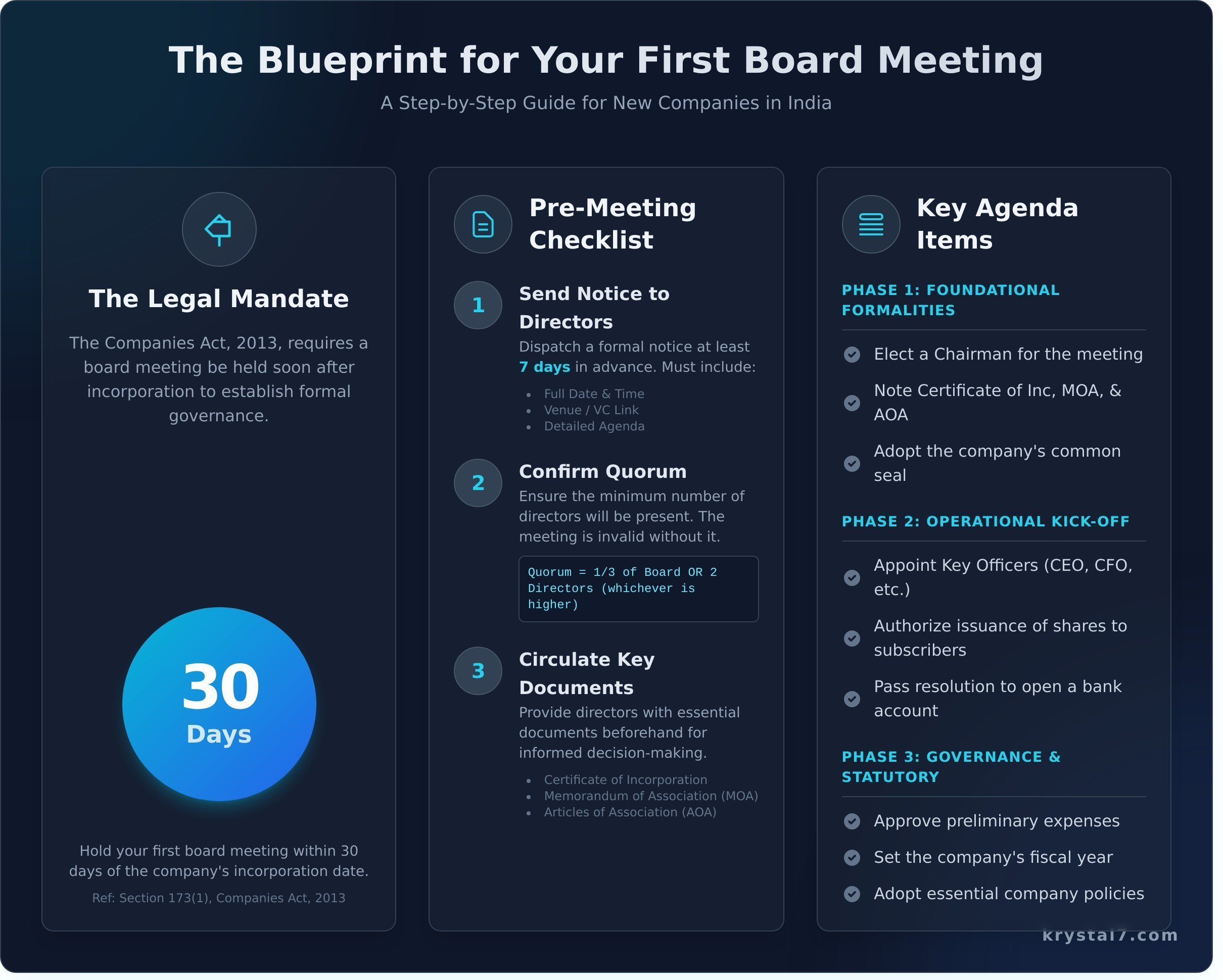
In India, the requirement for this meeting is not a suggestion-it’s a statutory command. Section 173(1) of the Companies Act, 2013, mandates that every company must hold its first board meeting within 30 days of its incorporation date. Non-compliance can result in penalties for the company and its directors, an avoidable hassle for any new venture. This meeting is your first official act of corporate governance, demonstrating your commitment to statutory compliance from the outset.
The Strategic Importance: Laying Your Company’s Foundation
Beyond compliance, the strategic value of your first board meeting after incorporation cannot be overstated. This is where the foundational decisions are formally ratified, giving your business the operational framework it needs to thrive. This meeting is where you formally establish the leadership team and clarify the duties and responsibilities of a board of directors, setting the stage for clear accountability.
Key strategic actions taken during this meeting typically include:
- Appointing Key Officers: Formally appointing the Chairperson of the Board, CEO, CFO, and Company Secretary.
- Formalising Capital Structure: Authorising the issuance of shares to subscribers and formally recording the initial capital infusion.
- Authorising Operations: Passing resolutions to open the company’s first bank account, adopt a common seal, and approve preliminary expenses.
- Establishing Governance: Adopting essential company policies and setting the fiscal year.
Think of this meeting as the moment your company’s blueprint becomes its bedrock, providing the stable foundation required for sustainable growth.
Preparing for Success: How to Convene Your First Board Meeting
A successful first board meeting after incorporation begins long before anyone enters the boardroom. Meticulous preparation is not just a best practice; it’s a statutory requirement that safeguards the validity of every decision made. Failing to follow the correct procedure can render your resolutions void, creating significant legal and operational hurdles down the line. This guide provides the clarity you need to convene your meeting with confidence, ensuring a smooth, compliant, and productive start to your company’s governance journey.
Drafting and Sending the Notice of Meeting
As per India’s Companies Act, 2013, a formal notice must be sent to every director at their registered address (including email). This notice should be dispatched to provide at least seven clear days of notice before the meeting date. It is crucial that the notice contains all essential details to be legally compliant:
- The full date and time of the meeting.
- The complete venue address or video conferencing link.
- A detailed agenda outlining the specific business to be transacted.
Understanding Quorum Requirements
A ‘quorum’ is the minimum number of directors who must be present for a board meeting to be legally valid. In India, the standard quorum is one-third of the total strength of the Board or two directors, whichever is higher. Without a quorum, the meeting cannot proceed, and any business conducted is legally unenforceable. Verifying that you will meet the quorum is a critical, non-negotiable step to ensure your meeting’s legitimacy.
Circulating the Agenda and Initial Documents
The agenda is your roadmap for the meeting, ensuring every critical point is addressed efficiently. For a practical template, you can review this Sample First Board Meeting Agenda to structure your own. To empower your directors for informed decision-making, you must circulate this agenda along with foundational corporate documents beforehand, including copies of the Memorandum of Association (MOA), Articles of Association (AOA), and the Certificate of Incorporation.
This simple act of preparation gives every director the freedom to focus on strategic decisions, rather than spending valuable meeting time getting up to speed. For a streamlined process, consider creating a simple pre-meeting checklist for all attendees to ensure everyone arrives prepared and aligned.
The Definitive Agenda: 10 Key Items for Your First Board Meeting
Your company is officially incorporated-a milestone worth celebrating. Now, it’s time to build the foundation for governance and growth. This agenda serves as a clear, compliant roadmap for your first board meeting after incorporation. Following this structure ensures you address every critical legal and operational requirement, transforming potential complexity into streamlined action. We’ve organized these 10 essential items into three logical phases: foundational, operational, and statutory.
Foundational Formalities
These initial steps formally establish the meeting’s legitimacy and acknowledge the company’s legal framework. They are the bedrock upon which all future board decisions will be built.
- Elect a Chairman for the meeting: The first order of business is to appoint a director to preside over the meeting, ensuring proceedings are orderly and properly recorded.
- Note the Certificate of Incorporation, MOA, and AOA: The board must formally acknowledge the company’s key constitutional documents-the Certificate of Incorporation, Memorandum of Association (MOA), and Articles of Association (AOA)-placing them on record.
- Adopt the company’s common seal (if applicable): While no longer mandatory for all documents under the Companies Act, 2013, if your company chooses to have a common seal, it must be officially adopted by a board resolution.
Operational Setup
With the formalities complete, the focus shifts to making the company operational. These resolutions empower the company to transact financially, manage its affairs, and formalise its initial ownership structure.
- Approve the location of the Registered Office: The board must pass a resolution formally recording the company’s registered office address, which is the official address for all statutory correspondence from the Registrar of Companies (ROC) and other authorities.
- Pass a resolution to open a company bank account: A crucial step to manage finances, receive share capital, and pay expenses. The resolution should specify the bank and authorise designated directors to operate the account.
- Allot shares to the subscribers of the MOA: The board must formally allot shares to the initial subscribers as committed in the Memorandum of Association, and authorise the issuance of share certificates.
- Authorise payment of preliminary incorporation expenses: This resolution ratifies and approves the reimbursement of expenses incurred by the promoters or directors during the company formation process (e.g., filing fees, professional charges).
Statutory Appointments and Disclosures
The final phase addresses mandatory compliance requirements. These actions ensure transparency and establish the necessary roles for ongoing statutory obligations, providing a clear path for future governance.
- Appoint the First Auditors of the company: Within 30 days of incorporation, the board must appoint the company’s first statutory auditor, who will hold office until the conclusion of the first Annual General Meeting (AGM).
- Take note of the directors’ disclosure of interest (Form MBP-1): Each director must formally disclose their interest in other companies or firms by submitting Form MBP-1. This is a critical step for ensuring transparency and avoiding conflicts of interest.
- Authorise a director to handle statutory filings with the ROC: To streamline compliance, the board should authorise one or more directors to sign and file various forms, returns, and documents with the Registrar of Companies and other government bodies.
Creating the Official Record: Mastering Board Minutes and Resolutions
What happens in the boardroom doesn’t stay in the boardroom. Every discussion, decision, and directive from your first board meeting after incorporation must be meticulously documented. This official record, known as the ‘minutes of the meeting’, is not just good corporate governance-it’s a statutory requirement under the Companies Act, 2013. Properly drafted minutes provide indisputable proof of the board’s actions, protecting the company and its directors from future disputes and ensuring crystal-clear compliance.
What are Minutes of the Meeting?
Minutes are the formal, written record of the proceedings of a meeting. They serve as the official evidence of the business transacted. In India, these must be prepared and entered into a dedicated minute book within 15 days of the meeting’s conclusion. To be legally valid, the minutes must be signed by the Chairman of the meeting, confirming their accuracy and finality.
Key Components of Effective Minutes
To ensure your minutes are compliant and comprehensive, they must contain specific details. Vague notes are not enough; clarity is essential. Every set of minutes should include:
- Meeting Identification: The type of meeting (e.g., Board Meeting), serial number, date, time, and location (physical address or virtual platform).
- Attendance Record: A list of all directors present, noting who attended in person or via video conference. It should also record any apologies for absence from directors who could not attend.
- Decisions Made: A clear and concise record of each resolution passed under the relevant agenda item, including the names of the directors who proposed and seconded the motions.
Understanding Board Resolutions
While minutes record the entire proceeding, a resolution is the formal text of a specific decision made by the board. When a motion is voted on and approved by the required majority, it is considered ‘passed’ and becomes a formal board resolution. This is the legally binding expression of the board’s will. For example, a resolution to open a company bank account during the first board meeting after incorporation would be worded formally.
Example Resolution:
“RESOLVED THAT a current bank account be opened in the name of [Your Company Name] with [Bank Name], [Branch Address].
RESOLVED FURTHER THAT Mr./Ms. [Director’s Name], Director, and Mr./Ms. [Another Director’s Name], Director, be and are hereby jointly authorised to sign and execute all documents and papers on behalf of the company in this regard.”
Mastering this documentation provides the clarity and legal foundation your new venture needs to thrive. For expert assistance in streamlining your corporate compliance, visit us at krystal7.com.
Beyond the First Meeting: Setting Up for Annual Compliance
Congratulations on concluding a successful first board meeting. This foundational event is not the end of your corporate formalities but the beginning of your company’s compliance journey. The resolutions passed and decisions made now require action to ensure your business remains in good standing with the Registrar of Companies (ROC).
Think of it as setting the course. Your first board meeting after incorporation charted the direction; now, it’s time to navigate the waters of annual compliance with clarity and confidence.
Immediate Post-Meeting Filings
Certain critical decisions from your meeting trigger immediate filing requirements with the ROC. Missing these deadlines can lead to unnecessary penalties. Key forms to file include:
- Form INC-22: If your registered office address was not finalized during incorporation, this form must be filed to notify the ROC of the official address. The deadline is within 30 days of incorporation.
- Form ADT-1: This form is used to intimate the ROC about the appointment of your company’s first statutory auditor. It must be filed within 15 days of the board meeting in which the auditor was appointed.
Establishing a Compliance Calendar
Proactive management is the key to avoiding last-minute stress and non-compliance. Establishing a simple compliance calendar helps you stay ahead of statutory deadlines throughout the year. Map out key dates for:
- Subsequent Board Meetings (at least one per quarter)
- Annual General Meeting (AGM)
- Annual ROC Filings (Forms AOC-4 and MGT-7)
- Other event-based compliance as needed
This roadmap removes the guesswork and brings predictability to your legal obligations. For entrepreneurs who want the freedom to focus on their vision, professional support is a powerful asset. Let us handle your compliance, so you can focus on growth.
Why Ongoing Compliance Matters
Maintaining diligent compliance is about more than just avoiding hefty penalties. It is fundamental to building a sustainable and trustworthy business. Consistent compliance maintains your company’s “Active” status, which is crucial for daily operations. More importantly, it builds a foundation of trust with investors, lenders, and partners, signaling that your venture is managed with professionalism and integrity from day one.
Your First Meeting: The Cornerstone of Corporate Governance
Your inaugural board meeting is far more than a formality; it’s the foundational act of corporate governance that transforms your vision into a legally sound entity. By meticulously preparing an agenda, appointing key officers, and formally documenting every decision, you establish a framework for transparent operations and future growth, setting a professional precedent for all proceedings to come.
Successfully conducting your first board meeting after incorporation lays the groundwork, but the journey of compliance is just beginning. Navigating the complexities of statutory filings and annual requirements can quickly pull your focus away from your core mission. This is where Krystal7 brings clarity. Let our team of top-tier Chartered Accountants and Company Secretaries manage the regulatory maze for you.
With a dedicated relationship manager for your business and transparent pricing with no hidden costs, you gain the freedom to focus on what truly matters: building your legacy. Ensure Krystal-Clear compliance from day one. Explore our Annual Compliance Package. Your venture deserves a foundation as strong as your vision. Build it with confidence.
Frequently Asked Questions
What happens if we miss the 30-day deadline for the first board meeting?
Missing the 30-day deadline is a statutory non-compliance under the Companies Act, 2013. This can lead to penalties for both the company and its directors, potentially amounting to ₹25,000 for the company and ₹5,000 for each defaulting officer. It is crucial to adhere to this timeline to establish good corporate governance from the outset and avoid unnecessary legal complications. Proactive compliance gives you the freedom to focus on growing your business.
Can the first board meeting be held online via video conference?
Absolutely. The first board meeting after incorporation can be conducted online via video conferencing, as permitted by the Companies Act, 2013. This provides flexibility and efficiency for directors in different locations. To ensure compliance, you must maintain proper records of the meeting, including a recorded transcript, and follow prescribed procedures for virtual attendance and voting. This modern approach helps streamline your initial statutory duties, bringing clarity to the process from the very beginning.
Do we need a Company Secretary present at the first board meeting?
The mandatory presence of a Company Secretary (CS) depends on your company’s paid-up share capital. For most startups and private limited companies below the ₹10 Crore threshold, it is not a statutory requirement. However, having a CS or a qualified professional present is highly advisable. Their expertise ensures that the meeting’s agenda, resolutions, and minutes are perfectly aligned with the Companies Act, 2013, removing guesswork and setting a high standard for compliance.
What is the difference between the first board meeting and the first Annual General Meeting (AGM)?
The key difference lies in the attendees and purpose. The first board meeting is for directors only, focused on initial operational decisions like appointing auditors and opening bank accounts. In contrast, the first Annual General Meeting (AGM) is a meeting of the company’s shareholders (the owners). The AGM is held later to approve annual financial statements, declare dividends, and appoint directors, giving shareholders oversight of the company’s performance and governance.
Where should the minutes of the board meetings be kept?
The minutes of every board meeting, including the first one, must be meticulously recorded and maintained in a Minute Book. This official record must be kept securely at the company’s registered office in India, as mandated by the Companies Act, 2013. Whether you maintain the Minute Book in physical or electronic form, ensuring it is properly signed and stored is crucial for statutory compliance and serves as the official evidence of the board’s decisions.
Is a common seal still mandatory for a private limited company in India?
A common seal is no longer mandatory for a private limited company in India. Following the Companies (Amendment) Act, 2015, having a common seal is now optional. Important documents can be legally executed by the signature of two directors, or by one director and the Company Secretary, if one has been appointed. This change has streamlined the execution process for official documents, reducing a layer of administrative hassle for new ventures.