

Opening a Company Bank Account in India: The 2026 Founder’s Guide
Your business is officially incorporated, the vision is set, but a critical hurdle remains: your capital is inaccessible, caught in procedural limbo. For many founders, the seemingly straightforward task of opening a company bank account in India quickly devolves into a frustrating cycle of unexpected document requests and confusing choices between PSU, Private, and emerging Neo-banks. This red tape doesn’t just cause delays; it stalls momentum at the most crucial stage of your venture.
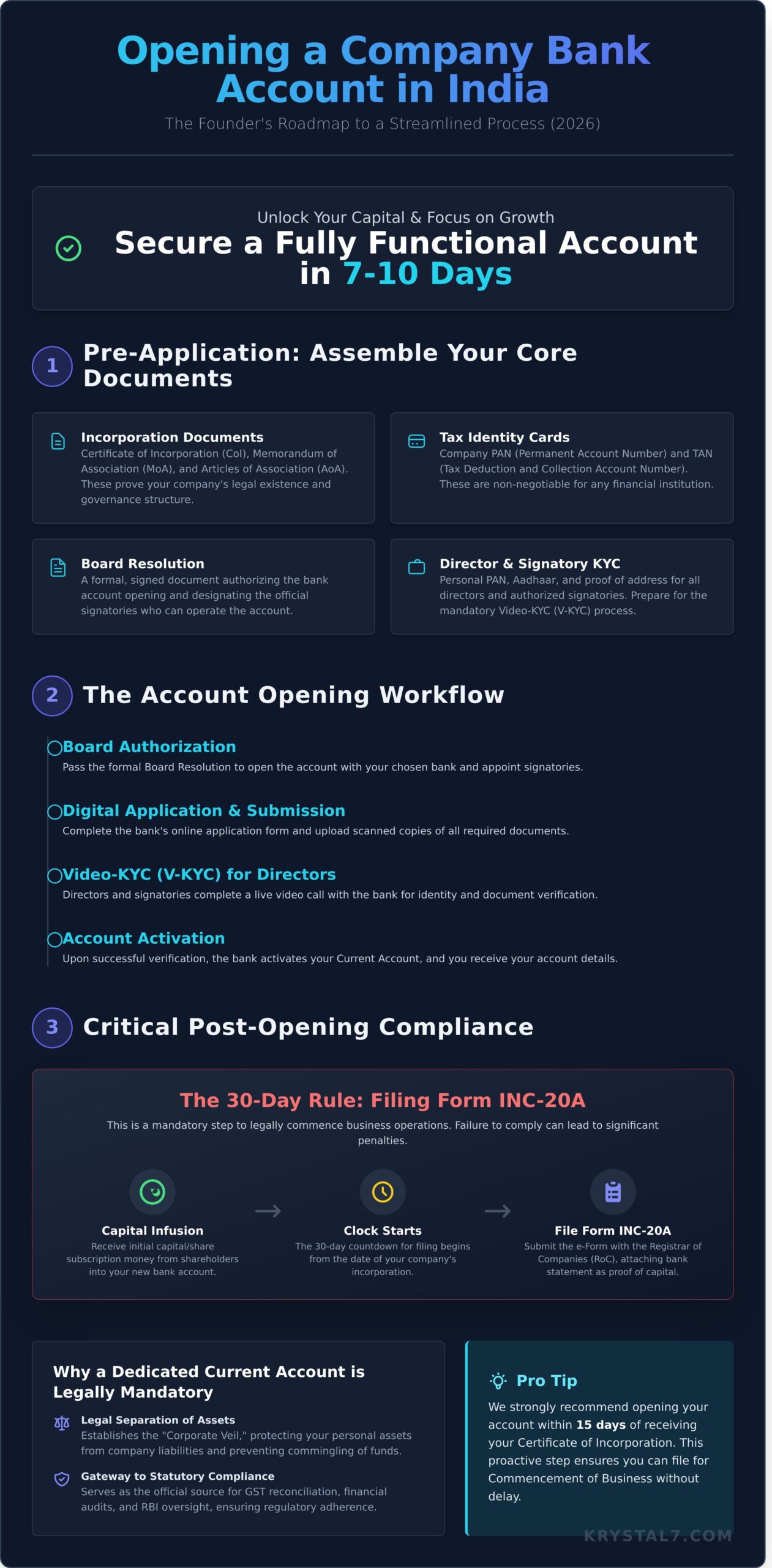
This is where clarity becomes your greatest asset. Our 2026 Founder’s Guide is engineered to eliminate the guesswork and empower you with a streamlined, predictable path forward. We provide a crystal-clear roadmap covering everything from a definitive documentation checklist to a strategic framework for selecting the right banking partner for your specific needs. Prepare to master the complexities of corporate banking and secure a fully functional, compliance-ready account within 7-10 days, giving you the freedom to focus on growth.
Key Takeaways
- Gain clarity on why a dedicated Current Account is legally mandatory for your venture, serving as the financial core for all statutory payments and operations.
- Streamline your application by preparing the complete document checklist and confidently navigating the 2026 Video-KYC (V-KYC) process for directors.
- Master the step-by-step process for opening a company bank account in india, ensuring your Board Authorization and digital document submission are handled flawlessly.
- Secure your business by understanding crucial post-opening compliance, such as the 30-day rule for filing form INC-20A after capital infusion.
The Strategic Role of a Current Account in Your Indian Venture
Upon incorporating your company, one of the most critical next steps is establishing its financial identity. This isn’t just a matter of convenience; it’s a foundational pillar of your business’s legal and operational structure. A company Current Account is a specialised transactional account designed exclusively for business entities. Using a personal or savings account for company transactions is legally prohibited in India, as it blurs the lines between personal and corporate finances, creating significant compliance risks.
Think of your Current Account as the heart of your venture’s financial operations. It is the central hub through which all monetary activities flow-from receiving client payments and processing employee payroll to settling vendor invoices and remitting statutory dues like GST. For foreign-backed entities, the Reserve Bank of India (RBI) mandates a domestic bank account to ensure regulatory oversight and transparent fund flow. Successfully opening a company bank account in India is your first step towards building a compliant and scalable business.
Legal Separation of Assets and Liability
The primary function of a dedicated business account is to establish a clear legal distinction between you and your company. Commingling personal and business funds is a major red flag for the Income Tax Department and can trigger immediate scrutiny. A Current Account helps erect the “Corporate Veil”-a legal concept that separates the company’s liabilities from the personal assets of its directors and shareholders. This protection is essential for mitigating personal risk.
The Current Account serves as the primary legal interface between a company and the Reserve Bank of India (RBI).
The Gateway to Statutory Compliance
Your company’s bank account is more than just a transactional tool; it is a crucial instrument for regulatory adherence. It serves as the official source of truth for financial audits, particularly for Goods and Services Tax (GST) reconciliation. Furthermore, proof of an active bank account is a prerequisite for filing the e-Form INC-20A (Certificate of Commencement of Business) with the Registrar of Companies-a mandatory step before your company can legally begin operations.
Krystal7 Insight: We strongly recommend opening your account within 15 days of receiving your Certificate of Incorporation. This proactive step ensures you can file for Commencement of Business without delay, avoiding potential penalties and providing the freedom to focus on growth.
As India’s financial ecosystem evolves, the process has become significantly more streamlined. The landscape is shifting toward instant, API-driven corporate onboarding, a change that simplifies procedures and enhances security. Navigating the options within this dynamic environment-from established public sector banks to agile private institutions detailed in this comprehensive overview of the Indian banking system-is key to finding a partner that aligns with your company’s digital and operational needs.
Essential Documentation and the 2026 KYC Framework
Navigating the documentation for opening a company bank account in India can seem daunting, but with clarity, it becomes a streamlined part of your business launch. The process is evolving, with a significant shift towards digital verification that promises a more efficient future. Understanding these requirements is the first step toward giving your business the financial foundation it needs to thrive.
The Standard Document Checklist
Think of these documents as the foundation of your company’s financial identity. Banks require this core set to ensure full compliance and establish your business’s legal standing. Getting these right from the start prevents unnecessary delays and removes the guesswork from the process.
- Certificate of Incorporation (CoI), MoA, and AoA: This is the holy trinity of your company’s existence. The CoI proves your company is legally registered, while the Memorandum and Articles of Association outline its purpose and internal governance.
- PAN and TAN Cards: Your company’s Permanent Account Number (PAN) and Tax Deduction and Collection Account Number (TAN) are non-negotiable tax identities. Without them, no bank can proceed with the application.
- Board Resolution: A formal document, signed by the directors, that officially authorizes the opening of the bank account and designates the signatories. For a comprehensive overview of what banks expect, this Current Account Opening Documents: Complete Guide from Forbes offers excellent additional context.
Beyond these papers, the digital landscape is key. A Digital Signature Certificate (DSC) for directors is often used for online authentication, adding a secure layer to the process. Looking ahead to 2026, Video-KYC (V-KYC) is set to become the standard, allowing directors to verify their identity remotely via a live video call. Finally, every application must include a declaration of the Ultimate Beneficial Owner (UBO)-the individual(s) who ultimately own or control the company. This is a mandatory step for transparency and anti-money laundering compliance.
Special Requirements for Foreign Directors
For international founders, a few extra steps ensure your documents are recognized in India. The Apostille Process is a form of international certification that validates foreign-issued documents, like a director’s passport or proof of address. If a foreign parent company is involved, a specific board resolution from that entity may also be required. The good news? The old myth of mandatory “physical presence” is fading. With the rise of V-KYC, a fully digital-only process for opening a company bank account in India is becoming a reality, offering unprecedented freedom for global entrepreneurs.
Choosing the Right Partner: PSU, Private, or Neo-Banks?
Selecting the right institution is a critical step when opening a company bank account in India. Your choice between a Public Sector Unit (PSU), a private bank, or a modern neo-bank will define your day-to-day financial operations, transaction costs, and technological integration. This decision requires clarity, aligning your banking partner with your business vision and operational needs.
Public vs. Private Sector Banks
The traditional banking landscape offers a clear trade-off: stability versus service agility. Public Sector Banks like the State Bank of India (SBI) offer an unparalleled network and government-backed security, making them a dependable choice for businesses that prioritize stability. However, their processes can sometimes be less streamlined.
In contrast, private banks like ICICI, HDFC, and Axis Bank lead with technological innovation. ICICI is often recognized for its startup-friendly programs, while HDFC and Axis provide a robust tech-stack with advanced APIs, catering perfectly to fast-growing tech companies. Their fee structures often revolve around a higher Minimum Average Balance (MAB) but can offer more value through bundled digital services and clearer per-transaction costs.
The Neo-Banking Revolution in 2026
Neo-banks such as RazorpayX or Jupiter have disrupted the market by offering a superior digital experience. It’s crucial to understand they are not banks themselves; they are fintech platforms that partner with licensed scheduled banks to provide a legitimate current account. Their primary advantage is speed and convenience-often providing an instant account number and seamless integration with payroll and accounting software.
However, this convenience comes with a need for due diligence. To avoid any “shadow banking” risk, you must ensure your fintech partner is backed by a Tier-1 licensed bank. This guarantees your funds are secure and that the provider adheres to the stringent Reserve Bank of India’s KYC guidelines for all verification processes. A transparent declaration of their partner bank is the hallmark of a trustworthy platform.
So, which model fits your venture?
- For High Transaction Volume & Tech Integration: A leading private bank or a well-established neo-bank is your best fit.
- For Pan-India Physical Presence & Stability: A PSU remains a solid, traditional choice.
- For a Purely Digital, Hassle-Free Experience: Neo-banks are purpose-built for the modern, agile business.
The Step-by-Step Opening Process and Timeline
Navigating the formalities of opening a company bank account in India can be a streamlined and efficient experience. With most banks now offering digital-first solutions, the journey from application to activation is clearer than ever. We’ve broken down the entire process into four distinct, manageable steps to provide you with the clarity needed to get your business banking operational without delay.
Here is the typical path your application will follow:
- Step 1: Board Authorization: Your company’s Board of Directors must pass a resolution to open the bank account. This legal document also officially appoints the ‘Authorized Signatories’-the individuals empowered to operate the account on behalf of the company.
- Step 2: Digital Application: Using the bank’s corporate portal, you will fill out the application form and upload digital copies of all required documents, such as the Certificate of Incorporation, MOA, AOA, and Director KYC proofs.
- Step 3: KYC Verification: The bank will verify the identity and address of all directors and beneficial owners. This is now commonly completed via a swift Video KYC (V-KYC) call, though some banks may still require a physical verification.
- Step 4: Funding and Activation: Once verification is successful, you’ll make an initial deposit to fund the account. The bank will then dispatch your welcome kit, including your debit card and cheque book, and activate your corporate net banking credentials.
Avoiding the “KYC Loop” Delays
The most frequent cause of delay is a mismatch in KYC details. Banks meticulously cross-reference the information you provide with official records at the Ministry of Corporate Affairs (MCA). A simple discrepancy in an address or an outdated ID proof can lead to rejection, forcing you to restart. To ensure a smooth process, confirm that every detail on your application is an exact match with your company’s MCA filings. This diligence determines whether your account is opened instantly or takes up to 14 business days.
Setting Up Corporate Net Banking
Activating your account is just the beginning. To truly empower your financial operations, configure your corporate net banking for maximum efficiency and security. Set up “maker-checker” workflows to ensure no payment goes out without a second approval, a crucial control for growing businesses. Integrate your bank feed directly with accounting software like Tally or Zoho to automate reconciliation. For expert guidance on streamlining these financial workflows, the team at Krystal7 is always here to help.
Krystal7 Tip: Enable the ‘auto-fetch’ feature for GST challans within your net banking dashboard. This simple configuration streamlines your monthly tax filings and eliminates manual data entry, giving you back valuable time.
Post-Opening Compliance and the Krystal7 Advantage
Congratulations, your company bank account is active! But the journey doesn’t end here. Successfully opening a company bank account in India is a critical milestone that unlocks the next phase: mandatory post-incorporation compliance. Your new account is the primary tool for fulfilling these crucial legal obligations, and managing them correctly from day one provides the clarity you need to build a strong foundation for growth.
From capital infusion deadlines to annual audits, your bank statements become the official record of your company’s financial health. Here’s what you need to manage immediately:
- The 30-Day Rule: Within 30 days of incorporation, all subscribers to the Memorandum must deposit their share capital into the company’s bank account. This isn’t just a guideline; it’s a legal prerequisite.
- FDI Reporting: If your capital has come from outside India (Foreign Direct Investment), you must report the transaction to the Reserve Bank of India (RBI) through specific forms like the FCGPR. Missing these deadlines can lead to significant penalties.
- Annual Compliance: Your bank statements are the bedrock of your annual financial reporting. They provide the raw data for your bookkeeper, the evidence for your auditor, and the basis for your tax filings with the ROC and Income Tax Department.
Linking Banking to ROC Compliance
Your first major compliance task is filing Form INC-20A to receive your Certificate of Commencement of Business. Without this certificate, your company legally cannot trade, enter into contracts, or borrow funds. The proof required by the Ministry of Corporate Affairs (MCA) for this filing is your company’s bank statement, clearly showing the infusion of share capital from the initial subscribers. This step transforms your bank account from a simple account into a vital compliance instrument. Check our Annual Compliance Package to automate these steps and eliminate the guesswork.
Freedom to Focus: Let Krystal7 Consultants Handle the Red Tape
Navigating post-banking formalities can feel like a full-time job. At Krystal7 Consultants, we believe your energy is better spent building your vision. Our all-in-one approach integrates every step, from incorporation and bank account assistance to flawless annual compliance. Our dedicated relationship managers speak the language of both entrepreneurs and bankers, ensuring a smooth, streamlined process. We make compliance a “non-event” so you can have the freedom to focus on what truly matters: growing your business. Get Started with Krystal7 Consultants for a hassle-free India setup.
Your Next Step: From Compliance to Growth
As we’ve explored, selecting the right bank is a strategic decision, not just an administrative task. Understanding the 2026 KYC framework and the nuances between PSUs, private banks, and neo-banks are critical first steps for successfully opening a company bank account in India. While the process is detailed, it’s a foundational move that sets the stage for your financial operations and future growth.
This journey shouldn’t be a roadblock to your vision. Krystal7 provides the clarity you need to navigate this crucial step with confidence. Our team of top-tier CA and CS experts ensures every document is perfect, backed by transparent pricing with no hidden costs. With dedicated relationship management, you’re never left with guesswork. It’s time to trade complexity for clarity.
Ready to build your venture on a solid financial foundation? Streamline your business setup with Krystal7’s Incorporation Package and gain the freedom to focus on what truly matters: building your legacy.
Frequently Asked Questions
Can a foreign company open a bank account in India without an Indian director?
Yes, it is legally possible for a foreign national to be the sole director and open a corporate account. However, the process can be complex due to stringent FEMA regulations and individual bank KYC policies. Many banks prefer having a resident Indian director as it simplifies verification and provides a local point of contact. Appointing a resident director often leads to a more streamlined and faster account opening experience, bringing clarity to the compliance process.
What is the minimum balance required for a corporate current account in India?
The Minimum Average Balance (MAB) requirement varies significantly across different banks. Public sector banks may offer accounts with a lower MAB, often starting around ₹10,000. In contrast, private banks typically require a higher balance, ranging from ₹25,000 to over ₹1,00,000, in exchange for premium services and features. It is essential to compare the offerings to find an account that aligns with your company’s financial strategy and cash flow.
How long does it take to open a company bank account in 2026?
With all documentation correctly prepared and submitted, the timeline has become quite efficient. Most major banks in India can activate a new corporate bank account within 7 to 15 working days. Any delays are typically caused by incomplete KYC documents or issues in director verification. A meticulously prepared application is the key to a swift, hassle-free process, giving you the freedom to focus on your business operations.
Is it possible to open an Indian business bank account entirely online?
While the initial stages of the application can often be completed online, a completely digital process for company accounts is still uncommon. Most banks mandate at least one in-person visit by the authorized signatories for final identity verification and to sign the physical account opening form. This final step is crucial for security and compliance. Always check with your chosen bank for their most current and streamlined procedure.
Do I need a GST registration before opening a bank account?
No, GST registration is not a mandatory prerequisite for opening a company bank account in India. You can proceed with the application using your company’s PAN card and Certificate of Incorporation. However, once your business is registered for GST, you must update the bank with your GSTIN. This is a crucial step for maintaining compliance and ensuring your account is fully operational for all business transactions, including tax payments.
What happens if I don’t open a bank account within 30 days of incorporation?
While there is no direct 30-day penalty, a bank account is critical for a key compliance step: filing the Declaration of Commencement of Business (Form INC-20A). This must be done within 180 days of incorporation and requires proof of deposit of the subscribed share capital. Without a bank account, you cannot complete this filing, which can lead to significant penalties and potential action from the Registrar of Companies to strike off the company name.
Can I open multiple current accounts for the same company?
Absolutely. A company is permitted to open multiple current accounts with various banks or even different branches of the same bank. Businesses often do this to manage funds for different departments, separate collection and payment accounts, or take advantage of unique services offered by different financial institutions. This strategy can provide greater operational clarity and help streamline your financial management as your venture grows.
What is the difference between a Current Account and a Capital Account for FDI?
A Current Account is your primary operational account used for all day-to-day business transactions like paying salaries, receiving customer payments, and managing expenses. A Capital Account, in the context of Foreign Direct Investment (FDI), is a temporary, non-interest-bearing account opened specifically to receive investment funds from abroad. Once received, these funds are transferred to the Current Account for operational use, ensuring clear compliance with FEMA regulations.

Article by
Nihal Srivastava
Nihal Srivastava is the Co-Founder of Krystal7 Consultants, helping Indian entrepreneurs and startups navigate company registration, compliance, trademark protection, and regulatory requirements with clarity and confidence. With 6+ years of hands-on expertise in MCA filings, GST compliance, and corporate structuring, Nihal has guided 1000+ businesses across India through their legal and compliance journeys. He believes every business dream deserves crystal clear foundations, and that no founder should be held back by paperwork or red tape.