

Business Registration Without a Physical Office: A Guide for Indian Founders (2026)
Did you know that 98% of Indian professionals now prefer working remotely at least part-time? If your team is distributed across the country, signing a heavy commercial lease just to get a piece of paper from the government feels like an unnecessary burden. You can successfully complete your business registration without a physical office by using virtual office solutions that keep your startup lean. This strategy allows you to secure a professional presence in a prime business hub without the sting of high security deposits or the privacy risks of listing your home address on public portals.
It’s natural to feel anxious about Ministry of Corporate Affairs (MCA) requirements or the specifics of GST address verification. We’ll help you understand how to use the Companies Act, 2013, to ensure your registered office is 100% compliant. You’ll discover exactly which documents you need, such as the No Objection Certificate (NOC) and recent utility bills, to satisfy every regulatory check. This guide provides a clear roadmap to incorporation so you can focus on your long-term growth while we manage the procedural details.
Key Takeaways
- Understand the legal mandate of Section 12 of the Companies Act 2013 and how to satisfy it without a traditional commercial lease.
- Evaluate the pros and cons of using your residential address, including the privacy implications of public data on the MCA portal.
- Learn how to use virtual office solutions for business registration without a physical office to ensure 100% compliance with GST and MCA rules.
- Identify the essential documentation, such as No Objection Certificates and utility bills, needed to fast-track your incorporation process.
- Discover how professional vetting of your registered address can eliminate administrative burdens and lower your initial startup costs.
Understanding the Registered Office Requirement in India
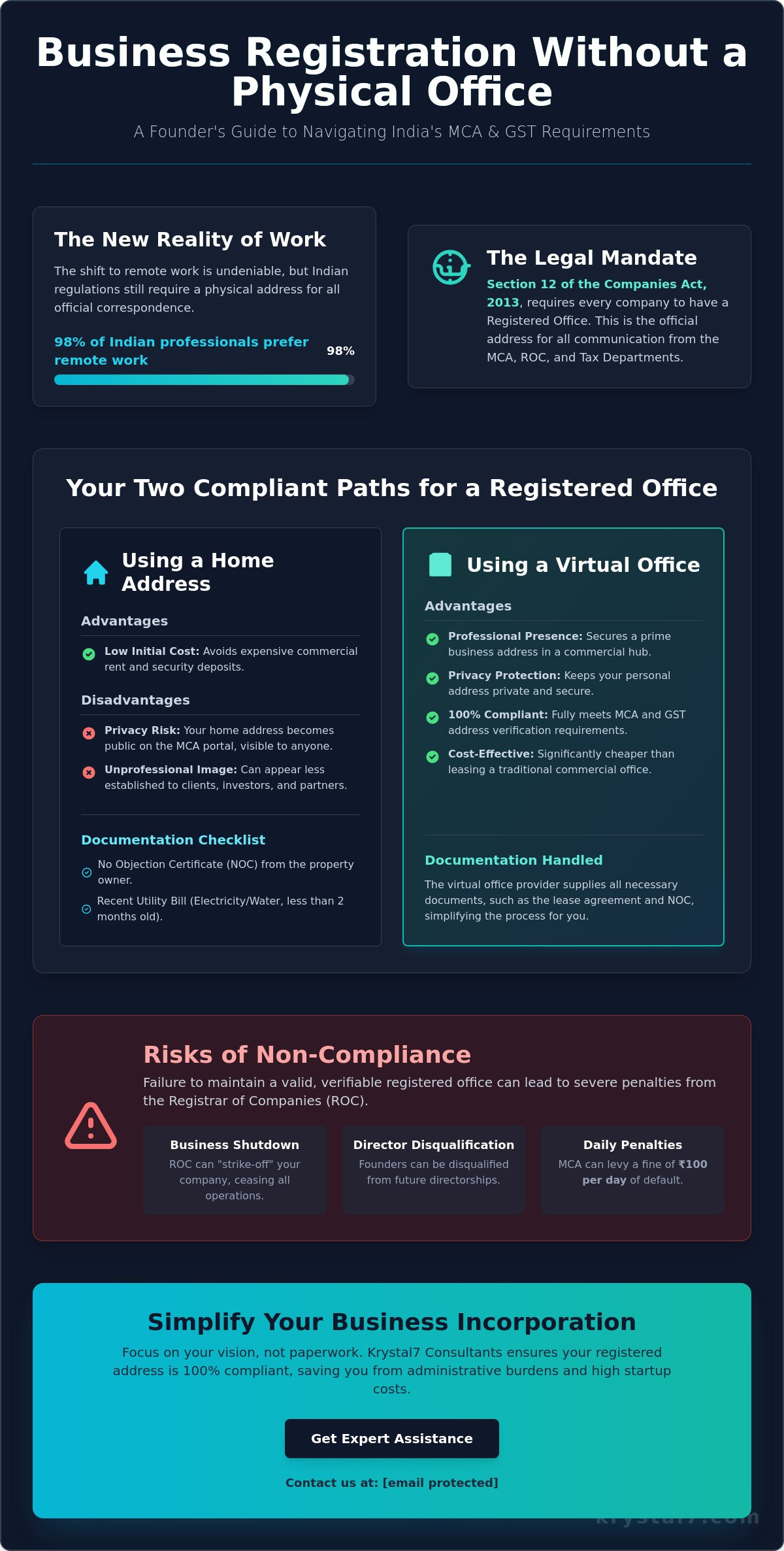
Every Indian company must establish a home base upon incorporation. Section 12 of the Companies Act, 2013, defines the “Registered Office” as the official address for all government correspondence. While the 2026 economy empowers remote-first startups, the Ministry of Corporate Affairs (MCA) still requires a physical point of contact. This address ensures the Registrar of Companies (ROC) can reach you for statutory notices or legal summons. You don’t need a traditional commercial lease to meet this standard. You can successfully navigate business registration without a physical office by choosing compliant alternatives that satisfy the law’s demand for transparency.
The ROC plays a critical role in verifying these locations to prevent the rise of “shell” companies. In our current digital-first environment, approximately 77% of Indian organizations plan to implement hybrid work models. This shift toward operational liberty doesn’t change the statutory requirement for a verifiable address. The ROC possesses the authority to conduct physical inspections to confirm that the business actually exists at its declared location. We handle the technicalities of this process so you can focus on building your vision without worrying about bureaucratic hurdles.
The Statutory Necessity for Business Registration Without a Physical Office
You must provide a verifiable address in your initial filing to obtain a Certificate of Incorporation. This location serves as the destination for all official mail from the GST portal, the Income Tax Department, and the MCA. Understanding the Registered Office Requirement is vital because it establishes your company’s legal domicile and jurisdiction. If you’re just starting, review our guide on company registration to see how this fits into your journey. Even when pursuing business registration without a physical office, your chosen address must acknowledge official documents to remain in good standing.
Consequences of Non-Compliance
Failing to maintain an active registered office carries heavy risks for any founder. The ROC often initiates a “suo motu” strike-off if they discover an office is non-existent or unreachable during a routine check. This action effectively shuts down your business operations and can disqualify you as a director. Under the latest 2026 MCA guidelines, the MCA levies a penalty of ₹100 for each day the default continues. These costs add up quickly and can drain your startup’s capital before you’ve even scaled. We ensure your documentation remains meticulous to protect your company from these avoidable financial burdens.
Can You Use Your Home Address for Company Registration?
The Ministry of Corporate Affairs (MCA) permits founders to use their residential address as a registered office. This is a common starting point for entrepreneurs seeking business registration without a physical office to keep initial costs low. While legally valid, this choice requires specific documentation to satisfy the Registrar of Companies. You must provide a No Objection Certificate (NOC) from the property owner along with a recent utility bill, such as electricity or water, dated within the last two months. Even if you own the property, an NOC is still necessary to formally authorize the business use of the premises.
Using a home address isn’t just about paperwork; it’s about transparency. Under the Companies Act, your registered address is a matter of public record. Anyone searching for your Corporate Identification Number (CIN) on the MCA portal can view your full home address. This lack of privacy can be unsettling for many founders. If you’re concerned about how this affects your corporate image, our private limited company india guide explains the importance of maintaining a professional front for investors and clients.
Privacy and Professionalism Concerns
A home address can sometimes signal a lack of scale to potential global partners or high-value clients. Beyond brand perception, the safety of your family is a factor to consider. Legal notices, tax summons, or even disgruntled vendors could show up at your front door. Many founders find that as their business grows, the need for a separate, professional identity becomes clear. You can explore how Virtual Office Solutions bridge this gap by providing a prestigious business address without the high overhead of a commercial lease. If you want to ensure your setup meets all professional standards, our experts at krystal7.com can review your address documentation before you file.
Zoning and Municipal Limitations
Local laws often complicate the use of residential spaces for business. In cities like Gurgaon or Bangalore, municipal bylaws strictly regulate commercial activities in residential zones. You might face unexpected challenges, such as:
- Commercial Utility Rates: Your electricity board might reclassify your connection, leading to significantly higher monthly bills.
- Property Tax Hikes: Municipal authorities often charge higher tax rates for properties used for commercial purposes.
- GST Verification Risks: Under Rule 25 of the CGST Rules, a GST officer can conduct a physical verification of your office. Having a government official inspect your living room can be intrusive and may lead to complications if the space doesn’t look like a functional place of business.
Before committing to a home-based registration, check your local zoning laws to avoid “commercial usage” notices. This due diligence ensures that your path toward business registration without a physical office remains compliant and stress-free.
Virtual Office Solutions: The Compliant Way to Register
A virtual office in India is a sophisticated compliance tool designed for the modern, remote-first entrepreneur. It provides the legal right to use a premium commercial address for business registration without a physical office, satisfying the stringent requirements of the Companies Act, 2013. This solution isn’t just about a mailing address; it’s about securing the specific documentation the government demands. A compliant provider gives you a formal rent agreement, a No Objection Certificate (NOC), and a utility bill dated within the last two months. These assets are vital for your SPICe+ application on the MCA portal.
Choosing this path grants you operational liberty. You’re no longer tethered to a specific city or burdened by the administrative weight of managing a physical facility. This transparency in your setup allows investors to see a lean, efficient business model that prioritizes growth over overhead. It also ensures your personal life remains private, as your home address stays off public government records.
Is a Virtual Office Legal for GST Registration?
GST authorities accept virtual offices provided they meet the standards for a “Principal Place of Business.” Under Rule 25 of the CGST Rules, officers can conduct physical verifications to ensure the business actually operates from the declared location. To pass this check, your virtual office must offer a dedicated space or a desk where your statutory registers and records are kept. We ensure that our recommended virtual office partners are fully GST-compliant, so you don’t face the anxiety of a rejected application or a sudden suspension of your GSTIN.
Cost-Benefit Analysis for Startups
The financial impact of skipping a traditional lease is immediate and transformative. In business hubs like Gurgaon, a private commercial lease often demands a massive security deposit and a long-term commitment. By utilizing a virtual office, you can reduce your initial setup costs by 60% to 80% based on 2026 market data. Consider the following comparison:
- Virtual Office: Low annual fee, zero maintenance, zero utility bills.
- Coworking Space: Monthly per-desk fees, shared amenities, moderate deposit.
- Private Lease: High monthly rent, 6-month security deposit, fit-out costs, and ongoing electricity charges.
Redirecting these savings into your core business operations allows you to scale faster. You aren’t just saving money; you’re buying the freedom to pursue your primary goals while we handle the meticulous documentation required for your professional standing.
Documentation Checklist for Registration Without a Traditional Office
Meticulous documentation forms the bedrock of a successful application with the Ministry of Corporate Affairs (MCA). The Registrar of Companies (ROC) scrutinizes every detail of your filing, and even a minor discrepancy can lead to a “resubmission” status that delays your launch. You can achieve business registration without a physical office by presenting a cohesive set of records that prove your legal right to use the declared address. Clear, high-quality scans of your documents significantly increase your chances of a smooth, one-time approval.
Essential Document Set for Business Registration Without a Physical Office
You must upload the following digital copies to the SPICe+ web form on the MCA portal during the incorporation process. These documents serve as the primary evidence for your registered office address:
- Rent Agreement or Lease Deed: You must provide the formal contract between the virtual office provider and your company. This document must clearly outline the terms of your usage rights.
- No Objection Certificate (NOC): You must include a certificate signed by the legal owner of the premises. It explicitly states that the owner has no objection to your company using the address as its registered office.
- Recent Utility Bill: You must present a copy of an electricity or gas bill that is not older than two months. This bill acts as proof of the property’s existence and its current utility status.
Ensuring MCA Approval for Your Business Registration Without a Physical Office
Address mismatches cause the majority of document rejections. You must ensure the address you type into the SPICe+ form matches the text on your utility bill exactly. If the bill lists “Suite 402, 4th Floor,” don’t shorten it to “402, 4F” in your application. The ROC relies on visual precision, and any deviation can trigger an objection regarding address clarity.
Navigating these requirements is a vital part of the broader how to register flow for Indian startups. If the paperwork feels overwhelming, our experts can help you organize and verify every file before you hit submit. You can get expert assistance with your company incorporation package to ensure your documentation meets every statutory standard from day one. This methodical approach protects your professional standing and gets your business operational without unnecessary bureaucratic hurdles.
Simplifying Your Business Incorporation with Krystal7 Consultants
Starting a business in India often feels like navigating a dense regulatory maze. You shouldn’t let the lack of a commercial lease stop your momentum. We specialize in business registration without a physical office, ensuring your startup remains fully compliant with MCA and GST regulations from day one. Our team handles the meticulous paperwork so you can dedicate your energy to scaling your vision.
We don’t just file forms; we vet your documentation for absolute precision. Our advisors verify that your virtual office provider meets the specific standards required for a Principal Place of Business under Rule 25 of the CGST Rules. This proactive approach prevents the anxiety of sudden rejections or legal notices from the ROC. You get a transparent, methodical path to incorporation without the traditional overhead costs.
Krystal7 offers a comprehensive suite of services tailored for the modern Indian founder. From our initial Company Incorporation Package to ongoing GST Filing & Compliance, we act as your dedicated financial partner. We bring order to complicated processes, allowing you the operational liberty to work from anywhere in the country. Our Accounting and Bookkeeping services further ensure your financial records are always audit-ready.
Why Founders Trust Krystal7
Our deep institutional knowledge spans Gurgaon and the rest of India, providing you with elite consultancy at every stage. We operate on a fixed pricing model to build a foundation of reliability and trust. Beyond the initial setup, we provide long-term support for annual compliance for private limited company mandates. This ensures you never miss a deadline or face penalties for late filings under the Companies Act, 2013.
Take the First Step Toward Your Business
Our onboarding process is designed to be seamless and supportive. You’ll work with experts who understand that a physical office is not a barrier to your success in the 2026 economy. We’re here to humanize the expertise required for complex financial and legal hurdles. Your journey toward business registration without a physical office starts with a single, confident decision to delegate the administrative burden to us.
Contact Krystal7 Consultants today at business@krystal7.com or visit krystal7.com for expert assistance with your incorporation plan. Let’s build your professional presence together.
Build Your Future Without the Burden of Rent
You’ve discovered that a traditional commercial lease isn’t a prerequisite for launching your vision in 2026. Virtual offices offer a legally sound path under the Companies Act, 2013, provided your documentation is meticulous and your address is GST-compliant. This approach grants you operational liberty while keeping your startup lean and professional from day one.
Our team has helped over 500 Indian startups navigate the complexities of the MCA and GST portals with calm competence. As Gurgaon-based specialists with a pan-India reach, we bring order to the regulatory maze and handle the meticulous details of your filing. Achieving business registration without a physical office is a strategic move that allows you to redirect capital toward your primary goals.
Start your business registration without a physical office today—contact Krystal7 Consultants at business@krystal7.com or visit krystal7.com for expert assistance. We’re ready to be the dependable partner in your entrepreneurial journey. Your vision deserves a compliant foundation, and we’re here to help you build it.
Frequently Asked Questions
Can I register a Private Limited Company using a virtual office address?
Yes, you can register a Private Limited Company using a virtual office address as long as it satisfies the requirements of the Ministry of Corporate Affairs. The address serves as your statutory point of contact for receiving government notices. You’ll need to submit a valid rent agreement and a No Objection Certificate (NOC) from the property owner during the filing process to ensure full compliance.
Do I need a separate address for GST registration and MCA registration?
No, you don’t need separate addresses for GST and MCA registrations. Using the same virtual office address for both ensures consistency across official records and simplifies your administrative burden. You must ensure your virtual office agreement explicitly permits GST registration. This involves providing a dedicated space for statutory records as required by Rule 25 of the CGST Rules.
Is a virtual office address legal for opening a business bank account in India?
Yes, a virtual office address is legally acceptable for opening a business bank account in India. Banks generally require the Certificate of Incorporation and the GST registration certificate as proof of address. Since these documents will already feature your virtual office address, most leading private and public sector banks will facilitate the account opening process without requiring a physical commercial lease.
What happens if a GST officer visits my virtual office for physical verification?
If a GST officer visits for physical verification, they will check for a functional business presence and statutory records. Compliant virtual office providers maintain a dedicated desk or cabin for your company and keep your records accessible. This ensures that your business registration without a physical office remains in good standing during surprise inspections by tax authorities.
Can I change my registered office address later if I get a physical office?
Yes, you can change your registered office address at any time by filing Form INC-22 with the MCA. If the new office is within the same state, the process is straightforward and requires minimal documentation. If you move to a different state, you’ll need to follow specific procedures involving a special resolution and approval from the Regional Director. This flexibility allows your business to scale naturally.
Is a coworking space the same as a virtual office for registration purposes?
A coworking space and a virtual office differ primarily in terms of physical occupancy. A coworking space provides a physical desk where you work daily. A virtual office provides the legal address and documentation required for business registration without a physical office without requiring your physical presence. Both are legally valid for registration, but virtual offices are significantly more cost-effective for remote-first teams.
What is the minimum duration for a virtual office agreement in India?
The minimum duration for a virtual office agreement in India is typically 12 months. This timeframe aligns with the annual nature of business compliance and ensures that your registered address remains stable for the Registrar of Companies. Shorter durations are rarely offered because frequent address changes can trigger additional filing fees and administrative scrutiny from the MCA and GST authorities.
How much does a virtual office for business registration typically cost in INR?
The cost of a virtual office for business registration varies based on the city and the prestige of the location. In major hubs like Gurgaon or Mumbai, annual fees are significantly lower than the monthly rent of a small commercial cabin. You should budget for the agreement fee plus any additional charges for mail handling or GST verification support provided by the facility owner to maintain compliance.

Article by
Nihal Srivastava
Nihal Srivastava is the Co-Founder of Krystal7 Consultants, helping Indian entrepreneurs and startups navigate company registration, compliance, trademark protection, and regulatory requirements with clarity and confidence. With 6+ years of hands-on expertise in MCA filings, GST compliance, and corporate structuring, Nihal has guided 1000+ businesses across India through their legal and compliance journeys. He believes every business dream deserves crystal clear foundations, and that no founder should be held back by paperwork or red tape.