

Steps After Getting Company Incorporation Certificate: Your Post-Incorporation Roadmap
You’re holding the Certificate of Incorporation-the official birth certificate of your business vision. It’s a moment of triumph, but it’s often followed by a wave of uncertainty. The fear of missing critical MCA deadlines and incurring heavy penalties, the confusion over opening a bank account before getting your PAN, and the looming requirement of Form INC-20A can quickly turn excitement into anxiety. Navigating the essential steps after getting company incorporation certificate shouldn’t be a source of stress that distracts you from your core mission.
This is where clarity becomes your greatest asset. This post-incorporation roadmap is designed to eliminate the guesswork and remove the red tape. We will provide a crystal-clear, sequential checklist of every legal and operational duty you need to fulfill, from securing your PAN and TAN to filing for your Commencement of Business certificate. You will gain the confidence that your business foundation is legally sound and understand precisely which tasks you can manage and when to call on professional expertise. It’s time to move forward with certainty and get back to what you do best: building your legacy.
Key Takeaways
- Establish your company’s financial identity by securing your PAN and TAN, which are essential prerequisites for opening a dedicated business bank account.
- Understand the non-negotiable compliance deadlines, including the 30-day window to appoint your first auditor, to avoid costly penalties from the start.
- The essential steps after getting company incorporation certificate go beyond paperwork; they establish the compliant framework your business needs to thrive.
- Discover why filing the Declaration of Commencement of Business (INC-20A) is the most crucial final step to officially authorize your company to trade and operate legally.
Understanding Your Certificate of Incorporation (COI): The Birth Certificate of Your Business
Congratulations on incorporating your company! Holding your Certificate of Incorporation (COI) is a defining moment for any founder. Think of this document as your company’s official birth certificate-it is the conclusive, government-issued evidence that your business legally exists and is recognized by the Registrar of Companies (ROC). Understanding its components is one of the most vital steps after getting company incorporation certificate, as it forms the bedrock for all future compliance, banking, and operational activities. Let’s bring some Krystal-Clarity to what this document contains and the immediate actions you must take.
The Anatomy of a COI
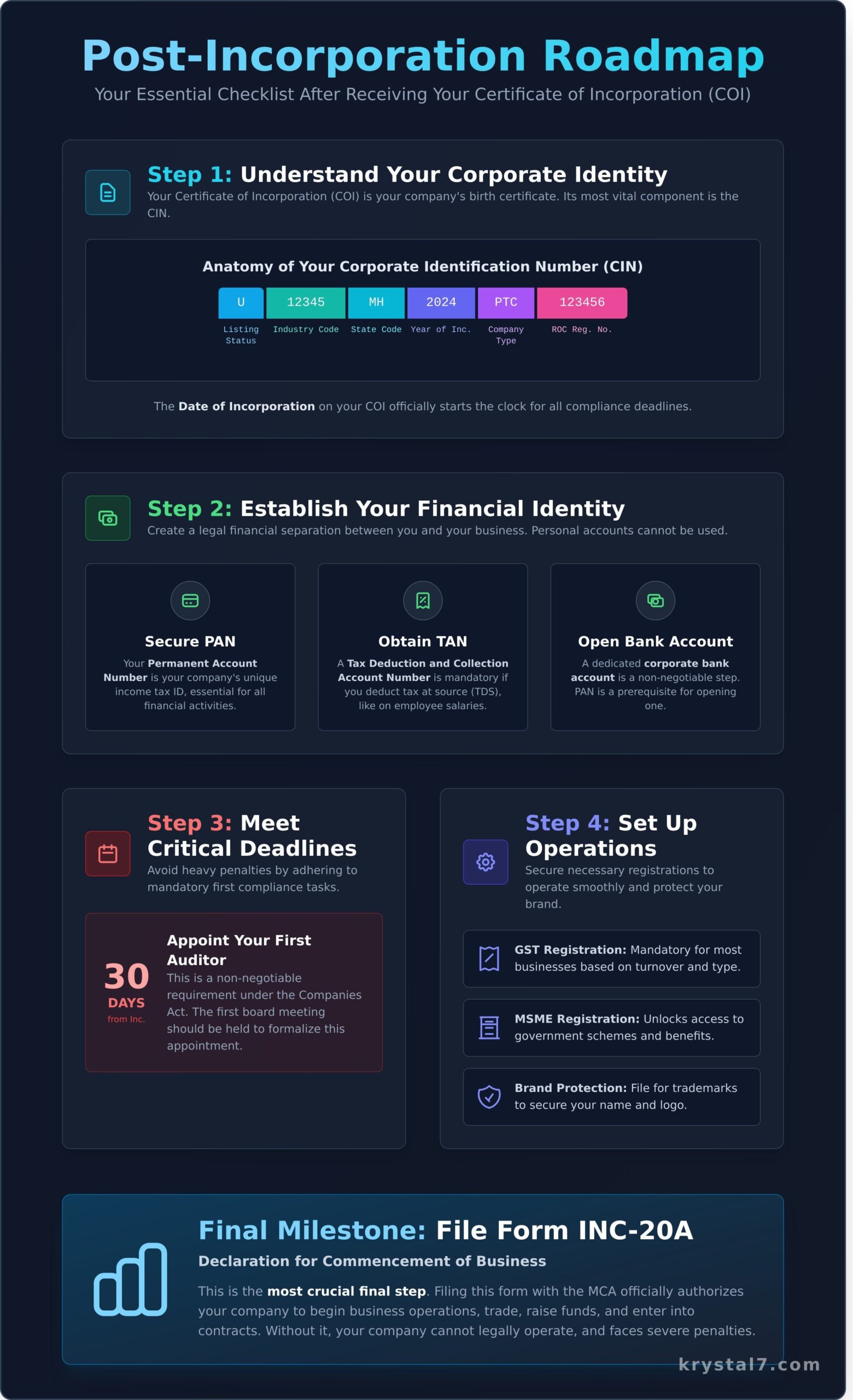
Your COI is more than just a certificate; it’s a data-packed document. The most crucial element is your Corporate Identification Number (CIN). The CIN is the unique fingerprint of your Indian business entity, a 21-character alphanumeric code that tells a story about your company and must be quoted on all official correspondence, from letterheads to invoices. Here’s what it means:
- Character 1: Your company’s listing status (L = Listed, U = Unlisted).
- Characters 2-6: A five-digit code identifying your business’s industry.
- Characters 7-8: The two-letter code for the state of registration (e.g., DL for Delhi, MH for Maharashtra).
- Characters 9-12: The four-digit year of your company’s incorporation.
- Characters 13-15: The company type (e.g., PTC for Private Limited Company).
- Characters 16-21: The unique six-digit registration number issued by the ROC.
You can instantly verify your company’s status on the Ministry of Corporate Affairs (MCA) portal using this CIN. Crucially, note the Date of Incorporation printed on the COI. This date officially starts the clock for your first financial year and all subsequent compliance deadlines.
Immediate Document Management
With your legal existence confirmed, organized documentation becomes your top priority. One of the first steps after getting company incorporation certificate is to create a “Master File”-both physical and digital-for your foundational documents: the COI, your Memorandum of Association (MOA), and your Articles of Association (AOA). If not finalized during the incorporation process, ensure all directors have an active Digital Signature Certificate (DSC) ready for future e-filings. While digital records are essential for access, they don’t replace legal requirements. You must maintain physical “Statutory Registers.” Your COI is the first entry into your official company register, which acts as the formal, auditable record of your corporation’s history and structure. Securing these documents provides the clarity you can build on for banking, funding, and flawless compliance.
The Statutory “Holy Trinity”: PAN, TAN, and Your Business Bank Account
With your Certificate of Incorporation in hand, your company is officially a separate legal entity. This distinction is critical and brings us to the first non-negotiable set of steps after getting company incorporation certificate: establishing your company’s financial identity. You can no longer use a personal bank account for business transactions. Doing so blurs the legal line between you and your company, exposing you to personal liability and creating a compliance nightmare. To operate legitimately, you must secure three foundational pillars: your PAN, TAN, and a dedicated corporate bank account.
Acquiring Your Tax Identifiers (PAN & TAN)
Before any bank will speak to you, the government needs to know you. This is where your tax identifiers come in, and it’s vital to understand the difference. Your Permanent Account Number (PAN) is your company’s unique income tax ID, while the Tax Deduction and Collection Account Number (TAN) is required if you deduct tax at source (TDS), such as on employee salaries. Thankfully, the modern SPICe+ incorporation form, managed by the Ministry of Corporate Affairs, often integrates these applications. However, if they are delayed or not received, you must apply for them immediately. Ensuring your registered office address is identical across all documents is crucial for Krystal-Clear compliance.
Opening the Corporate Bank Account
With your PAN and TAN secured, you can now approach a bank. This isn’t just a formality; it’s one of your first official acts as a director. You will need to pass a Board Resolution-a formal decision documented in meeting minutes-authorizing the opening of the bank account and appointing signatories. As of 2026, KYC norms for private limited companies are increasingly stringent, so meticulous documentation is key. Be prepared with the following:
- Certificate of Incorporation (COI)
- Memorandum of Association (MOA) and Articles of Association (AOA)
- The Board Resolution to open the account
- Company PAN card
- Identity and address proofs for all directors
Choose a bank that understands the needs of a growing venture, offering features like API banking, streamlined payment gateways, and easy GST integration. Finally, a critical last step is depositing the “Initial Subscription Money”-the capital pledged by shareholders in the MOA. This action formalizes their investment and provides your new company with its first operational funds.
Mandatory Compliance Under the Companies Act: Deadlines You Cannot Miss
Receiving your Certificate of Incorporation is a monumental achievement, but the work has just begun. The next steps after getting company incorporation certificate are not mere suggestions; they are statutory requirements with strict deadlines. Overlooking them can lead to significant penalties and operational hurdles. Navigating this initial phase can feel like a complex maze, but a clear post-incorporation compliance checklist provides the structure needed to ensure your venture starts on a solid legal footing.
These initial actions establish your company’s governance framework and financial integrity. They are the bedrock upon which your business will be built, providing the clarity and stability you need for sustainable growth.
Appointment of the First Auditor
The clock starts ticking the moment your company is incorporated. The Board of Directors has a non-negotiable window of 30 days to appoint the company’s first statutory auditor. This appointment is formalized by filing Form ADT-1 with the Registrar of Companies. Think of your auditor as a partner in building trust; their role is to ensure Krystal-Clear financial transparency, giving stakeholders confidence in your venture from day one. If the Board fails to act within this period, the responsibility shifts to the shareholders, who must make the appointment at an extraordinary general meeting.
The First Board Meeting and Share Certificates
Your first Board Meeting, which must be held within 30 days of incorporation, is a foundational event. It’s where key initial decisions are formally recorded. The agenda must cover several critical items:
- Auditor Appointment: Formally ratifying the appointment of the first auditor.
- Director Disclosures: Taking note of Form MBP-1, where each director discloses their interest in other entities to prevent conflicts of interest.
- Bank Account Authorization: Passing a resolution to open the company’s first bank account.
Following this, you have 60 days from the date of incorporation to issue physical share certificates to the initial subscribers. Crucially, these certificates must be stamped according to your state’s specific stamp duty act. This is a small but vital step that legitimizes ownership and prevents future disputes.
Operational Setup: GST, MSME, and Brand Protection
Once your company is legally born, the real work of building its operational and financial skeleton begins. These next steps after getting company incorporation certificate are not just about compliance; they are about creating a resilient foundation for growth, protecting your unique identity, and unlocking powerful government benefits. Getting this framework right from day one provides the clarity you need to focus on your vision.
GST and Professional Tax Registrations
Navigating the tax landscape is a critical first move. GST registration becomes mandatory once your turnover exceeds a specific threshold (e.g., ₹40 lakh for goods) or if you operate in certain sectors like e-commerce. However, many businesses opt for voluntary registration to claim Input Tax Credit (ITC) and enhance their professional standing. Additionally, Professional Tax (PT) is a state-level requirement for employers, with rules varying significantly-it’s mandatory in states like Maharashtra and Karnataka but not applicable in Delhi. Streamlining these registrations early prevents future compliance headaches.
Gain complete clarity on your tax obligations with Krystal7’s expert GST Filing & Compliance services.
Trademark and Brand Security
Here’s a fact that surprises many entrepreneurs: registering your company name with the MCA does not automatically protect your brand. It only prevents others from incorporating a company with the same name. To own your brand name, logo, and slogan, you need a trademark. We call this the “Crystal Clarity” check-ensuring your brand is unique, defensible, and truly yours. Securing your trademark is a day-one priority to avoid costly rebranding or legal disputes down the line.
Protect your most valuable asset. Secure your legacy with Krystal7’s Trademark Registration service.
Beyond taxes and trademarks, two other pillars support your operational setup:
- MSME (Udyam) Registration: This voluntary registration is a strategic advantage. It provides access to priority sector lending from banks, eligibility for government tenders, and various subsidies, giving your new venture a competitive edge.
- Professional Accounting: Don’t wait for the first-quarter end to think about bookkeeping. Setting up a professional accounting system from the start ensures financial transparency, simplifies compliance, and provides the data-driven insights needed for strategic decision-making. These foundational setups are among the most vital steps after getting company incorporation certificate, paving the way for sustainable success.
The Final Milestone: Filing the Declaration of Commencement of Business (INC-20A)
You have the Certificate of Incorporation in hand, but there is one final, mandatory hurdle before your company can legally start operating. Among all the steps after getting company incorporation certificate, filing Form INC-20A is arguably the most critical. This declaration confirms to the Registrar of Companies (RoC) that the initial subscribers have paid for their shares, officially capitalizing the company.
From your date of incorporation, a 180-day countdown begins. Failure to file INC-20A within this period carries significant consequences, including hefty penalties and the risk of the RoC striking your company’s name from the register. This isn’t just paperwork; it’s the legal green light that transitions your venture from a registered entity to an operational business.
Mastering the INC-20A Filing
Successfully filing INC-20A hinges on providing concrete “Proof of Subscription.” Before you can proceed, you must ensure that every subscriber to the Memorandum of Association (MoA) has deposited their respective share subscription amount into the company’s current bank account. The key evidence required includes:
- A copy of the company’s bank statement showing the credit of subscription money from all subscribers.
- A declaration from the directors confirming that these payments have been received.
This form must be verified and certified by a practicing professional, such as a Chartered Accountant or Company Secretary, who attests to its accuracy. Crucially, a company cannot legally commence any business activities or exercise borrowing powers until this declaration is filed and approved.
Establishing an Annual Compliance Calendar
With INC-20A filed, the initial setup is complete. Your focus now shifts from formation to sustained compliance. This is the perfect time to establish an annual calendar to manage mandatory filings like Form AOC-4 (Financial Statements) and MGT-7 (Annual Return), preventing last-minute stress and penalties. This proactive approach is fundamental for maintaining your company’s good standing.
This is where you gain the Freedom to Focus. Instead of getting entangled in recurring compliance dates, you can partner with experts. Krystal7’s “All-in-one Annual Compliance Package” provides the Krystal-Clear framework and peace of mind you need to drive your business forward without the administrative burden. Let Krystal7 handle your compliance so you can focus on your vision.
From Incorporation to Operation: Your Next Steps with Clarity
Receiving your Certificate of Incorporation is a monumental achievement, but it’s the starting line, not the finish. The journey ahead requires immediate, decisive action-from securing your PAN, TAN, and business bank account to mastering a series of crucial statutory deadlines. Successfully navigating these steps after getting company incorporation certificate is non-negotiable for building a compliant, resilient, and penalty-proof business foundation.
This post-incorporation roadmap can feel overwhelming, but you don’t have to walk it alone. Krystal7 is here to streamline the entire process, giving you the freedom to focus on your vision. Our team of top-tier Chartered Accountants and Company Secretaries manages every compliance detail with precision. We guarantee Krystal-clear communication with a dedicated relationship manager and transparent pricing with absolutely no hidden costs.
Ready to build your venture on a foundation of confidence and clarity? Get Started with Krystal7’s Post-Incorporation Compliance Package and let our experts secure your business for the growth ahead.
Frequently Asked Questions
How many days do I have to open a bank account after getting the COI?
While the Companies Act doesn’t specify a strict deadline, it’s a critical first step that should be completed promptly, ideally within 30 days of incorporation. You need an active corporate bank account to deposit the initial share capital from subscribers. This is a mandatory prerequisite for filing Form INC-20A (Commencement of Business), so delaying this step will prevent you from legally starting your operations and meeting other compliance deadlines.
Is it mandatory to appoint an auditor immediately after incorporation?
Yes, it is a mandatory and time-sensitive requirement. The Board of Directors must appoint the company’s first statutory auditor within 30 days from the date of incorporation. This appointment is crucial for ensuring financial transparency and fulfilling your statutory obligations from the very beginning. Prompt action on this step helps build a foundation of good governance and avoids unnecessary penalties for non-compliance, providing clarity and confidence in your financial reporting.
What is Form INC-20A and why is it so important for new companies?
Form INC-20A is a mandatory declaration that a company must file with the Registrar of Companies (ROC) within 180 days of its incorporation. This form confirms that the subscribers to the Memorandum of Association have paid the value of the shares they agreed to take. It is critically important because until this form is filed and approved, your company cannot legally commence any business activities or exercise any borrowing powers, effectively halting your venture before it begins.
Can I start my business operations immediately after getting the incorporation certificate?
No, you cannot. Receiving your Certificate of Incorporation (COI) is a major milestone, but it does not grant you the right to begin business activities. One of the most essential steps after getting company incorporation certificate is to file Form INC-20A. This can only be done after you have opened a company bank account and received the subscription money from shareholders. Only after the ROC approves your Form INC-20A filing can you officially commence operations.
What are the penalties for not issuing share certificates within 60 days?
Failing to issue share certificates to subscribers within 60 days of incorporation is a serious compliance breach with significant financial consequences. The company itself can be fined anywhere from ₹25,000 to ₹5,00,000. Additionally, every officer of the company who is in default can be personally fined from ₹10,000 to ₹1,00,000. Ensuring timely issuance is a simple way to maintain good legal standing and avoid these heavy penalties.
Do I need a GST registration if my turnover is currently zero?
Generally, GST registration is tied to turnover thresholds (e.g., exceeding ₹40 lakhs for goods). However, registration may be mandatory from day one, regardless of turnover, if your business engages in inter-state supply of goods, operates as an e-commerce aggregator, or falls into other specific categories. It is crucial to assess your business model for clarity, as voluntary registration can also be beneficial for claiming input tax credits.
How do I obtain a Commencement of Business Certificate?
The “Commencement of Business Certificate” is essentially the approval you receive after successfully filing Form INC-20A with the Registrar of Companies (ROC). To file this, you must provide proof of the deposit of share subscription money into the company’s bank account. The form must be verified by a professional like a Chartered Accountant or Company Secretary. Once the ROC approves the filing, you receive an acknowledgement, which serves as your official permission to start business.