

FSSAI License for Home Kitchens in India: The Complete 2026 Guide
Your home kitchen is filled with the aroma of passion and delicious creations, but the thought of legal compliance can quickly turn that excitement into anxiety. Navigating the requirements for an FSSAI license for home kitchen India often feels like a maze of confusing government portals and overwhelming paperwork. Are you unsure which license to apply for, or if you even need one for your small-scale venture? You are not alone in feeling this way.
This is where the guesswork ends. This complete 2025 guide is designed to cut through that complexity and provide the clarity you deserve. We will walk you through a streamlined, step-by-step process, from identifying the correct license type for your turnover to preparing the exact documents you need. Gain the confidence to secure your FSSAI registration without the hassle, ensuring your business is legally compliant, trusted by customers, and ready to thrive on platforms like Zomato and Swiggy.
What is an FSSAI License and Why Your Home Kitchen Needs One
Starting a food business from your home is an exciting venture, but turning your culinary passion into a profession requires more than just great recipes. It requires clarity, compliance, and credibility. This is where the FSSAI license comes in. The Food Safety and Standards Authority of India (FSSAI) is the country’s primary regulatory body, established to ensure that all food sold to consumers is safe, hygienic, and of high quality.
Many aspiring entrepreneurs mistakenly believe these regulations only apply to large restaurants or factories. However, the law is clear: if you prepare and sell food, regardless of the scale of your operation, you are a Food Business Operator (FBO). This means that obtaining an FSSAI license for home kitchen India is a foundational, non-negotiable step to legally launch and grow your business.
The Legal Mandate: Is it Compulsory?
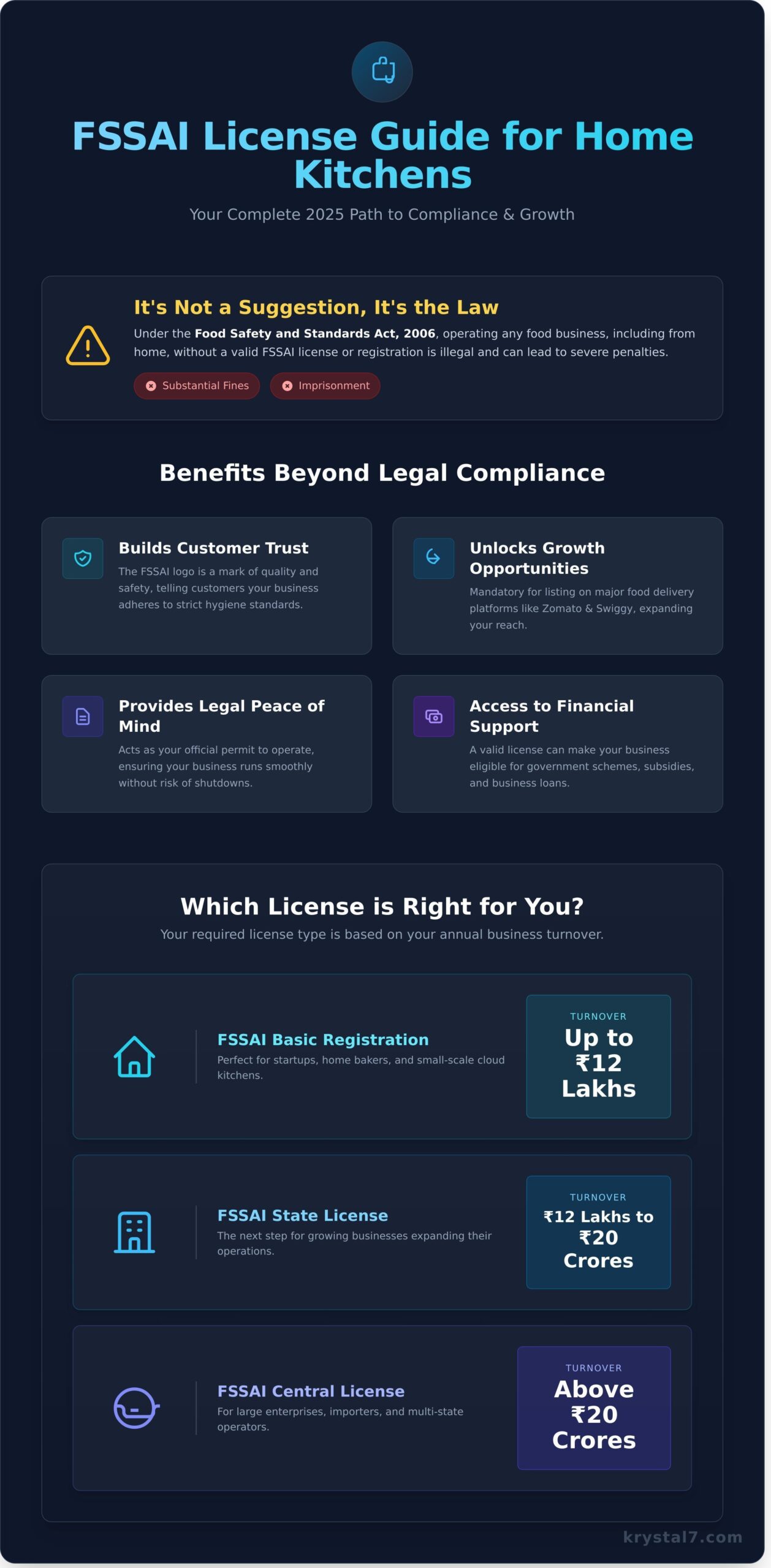
Yes, it is absolutely mandatory. Under the Food Safety and Standards Act, 2006, no person can commence or carry on any food business without a valid FSSAI license or registration. Operating without this crucial compliance can lead to severe penalties, including substantial fines and even imprisonment. This requirement ensures a level playing field where every FBO, from a home kitchen to a five-star hotel, is held to the same standards of food safety, protecting public health.
Benefits Beyond Compliance for Your Home Business
Securing an FSSAI license is not just about avoiding penalties; it’s a strategic move that provides a powerful launchpad for your home business. It offers a clear path to growth and unlocks numerous advantages that can set you apart from the competition.
- Builds Immense Customer Trust: The FSSAI logo on your packaging is a mark of quality and safety. It instantly tells customers that your business is legitimate and adheres to strict hygiene standards, building brand credibility from day one.
- Unlocks Growth Opportunities: Major food aggregator platforms like Swiggy and Zomato mandate FSSAI registration for all their partners. A license is your ticket to reaching a much wider audience online.
- Provides Legal Peace of Mind: This license acts as your official permit to operate. It ensures your business runs smoothly, free from the hassle and risk of legal interruptions or shutdowns.
- Access to Financial Support: A valid FSSAI license can make your business eligible for government schemes, subsidies, and business loans specifically designed to support the food industry.
Which FSSAI License is Right for Your Home Business?
Choosing the correct FSSAI license for your home kitchen in India doesn’t have to be a source of stress. The decision is streamlined and depends entirely on one key factor: your annual business turnover. The Food Safety and Standards Authority of India (FSSAI) has established a clear, three-tiered system to cater to businesses of all sizes. For the most detailed and up-to-date guidelines, you can always consult the FSSAI official website, but we’ve broken down the essentials to give you Krystal-clear guidance.
- FSSAI Basic Registration: Best for annual turnover up to ₹12 Lakhs. Perfect for startups, home bakers, and small-scale cloud kitchens.
- FSSAI State License: Required for annual turnover between ₹12 Lakhs and ₹20 Crores. The next step for growing businesses expanding their operations.
- FSSAI Central License: Mandatory for annual turnover above ₹20 Crores. Designed for large enterprises, e-commerce platforms, and importers.
For most entrepreneurs starting their culinary venture from home, the compliance journey begins with the Basic Registration. It’s designed to be accessible and straightforward. As your vision grows and your business thrives, upgrading your license is a seamless next step, ensuring you have the freedom to focus on what you do best: creating delicious food.
FSSAI Basic Registration (For Turnover up to ₹12 Lakhs/year)
This is the ideal starting point and the most common type of fssai license for home kitchen india. If you are a home baker, tiffin service provider, or running a small cloud kitchen with an annual turnover under ₹12 Lakhs, this registration is for you. The process is simplified, typically requiring just basic identity proof and a photograph, allowing you to get compliant quickly and without the usual bureaucratic hassle.
FSSAI State License (For Turnover between ₹12 Lakhs and ₹20 Crores/year)
When your home business flourishes and your annual turnover surpasses the ₹12 Lakh mark, it’s time to upgrade to a State License. This license signifies a new stage of growth and is required for mid-sized Food Business Operators (FBOs). The documentation is slightly more detailed, but it is a manageable and necessary step for a business on an upward trajectory, cementing your credibility in the market.
FSSAI Central License (For Turnover above ₹20 Crores/year)
The Central License is reserved for large-scale food businesses, such as major manufacturers, importers, and businesses operating across multiple states. With a turnover threshold exceeding ₹20 Crores per year, it is highly unlikely that a home-based kitchen would require this license. Understanding this helps you eliminate the guesswork and focus on the registration that truly applies to your venture.
The Application Process: A Step-by-Step Walkthrough
Navigating the government compliance landscape can feel overwhelming, but securing your fssai license for home kitchen india is a clear, manageable journey when broken down. This streamlined guide demystifies the entire process, providing the clarity you need to move forward with confidence. We’ll walk you through each stage on the official FoSCoS portal, highlighting key details to ensure a smooth, error-free submission. Remember, accuracy is paramount to avoid delays.
Feeling overwhelmed? Let Krystal7 Consultants handle the entire FSSAI registration for you.
Step 1: Document Preparation
Before you begin the online application, gathering your documents provides a solid foundation. For the Basic Registration, you need digital copies of a few key items. Having these ready will make the process significantly faster and remove any last-minute hassle. Ensure your documents are clear and legible.
- Photo Identity Proof: Aadhaar Card, Voter ID, or Driver’s License of the Food Business Operator (FBO).
- A Passport-Sized Photograph: A recent, clear digital photo of the applicant.
- Proof of Business Address: Utility bill (electricity, water), rent agreement, or sale deed.
Crucially, you must have a valid mobile number and email ID, as all official communication, including your final certificate, will be sent to them.
Step 2: Online Application on the FoSCoS Portal
The entire application for an FSSAI license for a home kitchen in India is processed online. You will need to create an account on the official FSSAI’s FoSCoS portal. Once you sign up, select ‘Apply for New License/Registration’ and choose your state. You will then be prompted to select the ‘Kind of Business’. For most home kitchens, categories like ‘Restaurant’, ‘Food Vending Agencies’, or ‘Petty Retailer of Snacks/Tea shop’ are appropriate. Fill out Form A with meticulous care, ensuring your name, address, and business details match your supporting documents exactly.
Step 3: Fee Payment and Submission
After completing Form A, the final step is to pay the government fee. For a Basic Registration, the fee is a nominal ₹100 per year, and you can select a validity period from one to five years. The portal supports various online payment methods, including credit/debit cards, net banking, and UPI. Upon successful payment, your application will be submitted, and you will receive a 17-digit Application Reference Number. Keep this number safe, as you can use it to track the status of your application directly on the FoSCoS portal.
Documents & Hygiene Standards for Your Home Kitchen
Securing your FSSAI license is a two-part process: submitting the correct documents and ensuring your kitchen meets mandatory safety standards. Navigating these requirements can seem complex, but with clarity and preparation, it becomes a straightforward step in your entrepreneurial journey. This section breaks down exactly what you need to provide and how to prepare your space for compliance, giving you the freedom to focus on your culinary creations.
Document Checklist for FSSAI Basic Registration
The documentation needed for your fssai license for home kitchen india is minimal and easy to gather, especially for the Basic Registration that most home-based businesses require (for annual turnover up to ₹12 lakh). You will need digital copies of the following:
- Passport-sized Photograph: A clear, recent photograph of you, the food business operator.
- Government-Issued Photo ID: A scanned copy of your Aadhaar Card, Voter ID, or Driver’s License.
- Proof of Business Address: An electricity bill, rent agreement, or property document for your home address.
- A Simple Declaration Form: This is a standard form available on the FoSCoS portal that you fill out during the application process.
Note: If your business grows to require a State License, you will need additional documents like a kitchen layout plan and water testing reports.
Key Hygiene Practices (Schedule 4 Simplified)
FSSAI’s Schedule 4 guidelines are not about creating a commercial-grade facility but about ensuring safe food handling in your existing space. Adhering to these practices builds immense customer trust and guarantees quality.
- Personal Hygiene: Always work with clean hands, tied-back hair (ideally covered with a cap or net), and clean clothing or an apron. This is non-negotiable.
- Clean Water Supply: Ensure the water used for cooking, washing ingredients, and cleaning utensils is potable and from a safe source.
- Waste & Pest Control: Use a covered dustbin for all kitchen waste and dispose of it regularly. Keep your kitchen free from pests by maintaining cleanliness and sealing any potential entry points.
- Food Segregation: This is crucial to prevent cross-contamination. Use separate chopping boards and utensils for raw meat/vegetables and cooked food. In the fridge, always store raw items below cooked items.
Meeting these standards is fundamental to running a successful and reputable home kitchen business. If you feel overwhelmed by the paperwork or need Krystal-Clear guidance on ensuring compliance, our team of experts is here to streamline the entire process for you.
FSSAI License Costs, Validity, and Renewal Explained
Navigating the financial and administrative aspects of compliance is a critical step in your entrepreneurial journey. Gaining clarity on the costs, validity period, and renewal process for your FSSAI license ensures your home kitchen operates smoothly and legally, giving you the freedom to focus on what you do best: creating delicious food.
Government Fees & Total Cost
One of the most reassuring aspects of the fssai license for home kitchen india is its affordability. The government has structured the fees to empower small businesses and startups. Here’s a clear breakdown:
- Basic FSSAI Registration: This is designed for small-scale operators and costs just ₹100 per year.
- State FSSAI License: For growing home kitchens with a higher turnover, the fee ranges from ₹2,000 to ₹5,000 per year, depending on your specific business activities and production scale.
It is important to note that these are statutory government fees. If you choose to partner with a professional consultant for a streamlined and error-free application, their service fees will be separate. At Krystal7, we provide Krystal-Clear pricing to handle the entire process for you, eliminating guesswork and saving you valuable time.
License Validity and Renewal Process
Your FSSAI license can be issued for a validity period of 1 to 5 years, which you can select during the application process. Opting for a longer duration, such as 5 years, is often more cost-effective and significantly reduces the administrative hassle of frequent renewals.
To ensure continuous compliance, you must initiate the renewal process at least 30 days before your license expires. Missing this deadline can lead to complications:
- A late renewal application incurs a penalty of ₹100 for each day of delay.
- If the license is not renewed before its expiry date, it is considered lapsed. You will then have to apply for a completely new license, which can disrupt your business operations.
Displaying Your License: A Mark of Trust
Obtaining your FSSAI license is not the final step; displaying it is a mandatory requirement that doubles as a powerful marketing tool. It serves as a visible promise to your customers about your commitment to food safety and quality.
You must display the FSSAI certificate or registration prominently at your premises. For home-based businesses selling online, the FSSAI license number must be clearly mentioned on invoices, receipts, and your listings on food aggregator platforms like Zomato and Swiggy. This simple act of transparency builds immense customer confidence and sets your brand apart in a competitive market.
Turn Your Culinary Dream into a Compliant Reality
Launching a food business from your home kitchen is an exciting venture, but its long-term success is built on a foundation of legal compliance. As we’ve detailed, securing an fssai license for home kitchen india is not just a regulatory hurdle; it’s a powerful statement of quality and safety that builds immense customer trust. From choosing the correct license based on your turnover to meticulously adhering to hygiene standards, each step is crucial for transforming your passion into a legitimate, thriving enterprise.
The path to compliance can seem complex, filled with paperwork that distracts from your craft. At Krystal7, we bring clarity to this process. With deep expertise in all business registrations, we guarantee a transparent and completely hassle-free experience. Our dedicated advisors manage all the statutory requirements, giving you the freedom to focus on perfecting your recipes. Don’t let paperwork stand between you and your vision. Ensure your dream business is fully compliant. Get Krystal-Clear guidance on your FSSAI license today.
Frequently Asked Questions
Can I use my home address for the FSSAI registration?
Yes, absolutely. For a home-based food business, your residential address is considered your primary place of operation. The FSSAI authorities understand the nature of home kitchens and permit you to use your home address on the application and the final certificate. This simplifies the process, removing the need for a separate commercial address and making compliance clear and straightforward for entrepreneurs starting their food venture from home.
How long does it take to get the FSSAI license for a home kitchen?
The timeline depends on the type of authorisation you require. An FSSAI Basic Registration, suitable for most home kitchens, is typically processed within 7 to 10 working days. If your annual turnover exceeds ₹12 lakhs and you need a State License, the process can take longer, usually between 30 to 60 days. Ensuring your documentation is accurate and complete from the start is the key to a streamlined and swift approval.
Do I need a trade license or GST registration before applying for an FSSAI license?
Not necessarily. You can apply for an FSSAI license without having a trade license or GST registration. A trade license is a municipal requirement that may not be mandatory for home kitchens in all areas. Similarly, GST registration is only compulsory once your annual turnover crosses the threshold of ₹40 lakhs for goods. It is wise, however, to check your local municipal rules and monitor your turnover to ensure full compliance as your business grows.
What happens if my FSSAI application is rejected?
If your application is rejected, the FSSAI portal will provide a specific reason, which is often due to incorrect information or missing documents. You will have an opportunity to rectify these errors and re-submit the application. This is where professional guidance becomes invaluable. An expert can help you understand the rejection notice, correct the application precisely, and ensure a successful re-submission, saving you time and preventing further hassles.
Do I need a separate commercial kitchen, or can I use my personal kitchen?
You can certainly use your personal kitchen. The FSSAI permits home-based food operators to use their residential kitchens, provided they adhere to the basic hygiene and safety standards outlined in the FSSAI’s Schedule 4 guidelines. This includes maintaining cleanliness, using potable water, and ensuring proper waste disposal. There is no requirement to build a separate commercial-grade kitchen, making it easier to launch your food business from home.
Is an FSSAI license required for selling homemade products on Instagram or WhatsApp?
Yes, it is mandatory. Any individual or business involved in selling food products, regardless of the platform-be it a physical store, a website, or social media channels like Instagram and WhatsApp-must hold an FSSAI registration or license. This legal requirement ensures food safety for your customers and builds critical trust in your brand. Operating without this certification can lead to significant penalties and legal complications.
What is the difference between an FSSAI license and an FSSAI registration?
The primary difference lies in your business’s annual turnover. FSSAI Basic Registration is designed for small food businesses and home kitchens with an annual turnover of up to ₹12 lakhs. An FSSAI License (either State or Central) is required for businesses with a turnover exceeding this limit. Registration is a simpler process with basic documentation, while a license involves a more detailed application. Choosing the correct fssai license for home kitchen india is the first step towards compliant operations.

Article by
Nihal Srivastava
Nihal Srivastava is the Co-Founder of Krystal7 Consultants, helping Indian entrepreneurs and startups navigate company registration, compliance, trademark protection, and regulatory requirements with clarity and confidence. With 6+ years of hands-on expertise in MCA filings, GST compliance, and corporate structuring, Nihal has guided 1000+ businesses across India through their legal and compliance journeys. He believes every business dream deserves crystal clear foundations, and that no founder should be held back by paperwork or red tape.