

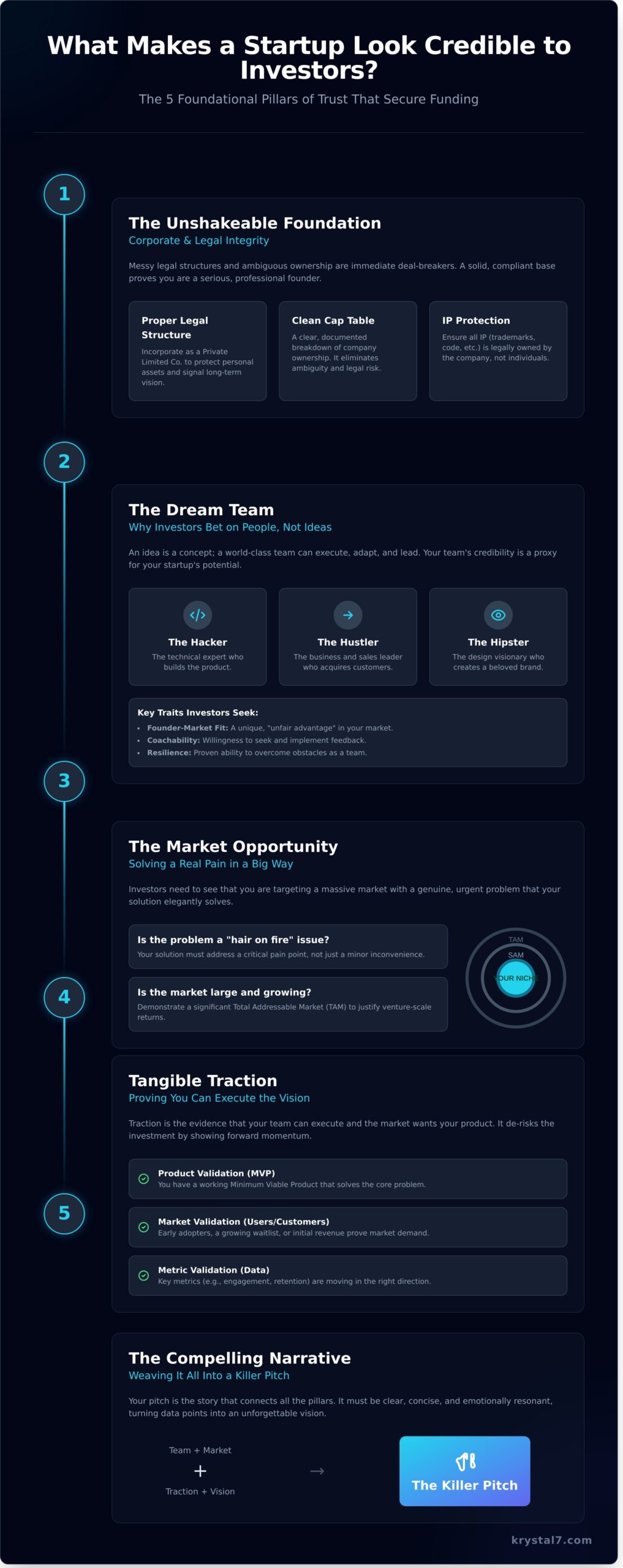
What Makes a Startup Look Credible to Investors? The 5 Pillars of Trust
You’ve perfected your pitch deck, rehearsed your presentation, and believe passionately in your vision. Yet, as you prepare for that high-stakes investor meeting, a feeling of uncertainty can creep in. This is a common fear, but it’s one you can overcome. A compelling story is crucial, but seasoned investors are trained to look deeper for tangible signals of stability and foresight. Understanding what makes a startup look credible to investors is the key that unlocks their confidence and separates promising ideas from truly fundable ventures.
This is where the guesswork ends. We’re moving beyond abstract advice to give you crystal clarity on the five foundational pillars of trust that investors demand before writing a check. From your legal and compliance health to your proven market traction, this guide provides an actionable checklist. Our goal is to empower you to walk into any meeting not just with a great idea, but with the undeniable credibility of an investor-ready business, ready to secure the capital your vision deserves.
Key Takeaways
- A clean legal and corporate foundation is non-negotiable; investors view messy structures as an immediate deal-breaker.
- Go beyond the idea and demonstrate why your team possesses the unique expertise and drive to execute the vision successfully.
- A key part of what makes a startup look credible to investors is proving a massive market opportunity with early, tangible traction.
- Learn to weave your data, team, and vision into a compelling narrative that makes your pitch unforgettable.
Pillar 1: The Unshakeable Foundation: Corporate & Legal Integrity
Before an investor even glances at your pitch deck, they perform a crucial first check: assessing your corporate and legal integrity. This isn’t just about paperwork; it’s a direct reflection of your seriousness as a founder. Messy legal structures and ambiguous ownership are major red flags that can kill a deal instantly. Think of this as the foundation of a house-without a solid, compliant base, everything you build on top is at risk of crumbling. Understanding these startup company fundamentals is the core of what makes a startup look credible to investors from day one.
Proper Legal Structure
For most Indian ventures seeking funding, incorporating as a Private Limited Company (Pvt. Ltd.) is the gold standard. This structure demonstrates long-term vision and a readiness for equity distribution. It creates a distinct legal entity, shielding your personal assets from business liabilities-a critical separation that investors expect. A formal corporate structure provides a clear, professional framework for governance, operations, and future growth, signaling that your venture is built to scale and handle investment professionally.
A Clean Capitalization (Cap) Table
A capitalization (or “cap”) table is a simple spreadsheet that provides absolute clarity on who owns what percentage of your company. It must be meticulously maintained, replacing all verbal agreements and handshake deals with formal documentation. For an investor, a clean cap table is a roadmap; it shows them exactly how their capital will translate into equity and what the ownership landscape looks like. A messy, confusing cap table creates immediate legal risks and scares serious investors away.
Intellectual Property (IP) Protection
Your idea is your most valuable asset, and investors need assurance that it’s protected. This begins with securing trademarks for your brand name and logo but extends much deeper. It is critical to have agreements in place ensuring that all IP developed by founders, employees, or contractors is legally owned by the company, not the individuals. Without clear IP ownership, an investor will question what they are actually funding. If the company doesn’t own its core technology or brand, it may own nothing of real value.
Pillar 2: The Dream Team: Why Investors Bet on People, Not Ideas
A brilliant idea is a powerful starting point, but it remains a mere concept without a world-class team to execute it. Investors know this better than anyone. They receive countless pitches for revolutionary products, but they ultimately write checks to the founders who demonstrate an undeniable capacity to build, adapt, and lead. Your team’s collective credibility is a direct proxy for your startup’s potential for growth and success.
Ultimately, understanding the human element is central to the question of what makes a startup look credible to investors. They aren’t just funding a business plan; they are investing in your ability to navigate immense challenges and pivot when necessary. Your team is the engine that will drive the venture forward, long after the initial idea has evolved.
Founder-Market Fit and Unfair Advantage
Investors will ask: “Why are you and your co-founders the only people who can solve this specific problem?” Your answer lies in founder-market fit. This is the unique alignment between your team’s background and the market you’re serving. Whether it’s deep domain expertise from years in the industry or a unique personal experience with the customer’s pain point, this connection is your ‘unfair advantage.’ It provides clear proof that you understand the market’s challenges intimately.
Complementary Skills and Shared Vision
A single founder rarely possesses every skill needed to build a scalable company. Investors look for a balanced, complementary team that covers the core pillars of a business:
- The Hacker: The technical expert who can build the product.
- The Hustler: The business and sales leader who can acquire customers.
- The Hipster: The design and user experience visionary who can create a beloved brand.
This combination demonstrates operational readiness. Venture capitalists analyze the management team’s capabilities as a primary risk factor. In fact, most official guidance on how to fund your business from leading venture capital firms and investment experts highlights a strong, unified team as a prerequisite for investment. A shared vision is the glue that holds this talent together under pressure.
Coachability and Resilience
Confidence is crucial, but arrogance is a red flag. Investors are looking for partners, not just investments. They want to see that you are coachable-that you actively seek and implement feedback from mentors, advisors, and even customers. Showcasing your resilience is equally important. Be prepared to share clear examples of how your team has overcome past obstacles. This proves you have the fortitude to handle the inevitable storms that every startup faces, which is a key factor in what makes a startup look credible to investors.
Pillar 3: The Market Opportunity: Solving a Real Pain in a Big Way
An inspiring vision and a brilliant team are foundational, but investors are ultimately funding a business, not a project. They need to see a clear, tangible path to a significant return on their investment. This is where your market opportunity takes center stage. Demonstrating that your venture is built on a massive, validated market need is a critical part of what makes a startup look credible to investors. Your passion for the problem must be matched by the market’s real, measurable demand for a solution.
A Large and Growing Addressable Market
You must provide clarity on the scale of your ambition with a data-driven, bottom-up analysis. Avoid generic, top-down statements like “we’re targeting the $1 trillion healthcare market.” Instead, break down your market with precision:
- Total Addressable Market (TAM): The total market demand for a product or service.
- Serviceable Addressable Market (SAM): The segment of the TAM targeted by your products and services which is within your geographical reach.
- Serviceable Obtainable Market (SOM): The portion of SAM that you can realistically capture.
Use credible sources and clearly explain the trends-be it technological, regulatory, or cultural-that are fueling your market’s growth. This shows meticulous planning, not just wishful thinking.
Evidence of a ‘Hair on Fire’ Problem
A large market is meaningless if the problem you solve is a minor inconvenience. Investors look for “hair on fire” problems-urgent, painful issues that customers are desperate to solve. Show, don’t just tell. Use powerful evidence like direct quotes from customer interviews, compelling survey data, or case studies of early adopters. Prove that existing solutions are broken, inadequate, or non-existent. This urgency is the engine for early sales and demonstrates a clear need for your venture.
A Clear Competitive Advantage
No great idea exists in a vacuum. Acknowledging your competitors shows you’ve done your homework. A thorough competitive analysis is a non-negotiable part of the due diligence on a startup that investors perform, so get ahead of it. Articulate with clarity why your solution isn’t just different, but 10x better. More importantly, explain your “moat”-the defensible advantage (e.g., proprietary technology, network effects, unique partnerships) that will protect your business over time. This strategic foresight transforms your idea from a fleeting opportunity into a lasting enterprise.
Pillar 4: Tangible Traction: Proving You Can Execute the Vision
A compelling vision and a stellar team are essential, but investors fund businesses, not ideas. Tangible traction is the undeniable proof that your concept resonates in the real world. It transforms your pitch from a hopeful story into a data-backed investment opportunity. This evidence of execution is a critical factor in what makes a startup look credible to investors because it systematically de-risks their capital by proving you can not only build a product but also attract a market for it.
Defining Traction for Your Stage
Traction isn’t a one-size-fits-all metric; it evolves with your startup. Early on, focus on showing a positive trend line, even with small numbers. Investors look for momentum and validation at the appropriate level:
- Pre-seed: A functional Minimum Viable Product (MVP), a handful of enthusiastic pilot customers, or signed Letters of Intent (LOIs) demonstrate initial market validation.
- Seed: The focus shifts to early revenue, consistent month-over-month user growth, low churn rates, and glowing customer testimonials. Here, qualitative feedback can be just as powerful as quantitative data.
Knowing Your Key Metrics Inside and Out
Demonstrating a firm grasp of your key performance indicators (KPIs) signals operational competence. You must be fluent in your business’s language, ready to discuss metrics like Monthly Recurring Revenue (MRR), Customer Acquisition Cost (CAC), Lifetime Value (LTV), and churn rate. Understanding these numbers shows investors you know which levers drive growth and are prepared to manage their capital efficiently. Be ready to defend every number and the assumptions behind them with clarity and confidence.
Realistic Financial Projections
Investors know your financial model won’t be perfect, but they need to see you have a logical, well-reasoned plan. A bottom-up forecast, built on clear assumptions (e.g., conversion rates, market size, pricing), is far more credible than a top-down “we’ll capture 1% of the market” claim. Your projections must clearly show your burn rate and establish a runway for how long the requested funding will last. This isn’t about fortune-telling; it’s about proving you have a strategic roadmap to growth. Get your financial house in order with expert accounting services.
Pillar 5: The Compelling Narrative: Weaving It All Into a Killer Pitch
Your solid team, proven traction, and clean financials are the essential ingredients of credibility. But investors don’t invest in a list of ingredients; they invest in a compelling vision. Your pitch is where you transform these data points into a powerful story that captures attention and inspires confidence. In a sea of pitches, a clear, persuasive narrative is the ultimate differentiator. It’s a direct reflection of your ability to lead, communicate, and sell-critical skills for any founder seeking growth.
The Anatomy of a Persuasive Pitch Deck
Your pitch deck is the visual backbone of your story. While the classic 10-slide structure (Problem, Solution, Market Size, etc.) provides a trusted framework, the execution is what matters. Focus on simplicity and visual impact. Each slide should convey a single, powerful idea, supported by compelling data or visuals. Remember, your deck is a visual aid, not a script. It’s there to enhance your presentation, not replace it, bringing your venture’s potential into sharp focus.
The ‘Ask’: Clarity on How You’ll Use the Capital
A vague request for funding is a major red flag. True credibility comes from precision. State exactly how much you are raising and provide a clear breakdown of how you will deploy that capital. This is a crucial element of what makes a startup look credible to investors. Detail the specific milestones this funding will unlock-such as hitting a revenue target or launching a key feature-and show how achieving them de-risks the venture for the next stage of growth. This demonstrates you are a disciplined and strategic operator.
Mastering the Q&A Session
The Q&A is where trust is truly forged. Investors will probe your weaknesses and test the assumptions in your model. Anticipate these tough questions and prepare concise, data-backed answers. Answering with confidence and honesty demonstrates your deep understanding of the business and its risks. If you don’t know an answer, it is far better to say, “That’s a great question; I’ll follow up with the specific data,” than to invent a response on the spot. This transparency builds immense credibility.
Ultimately, your pitch is the synthesis of all your hard work. It brings your vision to life and proves you have the strategic clarity to execute it. A powerful narrative, built upon a foundation of impeccable corporate and financial structure, is the final step in securing the capital your venture deserves. Ensure your business is investment-ready with expert guidance from Krystal7.
Your Blueprint for Investor Confidence
Securing investor trust isn’t about a single silver bullet. It’s the answer to the crucial question of what makes a startup look credible to investors, and it lies in building a complete fortress of credibility. As we’ve explored, this means having an unimpeachable legal foundation, a team that inspires confidence, and tangible traction that validates your compelling narrative.
While you assemble the dream team and chase market traction, that first pillar-your corporate and legal integrity-must be flawless. It’s the bedrock upon which everything else is built. With all-in-one company incorporation packages, Chartered expertise in legal and financial compliance, and transparent pricing with no hidden costs, Krystal7 provides the clarity you can build on. Build your foundation of credibility. Let Krystal7 handle your company registration and compliance.
This gives you the freedom to focus on what you do best: turning your vision into a venture that investors are excited to back.
Frequently Asked Questions
What is the very first thing an investor checks for credibility?
The very first thing investors scrutinize is the founding team. Before they dive into financials or traction, they evaluate the people behind the idea. They look for relevant industry experience, a history of execution, and a cohesive team dynamic. A strong, passionate, and knowledgeable team with complementary skills demonstrates the capacity to navigate challenges and turn a vision into a thriving business. This human element is the ultimate proof of potential.
How much traction do I really need to get seed funding?
While there is no single magic number, investors seek clear evidence of product-market fit. For a SaaS company, this might mean achieving $5k-$15k in Monthly Recurring Revenue (MRR) with a consistent 10-20% month-over-month growth. For a consumer app, it could be a highly engaged and growing user base. The key is to present data that proves your business model is not just a theory but a repeatable, scalable reality that is ready for growth.
Can I approach investors before my company is officially registered?
You can have preliminary conversations, but it is highly advisable to formalize your business structure first. Official registration as a Private Limited Company demonstrates commitment and professionalism. It provides the legal framework necessary for issuing shares and accepting investment, giving investors the clarity and security they require to proceed. This foundational step removes ambiguity and signals that you are serious about your venture and ready for a formal partnership.
What is a capitalization table and why do investors care so much about it?
A capitalization table, or “cap table,” is a detailed record of your company’s equity ownership. It provides crystal-clear transparency into who owns shares, how many they own, and at what valuation. Investors examine it meticulously to assess founder dilution, identify potential red flags (like too much “dead equity” held by former contributors), and understand how their investment will impact the ownership structure. A clean, well-organized cap table is a sign of good corporate governance.
How do I protect my idea when pitching to multiple investors?
Most venture capitalists will not sign a Non-Disclosure Agreement (NDA), so your best protection is strategic disclosure and swift execution. You should secure your core intellectual property through formal means like patents or trademarks where applicable. When pitching, focus on the problem you solve and your unique solution without revealing proprietary algorithms or your “secret sauce.” Ultimately, your ability to build and scale faster than competitors is your strongest defense.
Is a strong pitch deck more important than the actual business fundamentals?
A compelling pitch deck is your key to securing a meeting, but strong business fundamentals are what secure the investment. The deck is the story; the fundamentals are the proof. Ultimately, what makes a startup look credible to investors is the synergy between a clear, ambitious vision (the deck) and the tangible evidence to back it up-like a solid team, market traction, and a sound financial model. One cannot succeed for long without the other.

Article by
Nihal Srivastava
Nihal Srivastava is the Co-Founder of Krystal7 Consultants, helping Indian entrepreneurs and startups navigate company registration, compliance, trademark protection, and regulatory requirements with clarity and confidence. With 6+ years of hands-on expertise in MCA filings, GST compliance, and corporate structuring, Nihal has guided 1000+ businesses across India through their legal and compliance journeys. He believes every business dream deserves crystal clear foundations, and that no founder should be held back by paperwork or red tape.